Could the rules of a game start the game on their own?
Imagine a chessboard in an empty room. The rules of chess are perfectly clear: how the knight jumps, how the bishop slides, when a king is in check. Now imagine waiting. An hour, a year, a century. The rules stay just as true the whole time. Not one piece moves.
Now imagine the room has no board and no pieces either, only the rules. Would anyone expect a game to appear?
That is close to the claim this page examines. You may have met it in a documentary or a bestselling book: because there is a law such as gravity, the universe can and will create itself from nothing. It sounds bold and scientific. Let us look at what it actually says.
The claim, stated fairly
Some well-known physicists have written, in popular books, something like this: since a law such as gravity exists, the universe can and will create itself from nothing, so there is no need to bring God into it. The claim is not made carelessly. Behind it lie real models in cosmology. In some of them, the positive energy of matter is balanced by the negative energy of gravity, so the total energy of the universe could be close to zero. In others, quantum laws allow a tiny region of space to appear and expand.
The thought then runs: if the total "cost" is zero, and the laws permit it, why should a universe not simply happen?
First, what is not in dispute. The models may be good physics. Some may turn out true. Muslims have no reason to fear any of them. The question here is not whether the equations work. It is whether a law, any law, can be the thing that makes a universe exist10.
What a law is
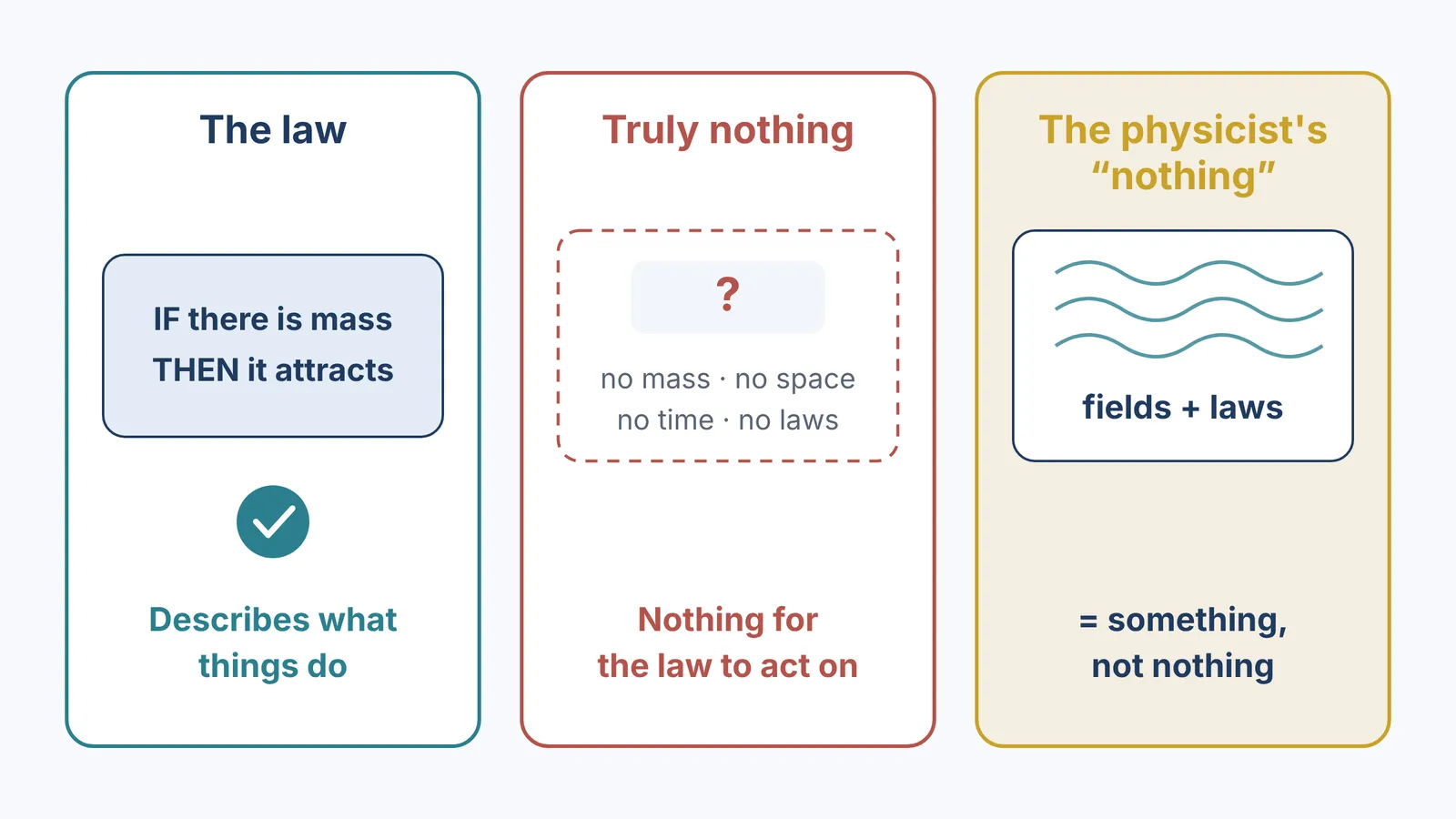
A law of nature is a statement of how things behave. Gravity, as a law, says roughly this: if there are masses, then they attract one another in this measured way. Every law of physics has that shape. If there is a charge, it behaves like this. If there is a field, it changes like that.
Notice the little word at the front: if. A law tells you what happens to things that are already there. It never supplies the things.
Think of arithmetic. The rules of addition are certain: put 100 in your bank account, then another 100, and you will have 200. But the rule has never put a single coin into anyone's account. If you put nothing in, arithmetic will tell you, with complete precision, that you have nothing.
The chessboard is the same. The rules decide what may happen once there are pieces and a player. They move nothing by themselves. A law is a description of a pattern; it is not an agent that acts11.
(We looked at the wider question of why there are laws at all, and why they are mathematical, on a separate page. Here we stay with one narrow claim: that a law can produce a universe.)
Gravity without anything to pull
Now apply this to gravity in particular. What is gravity? In Newton's picture it is the attraction between masses. In Einstein's picture it is the curving of space and time by matter and energy. In both pictures, gravity is something that belongs to a physical world: it is how matter, energy, space and time relate to each other.
So the sentence "because there is gravity, the universe can create itself" has a strange shape. Gravity is a feature of the universe. To say "because there is gravity" is already to say "because there is a universe with mass and space in it". The thing to be explained has been slipped into the explanation.
It is like saying, "Because there is a law of traffic, the cars built themselves." There can only be a law of traffic where there are roads and cars. The law is about them; it cannot be before them.
Which "nothing"?
The word "nothing" carries most of the weight in this claim, so look at it closely.
When philosophers, or ordinary people, say "nothing", they mean the absence of anything at all: no matter, no energy, no space, no time, no fields, no laws. Not even an empty box, because there is no box.
When physicists speak of a universe coming "from nothing", they almost always mean something else: a quantum vacuum, or a state described by quantum equations, or space with zero total energy. These are rich physical realities. A vacuum has fields, energy, and a precise structure that obeys laws. A "zero total" is not the same as nothing either. A business whose debts exactly equal its assets still has debts, assets, customers and a building.
So the claim tends to say "nothing" at the start and smuggle in "something" in the middle. We have a whole page on the quantum vacuum and why it is not nothing; the short version is that whatever the universe came "from" in these models, it was not nothing10.
And once the starting point is something, the question has not been answered. It has only been moved. Where did that vacuum, those fields, those laws come from? Why is there that rather than nothing at all?
A universe that creates itself?
There is a deeper problem in the very phrase "the universe created itself".
To create something, you must exist. Something that does not exist cannot do anything, including bring itself about. So for the universe to create itself, it would have to exist before it existed, in order to give itself existence. That is not a scientific puzzle waiting for better data. It is a contradiction, like a square circle.
Some reply that time began with the universe, so there was no "before". But that does not rescue the claim. If there was no before, then there was no moment in which the universe, or gravity, could act to produce anything. You are left with a universe that simply begins, with nothing at all as its cause. That is not self-creation; it is the claim that something came from nothing with no reason whatsoever, which is the very thing reason refuses11.
The Qur'an put these exact options to its first listeners, in one sharp question: Or were they created from nothing, or were they the creators [of themselves]?4. The two escape routes the modern claim tries to use, "from nothing" and "by itself", are the two the verse names and leaves the listener to reject. A man named Jubayr ibn Mut'im, who had not yet accepted Islam, heard the Prophet ﷺ recite this passage in prayer and said his heart almost flew7. He understood that there was no third way out except a Creator.
Then where does the claim leave us?
Put the pieces together.
A law describes what things do; it does not produce them. Gravity belongs to the universe; it cannot come before it. The physicist's "nothing" is something, so the question returns. And "self-creation" contradicts itself.
None of this attacks physics. It only shows that the laws, however beautiful, sit on the how side of the question. They tell you how a universe behaves, and perhaps how it developed from its earliest moments. They cannot tell you why there is a universe, with laws, at all. To answer that, you need something that is not itself one more piece of the universe: a source that exists by itself, depends on nothing, and gives existence to everything else11.
A law tells you what things will do if they exist. It has never given anything its existence.
Creation and command belong to Him
Islam has its own language for the laws of nature, and it removes the false choice between "laws" and "God".
The Qur'an calls God's settled way of acting His sunnah, and says: You will never find any change in the way of God3. It says He created everything and determined it with precise measure2, and Indeed, We have created everything according to a measure5. In this view a law of physics is a description of the regular way God runs His creation. It is not His rival, and it is not His replacement. It is His handiwork, read carefully.
One verse brings the two sides together in a single breath: The sun, the moon and the stars are subjected by His command. Indeed, to Him belong the creation and the command1. Creation is bringing things into being. Command is how they are directed and run. The modern claim tries to make the "command", the laws, do the work of "creation". The Qur'an keeps both, and gives both to the same Lord.
Look also at three of God's names placed side by side: He is Allah, the Creator, the Originator, the Fashioner6. Commentators explained that al-Khaliq includes determining and measuring a thing, al-Bari' is bringing what was measured into actual existence, and al-Musawwir is giving it its form8. A plan, however exact, is not yet a building. Laws are the measure; existence itself is a gift from the One who brings into being.
There is real beauty in this. You do not have to choose between admiring the equations and worshipping God. Every law a physicist uncovers is one more line in the record of how wisely the world was made. A Muslim scientist studies gravity with the same seriousness as anyone else, and then looks up and says: this is His way, and it does not change.
"Physics has replaced the need for God. 'God did it' explains nothing."
This is the strongest form of the objection, and it deserves a straight answer. It runs: "For centuries people said God made the rain, the plague, the planets' paths. One by one, science found the real mechanisms. The origin of the universe is just the last gap. Saying 'God did it' tells us nothing we can test or calculate; it is an empty word where an explanation should be."
Part of this is right. If someone used God as a substitute for studying how rain forms, that would be lazy, and it would make faith depend on our ignorance. Islam does not ask that. The Qur'an tells people to look at the rain, the stars and their own bodies and to think; Muslim scholars held that causes are real and that God made them causes9. The Muslim does not need gaps. Finding the mechanism of rain does not take rain away from God; it shows you how He sends it.
But the objection mixes up two kinds of explanation. Suppose you find a letter on your table. One explanation is about ink, paper and the pressure of the pen. Another is: your friend wrote it to tell you something. Both are true. Neither replaces the other. The chemistry will never tell you who wrote it, or why, and the friend's intention will never tell you the chemistry.
Physics gives the first kind of answer about the universe: how its parts behave. The question "why is there a universe with laws at all?" asks for the second kind: what or who accounts for its existence. Laws cannot give that answer, because they are part of what needs explaining. So "God created it" is not an empty word in a gap. It is an answer to a question that physics, by its own method, does not even ask: a living, knowing, powerful Creator who exists without depending on anything, and whose will accounts for why there is something rather than nothing11.
And notice what the alternative offers. "The universe came from nothing, because of laws that also came from nothing" is not a more scientific answer. It is no answer at all, dressed in scientific words.
Questions you may have
Does Islam deny that gravity is a real cause?
No. Things really do pull on one another; fire really burns; medicine really heals. Ahl al-Sunnah hold that these causes are real and effective, and that God created both the causes and their effects9. What Islam denies is that any created cause is self-sufficient, or that it can give itself or the universe existence.
What if physicists one day find a single law that explains everything?
That would be a wonderful discovery, and a Muslim would welcome it. But it would still be a law: a description of how things behave if they exist. The same questions would stand in front of it. Why does that law hold? Why is there anything for it to describe? A deeper law moves the question one step back; it does not answer it.
Then who created God?
The question assumes God is one more thing that begins to exist. He is not. Everything that begins needs a cause; the One who never began and depends on nothing does not. We give this question its own page, because it deserves a careful answer.
When you first heard that "the laws of physics can create a universe from nothing", what did you picture the laws doing? Try to say it in one sentence without the word "nothing" meaning "something".
Show a thought
Many people find the claim harder to state once the words are pinned down. A law turns out to be a pattern, not a doer, and "nothing" turns out to be a vacuum full of fields. If that is what you noticed, the question has not gone away. It has become clearer: where do existence, and its laws, come from?
We began with a chessboard and its rules, waiting in an empty room. The rules were perfect, and they moved nothing. The universe is far more wonderful than a game, and its laws are far more precise than any rulebook. That precision is exactly why they point beyond themselves.
Islam does not ask you to choose between science and God. It tells you that the measure and the existence, the command and the creation, belong to one wise Lord. If that is true, every law you learn is a sign. And the next step is to ask who He is.
Your next step
Sources (11)
- Qur'an 7:54 (al-A'raf)
- Qur'an 25:2 (al-Furqan)
- Qur'an 35:43 (Fatir)
- Qur'an 52:35 (al-Tur)
- Qur'an 54:49 (al-Qamar)
- Qur'an 59:24 (al-Hashr)
- Sahih al-Bukhari 4854 (Jubayr ibn Mut'im hearing Surat al-Tur)
- Ibn Kathir, Tafsir al-Qur'an al-'Azim, commentary on 59:24
- Ibn Taymiyyah, Dar' Ta'arud al-'Aql wa al-Naql (causes are real and created by God)
- Centre course material: Physics and the beginning of the universe
- Centre course material: Causality, origination, dependence and objections