Why should a galaxy you will never visit obey the same rules as the kettle in your kitchen?
Imagine you are allowed into an observatory late at night. A telescope collects faint light from a galaxy so distant that the light left it long before any human being was born. An instrument spreads that light into a band of colours, and across the band you see a pattern of thin dark lines.
On the bench beside you, a glass tube of hydrogen glows when a current runs through it. Its light, spread out the same way, shows the same pattern of lines. In the galaxy's light the whole pattern is shifted a little towards red, but it is unmistakably the same pattern. Hydrogen out there behaves exactly like hydrogen in here.
Nobody arranged that match for your benefit. It was already there. And once you notice it, a simple question becomes hard to put down: why does the universe keep the same rules everywhere?
A universe that keeps its rules
Most of the time we take it for granted. Water boils when it is heated enough. A dropped key falls. The sun rises at a time you can look up a year in advance. Medicine tested on thousands of people works, more or less, on the next person too.
Behind all of this is something remarkable: nature behaves according to regular patterns. Scientists call the most general of them laws of nature. Gravity, the behaviour of electric charge, the way light travels, the way atoms combine: these are not local habits of our planet. As far as we can observe, they hold in the oldest light we can catch and in the furthest galaxies we can see.
This is not a side detail. It is the ground science stands on. If nature changed its rules from place to place or from day to day, no experiment could be repeated and no result could be trusted. Every laboratory in the world quietly assumes that tomorrow's world will follow today's patterns12.
Stable, universal, and written in mathematics
Three features of these laws deserve a closer look, because each is more surprising than it first seems.
They are stable. The patterns do not drift. The light from distant galaxies, which set out long ago, carries the same atomic fingerprints we measure today. Physicists have looked hard for signs that the basic constants of nature have changed over time, and the patterns have stayed remarkably steady.
They are universal. The same law of gravity that brings an apple to the ground also keeps the moon in its orbit and shapes the paths of planets around other stars. There is not one physics for earth and another for the sky.
They are mathematical. This may be the strangest feature. A handful of short equations describe all of electricity, magnetism and light. A planet in our own solar system, Neptune, was located because calculations on paper said an unseen body had to be pulling on its neighbour, and when astronomers pointed their telescopes there, it was. Patterns worked out with a pen turned out to describe the sky.

A law describes. It does not do
Now a question that sounds simple but matters a great deal: what is a law of nature, and what does it actually do?
Picture a snooker table. With the laws of motion you can predict exactly where the white ball will send the red one: the angle, the speed, the bounce off the cushion. But the laws of motion have never struck a single ball. The cue does that, and someone moves the cue. The laws tell you what will happen when something acts. They do not act.
Or think of a railway timetable. Suppose it were perfect: every train in the country arriving at the minute printed, year after year. The timetable would describe that order flawlessly. But no timetable ever pulled a train. If anything, the more reliable the timetable, the more you would be sure that someone, somewhere, is running the railway.
A law of nature is a description of how things regularly behave. It is a statement of the pattern, often in mathematical form. It is not a thing that sits outside the world and pushes it. It brings nothing into existence and makes nothing move11.
So when someone says, "The laws of physics explain the universe," we have to be careful about what is being claimed. The laws explain how one state of the world follows from another. They do not explain why there is a world, nor why it follows laws at all.

Three questions the laws cannot answer about themselves
If "the laws explain everything" is offered as the final answer, three questions are left standing.
1. Why is there regularity at all, rather than chaos? Nothing about the idea of a universe requires that every electron be exactly like every other electron, or that a rule obeyed here be obeyed everywhere. You can easily imagine a world of pure disorder, where nothing repeats and nothing can be predicted. Ours is not like that. The order is a fact about our world, and facts can be asked about.
2. Why these particular laws? The laws could have had other forms, and the numbers in them, the strength of gravity or the charge of the electron, could have had other values. As far as we can tell, nothing in logic forces them to be what they are. Yet the actual values fall within narrow ranges that allow stable stars, chemistry and life. That is the subject of the next page on fine-tuning13.
3. Why can the human mind grasp them in mathematics? It is one thing for nature to be orderly. It is another for that order to be readable by a creature sitting at a desk with a pencil. Physicists have spoken of the "unreasonable effectiveness" of mathematics. Why should our reasoning, which grew up handling ordinary things, be fitted to the structure of the cosmos?
None of these is a gap in our knowledge that the next experiment might close. Every experiment assumes the answers already: that there is order, that it has a definite form, and that we can understand it. You cannot use the laws to explain why there are laws12.
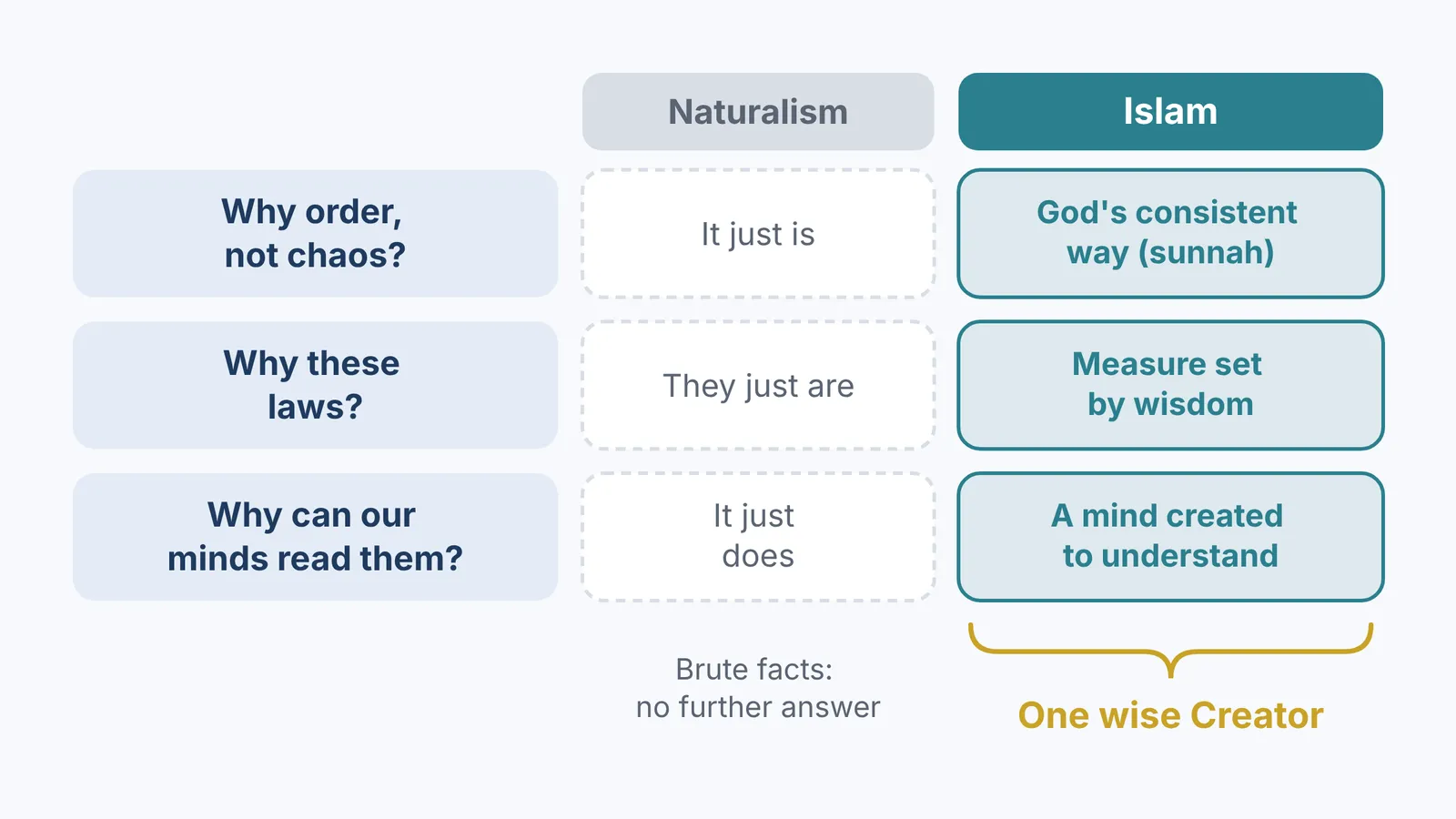
Two ways to end the chain of "why"
Every chain of explanation stops somewhere. The question is where, and whether the stopping point actually explains anything.
Naturalism, the view that nature is all there is, has to stop at the laws themselves. Ask why there is order, and the final answer is: there just is. Ask why these laws, and the answer is: they just are. Ask why the mind can read them, and the answer is: it just can, luckily. Philosophers call this a brute fact, something accepted with no explanation. Some naturalists say this openly and honestly. But notice what has happened. The most astonishing feature of the universe, the very thing that makes science possible, has been placed beyond explanation.
The other way to end the chain is with a source that explains the order rather than simply being more of it: a living, knowing, wise Creator who does not Himself depend on anything. Order comes from a mind; specific choices come from will and wisdom; a mind that can read the world comes from the same One who made both. This is not stopping at a puzzle. It is stopping at an answer11.
The way of God, which does not change
Islam has a word that fits this discussion with striking precision: sunnah, a settled and consistent way. The Qur'an speaks of sunnat Allah, the way of God, and says of it, in meaning: You will never find any change in the way of God, and you will never find it turned aside5. In its context the verse speaks of God's way with nations of the past, but Muslim scholars also speak of God's ways in creation, al-sunan al-kawniyyah: the constant patterns by which He runs the world. A law of nature, seen this way, is a description of God's sunnah in His creation12.
The Qur'an presents creation as measured from the start. Indeed, We have created everything according to a measure6. God created everything and determined it with precise determination4. The sun and the moon move by precise calculation7. Measure, proportion, calculation: this is the vocabulary of a universe that can be described by mathematics.
And it invites you to test the claim yourself: You will not see any inconsistency in the creation of the Most Merciful. So look again: do you see any flaw?8. The word translated "inconsistency" means things not matching, being out of step with each other. The physicist who finds the same law in the apple and the moon, and the same hydrogen in the tube and the galaxy, is in effect looking again and finding none.
There is a further point here. One consistent order across the whole universe is exactly what you would expect from one Lord. The Qur'an says, in meaning, that if there had been other gods besides God in the heavens and the earth, both would have fallen into ruin3. The unity of the laws is a quiet echo of the oneness of the One who set them.
A mind made to read the book
What about the third question, why our minds fit the world?
For Islam this is not an accident. The same Lord who made the world made the mind that studies it, and gave it the tools to understand. The Qur'an reminds you that God brought you out of your mothers' wombs knowing nothing and gave you hearing, sight and hearts, so that you might be grateful2. And among the very first verses revealed is this: He taught man what he did not know9.
So the fit between mathematics on paper and the motion of planets is not a lucky coincidence that a naturalist has to accept without asking. It is what you would expect if the world was made to be read, and the reader was made to read it. The universe is a book of signs, and you were given eyes for it12.
Created laws, and a Creator who is not bound by them
If the laws are God's way of governing creation, they are themselves created. God is not "bound" by them as if they stood above Him. They hold because He keeps them, and they are constant because His wisdom and mercy make them constant10.
That constancy is itself a gift. Because fire burns and water quenches, a farmer can plan a harvest, a doctor can trust a dose, and a child can learn that a hot stove hurts. A world without stable laws would be a world where no one could act wisely. The order you rely on every morning is mercy you rarely notice.
This also places miracles in their proper light. A miracle in Islam is a rare sign, given to a prophet to confirm his message, by the same Lord who made the normal order. It is not chaos breaking in. It stands out precisely because the order is so reliable, and its rarity is part of its meaning. The God who can do otherwise chooses, almost always, to keep His sunnah, and that is why science works.
"Laws are just our descriptions. There's nothing to explain."
Here is the objection at full strength: "You are treating laws of nature as if they were real things that need a source. They are not. They are human summaries of what we observe, written in our mathematics. Newton's laws were replaced by Einstein's, and Einstein's may be replaced too. A summary does not need a lawgiver. Things simply behave as they behave, and we write it down. There is nothing more to explain."
Part of this is right, and it should be granted. The laws as written in textbooks are human formulations. They are revised and improved. In that sense they are descriptions, and this page has said so from the start.
But follow the argument one more step. If a law is a description, then it is a description of something. What it describes is a real regularity in nature: stones that fell the same way long before anyone wrote an equation, hydrogen that carried the same fingerprint before there were telescopes to catch it. Our wording of the law can change; the regularity being described does not wait for our wording.
So calling laws "just descriptions" does not remove the question. It only relocates it from the textbook to the world. The question was never "why do physicists write equations?" It was "why does the world behave so that equations fit it, everywhere, always, so precisely?" Saying "things simply behave as they behave" is not an answer to that. It is a decision to stop asking at the most interesting point.
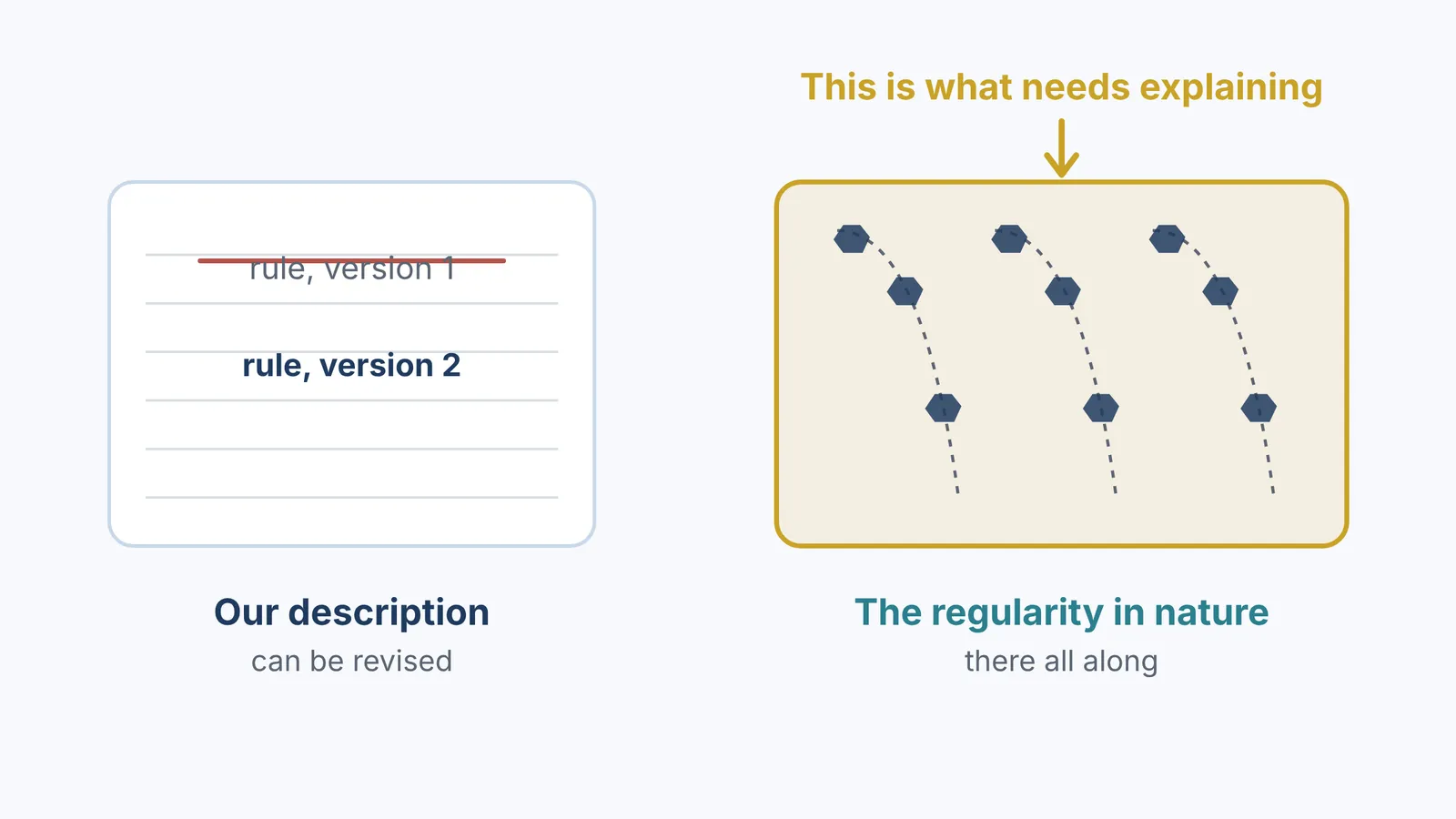
A timetable never pulled a train. And the more perfectly it holds, the surer you are that someone is running the railway.
Questions you may have
If God can perform miracles, can science still be trusted?
Yes. In Islam the normal order is God's own chosen way, and He keeps it constant; that constancy is why the world is reliable enough to study. Miracles are rare signs connected to prophethood and known through reliable report, not random interruptions in a laboratory. A Muslim scientist expects her experiment to repeat for the same reason she believes in God: the world is governed by a wise and consistent Lord.
Isn't "God did it" just a way of avoiding science?
Not here. Islam does not put God in place of the law of gravity; it says gravity is part of how God governs creation, and invites you to study it as closely as you can. The question on this page is not "how does gravity work?" but "why is there a lawful universe for science to study in the first place?" That question sits beneath all of science, not inside one of its gaps.
Couldn't the laws just be necessary, so that they could not have been otherwise?
Nothing we know shows that. We can describe consistent universes with different laws and different constants, and physicists study such models routinely. If the laws were logically necessary, we should be able to deduce them from pure reasoning without looking at the world. We cannot; we have to observe, measure and test, which is exactly what you would expect if the laws are a fact that could have been otherwise.
Think of the last time you studied, or used, a law of physics: a formula in school, a calculation, even just trusting that your brakes will work. Did it ever occur to you to ask why the world is so dependable?
Show a thought
Most of us rely on the order of the universe hundreds of times a day without noticing it. The Qur'an asks you to notice: to see in that dependability a sign of a wise and merciful Lord. People of understanding who reflect on the heavens and the earth end by saying, Our Lord, You did not create this in vain1.
We began in an observatory, matching lines in the light of a distant galaxy with the lines from a tube of hydrogen on a bench. Science can tell you a great deal about those lines. It cannot tell you why the universe keeps one set of rules everywhere, why those rules, and why you are able to read them.
Islam gives one answer to all three: the order you study in physics is the sunnah of a wise Creator, measured with precision, kept without change, and set before a mind He made to understand it. For a believer, a physics lesson is not a distraction from faith. It is a daily sign, studied with wonder and with gratitude. If that is true, the next step is to look more closely at how finely that order is set.
Your next step
Sources (13)
- Qur'an 3:190–191 (Al 'Imran)
- Qur'an 16:78 (al-Nahl)
- Qur'an 21:22 (al-Anbiya')
- Qur'an 25:2 (al-Furqan)
- Qur'an 35:43 (Fatir)
- Qur'an 54:49 (al-Qamar)
- Qur'an 55:5 (al-Rahman)
- Qur'an 67:3 (al-Mulk)
- Qur'an 96:5 (al-'Alaq)
- Ibn Taymiyyah, Dar' Ta'arud al-'Aql wa al-Naql (causes and their effects as created by God)
- Centre course material: Causality, origination, dependence and objections
- Centre course material: Order, fine-tuning and objections (the argument from order and precision)
- IslamReligion, Fine-Tuning of the Universe, part 1 (physical laws)