When a scientist on screen tells you the universe needs no Creator, which part of that sentence is science?
Imagine you are watching a documentary late at night. Galaxies turn slowly to quiet music. A calm voice explains how light from the early universe is measured today, and an equation appears on a blackboard. Everything is beautiful, and everything is careful. Then, without changing tone, the voice says: "So the universe did not need anyone to make it. It simply happened."
The music does not change. The galaxies keep turning. But somewhere in that last sentence the programme stopped measuring and started concluding. Did you notice the moment it happened?
This page is about that moment. It will not ask you to distrust physics. It will give you one skill that makes you a sharper listener to any claim about physics and God, from whichever side it comes.
Two floors in the same building
Every claim that "physics shows" something about God has two floors, even when they are presented as one.
The ground floor is the physics: equations, measurements and predictions. The universe is expanding; the faint glow left from its early hot state can be measured; quantum theory predicts the results of experiments with remarkable precision. On this floor you can check things. Someone calculates, someone measures, and the results either agree or they do not.
The upper floor is the interpretation: what someone says all this means for God, for purpose, for why anything exists at all. "So no Creator is needed." "So we are an accident." "So life has no meaning beyond what we invent." These sentences are not measured by any instrument. They are conclusions, and conclusions need arguments11.
Think of a piece of music. A physicist can describe every note in it precisely: the frequencies, the timing, the way the sound waves overlap. That description can be complete and correct. But it does not tell you whether someone composed the piece, or what it means. Those questions are real, and they are not foolish. They are simply not answered by the frequency chart.
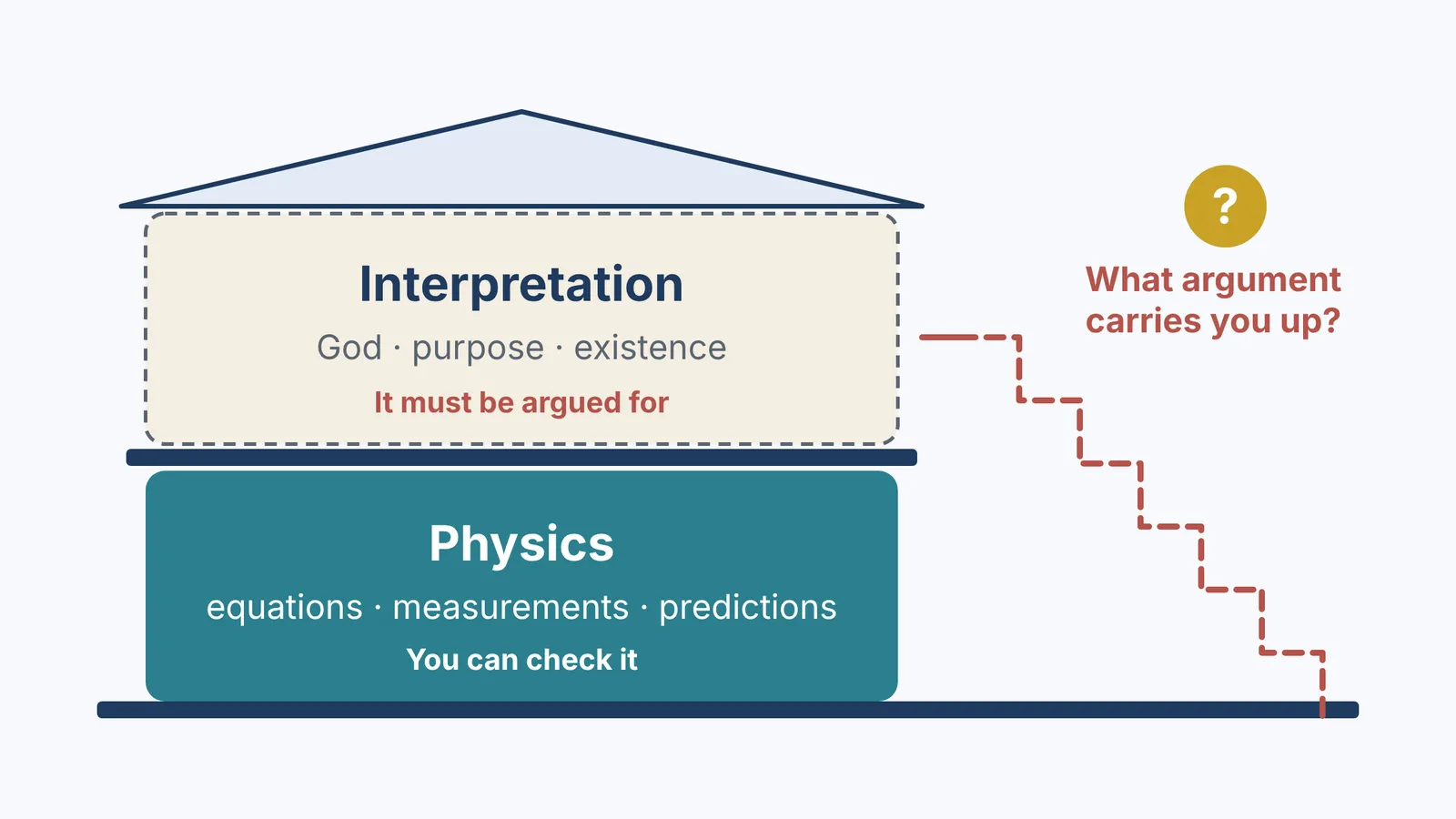
So here is the skill, in three questions you can ask of any such claim:
- What exactly was measured or calculated?
- What does the model predict that could, at least in principle, be checked?
- What sentence was added after that about God, purpose or existence, and what argument supports it?
The third question is where most of the real debate lives. It is also where most presentations go quiet.
Why the step is so easy to miss
Popular books and videos about the universe are often wonderful. They make difficult ideas clear and they awaken real wonder. But they have a habit worth noticing: the same voice, with the same confidence, moves from the ground floor to the upper floor without announcing the move.
The authority earned downstairs is carried upstairs. A presenter who has just explained, correctly, how stars make heavier elements then says something about the meaning of human life, and the second statement borrows the trust earned by the first. The grammar helps: "physics tells us", "science has shown", "we now know". These phrases fit the measurements well. They fit the philosophy far less well.
This is not always deliberate. Many writers simply do not separate the floors in their own minds. Nor does it run in one direction only. Some believers also take a physical model and announce that it "proves" a religious claim, skipping the same staircase. The skill on this page is a test for both sides.
Four claims, walked through calmly
Let us take four claims that circulate widely, in books, lectures and short videos. We will put each one on the two floors. The aim is not to mock anyone, but to see where the measuring ends.
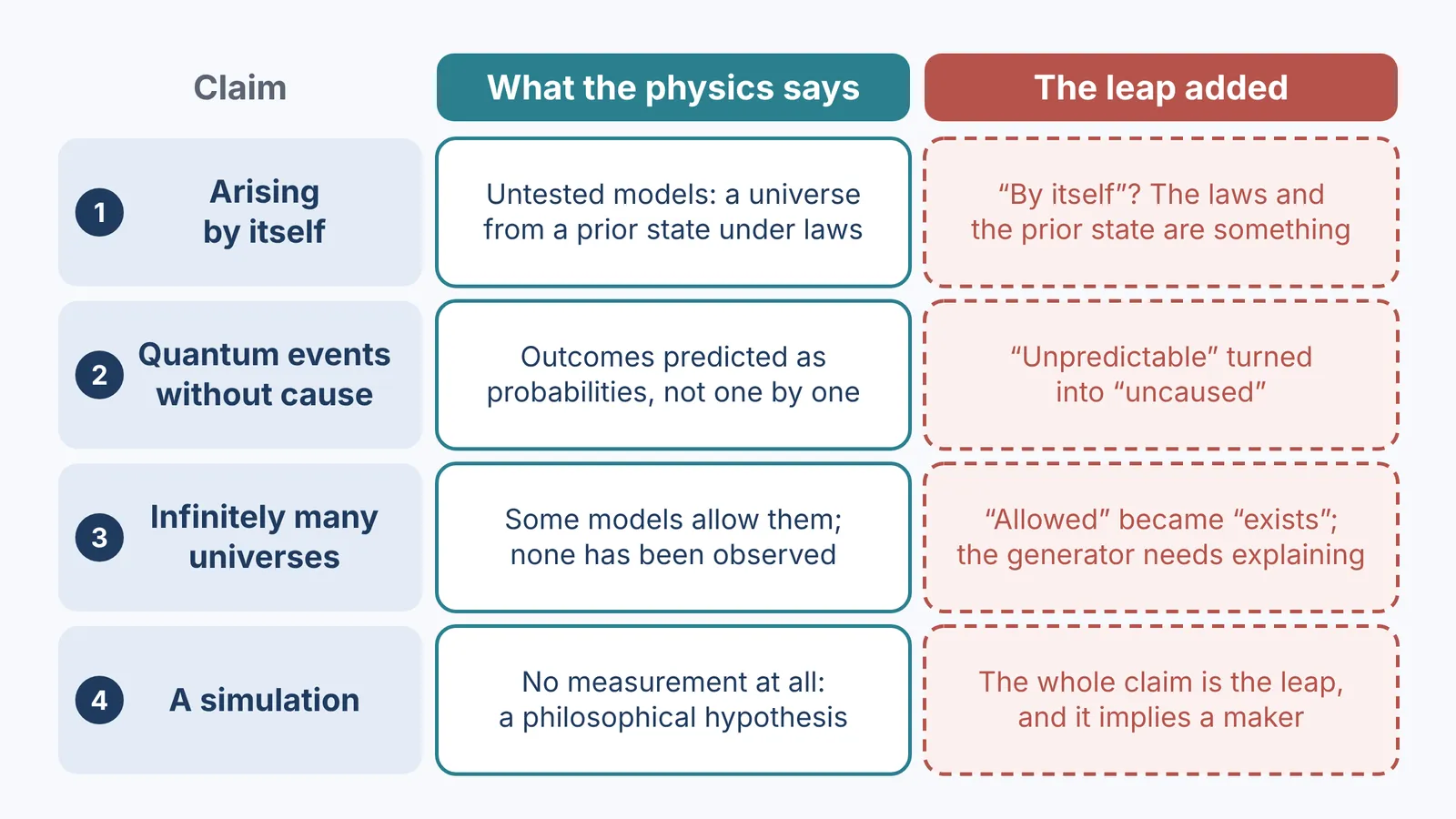
1. "The laws of physics explain how the universe could arise by itself."
What the physics says: some models, which are mathematical and so far untested at that stage, describe how a universe like ours could emerge from an earlier state governed by physical law, for example a state of quantum fields. Physicists do not yet have an accepted theory for the very earliest moment, where gravity and quantum effects must be combined.
The leap: the words "by itself". In these models the starting point is not nothing at all. It is a state with structure, governed by laws and equations12. And a law of physics is a description of how things behave; it is not a thing that creates. "Two plus two is four" will never put four coins in your pocket. If nothing exists, there is nothing for a law to describe. So the honest physical statement is: "given these laws and this prior state, a universe like ours could follow." The question of why there are such laws and such a state at all has not been answered. It has been moved back one step13.
2. "Quantum events have no cause."
What the physics says: quantum theory predicts probabilities. It can tell you, with great accuracy, what fraction of a large group of unstable atoms will decay in an hour, but not which atom will decay next. That is a genuine and fascinating limit on prediction.
The leap: from "we cannot predict it" to "nothing brings it about". Physicists themselves disagree about how to interpret quantum theory, and some of the interpretations on offer are fully deterministic. The experiments confirm the predictions; they have not settled which interpretation is true. And even on the interpretations where outcomes are genuinely open, the event happens inside an existing atom, within existing fields, according to existing laws. An event that is unpredictable within a world is very different from a world that comes from absolutely nothing13.
3. "There are infinitely many universes, so ours is not special."
What the physics says: certain models of the early universe, and certain theories of fundamental physics, allow for or suggest regions or universes beyond the one we observe, possibly with different properties. No other universe has been observed, and physicists themselves debate whether such ideas can be tested at all.
The leap: first, from "a model allows it" to "it exists". Second, from "it exists" to "the question is closed". A mechanism that produces many universes would itself be a structured, law-governed system, and its own precise setup would need explaining14. A machine that makes many loaves of bread does not remove the question of who built the bakery. And an infinite number of universes still leaves the oldest question untouched: why is there anything rather than nothing? There is a separate page on this site about the multiverse.
4. "The universe is just a simulation."
What the physics says: almost nothing. This is a philosophical hypothesis, usually argued from probabilities and assumptions about future technology, not from any measurement. No experiment has detected it.
The leap: the whole claim is the leap. And notice an irony: if it were true, it would mean that our universe was deliberately made by an intelligence outside it, with rules it set. That is hardly a step away from the idea of a Maker. It also leaves the deeper question open: what is the reality in which the simulation runs, and where did that come from?
Theories are human models
There is another reason to be careful on the upper floor: the ground floor itself is not equally firm everywhere.
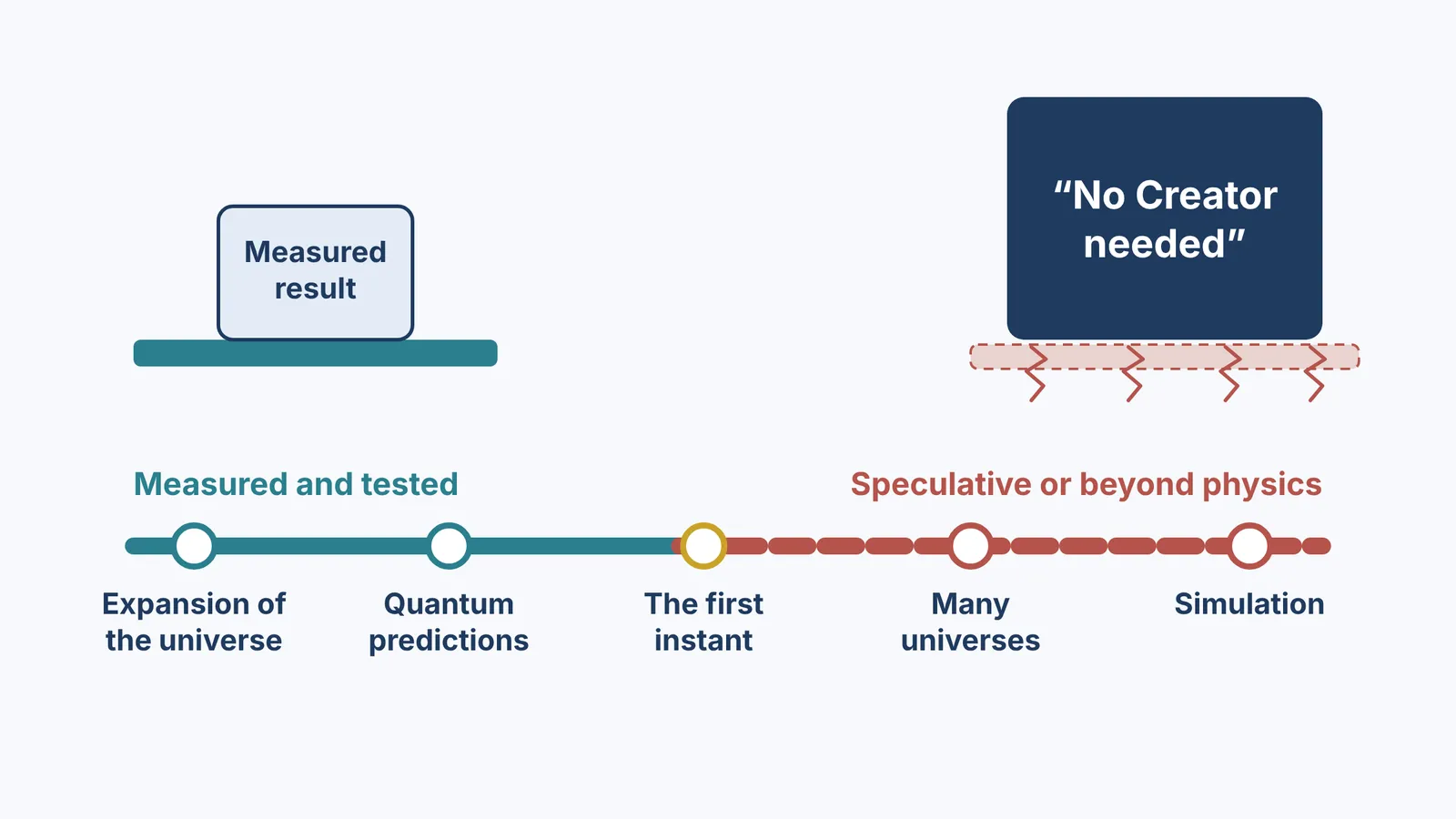
Physical theories are human models of the world. Some are measured and tested from every side, and are not going to be overturned in the way people sometimes imagine: that the universe is expanding, for example, rests on repeated observation. Others are powerful theories that work superbly within the range where they have been tested. Others still are extrapolations to conditions no one has observed, such as the first instant of the universe. And some are speculative models that no experiment has yet been able to reach. Physics itself has had to revise its picture of space and time before, and it may do so again11.
Physicists know this better than anyone. That is why careful physicists speak of models, assumptions and ranges of validity. Problems begin when a confident conclusion about God, purpose or existence is built on the most speculative layer, and then presented with the confidence of the most established one.
A metaphysical conclusion is only as strong as the ground it stands on. If it rests on a model that may be revised next decade, it may be revised with it. To build "there is no Creator" on an untested model of the first moment, or on universes no one can observe, is to build a heavy roof on the softest ground available.
A fairness rule that applies to believers too
If this skill is fair, it must work in both directions. And it does.
Believers also should not tie their faith to a particular physical model. Many Muslims point to the strong evidence that the universe had a beginning, and that evidence is weighty12. But a Muslim's faith does not hang on the details of any cosmological model. If a believer says "this new theory proves God", the same three questions apply to him: what was measured, what is predicted, and what was added?
The Qur'an's own argument does not rest on any model: Were they created from nothing, or are they themselves the creators? Or did they create the heavens and the earth? No, they have no certainty7. That question concerns anything that exists and depends on something else, whatever the physics of its origin turns out to be13. It does not wait for the next paper. The site's method for apparent clashes between science and scripture makes the same point: grade each claim by its evidence before weighing it against anything else.
A faith that asks physics to speak in its own field
Here is something beautiful about Islam's position. It does not need to fear physics, and it does not need to flatter it. It simply asks physics to speak with full authority in its own field, and no further.
The Qur'an sets the standard first for everyone, believers included: Do not follow what you have no knowledge of; your hearing, your sight and your heart will all be questioned about it4. That verse is the three-question test in a single sentence. A conclusion that goes beyond what was actually known is precisely what it forbids.
To anyone making a claim about ultimate reality, the Qur'an says: Bring your proof, if you are truthful1. Not your prestige, not the beauty of your images, not the confidence of your voice: your proof. And it reminds us that conjecture is of no avail against the truth8.
At the same time, the Qur'an sends people outward to study the universe: We will show them Our signs in the horizons and within themselves until it becomes clear to them that it is the truth6. Every measurement of the cosmos is, for a Muslim, a closer look at those signs. The people of understanding it praises are those who reflect on the creation of the heavens and the earth and say: Our Lord, You did not create this in vain2. And the Prophet ﷺ said that whoever follows a path seeking knowledge, God makes easy for him a path to Paradise9.
Muslim scholars stated the principle that holds all this together: sound reason never contradicts authentic revelation10. The universe and the Qur'an come from the same Source. So a Muslim can welcome every honest finding of physics without anxiety. What he declines to do is let a philosophical leap pass itself off as a finding.
"Physicists know more about the universe than theologians, so their view on God should win"
This objection deserves to be put at full strength: "Physicists spend their lives studying how reality works at its deepest level. They understand the origin of the universe, quantum theory and cosmology far better than any preacher or philosopher. When the people who know the universe best say it needs no Creator, why should anyone listen to those who know it less?"
There is something right in this. On questions of physics, physicists should be heard first, and a believer who overrules careful measurement with his own guesses is making a mistake. Islam agrees. The Qur'an asks, Are those who know equal to those who do not know?5, and tells people to ask those who have knowledge when they do not know3.
But expertise in physics is not automatically expertise in philosophy. The moment the question becomes "Can a law cause anything?", "What does 'nothing' mean?", "Why does anything exist?" or "Does the universe have a purpose?", the speaker has left the laboratory. He may still have good arguments, but they are now philosophical arguments, and they must be judged as such, by the same standards as anyone else's. A brilliant heart surgeon deserves your full trust about your heart, and no special authority on whether your life has meaning.
There is also a simple observation. Physicists do not agree about God. Among excellent physicists, past and present, there are firm believers, firm atheists and many in between. If expertise in physics settled the question, that would not be the case. What the disagreement shows is that the question is decided somewhere other than the equations.
So the fair rule is this: on the physics, we listen. On the meaning, we weigh the arguments, wherever they come from.
On the physics, we listen. On the meaning, we weigh the arguments.
Questions you may have
Does Islam reject modern physics or the idea that the universe had a beginning?
No. Islam has no quarrel with measurement, and Muslims study and practise physics at every level. The evidence that the universe had a beginning sits comfortably with the belief that it was created. But a Muslim's faith does not depend on any particular model: if cosmology refines its picture of the first moment, the question of why there is a universe at all remains exactly where it was.
Isn't it convenient to call physics "only interpretation" whenever it seems to disagree with religion?
It would be, if the rule were applied only one way. It is not. The same three questions apply when a believer claims that physics proves God. And the distinction is not invented for this debate: physicists themselves separate measured results from models, and models from the interpretations people attach to them.
What should I do the next time a video says "physics proves" something about God?
Pause and ask the three questions. What was measured? What does the model predict? And which sentence was added about God, purpose or existence? Then look for the argument behind that last sentence. Sometimes there is one worth considering. Often there is only a change of tone.
Think of a statement about science and God that has stayed with you, from a book, a lecture or a video. If you split it into its two floors, what is left on the ground floor, and what is on the upper one?
Show a thought
Many people find that the part that troubled them was never the measurement; it was a sentence added after it. That does not mean the sentence is false. It means it has to be argued for like any other claim. Islam asks exactly this of you: to follow knowledge, to ask for proof, and to give every claim the weight its evidence deserves, no more and no less.
We began with a documentary that moved from galaxies to a verdict on God without changing its music. You now have a way to hear the change: the moment the measuring stops and the concluding begins.
That skill will not make you less curious about physics. If anything, it frees you to enjoy it more, because you no longer have to accept or fear every conclusion that rides along with it. Islam invites you into exactly that freedom. It tells you to study the heavens and the earth, to welcome what is truly known, and to ask every claim for its proof. A faith that is comfortable with physics in its own field, and honest about where that field ends, is worth a closer look.
Your next step
Sources (14)
- Qur'an 2:111 (al-Baqarah)
- Qur'an 3:191 (Al 'Imran)
- Qur'an 16:43 (al-Nahl)
- Qur'an 17:36 (al-Isra')
- Qur'an 39:9 (al-Zumar)
- Qur'an 41:53 (Fussilat)
- Qur'an 52:35–36 (al-Tur)
- Qur'an 53:28 (al-Najm)
- Sahih Muslim 2699
- Ibn Taymiyyah, Dar' Ta'arud al-'Aql wa al-Naql
- Centre course material: Empirical science, revelation and their relationship (scope of science; theories subject to revision)
- Centre course material: Physics and the beginning of the universe (Arabic course notes, physics section)
- Centre course material: Causality, origination, dependence and objections
- Centre course material: Order, fine-tuning and objections (including the multiverse objection)