If you knew every step by which a language changed over a thousand years, would you know how human speech began?
Imagine a historian of language at her desk. In front of her lie three versions of the same short prayer: one from about a thousand years ago that a modern reader can barely recognise, one from a few centuries later with odd spellings, and one in today's plain words. She can trace almost every change: this vowel shifted, that ending dropped away, this word was borrowed from a neighbour.
A student looks over her shoulder and says, "So now we know where language came from." She smiles and shakes her head. "I have explained how a language that already existed kept changing. How human beings first came to speak at all is a different question. And why there are minds capable of speech in the first place is a different question again."
Many arguments about life and God stumble exactly where that student stumbled.
Three questions hiding in one sentence
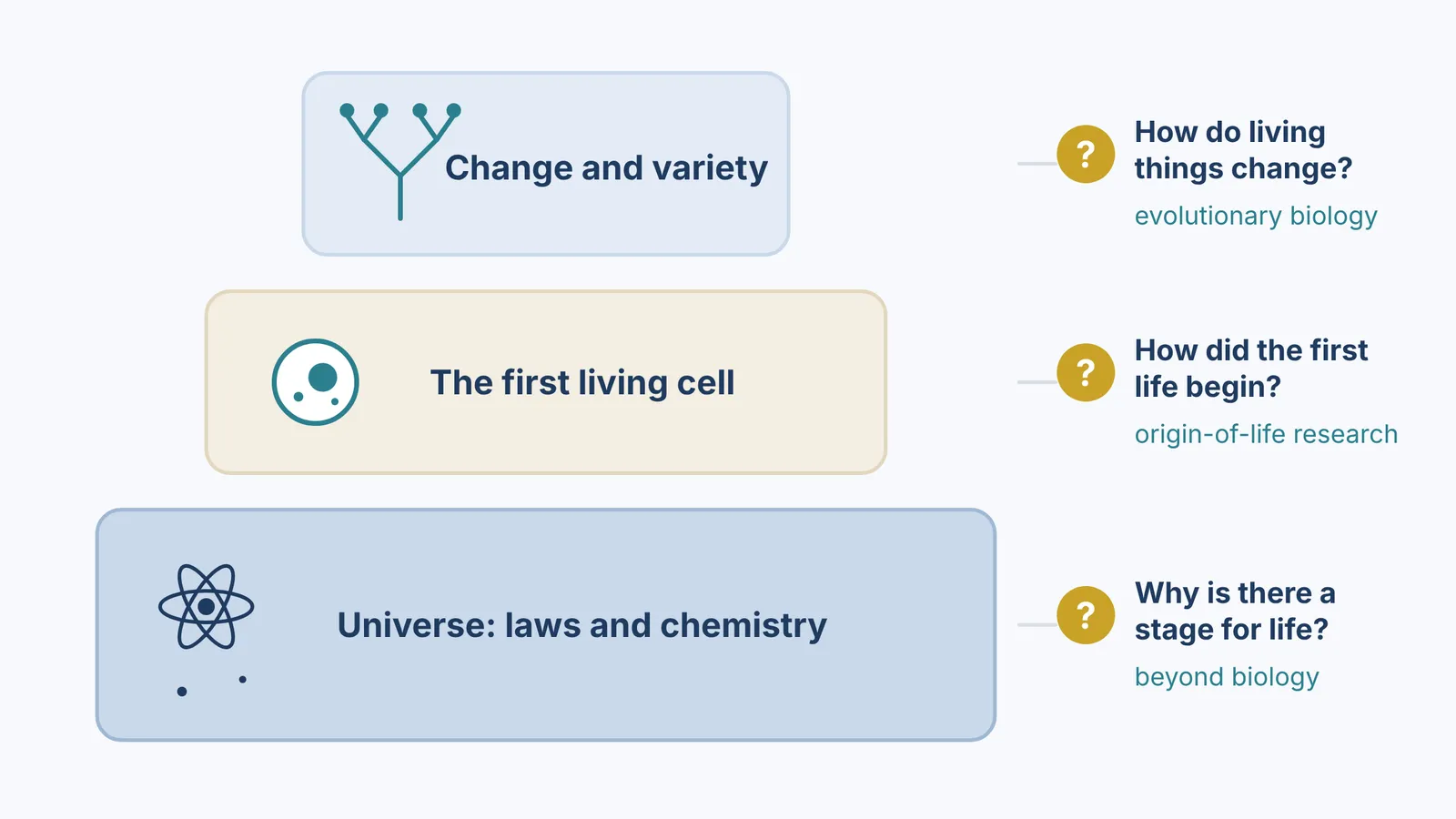
You have probably heard some version of this: "Evolution explains life, so there is no need for a Creator." It sounds like one claim. It is actually an answer to three separate questions folded together.
The question of change. Once living things exist, how do they vary, adapt and branch into the variety we see? This is the field of evolutionary biology.
The question of origin. How did the first living system appear, before there were any parents, any offspring or any inheritance? This is the field scientists call the origin of life, or abiogenesis.
The question of the stage. Why is there a universe at all, with stable laws and a chemistry able to support life? This is not a biology question. Biology works inside this stage; it does not build it.
The three are linked, but answering one does not answer the others. Much confusion, on both sides of the debate, comes from sliding between them without noticing15.
What evolutionary theory actually describes
To be fair, start with what biologists mean. In its textbook sense, evolution is change in the inherited features of a population over generations. Its mechanisms include mutation, which introduces variation; inheritance, which passes it on; natural selection, by which variations that help survival and reproduction become more common; and other processes such as genetic drift and migration15.
Some of this is observed directly and is not controversial: bacteria become resistant to antibiotics; populations shift in size, colour and behaviour as their environment changes. Muslims have no quarrel with this; it is part of the order God placed in the living world.
It helps to keep three things apart. There is observed change within populations, often called microevolution. There is the much larger claim that all living things descend from a single common ancestor through unguided processes, a claim the centre's material examines critically. And there is "Darwinism" as a philosophy: the belief that life is the product of blind processes with no Creator, purpose or meaning1521. The first is a finding. The second is a scientific theory open to debate. The third is not a finding of biology at all.
But notice what every one of these has in common, from the most modest to the most ambitious. Each describes what happens to living things that already reproduce, already carry inherited information, and already vary from one generation to the next. Even the founding book of the theory was about the origin of species, not the origin of life.
Selection needs something to select
Natural selection is often spoken of as a creative force that can do anything given enough time. But look at what it needs in order to work.
It needs things that make copies of themselves. It needs those copies to inherit the features of the original. It needs the copying to be slightly imperfect, so that there are differences to choose between. And it needs some of those differences to affect how many copies get made next time. Take away any one of these, and selection has nothing to act on.
Now step back to a world with no life in it. There are molecules, water, rock and energy, but nothing that copies itself with inherited information. With no offspring, there is no "fitter" or "less fit". Selection is not weak there; it does not exist yet. Its starting line is the first system that can reproduce and pass on instructions.
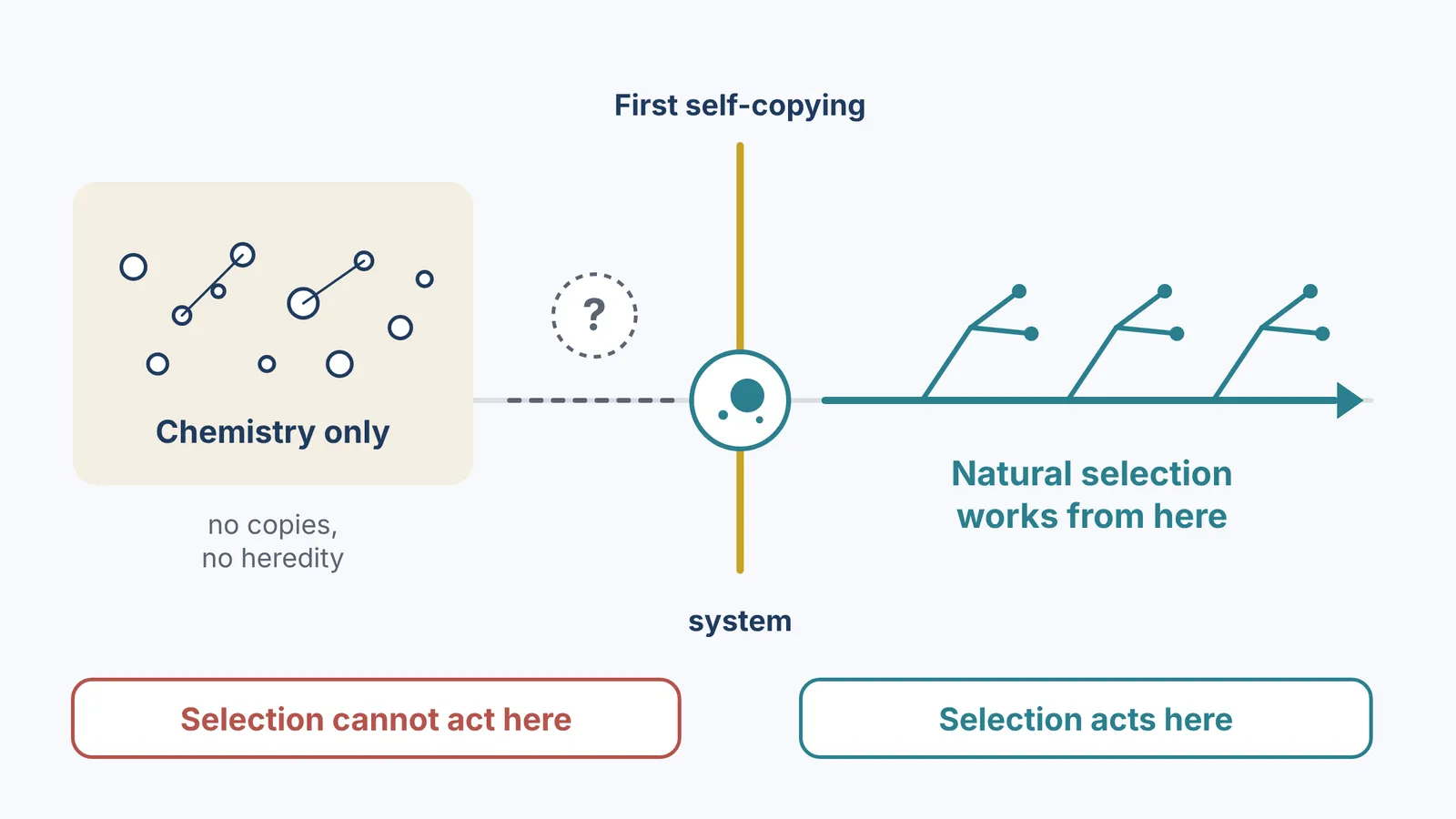
Some researchers suggest that a kind of chemical selection could have acted on molecules that were able to copy themselves, long before anything we would call a cell. That is a serious proposal, and the page on approaches to the origin of life looks at it more closely. But even there, the starting line has only moved back: you still need a molecule that can carry information and copy it. Selection can refine a replicator once it exists. It cannot be the explanation of the first one, because it assumes it.
The category slip
So when someone says "evolution explains life", the honest version of the sentence is narrower: evolution, at most, explains the variety of life once it exists. Moving from one to the other is what philosophers call a category slip: an answer about one kind of question is presented as the answer to another.
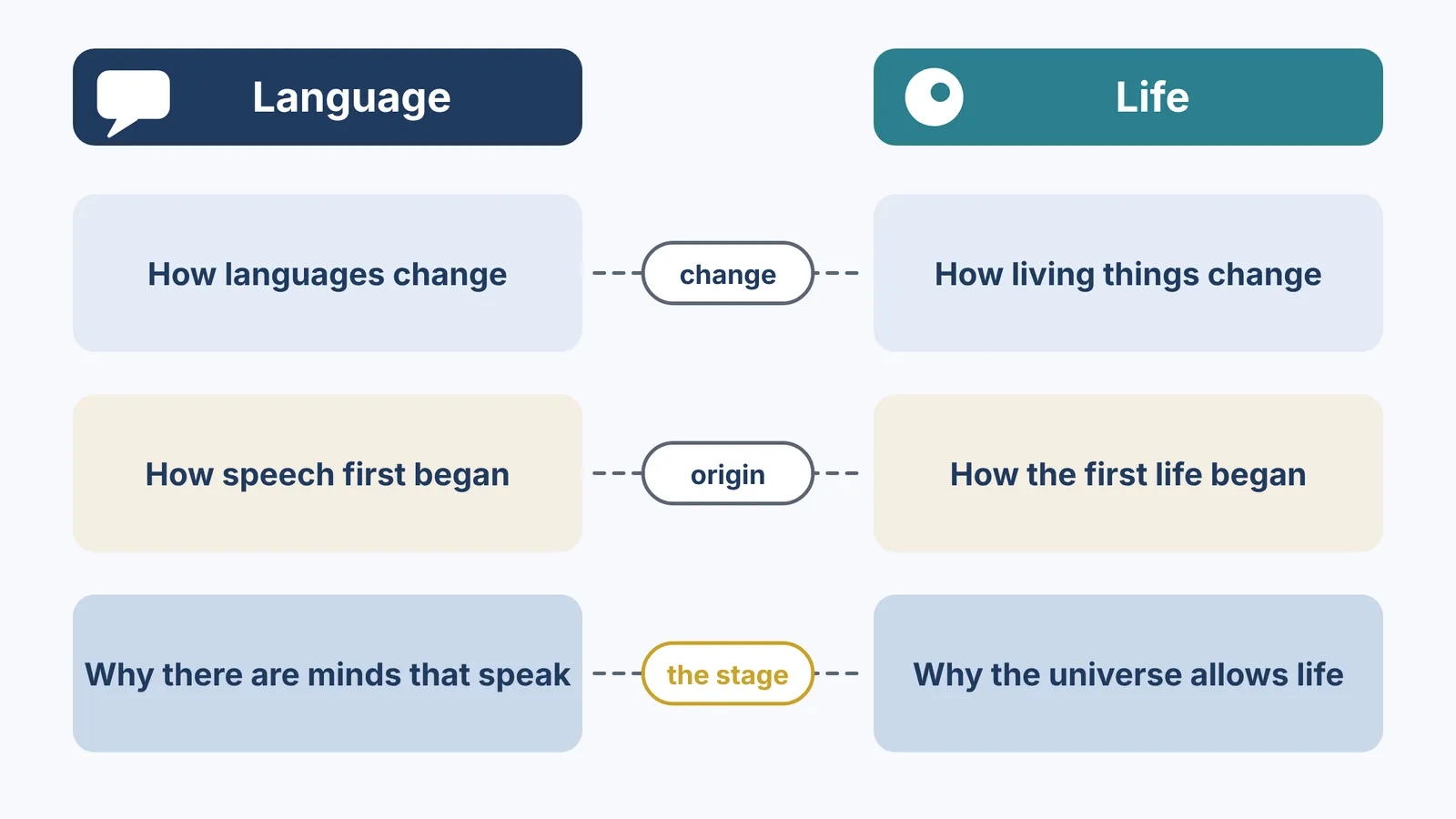
Return to the historian. Historical linguistics is a rigorous science; it can show how one language split into many. But however complete it becomes, it does not tell you how the first human words were spoken, and neither tells you why there are minds that can mean something by a word.
Life's story has the same three floors. How species change is one floor. How life first appeared is the floor beneath it. Why there is a universe in which either could happen is the foundation. A complete account of the top floor leaves the two below exactly where they were.
The slip runs in both directions. Some believers assume that if they can cast doubt on evolution, they have proved God. That is the same mistake from the other side. The case for a Creator does not hang on any one biological debate, and it should not be made to.
You can even see the blur in popular lists of "evidence for evolution". They often include a famous mid-twentieth-century experiment in which electric sparks in a mixture of gases produced some of the simple chemical building blocks found in living things15. Whatever that experiment shows, it is about the origin of life, not about how species change. Putting it on the same list is the category slip in action.
What the first cell would need
Why is the origin of life such a hard problem? The centre's material points to two things: information and coordination15.
Even the simplest cells we know are not a drop of jelly. They store instructions in DNA, a long chain whose order spells out how to build proteins. Proteins do most of the cell's work, including reading and copying the DNA. A molecular machine made of protein and RNA translates the instructions into new proteins. A membrane keeps the inside separate from the outside, and the cell needs a steady way to capture energy.
Here is the knot. DNA needs proteins to be read and copied. Proteins need the instructions in DNA to be built. Each depends on the other, and both depend on the membrane and the energy supply, all working together at once.
Then there is information. Chemistry explains why certain atoms bond. It does not, by itself, explain why the bonded units come in a particular order that carries a working instruction, any more than the chemistry of ink explains the meaning of the sentence written with it. Making the letters is one problem. Getting a meaningful sentence is another.
Biologists take these problems seriously. A well-known proposal is that RNA, which can both store information and speed up some chemical reactions, came first and did both jobs before DNA and proteins divided the work. But, as the field itself admits, no one has shown how a self-sustaining, self-copying system arose from non-living chemistry under plausible early-earth conditions. The origin of life is an open problem, not a solved one15. The page on the first-cell dilemma goes into this in more detail.
The question beneath both
Suppose chemists one day traced a full pathway from simple molecules to a first cell. The third question would still be waiting. That pathway would work only because of the laws the universe has: atoms that bond in stable ways, carbon able to form long chains, water with its unusual properties, a planet with the right conditions, and energy flowing in the right amounts. Every step would rely on these; none would be explained by it.
Why is there a universe whose laws and chemistry make life possible at all? Why is it orderly enough to be studied? These are questions about the stage, not about the actors on it17. And the fact that something exists, and depends on conditions it did not choose, points beyond itself to a source that does not depend on anything16.
One answer at every level
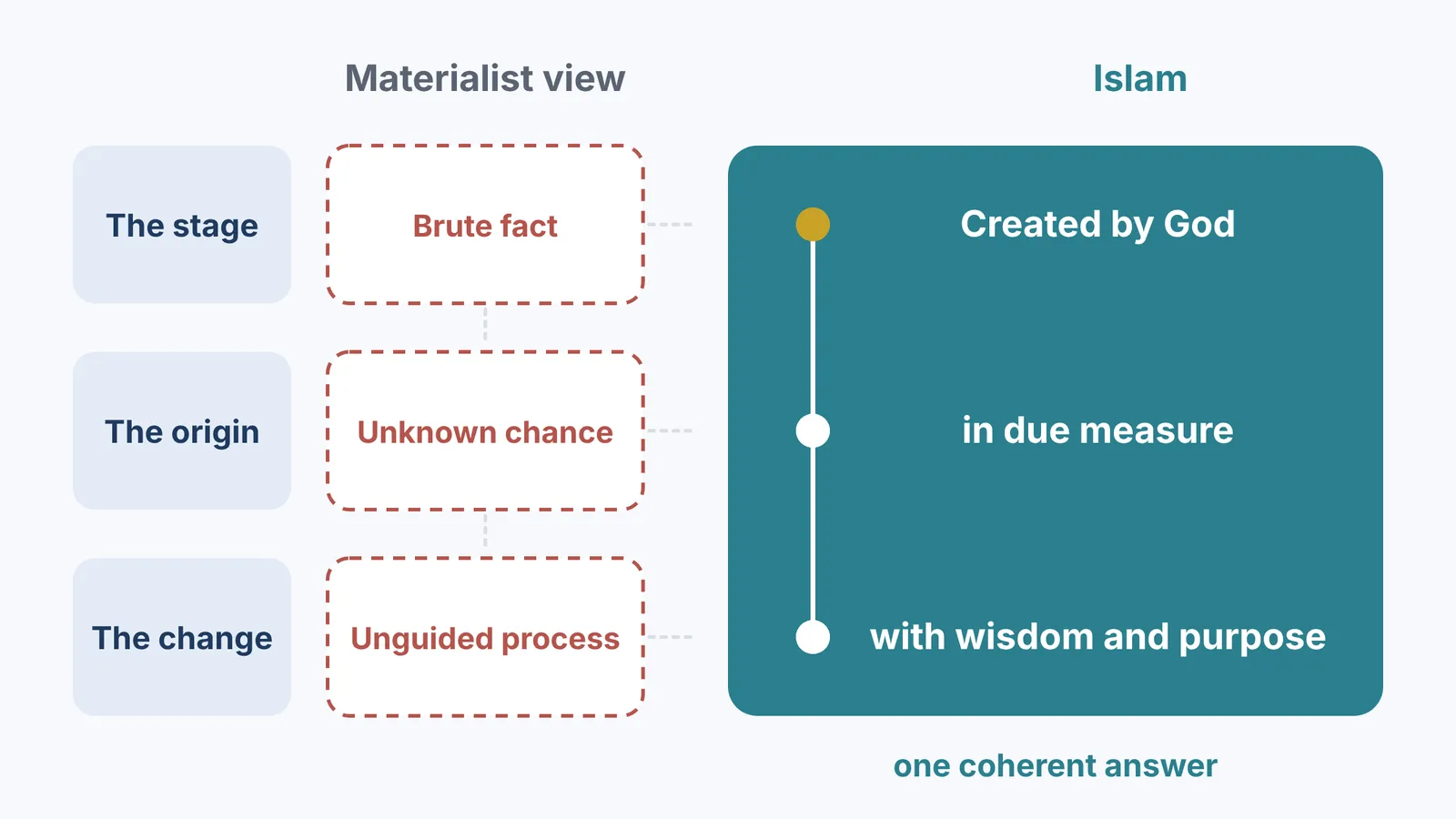
Here Islam offers something that a purely materialist account cannot: one coherent answer that reaches all three questions at once, without denying anything true that science finds.
The stage. The Qur'an says, in meaning: Indeed, We created all things in due measure11. The laws, the constants and the chemistry are not lucky accidents; they are measured, and measured by Someone.
The origin. God is the One who brings life out of what has no life: He brings the living out of the dead and brings the dead out of the living8. The verse speaks of God's constant work in nature, and the very first life is simply the first instance of it. And the Qur'an ties living things to water: and We made from water every living thing. Will they not then believe?5. Classical commentators read this as a statement about the basis of all life13. Life, in this view, is not something matter stumbled into. It is a gift given.
The change. The Qur'an describes God as the One who gave each thing its form and then guided it4. Whatever happens in living nature, including the variation and adaptation biologists observe, happens by God's creation, knowledge and will. Muslim scholars have long held that causes and their effects are both created by God; describing a cause does not remove the One who made it work14.
On the narrower question of whether non-human species developed from one another over long periods, contemporary Sunni scholars differ, and this page does not settle it20. What they agree on is the decisive point: nothing in nature is the product of blind chance standing on its own.
And on human beings, Islam is clear. Adam, peace be upon him, was created directly by God: He created him from dust, then said to him "Be", and he was1. God told the angels He would create a human being from clay, and when He had shaped him and breathed into him of the spirit He created, they were to bow down9. All human beings descend from that one soul2, created in the finest form12. This is the position of Sunni scholarship on human origins1819.
This is where the beauty lies. You are not asked to choose between the laboratory and meaning. The Qur'an even sends you out to investigate: Say: travel through the earth and see how He began creation7. Research into beginnings is invited, not feared.
And because the whole story has an Author, your own place in it is not an accident either. We have honoured the children of Adam3. I did not create jinn and humankind except to worship Me10. Did you think We created you without purpose, and that you would not be returned to Us?6. A blind process can describe what you are made of. It cannot tell you that you matter, or why. Islam can, and does.
"Fine, the origin of life is unsolved. But it's only a matter of time."
This is the strongest reply, and it deserves to be put in full. Science has a long record of explaining things people once thought only God could explain: lightning, disease, the movement of the planets. Origin-of-life research is young, and it has had real results: the building blocks of life can form naturally, and RNA can do surprising things. Betting against science has usually been a losing bet. And saying "God did it" whenever we are stuck would stop people looking.
Much of this is right. Research should continue, and Islam has no interest in a God who lives only in the gaps of our knowledge; the Qur'an places God behind the explained parts of nature as much as the unexplained ones. If a pathway is ever found, it will be a description of how God brought the living out of the dead8.
But notice what the objection admits. "It's only a matter of time" is a promise about the future, not an explanation in the present. It cannot be used today to support the confident claim that "evolution explains life". It is a statement of hope, and should be labelled as one.
There is also a difference between a gap of missing details and a problem of a different kind. The challenge is not just a few missing steps. It is how coordinated, functional information arose before there was any selection to build it. Nineteenth-century thinkers often pictured the cell as simple; the more we have learned, the more there is to explain.
And even complete success would leave the third question untouched. A pathway from chemistry to cell would show how life can arise in a universe like ours. It would not show why there is a universe like ours. The question of the stage would remain, and so would the answer Islam gives to it.
Explaining how something changes is not explaining how it began, or why it can exist at all.
Questions you may have
If scientists made a living cell in a laboratory, would that disprove God?
No. It would show that life can arise when the right materials are arranged under the right conditions by careful planning, using laws they did not write. For a Muslim, that would be one more look at the order God placed in creation. The question of why those materials, laws and conditions exist at all would remain exactly where it was.
Do Muslims have to reject all of evolution?
No. Variation and adaptation within living populations are observed, and Muslims accept them as part of God's creation. On whether non-human species developed from one another over long periods, contemporary Sunni scholars differ. What Islam rejects is the claim that life is the product of blind chance with no Creator, and the claim that human beings descended from non-human ancestors: Adam was created directly by God.
The next time you hear "evolution explains life", which of the three questions do you think the speaker is really answering?
Show a thought
Most of the time it is the first: how living things change. That is a real question, but it is the smallest of the three. How life began, and why there is a universe in which it could begin, are still waiting. Islam does not ask you to stop investigating any of them; it tells you whose work you are investigating.
We began with a historian who knew the difference between explaining how a language changed and explaining how speech began. That simple honesty is all this page asks of you: let each question be what it is.
Then the picture is clear. Science follows life's changes with great skill; life's first appearance is still an open problem; and beneath both stands the question of why there is a world able to hold life at all. Islam answers all three with one voice: the living world is created, measured and guided by God, and you are part of it on purpose. That answer deserves to be examined as carefully as any scientific claim.
Your next step
Sources (21)
- Qur'an 3:59 (Al 'Imran)
- Qur'an 4:1 (al-Nisa')
- Qur'an 17:70 (al-Isra')
- Qur'an 20:50 (Ta Ha)
- Qur'an 21:30 (al-Anbiya')
- Qur'an 23:115 (al-Mu'minun)
- Qur'an 29:20 (al-'Ankabut)
- Qur'an 30:19 (al-Rum)
- Qur'an 38:71–72 (Sad)
- Qur'an 51:56 (al-Dhariyat)
- Qur'an 54:49 (al-Qamar)
- Qur'an 95:4 (al-Tin)
- Ibn Kathir, Tafsir al-Qur'an al-'Azim (on 21:30)
- Ibn Taymiyyah, Dar' Ta'arud al-'Aql wa al-Naql (causes and their effects as created by God)
- Centre course material: Biology, evolution and human significance (definitions of evolution, claimed evidence, the first cell, evolution and philosophy)
- Centre course material: Causality, origination, dependence and objections
- Centre course material: Order, fine-tuning and objections
- Yaqeen Institute, Human Origins, Part 1: Theological Conclusions and Empirical Limitations
- Islam Q&A, Falseness of the theory of evolution (islamqa.info/en/answers/34508)
- IslamReligion, Biological Evolution: An Islamic Perspective
- Yaqeen Institute, Is Darwinism Compatible with Islam? (lecture)