When someone tells you "evolution is a fact", do you know which claim they mean?
Imagine one ordinary week. On Monday a doctor tells a friend that his infection has become resistant to the usual antibiotic: "the bacteria evolved". On Wednesday a nature documentary says that every living thing on earth shares one distant ancestor. On Friday a biology textbook explains that natural selection, acting on random genetic changes, is the engine behind it all. And on Sunday someone at dinner says, with total confidence: "Evolution proved that we are accidents. There is no God and no point."
Four statements, one word. They are not the same claim, and they do not rest on the same evidence. This page is about telling them apart.
One word, four claims
Most arguments about evolution go wrong in the first minute, because the two sides are using the same word for different things. It helps to lay the meanings out in layers18.
1. Change over time in populations. Living populations change from generation to generation. Bacteria exposed to an antibiotic can become resistant to it, because the few that happen to survive leave more offspring. In some bird populations, average beak size has been seen to shift across dry and wet years as different seeds become available. Biologists call this small-scale change microevolution. It is observed, measured and repeatable, and no serious person needs to deny it.
2. Common descent. This is the claim that all organisms, past and present, are branches of one family tree going back to a single ancestral form. It is a claim about the deep past, reconstructed from evidence in the present.
3. The mechanism. This is the claim that natural selection acting on random variation, together with other natural processes, is the main cause that produced the whole variety of life, including its most complex organs and systems.
4. Darwinism as a worldview. This is the claim that life, and human beings with it, are products of blind, purposeless processes, so there is no Creator, no purpose and no objective morality.
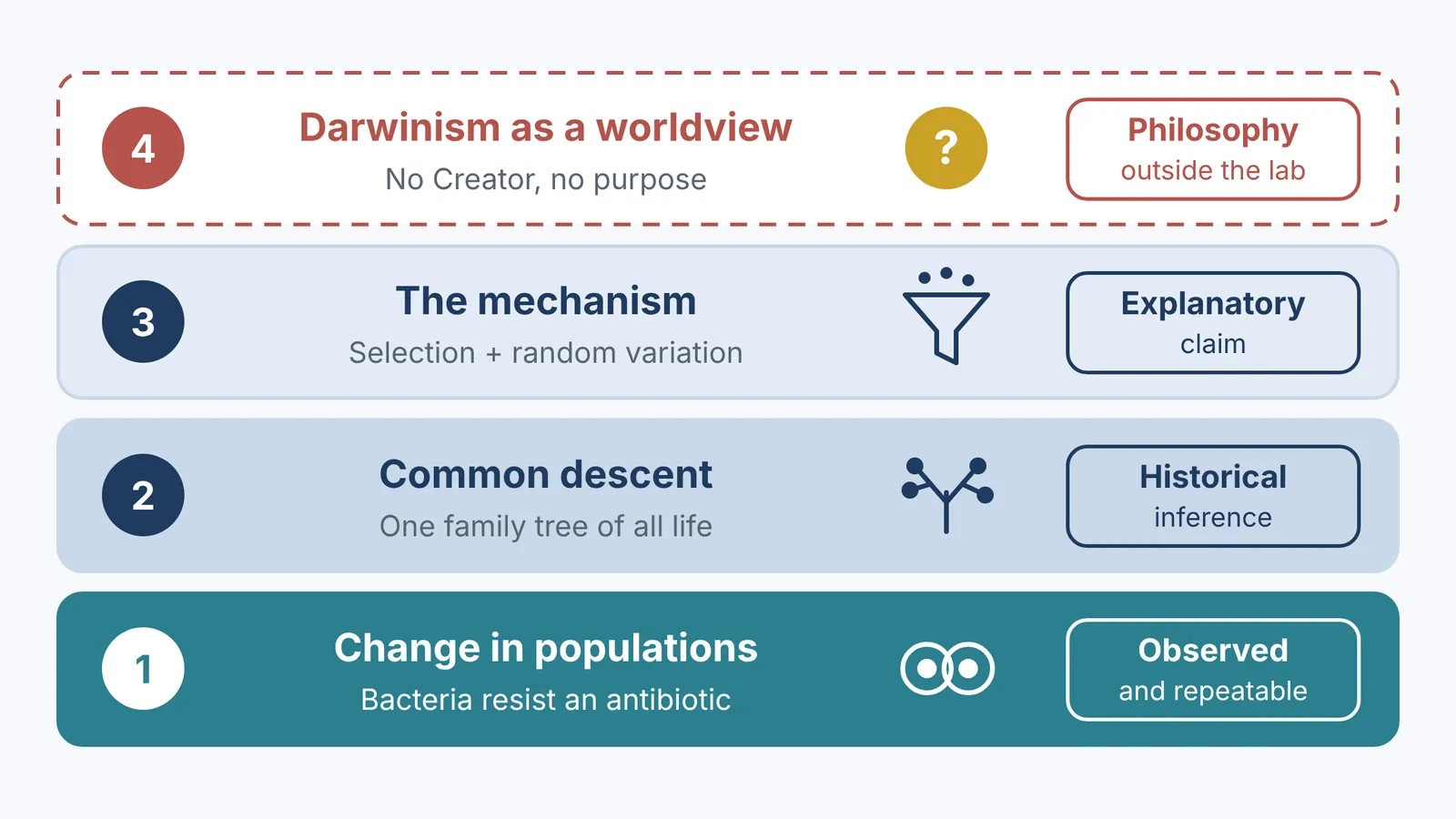
Notice how the kind of claim changes as you climb. The first is an observation. The second is a historical inference. The third is an explanation of how a long history happened. The fourth is not biology at all: it is a statement about God, meaning and morality. Each layer needs its own kind of evidence, and accepting one does not oblige you to accept the next.
What the theory claims, in its own terms
It is only fair to present the theory the way its supporters would. In modern biology, evolution means change in the genetic make-up of populations over generations. The processes named are mutation (changes in DNA), natural selection (variants that help survival and reproduction become more common), genetic drift (chance shifts in small populations) and migration between populations18.
When biologists say "random" here, they usually mean something specific: mutations are not produced in response to what the organism needs. A bacterium does not mutate because it needs resistance; resistant variants arise, and the antibiotic then filters the population.
Supporters of common descent point to several lines of evidence that they see as converging:
- The fossil record, where different groups appear in a broad order through the layers of rock, including forms they interpret as intermediate.
- Shared anatomy, such as the same basic bone pattern in the limbs of very different animals.
- Shared genetic patterns, where similarities in DNA across species fall into nested groups.
- Geographic distribution, where related species cluster in ways they explain by descent and migration.
For most working biologists, this framework is the organising idea of their field, and they consider common descent settled. The questions below do not deny it exists; they ask what exactly has been shown, and what has been added on top.
Where the extrapolation happens
The first layer is observed. The second and third reach much further: from small changes seen over years or decades to the origin of every body plan, organ and system across hundreds of millions of years. That step is an extrapolation, a projection of a process observed on a small scale onto an enormous one18.
Biologists reply that this is how all historical sciences work. Geologists did not watch a canyon being carved, but they can infer it from erosion they see today. That is a reasonable point: inference about the past is legitimate. But the strength of such an inference depends on whether the process you observe is shown to be capable of producing the result you attribute to it. Water carving rock is a process we understand well enough to scale. Whether random variation filtered by selection can build entirely new, complex structures is precisely the question in dispute.
Two further issues sharpen it:
- Sudden appearance. In a relatively short window of geological time, more than half a billion years ago, many of the major animal body plans appear in the fossil record, an event known as the Cambrian explosion. Biologists respond that earlier ancestors were small and soft-bodied and rarely fossilised, and that genetic estimates place their origins earlier. The debate is real, and critics argue that the pattern fits poorly with slow, step-by-step accumulation18.
- The first cell. Natural selection only works on things that already reproduce. Yet even the simplest known cell needs stored genetic information, molecular machines to read it and a membrane to hold it together. How the first self-reproducing system arose is, by wide agreement among researchers themselves, an unsolved problem. Biologists rightly say this is a separate field from evolution; but it means the "whole story without God" does not, in fact, have a beginning18.

The question of information
At the heart of every living thing is coded information. DNA stores instructions in a sequence of chemical letters, and the cell reads them to build proteins that fold into precise shapes and work together. A single function may need several parts, each specified in detail.
Natural selection is a filter. It can keep what works and remove what fails, but it does not write anything itself; it can only choose among the variations that mutation supplies. So the question is concrete: can random changes, filtered this way, generate genuinely new, coordinated information, or mainly adjust and trim what already exists?
Supporters point to mechanisms such as a gene being copied by accident and the copy later taking on a new role, and to the huge populations and long times available. Critics answer that many well-documented adaptive mutations work by damaging or switching off an existing gene, as in some cases of resistance: useful in one environment, but building nothing new22. You need not settle this debate to see its significance: the creative power of the mechanism is an open scientific question, not something to be assumed in order to settle the question of God.
The leap no experiment can make
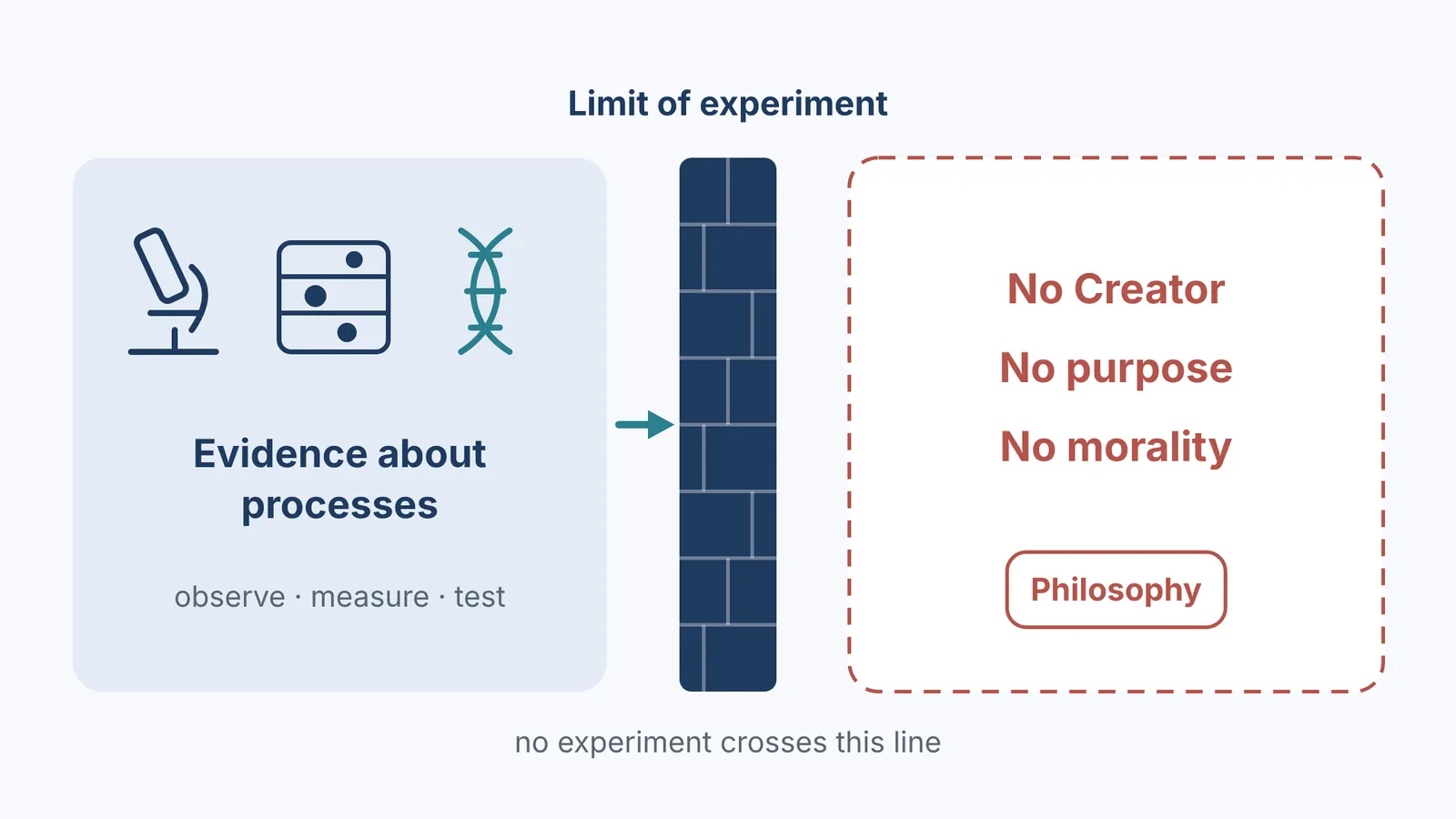
Now look at the fourth layer. "Life is the product of a blind, purposeless process, so there is no Creator" is not the result of any experiment. No microscope can detect the absence of purpose. No fossil carries a label saying "unguided". No genetic sequence can tell you that no mind willed it.
Here a single word does a lot of hidden work. In biology, "random" means not directed toward the organism's needs, in the sense described above. In philosophy, "chance" can mean uncaused, unknown and unwilled by anyone. The first is a scientific description of how variation relates to survival. The second is a metaphysical claim about the whole of reality. Sliding from one meaning to the other is how a biology lesson quietly turns into atheism23.
This is why many scientists themselves keep the two apart. Biologists who are religious believers and biologists who are not have said plainly that their science, by its method, studies natural processes and cannot rule on whether God exists. Even some of the most prominent defenders of evolution have written that one remains free to believe in God while accepting it18. They are making the same distinction this page is making: the theory describes processes; the worldview adds a philosophy.
And the philosophy has consequences. If human beings are only the product of a struggle for survival, it becomes hard to say why the weak should be protected or why cruelty is objectively wrong. In the early twentieth century, ideas of "survival of the fittest" were used to justify racism and campaigns against people considered "unfit". Biology was not to blame for that misuse; but a worldview that empties life of purpose has nothing within it to forbid it18.
Nothing in creation is "blind"
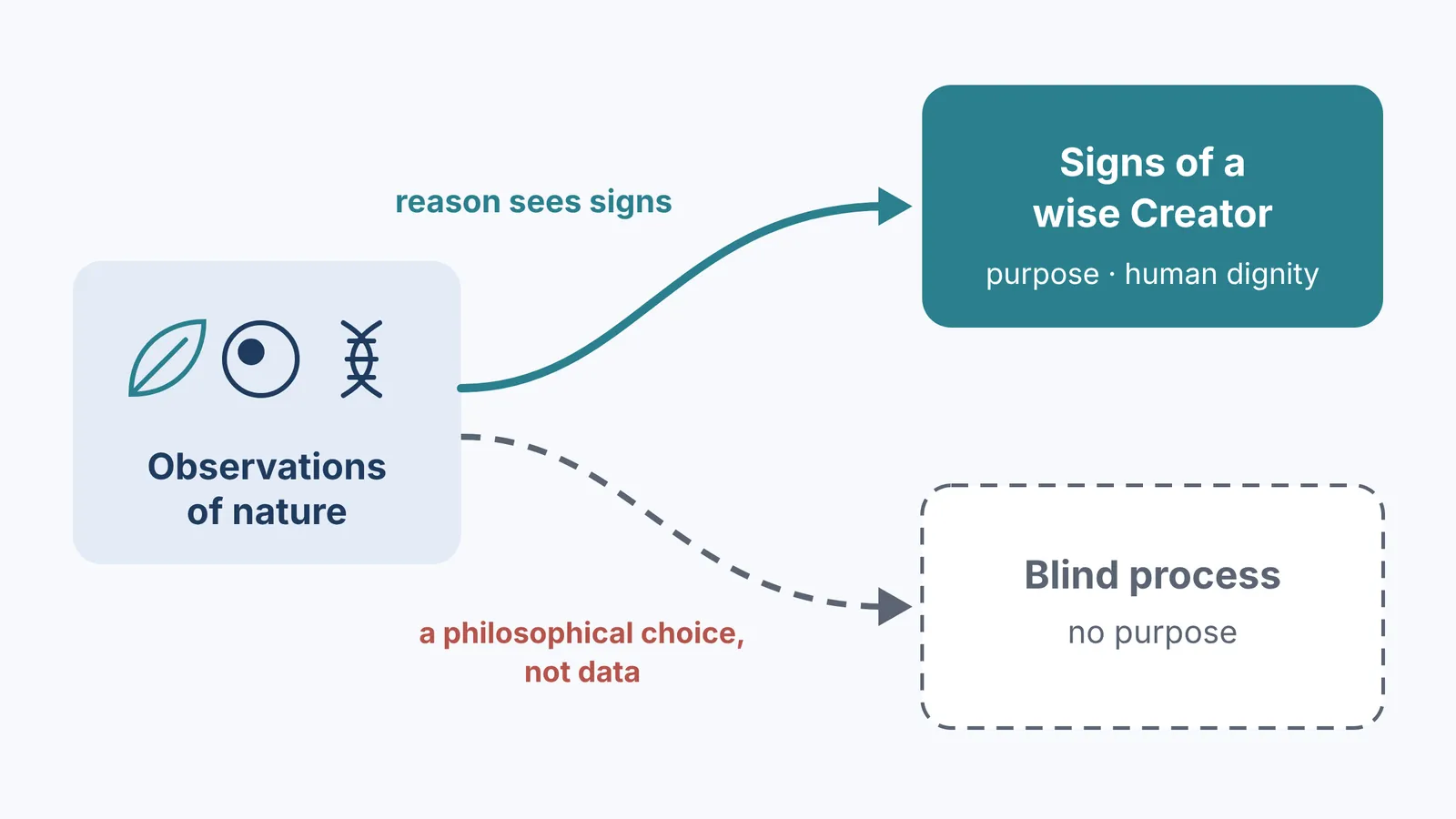
The Qur'an answers the fourth layer directly. Indeed, We have created everything according to a measure14. God created everything and determined it with a precise determining8. Ibn Kathir explains that such verses affirm God's decree: everything that exists was known to Him and measured by Him before it came to be16. And His knowledge is not general and distant: not a leaf falls but He knows it4.
So in Islam nothing is "blind chance" in the metaphysical sense. Something may look random to us, in the way a falling leaf looks random, and scientists may describe it statistically. That description can be perfectly accurate. But behind every cause stands the One who created the cause, knows its result and wills it. Causes are real; they are simply not independent of God.
On the question of non-human biological change over long periods, contemporary Sunni scholars have taken different positions, and this page does not need to decide between them19. The decisive points are elsewhere: whatever happens in nature happens by God's creation, knowledge and will, not by blind chance; and human beings were created specially.
On that second point the Qur'an is clear. Adam, peace be upon him, was created directly by God: He created him from dust, then said to him "Be", and he was1. God told the angels that He would create a human being from clay, fashion him and breathe into him of the spirit He created5,10. He created the human being in the best form15, and all people descend from that one soul3. Muslims therefore do not hold that human beings descended from non-human ancestors; Adam is the father of all humankind20,21.
Study everything, refuse the leap
Here is something many people do not expect: the Qur'an itself sends you to study the origins of life. Say: travel through the earth and see how He began the creation9. A Muslim biologist can examine cells, fossils and genes with full curiosity, because every discovery is a closer look at how God's creation works.
What the Qur'an refuses is the conclusion that the whole thing is pointless. People of understanding, it says, reflect on the creation of the heavens and the earth and say: Our Lord, You did not create this in vain2. The Qur'an also describes those who said that nothing destroys us but time, and answers that they have no knowledge of it and are only guessing11. That is exactly the charge against Darwinism as a worldview: not that it studied nature too closely, but that it claimed more than its study could show.
And Islam gives the human being something a purely materialist account cannot ground. We have honoured the children of Adam6. You were created for a purpose: to know and worship your Creator12. Did you think that We created you without purpose, and that you would not be returned to Us?7. Dignity, moral responsibility and meaning are not illusions laid over a blind process. They are part of what you were made for.
That is the beauty of the position: complete freedom to investigate nature, and complete refusal to let one theory be stretched into a verdict on God. Sound reason and authentic revelation do not truly conflict, because the same God made the world and revealed the Book17.
"Evolution explains everything about life without God, so belief is unnecessary."
This is the strongest form of the challenge. Before Darwin, the design of living things was one of the most common reasons people gave for believing in a Creator. Then a natural mechanism was proposed that could, its supporters say, produce the appearance of design without a designer. If the mechanism does the work, what is left for God to do? The simplest view, they conclude, is to drop Him.
There are three answers.
First, "explains everything" is a large overstatement. As we saw, the origin of the first cell remains unsolved, the ability of the mechanism to produce new information is still debated, and evolutionary biology was never designed to explain why there is a universe with orderly laws at all, why our minds can understand it, or why moral truths bind us. Leaving these out is not explaining everything; it is changing the subject.
Second, even a complete account of how would not answer whether anyone willed it. Imagine tracing every step by which a letter reached you: the printer, the envelope, the sorting office, the van. You would know exactly how it arrived, but you would not have shown that nobody wrote it. Describing a process and denying its author are two different claims.
Third, Islam never rested belief on gaps in biology. The Qur'an names natural causes openly and attributes them to God. Belief in the Creator rests on the existence of the universe itself, which cannot have come from nothing or created itself13, on the reasoning and moral sense within you, and on revelation. If a biological mechanism is found, it is one more cause God created. It does not make Him unnecessary any more than understanding rain makes the sky self-made.
The theory describes processes; the worldview adds a philosophy. Don't let one word carry both.
Questions you may have
Do Muslims reject all of evolution?
Muslims accept what is observed: populations change, adapt and vary, and these are signs of God's wisdom in creation. Muslims reject the claim that human beings descended from non-human ancestors, because the Qur'an states that Adam was created directly by God. On other forms of life, contemporary Sunni scholars have differed, while agreeing that nothing happens by blind chance outside God's knowledge and will19.
Isn't "it's just a theory" a good reply to evolution?
No, and it is better not to use it. In science, "theory" means a broad explanatory framework, not a guess. The honest questions are more specific: which claim is meant, what evidence supports that particular claim, and whether the proposed mechanism has been shown to be adequate.
What if a scientific finding seems to contradict the Qur'an?
Muslim scholars hold that a firmly established fact and an authentic, clearly understood text never truly conflict17. When a conflict appears, either the scientific claim goes beyond what has been established, as with the leap to "there is no purpose", or the text is being read in a way it does not require.
Think about the last time you heard someone say "evolution proves" something. Which of the four claims were they really making, and what evidence did they give for that one?
Show a thought
Often the evidence offered belongs to the first layer, observed change, while the conclusion belongs to the fourth, a philosophy of meaninglessness. Noticing that gap does not require you to reject any science. It simply asks each claim to show its own evidence, which is what the Qur'an asks of every claim.
We began with one word heard four times in a single week. The doctor, the documentary, the textbook and the dinner guest were not saying the same thing, and now you can tell them apart. Observed change is one claim; the history of all life is another; the power of a mechanism is a third; and "there is no Creator and no point" is a philosophy that no experiment has ever tested.
Islam invites you to study the living world with open eyes, because it is full of signs. And it tells you that you are not an accident: you were honoured, created for a purpose, and will return to the One who made you. That claim, too, deserves to be examined on its evidence.
Your next step
Sources (23)
- Qur'an 3:59 (Al 'Imran)
- Qur'an 3:190–191 (Al 'Imran)
- Qur'an 4:1 (al-Nisa')
- Qur'an 6:59 (al-An'am)
- Qur'an 15:28–29 (al-Hijr)
- Qur'an 17:70 (al-Isra')
- Qur'an 23:115 (al-Mu'minun)
- Qur'an 25:2 (al-Furqan)
- Qur'an 29:20 (al-'Ankabut)
- Qur'an 38:71–72 (Sad)
- Qur'an 45:24 (al-Jathiyah)
- Qur'an 51:56 (al-Dhariyat)
- Qur'an 52:35 (al-Tur)
- Qur'an 54:49 (al-Qamar)
- Qur'an 95:4 (al-Tin)
- Ibn Kathir, Tafsir al-Qur'an al-'Azim, on Qur'an 54:49
- Ibn Taymiyyah, Dar' Ta'arud al-'Aql wa al-Naql
- Centre course material: Biology, evolution and human significance (definitions of evolution, claimed evidence, critique, implications for morality, meaning and purpose)
- Yaqeen Institute, Human Origins, Part 1: Theological Conclusions and Empirical Limitations
- Islam Q&A, Falseness of the theory of evolution (islamqa.info/en/answers/34508)
- IslamReligion, Biological Evolution: An Islamic Perspective
- Sapience Institute, Book Review: Darwin Devolves
- Yaqeen Institute, Is Darwinism Compatible with Islam? (lecture)