If you could trace your family back to the very first person, what would you hope to find there?
Imagine walking into a quiet museum gallery. Along one wall is a long glass case, softly lit, holding a row of fossil skulls. Under each one is a small card with a name and an age, and painted on the wall between them is a line of arrows, leading from left to right, ending in a modern human skull.
Look closely and you notice something. The skulls are real: someone dug them out of rock with great patience. The arrows are not in the rock. Someone drew them, for reasons they could explain. The question of where we come from lives in the gap between those two things: what was found, and what was drawn.
What scientists actually claim
It is worth stating the mainstream scientific view fairly, in its own terms, before saying anything about it.
Most biologists today hold that human beings arose through the same natural processes as every other living thing: small inherited changes, sorted over many generations by natural selection and other mechanisms. On this view, humans and the great apes, especially chimpanzees, share a common ancestor that lived several million years ago, and modern humans appeared in Africa a few hundred thousand years ago before spreading across the earth20.
That claim rests on three main kinds of evidence.
Fossils. Researchers have found many remains of upright-walking primates, of varying sizes and features, in rock layers dated to different ages. These are arranged into a sequence that is read as a lineage.
Genetics. Human DNA is very similar to chimpanzee DNA; a commonly quoted figure is around 98–99 per cent for directly comparable sequences, depending on what is counted. Biologists also point to shared features in non-coding DNA, found at matching locations in both genomes, which they read as inherited from a common ancestor.
Comparative anatomy. The same basic plan of bones, the same organs and the same developmental patterns appear across mammals. The human arm, the bat's wing and the whale's flipper share a structure.
Serious people have spent careers gathering this evidence, and nothing here should be mocked. The fossils were really dug up, the genomes really sequenced, the bones really measured.
Three different things called "evolution"
Much of the confusion in this subject comes from one word doing three jobs.
The first is observed change within living populations: bacteria becoming resistant to antibiotics, the beaks of a bird species growing thicker after a drought, insects adapting to pesticides. This is watched, measured and repeated. Muslims have no quarrel with it at all.
The second is the claim of universal common descent by unguided processes: that every living thing, humans included, descends from one early form through processes with no direction or purpose. This is a reconstruction of the deep past, not something anyone watched.
The third is Darwinism as a philosophy: the belief that life, mind and conscience are products of blind chance, with no Creator, no purpose and no meaning20. That is not a laboratory result. It is a worldview, and a page on this site looks at it directly.
Keep these three apart, and most of the heat in the debate turns into light.
The evidence, and the reading of it
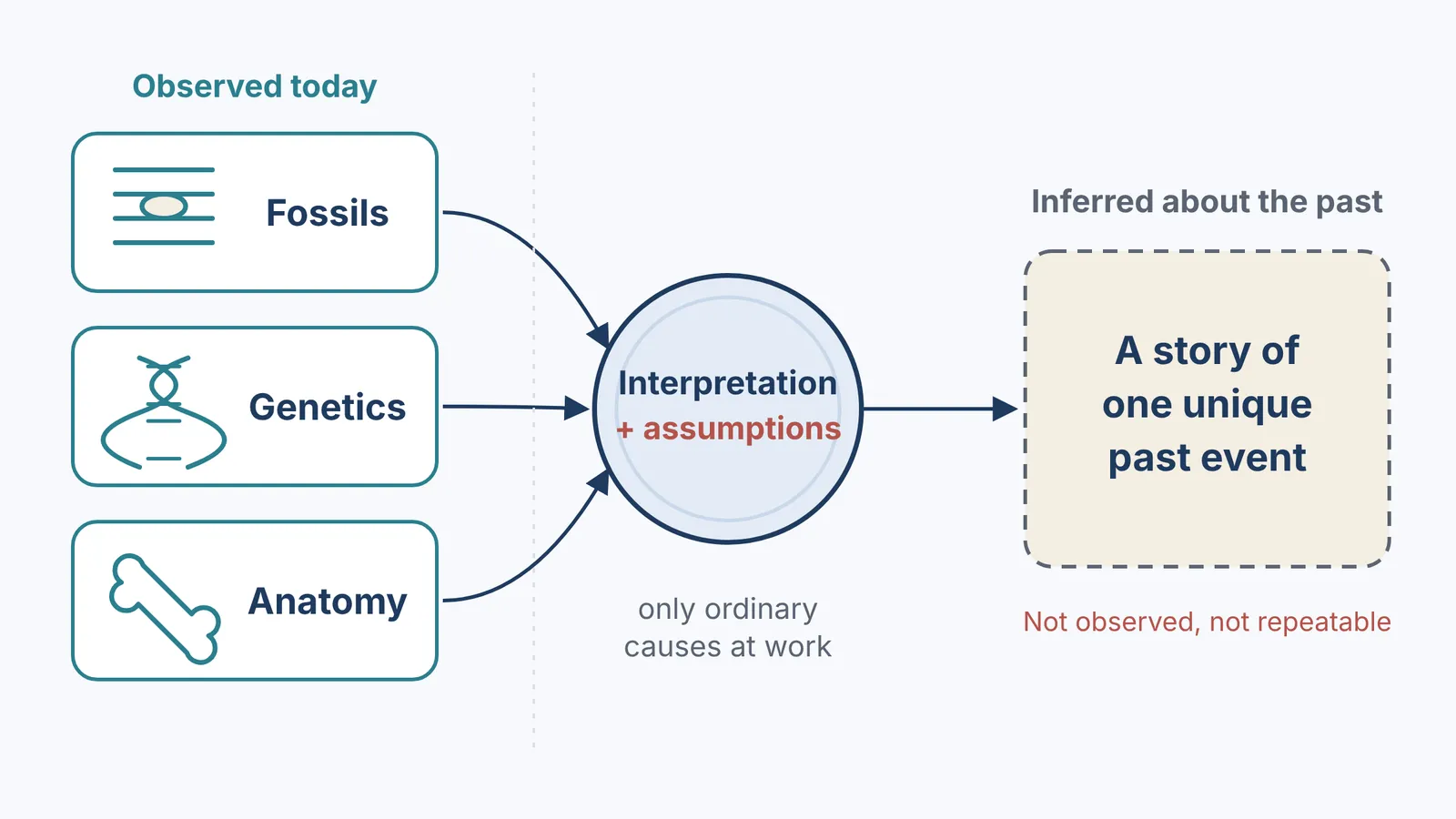
Every piece of evidence for human origins is observed in the present: a fossil in a drawer today, a genome in a computer today, a bone on a table today. What scientists want to know about is a single event, or chain of events, in the unrepeatable past. To move from one to the other, they need assumptions, and that is where three honest limits appear21.
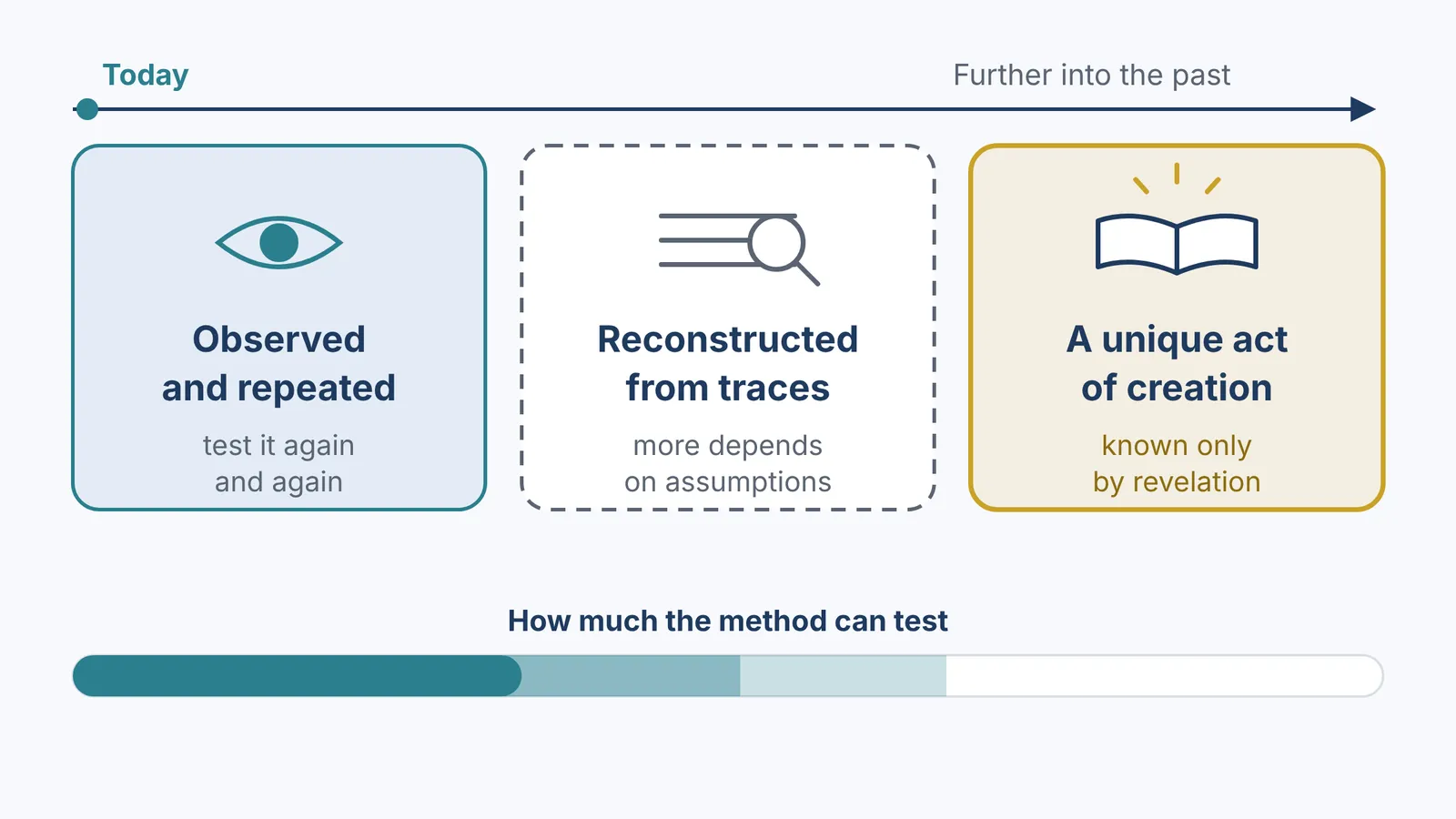
A unique event cannot be rerun. The heart of experimental science is repetition: do it again and see if you get the same result. The origin of the first human being happened once. Nobody can rerun it, and nobody was there to observe it. Historical sciences do valuable work by reasoning backwards from traces, but they reason under the assumption that only ordinary natural causes were at work. If something happened that was not ordinary, the method is, by design, unable to detect it21.
Similarity has to be interpreted. Two things being alike is an observation. Why they are alike is an interpretation. Shared bones and shared genes are consistent with common descent; they are also what you would expect if one Maker used a coherent plan across His creation. The data do not come labelled with their explanation20.
Small changes do not automatically add up to everything. Observed change within populations is real. The claim that the same process, extended over long ages, produced human reason, language, moral sense and the longing for meaning is an extrapolation across a very large gap. Biologists answer that small changes over enough time can accumulate into large ones. That is a reasonable hypothesis to explore. Some critics add that much of the change actually observed works by damaging or switching off existing genes rather than building new functions, which makes the extrapolation harder still22. Either way, an extrapolation is still an extrapolation, and the gap includes the very things that make us human20.
None of this means the scientists are dishonest. It means their conclusion about our first beginning is a model, built with care on present evidence, using the assumption that no direct act of creation took place. Whether that assumption is true is not something the model can test.
The doctor and the man made yesterday
Imagine a doctor examines a man and, from his bones, teeth and skin, estimates that he is about thirty years old. Her method is sound. Bones do change with age in predictable ways.
Now imagine, purely as a thought experiment, that this man was brought into being yesterday, fully grown. The doctor's estimate would be careful, competent and wrong, not because her science was poor but because her method assumes a normal history of growth, and this man did not have one.
That is the position of any empirical model of a unique act of creation. It can tell you, with real skill, what would have happened if only ordinary processes were at work. It cannot tell you whether they were. Only someone who knows what actually happened can tell you that.
What the Qur'an says happened
The Qur'an does not leave this question to guesswork. It tells the story plainly.
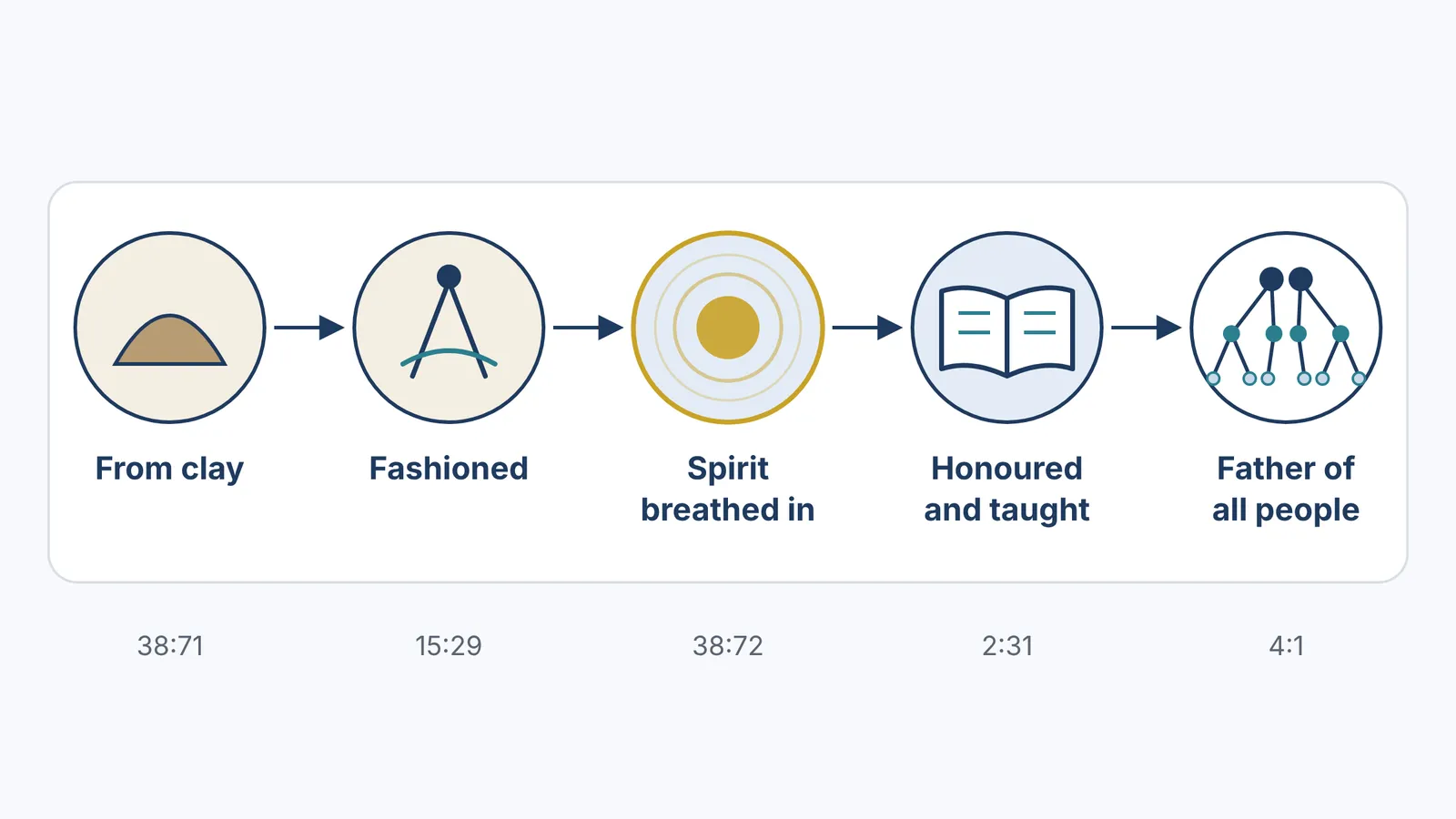
God announced to the angels that He would create a human being. When your Lord said to the angels, "I am going to create a human being from clay. When I have fashioned him and breathed into him of My spirit, fall down in prostration to him"11,5. Adam was formed from earth, given his shape, and then the spirit was breathed into him. The angels prostrated, as an act of honour to him and obedience to God2.
The Qur'an makes the directness of this creation unmistakable. It compares Adam with Jesus: the example of Jesus with God is like that of Adam: He created him from dust, then said to him "Be", and he was3. Adam had no father and no mother. God even says He created Adam with My two Hands12, an honour scholars note was given to Adam in particular, affirmed in a way that befits God's majesty without likening Him to anything17.
Then God taught Adam the names, all of them1, so that the first human being began life not as a creature groping in the dark but as a learner taught by his Lord. From Adam God created his wife, known in Muslim tradition as Hawwa (Eve), and from the two of them spread many men and women4. Every human being who has ever lived is their descendant.
Knowledge from the One who was there
How can anyone know this? Not by digging. As earlier pages on this site discussed, some things belong to al-ghayb, the unseen: real, but beyond the reach of our senses and instruments. For these, the only source of knowledge is a trustworthy report from someone who knows19,9.
The Qur'an points to this directly. Speaking of those whom people take as guides instead of God, it says: I did not make them witnesses to the creation of the heavens and the earth, nor to the creation of themselves7. No human being watched the creation of humanity. The only one who witnessed it is the One who did it.
So the Muslim position is not "science versus faith". It is a question about sources. Empirical science can neither replicate nor directly observe a unique act of creation, so its models, however careful, describe what would follow if no such act occurred. A report from the Creator, once its truth is established, tells us what did occur. A model built on an assumption cannot overturn a certain report about the very thing the assumption leaves out. Muslim scholars have long held that sound reason and authentic revelation never truly conflict18. There is a separate page on this site about how to weigh a scientific theory against a revealed text, if you want to follow that method step by step.
What this story gives you
A theory of origins is never only about the past. It shapes how we see each other today.
Dignity. We have certainly honoured the children of Adam6. We created the human being in the best of forms15. In Islam, your worth is not something you earn by being useful or strong. It was given at the beginning, by the One who made you.
Equality. Every human being comes from the same father and mother. O people, We created you from a male and a female and made you peoples and tribes so that you may know one another. The most honoured of you with God is the most mindful of Him13. The differences in our languages and colours are described as signs of God10, not as ranks. And the Prophet ﷺ said that God does not look at your forms or your wealth, but at your hearts and your deeds16. No race can claim to be "further along" than another; there is no ladder, only one family.
Purpose. Did you think We created you without purpose, and that you would not be returned to Us?8. I did not create jinn and humans except to worship Me14. You were not thrown up by an accident that had no idea you were coming. You were intended.
A purely materialist account struggles to give you any of these three. If we are only the latest product of blind processes, then dignity, equality and purpose are feelings we happen to have, not truths about what we are20. Islam says they are truths, and it tells you why.
"Genetics proves that humans and apes share an ancestor."
This is the strongest form of the challenge, and it deserves a careful answer. The objector says: it is not just that human and chimpanzee DNA are similar overall. The similarities fall into a branching pattern across many species, and both genomes even share the same apparently useless sequences at the same locations. The simplest explanation is that we inherited them from a common ancestor. A designer would have no reason to do that.
Here is the honest reply, in three steps.
First, similarity fits a common Designer as well. A single Author working with one coherent plan would be expected to reuse what works: the same biochemistry, the same building blocks, the same body plan suited to similar functions. Human and ape bodies do many of the same things, so similar genes for similar functions are not surprising. Biologists reply that common design does not by itself predict the particular branching pattern they find. That is a fair point to raise; but the pattern still has to be interpreted, and a Creator who made living things in an ordered, graded way is an equally coherent reading of an ordered, graded world20.
Second, "useless" is a claim that keeps being revised. The argument from shared "junk" depends on those sequences having no purpose. Research has since found functions for some of them, though certainly not all, and the field is still learning. An argument that rests on "we cannot see a use for this" is an argument from present ignorance, and it may weaken as knowledge grows.
Third, and decisively, ancestry is an inference, and the event in question is unique. Even if every observation is granted, the step from "similar" to "descended from" assumes that no direct act of creation took place. That assumption is exactly what is in question. Science, which can only test what repeats, cannot test whether God created Adam directly, any more than the doctor could test whether the man was made yesterday21. The genetic data tell us a great deal about how human bodies work and how closely they resemble others. They cannot tell us what happened on the one day that will never be repeated.
And there is a difference worth noticing. Resemblance to the animals is something Islam never denied: Adam was formed from the same earth as everything else. What Islam adds is what no gene sequence can show: the breath of the spirit, the knowledge taught, the honour given and the purpose set.

The skulls are in the rock. The arrows are drawn on the wall.
Questions you may have
Does Islam reject all of biology?
No. Muslims study and teach biology, medicine and genetics, and observed change within populations is not disputed. On whether God brought about other plants and animals through gradual change, contemporary Sunni scholars differ, and this page does not try to settle that. What all of them agree on is that whatever happens in nature happens by God's creation, knowledge and will, not by blind chance, and that human beings were specially created, beginning with Adam.
Why trust an ancient book over a modern laboratory on this?
Because they are not answering the same question in the same way. The laboratory studies what can be observed and repeated now. The Qur'an reports a unique past event that no one observed. The real question is whether the Qur'an is truly from God, and that question has its own evidence, which other pages on this site examine. If it is from God, then on the one subject where only God was present, His word is the most reliable source there could be.
Does the Qur'an say when Adam lived?
No. The Qur'an tells us who Adam was, how he was created and what he was given, but it does not give a date. Muslims are not required to adopt any particular figure, and nothing in the faith depends on one.
If you knew for certain that every person you will meet today is your distant brother or sister, created and honoured by the same God, what would change in how you treat them?
Show a thought
For a Muslim this is not a thought experiment. It is the plain meaning of being a child of Adam. The story of where we come from is also a story about how we should look at each other, and about the One we are all returning to.
We began in a museum gallery, between the skulls in the case and the arrows on the wall. The skulls deserve respect: they are real evidence, patiently found. The arrows deserve respect too, as careful reasoning. But they are reasoning about an event no one saw, using assumptions that leave out the one possibility that matters most.
Islam offers you a different kind of knowledge about your beginning: a report from the One who was there. It tells you that you come from a man made by God's own Hands, given a spirit, taught and honoured; that every person on earth is your family; and that you were made for a purpose. That is worth examining with the same seriousness you would give any claim about your own origins. Where you go next is your choice.
Your next step
Sources (22)
- Qur'an 2:31 (al-Baqarah)
- Qur'an 2:34 (al-Baqarah)
- Qur'an 3:59 (Al 'Imran)
- Qur'an 4:1 (al-Nisa')
- Qur'an 15:28–29 (al-Hijr)
- Qur'an 17:70 (al-Isra')
- Qur'an 18:51 (al-Kahf)
- Qur'an 23:115 (al-Mu'minun)
- Qur'an 27:65 (al-Naml)
- Qur'an 30:22 (al-Rum)
- Qur'an 38:71–72 (Sad)
- Qur'an 38:75 (Sad)
- Qur'an 49:13 (al-Hujurat)
- Qur'an 51:56 (al-Dhariyat)
- Qur'an 95:4 (al-Tin)
- Sahih Muslim 2564
- Ibn Kathir, Tafsir al-Qur'an al-'Azim
- Ibn Taymiyyah, Dar' Ta'arud al-'Aql wa al-Naql (sound reason never contradicts authentic revelation)
- Centre course material: Sources of knowledge (the unseen and revelation)
- Centre course material: Biology, evolution and human significance (scientific and philosophical critique)
- Yaqeen Institute, Human Origins, Part 1: Theological Conclusions and Empirical Limitations
- Sapience Institute, Book Review: Darwin Devolves