If two essays contain the same odd mistake in the same sentence, what would you conclude?
Imagine you are a teacher marking essays. Two of them misspell the same unusual word, in the same place, in the same way. You hardly need to think: they share a source. One copied the other, or both copied from somewhere else.
Now imagine you look closer and find that both students worked from a template you handed out yourself, and the "mistake" was in your template. Or that the odd spelling was not a mistake at all, but a marker you put there on purpose.
Shared features point to a shared source. But what kind of source? That question lies beneath the genetic evidence for how living things are related.
A library in every cell
Almost every cell in your body carries a long molecule called DNA. It is built from four chemical units, usually written as four letters: A, C, G and T. What matters is their order. Read in groups of three, stretches of these letters specify which building blocks go into a protein, and proteins do most of the work in a living body: they build, carry, signal and repair13.
A stretch of DNA carrying the instructions for a protein or another working molecule is a gene; the full set of DNA in an organism is its genome. Long regions do not code for proteins at all. Some switch genes on and off, some give chromosomes their structure, and the role of much of the rest is still debated.
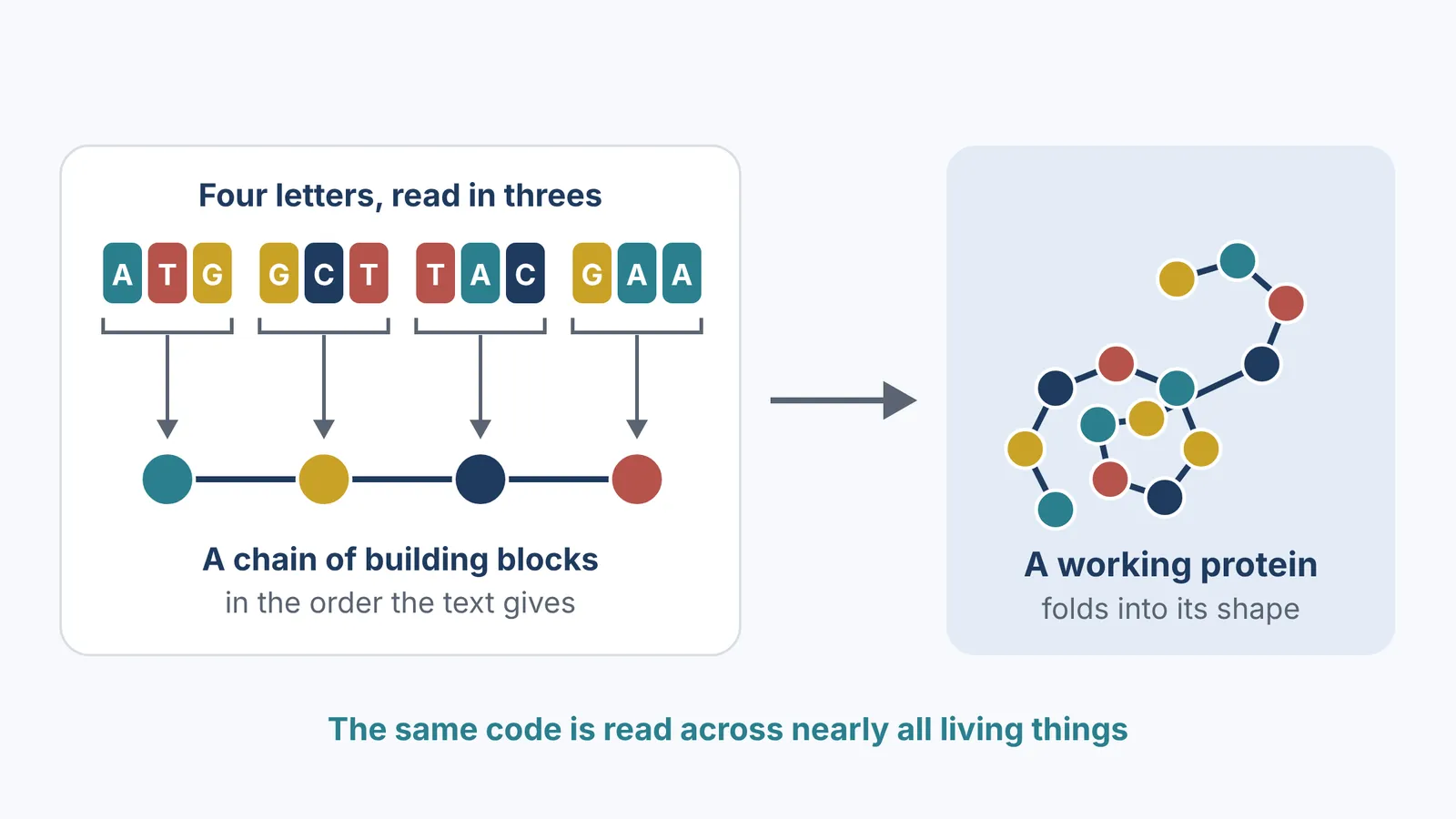
One fact is striking. With small variations, the same "dictionary" linking three-letter words to protein building blocks is used by bacteria, plants, animals and humans alike. All life reads its instructions in very nearly one language.
How biologists read kinship in DNA
Once genomes could be read, biologists began comparing them. Take the same gene from several species, line the sequences up letter by letter, and count the differences; fewer differences are taken to mean closer kinship. From many such comparisons, computer programs build the branching diagram that best fits the data, a phylogenetic tree.
The mainstream argument then has two parts, and deserves to be stated at full strength13.
The first is the nested pattern. Similarities do not fall at random. They fall into groups within groups, the way a family tree would produce them. And biologists point out that trees built from DNA often agree, broadly, with trees built earlier from anatomy.
The second is shared mistakes. Genomes contain pseudogenes, sequences that look like damaged copies of working genes. A well-known example is the gene for making vitamin C: most mammals make their own, but humans and some other primates cannot, and in their genomes the gene is present but disabled. Genomes also contain endogenous retroviruses: traces of viruses that once inserted their own genetic material into the DNA of a host's egg or sperm cell, and so were passed on to offspring. When two species carry the same viral insertion at the same position, biologists argue it is very unlikely to have happened twice independently; the simplest explanation is a common ancestor in which it happened once.
Many biologists regard this as the strongest evidence of all, and a fair discussion has to face it rather than mock it.
"How similar?" depends on how you measure
You have probably heard a figure for how much human DNA matches chimpanzee DNA. The honest thing to say about any such figure is that it depends heavily on what is being counted.
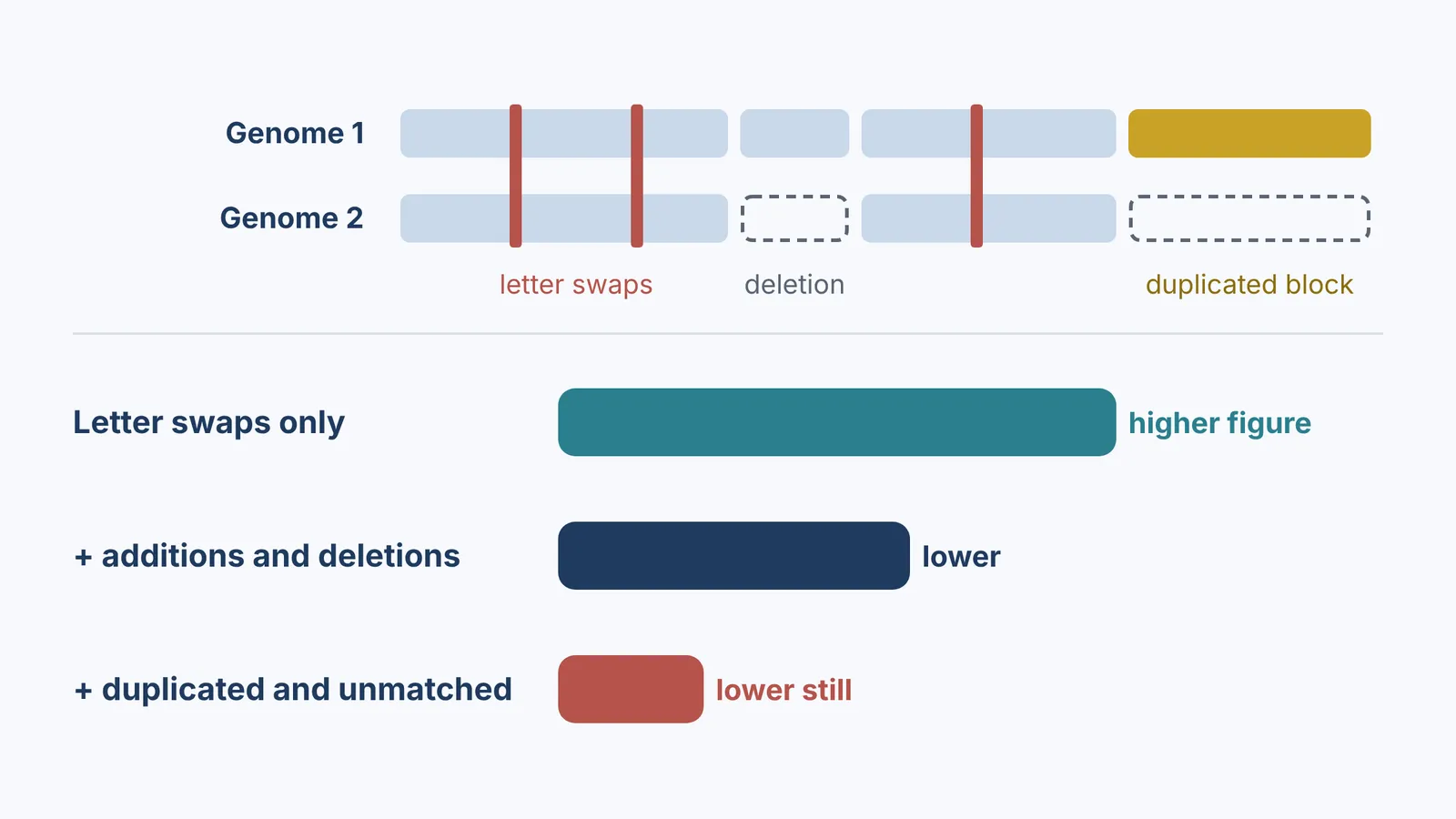
If you compare only the stretches that line up neatly and count single-letter differences, you get one number. If you also count places where letters have been added or deleted, you get a lower one. If you include sections that are duplicated in one genome but not the other, or that cannot be lined up at all, the figure drops again. Each method answers a slightly different question, as specialists know well. The trouble starts when one number travels from a paper into a headline as a plain fact about "how human" a chimpanzee is.
There is a deeper point. Similarity in the letters is not similarity in what the letters do. A small change in a region that controls when and where genes switch on can reshape the whole body, just as two texts can share most of their words and say very different things. The resemblance in the code is real, but it does not measure the distance between a human being and any other creature.
When the trees disagree
If all life formed one family tree, you might expect every gene to tell the same story. In practice, different genes often give different trees: one groups species A with B, another groups B with C. Biologists openly call this incongruence, and it can be widespread.
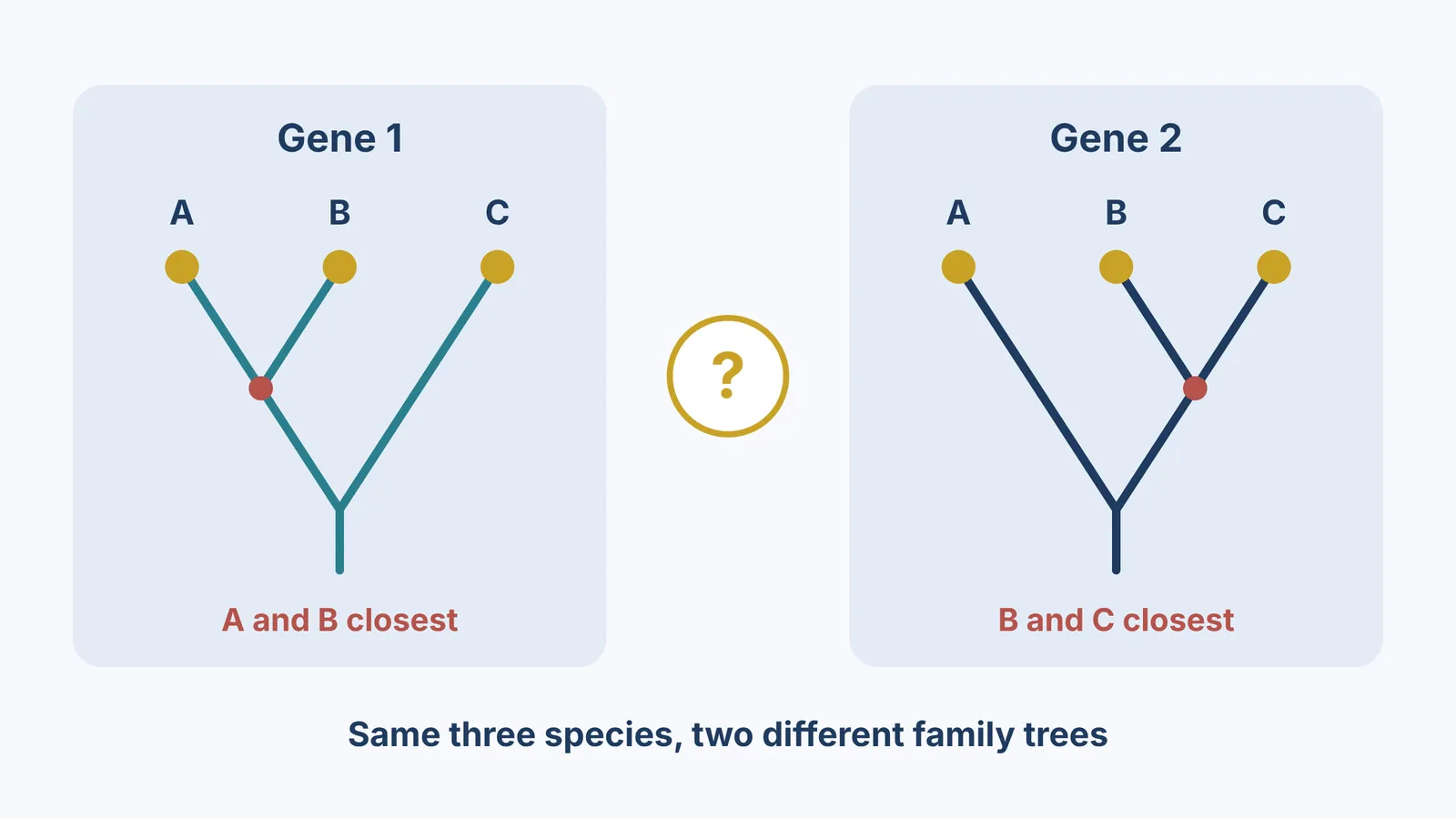
They offer several explanations. Where species are thought to have split quickly, gene variants can be sorted unevenly among descendants. Among microbes, genes pass sideways between unrelated organisms. Some methods produce statistical artefacts. And when many genes are combined, they add, a dominant signal usually emerges, and that is the tree they report13.
These are serious answers. But notice the critique in the centre's material: the tree is no longer simply read off the data. It is reconstructed by deciding which signals count as history and which as noise, using rules that themselves assume a tree13,16. That does not make the method worthless. It makes the result an inference with assumptions built in.
A second puzzle is the orphan gene: genes found in one group of organisms with no detectable counterpart elsewhere. Biologists propose that such a gene either changed beyond recognition or arose afresh from non-coding DNA, and research on both is active. Either way, orphan genes return us to a question that runs through this whole branch: where does new, working genetic information come from?16
The changing story of "junk"
For several decades it was common to describe most of the non-coding DNA as junk: leftovers from evolutionary history with no function. That verdict was often used as an argument. A designer would not fill a genome with rubbish; an unguided history would.
The picture has since grown more complicated. Research has found roles for a number of sequences once assumed idle: regions that regulate genes, sequences that shape how chromosomes fold, and some pseudogenes whose products help control other genes. Some sequences derived from viral insertions do real work, including a role in forming the placenta.
Care is needed both ways. Large projects have reported biochemical activity across much of the genome; many biologists reply that activity is not function, and that a large part of the genome probably has no specific role. That debate is not settled. What can fairly be said is that the confident claim that most of our DNA is useless has been weakened, and arguments resting on "we see no use for this" have repeatedly had to be revised13.
Shared code, shared requirements
Why would different creatures share so much of their genetic text? Common ancestry is one answer. Another is just as natural. Living things share a world: the same air, similar food, the same chemistry for storing energy, cells that must solve the same basic problems. Similar tasks call for similar tools. If one Maker made them all in one consistent language, we would expect the same "words" to recur wherever the same work is done15.
Biologists reply that common design does not predict the specific nested pattern. As the page on morphological similarities shows, a designer is not obliged to produce such a pattern, nor forbidden from it. Similarity alone cannot settle the choice.
A text that points to an Author
Step back and consider what is being compared. DNA carries coded instructions: symbols in a specific order, read by a system that translates them into something else entirely. In everything we know from experience, codes and instructions come from minds.
This is not a knock-down proof. Biologists will say "code" is partly a metaphor, and that natural processes can produce order. But a serious question remains: how did a reading system and the instructions it reads arise together, when each is useless without the other? The pages on the origin of life take this up. Here it is enough to notice that the very thing biologists compare is itself one of the most remarkable signs of wisdom in creation13.
Human beings: related in material, not descended
On non-human creatures, contemporary Sunni scholars differ about whether and how they changed over long ages, and this page does not choose between them. They agree on the decisive point: whatever happens in nature happens by God's creation, knowledge and will, never by blind chance14,15.
On human beings, Islam is clear. Adam, peace be upon him, was created directly by God from earth, and every human being descends from him. The Qur'an says: The example of Jesus with God is like that of Adam: He created him from dust, then said to him "Be", and he was1. God told the angels He would create a human being from clay, and that when He had shaped him and breathed His spirit into him, they were to bow before him3,6. All people were created from a single soul2.
So what does a Muslim make of your genetic resemblance to other creatures? It is not denied; it is expected. You were made from the same earth as the animals, by the same Creator, to live in the same world. That your cells use the same language as theirs is no surprise.
What the resemblance does not do is prove descent. Adam's creation is a single, unrepeatable event, and a laboratory cannot test whether God did something once14. Genetic data tell us a great deal about how our bodies work. They cannot rule out the creation that revelation reports, and our knowledge of that comes from revelation, whose truth is examined on its own evidence and which sound reason does not contradict12.
From clay, and honoured
The Qur'an does not flatter you by pretending you are made of anything but earth: We created the human being from an extract of clay, then placed him as a drop in a secure resting place, then made the drop into a clinging form, then into a lump, then into bones, then clothed the bones with flesh, then brought him into being as another creation. Blessed is God, the best of creators5.
Notice the turn in the last line: another creation. The same material, yet something new. Ibn Kathir explains it as the breathing in of the spirit, after which the being moves and lives as a human11. Your body shares its chemistry with the soil and its code with the creatures around you, yet you are not reducible to them.
The Qur'an says, We have honoured the children of Adam4, and We created the human being in the finest form9. The Prophet ﷺ said, "God does not look at your forms or your wealth, but He looks at your hearts and your deeds"10. Your worth was never located in the letters of your genome, so no comparison of letters can take it from you.
The Qur'an turns you to your own body as evidence: On the earth are signs for those with certainty, and in yourselves too. Will you not see?8. It promises: We will show them Our signs in the horizons and within themselves, until it becomes clear to them that it is the truth7. The molecule in each of your cells, written in a language all life shares, is one of those signs within you.
"Shared broken genes in the same places can only be explained by common ancestry. A designer wouldn't copy mistakes."
This is the strongest form of the genetic argument. The objector says: forget overall similarity; look at the damage. The vitamin C gene is disabled in humans and other primates. Viral remnants sit at the same positions in different species. Such mistakes serve no purpose; they are scars of history, and a designer making fresh creatures would never copy the same scars into each. Only inheritance explains them.
The argument is powerful. It also rests on several premises, each worth examining.
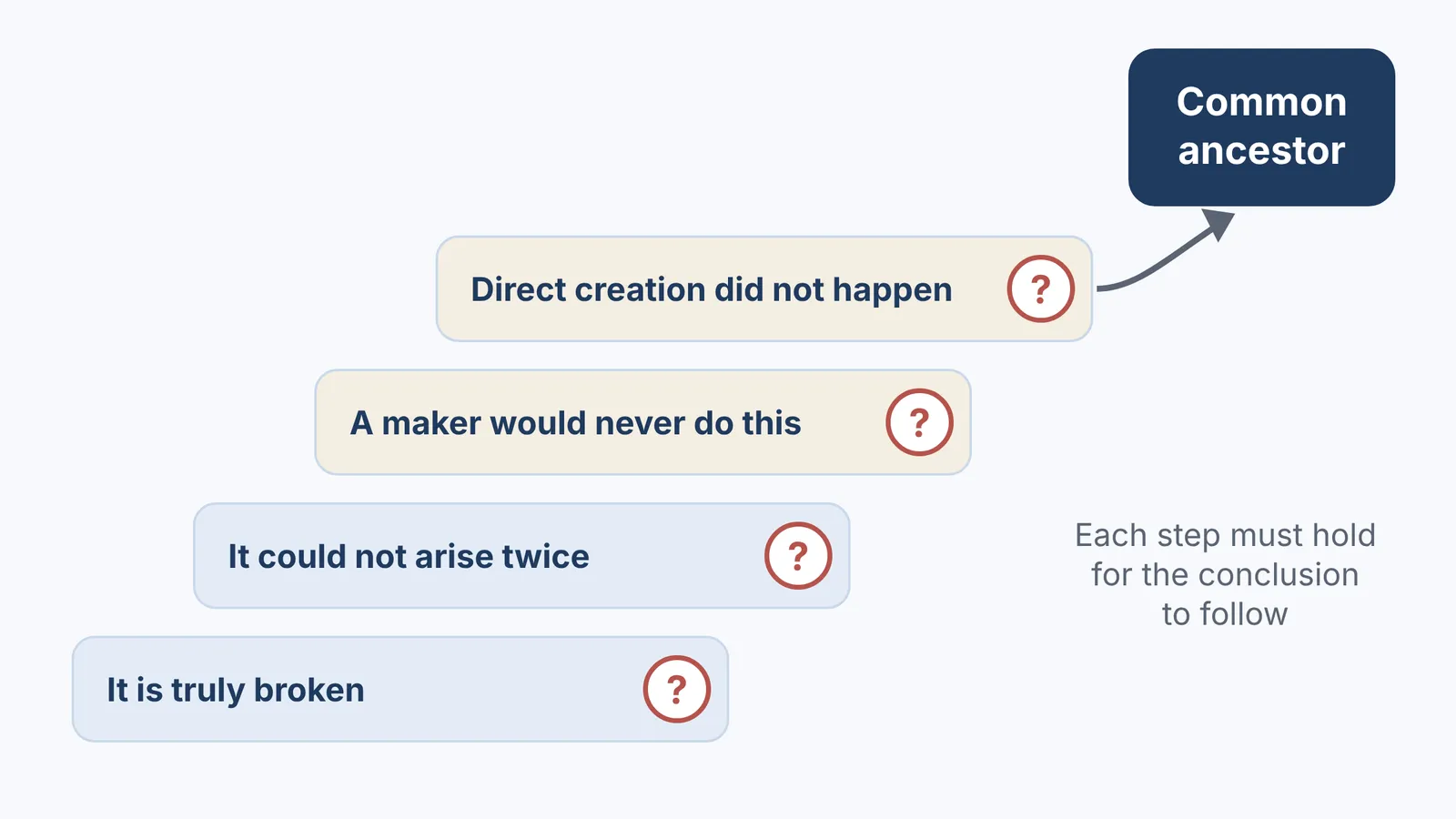
Is it really broken? Calling a sequence a "mistake" already assumes the story it is meant to prove. Some sequences once labelled broken or useless have turned out to have roles. Many have not, and we should not pretend otherwise. But the history of the "junk" label is a reason for caution before resting a large conclusion on present ignorance.
Could it have arisen twice? Viral insertion and mutation are not perfectly random; some regions of the genome are hotspots where similar changes happen more readily. Biologists reply, fairly, that hotspots explain only some shared cases, not most. So this point narrows the argument; it does not dissolve it.
Would a maker never do this? This premise is not biology. It is a claim about what God would or would not do, and making it requires knowing every purpose behind the human body and every constraint it was made within. Nobody has that knowledge. The objection turns a scientific discussion into a theological one, then answers the theological question by assumption.
Was direct creation ruled out? This is the heart of it. The argument shows that common ancestry would explain the pattern, not that nothing else could. For non-human creatures, a Muslim can weigh this evidence with an open mind, since scholars differ there. For the first human being, the question is whether God created Adam directly: a unique event that repeatable experiment cannot test and the data cannot rule out. Nor do we claim to know why every shared sequence is there. A Muslim can say honestly: this is a pattern I do not yet fully understand, and my certainty about human origins does not rest on it either way.
That is not evasion; it is putting each kind of knowledge in its place. The genome tells you how your body is built; revelation tells you how the first human came to be. They clash only if you assume revelation cannot be a source of knowledge.
Shared letters show a shared language. They cannot show that no one wrote it.
Questions you may have
If humans and chimpanzees share so much DNA, aren't we just clever apes?
Shared material is not shared identity; you share chemistry with the earth itself. What makes you human is not the percentage of matching letters, which in any case depends on how it is measured, but the spirit breathed into your father Adam, the knowledge you can grasp, and the responsibility you carry3,4. No ape asks where its genome came from. You are asking now.
Why would God create human DNA that looks so much like other creatures' DNA?
Part of the answer is clear: we share the same world, food, air and basic tasks, so similar instructions make sense, and one consistent language across all life is itself the signature of one Creator. Beyond that, we do not claim to know every reason, any more than a reader knows why an author chose each word. Not knowing every reason is very different from knowing there is no author.
Think about what you believe gives a human being worth. Could a laboratory measurement ever increase or reduce it?
Show a thought
Most of us sense that a person's dignity does not rise or fall with a number in a genetics paper. Then worth comes from somewhere the microscope cannot reach. Islam names that source: you were honoured by the One who made you from the same earth as everything else, for a purpose nothing else on earth shares.
We began with a teacher, two essays and one shared mistake. Shared features do point to a shared source. Genetics has shown, more vividly than anyone once imagined, that all life is written in one language. What genetics alone cannot tell you is whether that language has an Author, or whether the first human being was created directly by Him.
Islam invites you to read your own genome as a sign: the earth you were made from, the code all life shares, and the honour no code can measure. If that reading makes better sense of who you are, it deserves your serious attention.
Your next step
Sources (16)
- Qur'an 3:59 (Al 'Imran)
- Qur'an 4:1 (al-Nisa')
- Qur'an 15:28–29 (al-Hijr)
- Qur'an 17:70 (al-Isra')
- Qur'an 23:12–14 (al-Mu'minun)
- Qur'an 38:71–72 (Sad)
- Qur'an 41:53 (Fussilat)
- Qur'an 51:20–21 (al-Dhariyat)
- Qur'an 95:4 (al-Tin)
- Sahih Muslim 2564
- Ibn Kathir, Tafsir al-Qur'an al-'Azim, on Qur'an 23:14
- Ibn Taymiyyah, Dar' Ta'arud al-'Aql wa al-Naql
- Centre course material: Biology, evolution and human significance (claimed evidence for evolution, including the genetic evidence, and the centre's critique)
- Yaqeen Institute, Human Origins, Part 1: Theological Conclusions and Empirical Limitations
- IslamReligion, Biological Evolution: An Islamic Perspective
- Sapience Institute, Book Review: Darwin Devolves