What would you do if you found out that an argument for your own side was false?
Imagine two videos in your feed on the same evening. One is called "Ten Facts That Destroy Evolution". The other is called "Science Has Finally Disproved God". Both are confident, well edited and shared by thousands of people. Each was made for an audience that already agrees with it.
You could choose between them by asking which team you are on. Or you could put both through the same test and see which claims survive.
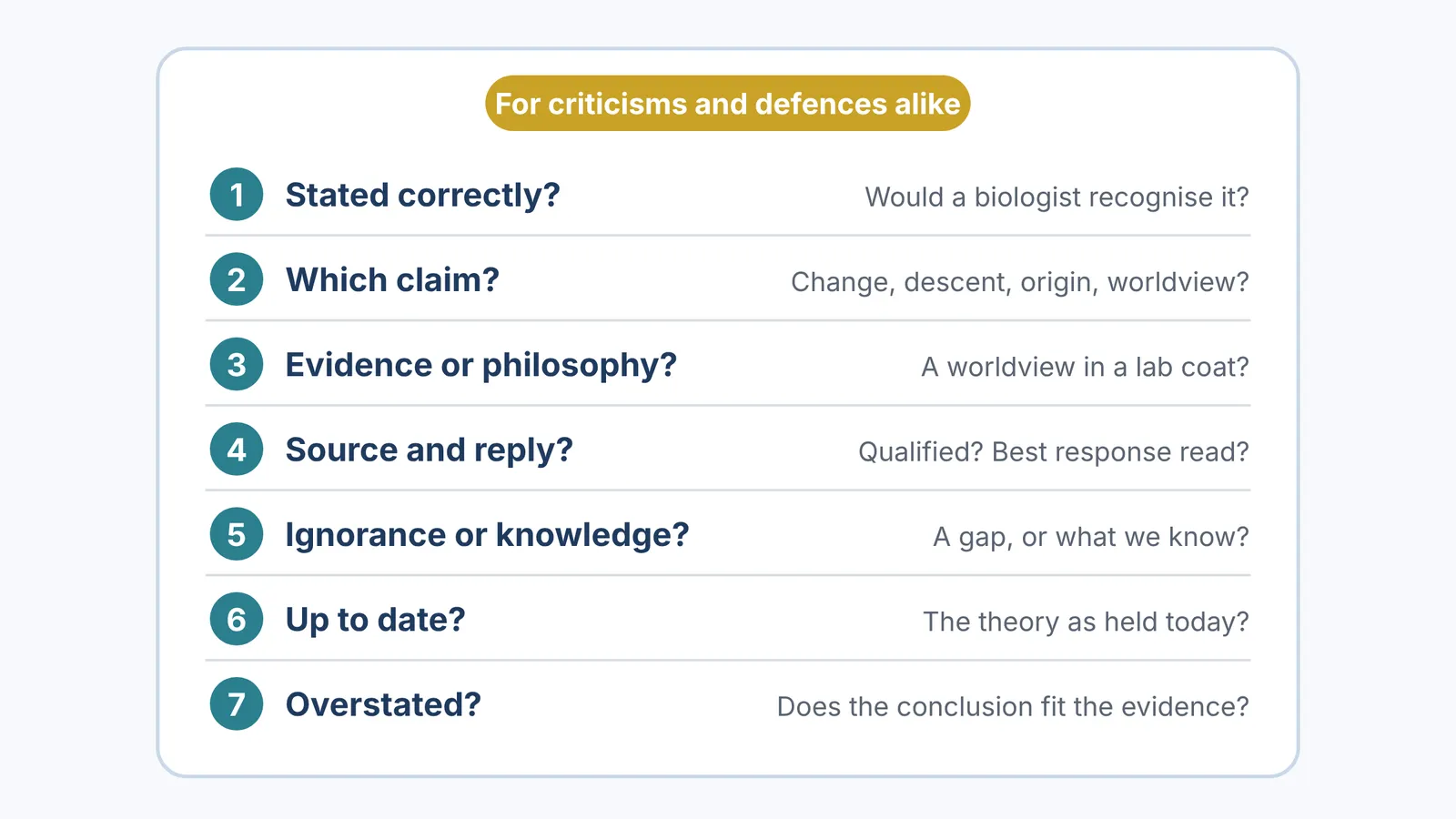
This page is about that test. It is a short set of questions you can carry with you through every criticism on this branch, and through every defence too.
Why a method comes before the arguments
The pages around this one look at particular criticisms of evolutionary theory: species, small and large changes, the Cambrian explosion, fossils, similarities. Each needs evidence and patience.
But before weighing any single argument, it helps to have a fair way of weighing arguments at all. Without one, people tend to accept whatever helps their side and pick apart whatever does not. That is not thinking; it is cheering.
The questions below are ordinary rules of honest inquiry. A careful scientist uses them, and a careful believer should too.
Seven questions to ask of any criticism
1. Does it state the theory correctly? A good test: would a working biologist recognise their own view in the way it is described? If the theory is first turned into a cartoon and then knocked down, nothing has been learned about the theory. This is the straw man, the most common failure in the whole debate.
2. Which claim does it target? "Evolution" is used for several different claims, and a criticism usually hits only one of them. Is it about small, observed changes within populations? About universal common descent, the idea that all living things share ancestors? About how the first living cell arose, which is strictly a separate question? Or about naturalism, the philosophy that says no Creator, purpose or meaning lies behind any of it? An argument that works against one level may say nothing about another12.
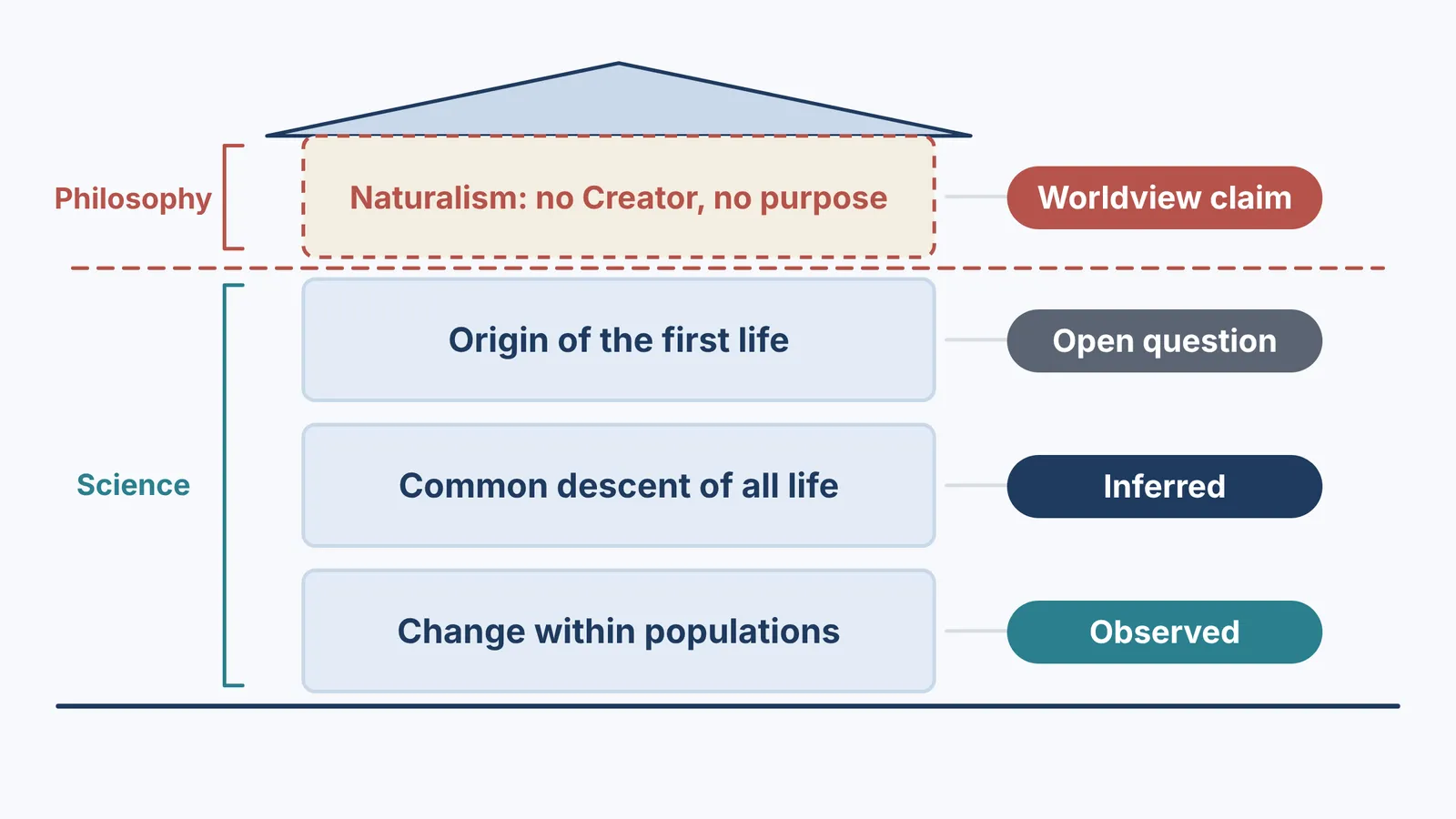
3. Is it evidence or philosophy? Some claims can be checked by observation and experiment. Others are conclusions about meaning, purpose or God. Both matter, but they are tested differently. Watch for a philosophical conclusion travelling in a scientific uniform.
4. Is the source qualified, and has the response been read? Who is making the claim, and do they work in the relevant field? Is the original cited, or a summary of a summary? And above all: what do the best people on the other side say in reply? An argument that has never faced its strongest answer is not yet tested.
5. Is it an argument from ignorance or from knowledge? "We do not know how this happened, so it must be God" rests on a gap that may close tomorrow. "Everything we know about coded information tells us it comes from a mind" rests on what we do know. The first is weak; the second is a serious argument that has to be answered on its merits15.
6. Is it up to date? A quotation from the nineteenth century, or a debate that was settled decades ago, may be repeated as if it were news. A fair critic deals with the theory as it is held now.
7. Does it claim more than it shows? "This is an unsolved problem for the theory" is one claim. "This destroys evolution" is a much bigger one. The same applies to the other side: "this is consistent with common descent" is not the same as "this proves there is no Creator".
Arguments a Muslim should leave behind
Honesty is part of calling people to God. Some arguments popular in religious circles fail the questions above. Using them does not defend the truth; it only convinces an educated listener that every critique is equally careless.
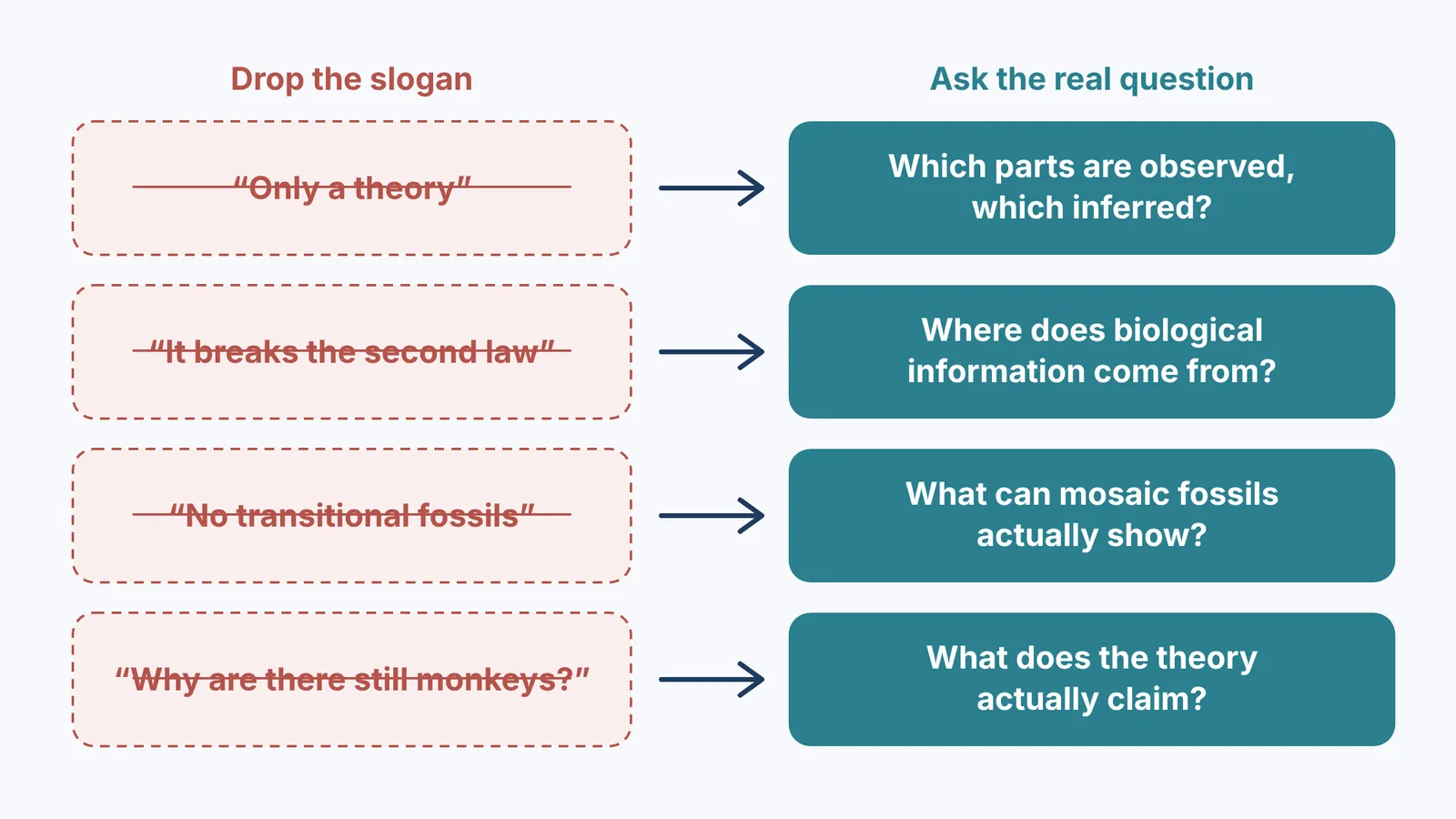
"It's only a theory." In everyday speech "theory" means a hunch. In science it means a framework of explanation that ties many observations together, as in the atomic theory or the germ theory of disease. Calling evolution "only a theory" misreads the word. The useful question is different: within the theory, which claims are observed directly and which are inferred about an unwitnessed past?
"Evolution breaks the second law of thermodynamics." The second law says that disorder tends to increase in an isolated system taken as a whole. The earth is not isolated: it receives a steady flood of energy from the sun. Local order increases all the time, as when water freezes into crystals or a seed grows into a tree. There is a real and serious question about where biological information comes from, but it is a question about information, not about heat, and dressing it up as thermodynamics only weakens it.
"There are no transitional fossils at all." There are fossils that combine features of different groups, for example of fish and four-limbed animals, or of reptiles and birds. Denying that they exist is simply untrue. The honest debate is about what such mosaics can show: a mixture of features is not, by itself, a record of who descended from whom, nor of whether the process was guided. A separate page on this branch takes that question further.
"If we came from monkeys, why are there still monkeys?" The theory does not claim that any living species turned into another living species. It claims that living groups share ancestors in the distant past. Think of languages: Spanish and Italian both grew out of Latin, and the existence of Italian today does not disprove Spanish. A Muslim rejects the claim that human beings descend from non-human ancestors, as we will see below, but this particular argument misstates what is being claimed.
Lists of hoaxes. A forged skull from the early twentieth century, nineteenth-century embryo drawings that exaggerated similarities: these episodes are real, and they are worth knowing as warnings about wanting a result too much. But they were largely exposed by scientists themselves, and a few frauds do not overturn a field. If they did, medicine would have fallen long ago. Waving hoax lists as if they were the evidence tells a biologist you have not looked at the evidence.
The same scale for the other side
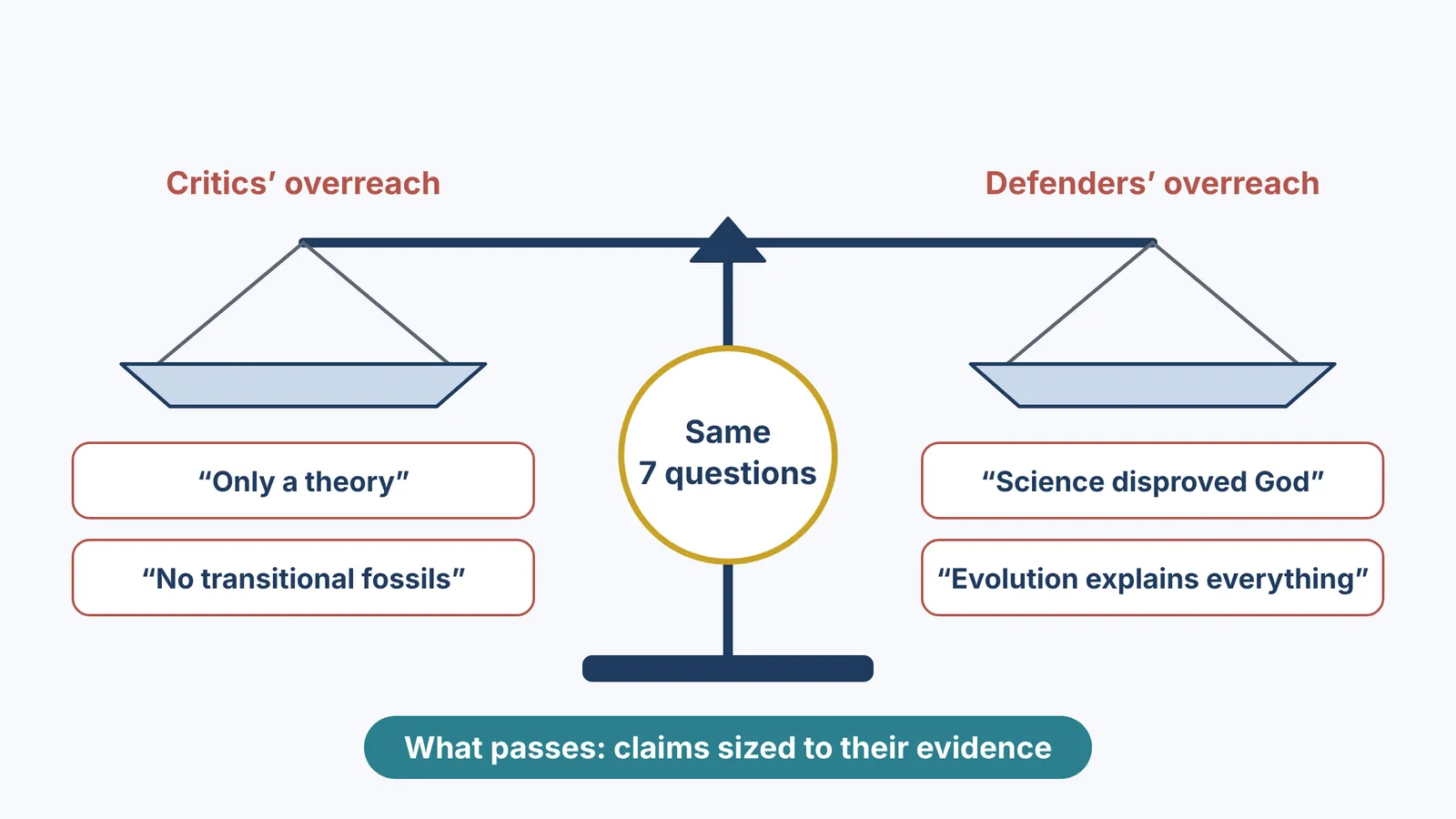
Fairness does not run in one direction. Claims made in the name of evolution must pass the same seven questions.
"Science has proven there is no God." Which floor is this? Not the first three. No experiment measures the absence of a Creator. A description of how living things change, however complete, tells you what happens, not whether anyone willed it. "There is no Creator" is a philosophical conclusion, and it needs philosophical argument, not a lab coat12.
"Evolution explains everything." It does not explain how the first living cell arose, since selection needs something that already copies itself. It does not explain why there are laws of nature at all, why our reasoning can be trusted, or why some things are truly right and wrong. A theory stretched to explain every possible outcome stops explaining anything.
"Anyone who questions it is anti-science." Questioning, testing and arguing are what science is. Most biologists regard common descent as very strongly supported by several converging lines of evidence, and they should be heard on that with respect. But how far unguided mechanisms can account for new organs and body plans is still discussed in the scientific literature itself. To call every question "denial" is to claim more than the evidence shows, which is question seven again.
Verify, be just, bring your proof
None of this is foreign to Islam. The Qur'an laid down rules for handling claims fourteen centuries ago.
O you who believe, if someone untrustworthy brings you news, verify it, lest you harm people out of ignorance and then regret what you have done7. That is question four: check the source before you act on it, and before you pass it on.
Do not follow what you have no knowledge of; your hearing, your sight and your heart will all be questioned about it5. Sharing a video you have not checked is following what you have no knowledge of.
Bring your proof, if you are truthful1. The Qur'an says this to those who made religious claims against it. It does not ask for numbers, volume or confidence. It asks for proof.
And the hardest rule of all: Do not let hatred of a people lead you to be unjust. Be just; that is nearer to piety3. Justice here includes intellectual justice: describing an opponent's view as he would describe it himself, and admitting what he gets right. A Muslim who misrepresents evolution to win an argument is breaking this verse.
The Prophet ﷺ said: "It is enough of a lie for a person to pass on everything he hears"8. Notice that he did not say "everything false". Passing things on without checking is already a kind of lying.
Muslims did not leave these rules as slogans. Out of them grew a whole science of checking reports: who said this, from whom, were they truthful and precise, could they have met? The scholar Abdullah ibn al-Mubarak said: "The chain of transmission is part of the religion; were it not for the chain, anyone could say whatever he wished"9. Ask that of the next viral claim: what is its chain?
There is mercy in this too. The Prophet ﷺ said that when a judge strives to reach the right judgment and succeeds, he has two rewards, and when he strives and errs, he has one10. Honest effort that falls short is not a disgrace. You do not have to win every exchange. What is never rewarded is deliberate distortion.
Underneath all of this is a calm confidence. Muslim scholars held that sound reason never contradicts authentic revelation; where they seem to clash, either the reasoning is faulty or the text has been misread11. If that is true, honest inquiry can only help. A believer who reaches for a dishonest argument is, without meaning to, showing that he does not trust the truth to stand on its own.
Where a Muslim actually stands
The checklist also tells you what a Muslim's position is based on, and what it is not.
Islam teaches that Adam, peace be upon him, was created directly by God and is the father of all human beings: The example of Jesus with God is like that of Adam: He created him from dust, then said to him "Be", and he was2. God honoured the children of Adam above much of His creation6. That conviction does not rest on a hoax list or on the second law of thermodynamics. It rests on a report from the Creator about a unique event no one witnessed, once the truth of that report has been established by its own evidence13.
On other living things, contemporary Sunni scholars have differed about whether God brought about their variety through gradual change over time, and this page does not settle that question. They agree on what matters most: whatever happens in nature happens by God's creation, knowledge and will, not by blind chance, and human beings were specially created and honoured14,16.
So a Muslim does not need to win every argument about bones and genes. He needs to be honest about what each argument shows, and clear about where his own conviction comes from.
"Ordinary people can't assess science. Just trust the consensus."
This deserves a respectful hearing, because much of it is right. Most of us cannot read a genetics paper or judge a statistical model. Someone who overturns decades of specialist work after one evening of videos is not being brave; he is being careless. Muslim scholars counted reliable testimony as a genuine source of knowledge, and the Qur'an itself tells those who do not know to ask the people of knowledge4, a verse scholars have long applied as a general rule for anyone outside a specialism.
But notice what the checklist actually asks you to do. It does not ask you to overrule experts on their data. It asks which claim is being made, whether a philosophical conclusion has been added on top, and whether the confidence matches the evidence. Those are questions any thoughtful reader can ask.
Trust the experts on what they are experts in, at the level of confidence they actually claim. Observed change within populations: accept it. Common descent: know that most biologists regard it as very well supported, and know what kind of evidence that support rests on. The adequacy of unguided mechanisms: know that this is debated. "Therefore there is no Creator": know that this is not a finding of biology at all, and that a biologist speaking about it speaks as a philosopher, not as a specialist12.
A consensus is strong evidence within its field. It is not a vote on God. Respecting it properly means respecting its limits as well.
The truth never needs a dishonest argument. If you have to bend the facts to defend it, you are no longer defending it.
A tool for the rest of the journey
You now have seven questions for every page of this branch. Use them on the critiques here too; if something on this site fails them, drop it.
Then go to the specific questions with a clearer eye, and keep in view the question none of them can answer by itself: not how living things work, but who made them, and why.
Questions you may have
So which criticisms of evolutionary theory are actually strong?
The ones that pass the seven questions. Serious critics focus on things like the origin of the information needed for new organs and body plans, the relatively sudden appearance of many animal forms in the Cambrian, how far small observed changes can be extended, and the origin of the first cell. Biologists respond with models and research, and the debates are real. The pages on this branch present both sides and leave you to weigh them.
Is it fair to quote scientists who admit problems in the theory?
Only if you are honest about what they meant. A biologist who calls something "an open puzzle" usually still accepts the theory and is working on the puzzle. Quoting the admission while hiding the rest of their view misrepresents them, which is question one again. Quote them for the puzzle, not as if they had switched sides.
Shouldn't I apply the same checklist to Islam?
Yes, and Islam invites you to. The Qur'an asks for proof1 and forbids following what you have no knowledge of5. Ask what Islam actually claims, which claims rest on reason and which on revelation, and what the evidence is that the revelation is genuine. Those are exactly the questions the other branches of this site try to answer.
Think of a claim about science and religion that you have repeated to someone, on either side. Which of the seven questions would it have struggled to pass?
Show a thought
Most of us find at least one. That is not a reason for embarrassment; it is the beginning of honest inquiry. The Qur'an asks you to verify before you pass things on, and to be just even towards those you disagree with. Someone who checks his own arguments first is better placed to recognise the truth when he meets it.
We began with two confident videos, each built for its own audience. The questions on this page will not tell you which side to join. They will tell you which claims deserve your trust, and how much.
Islam does not ask you to switch off that scrutiny when it comes to faith. It asks you to verify, to be fair to those you disagree with, and to bring proof, and it holds you accountable for your hearing, your sight and your heart. A religion that sets that standard for its own followers is confident that the truth can stand on honest ground. That confidence is itself worth examining.
Your next step
Sources (16)
- Qur'an 2:111 (al-Baqarah)
- Qur'an 3:59 (Al 'Imran)
- Qur'an 5:8 (al-Ma'idah)
- Qur'an 16:43 (al-Nahl)
- Qur'an 17:36 (al-Isra')
- Qur'an 17:70 (al-Isra')
- Qur'an 49:6 (al-Hujurat)
- Sahih Muslim, Introduction, hadith 5
- Sahih Muslim, Introduction: saying of Abdullah ibn al-Mubarak on the isnad (a scholar's saying, not a hadith)
- Sahih al-Bukhari 7352 (also Muslim 1716)
- Ibn Taymiyyah, Dar' Ta'arud al-'Aql wa al-Naql (sound reason never contradicts authentic revelation)
- Centre course material: Biology, evolution and human significance (definitions of evolution, the claimed evidence, the relationship with religion, and the centre's scientific and philosophical critique)
- Yaqeen Institute, Human Origins, Part 1: Theological Conclusions and Empirical Limitations
- IslamReligion, Biological Evolution: An Islamic Perspective
- Sapience Institute, Book Review: Darwin Devolves
- Yaqeen Institute, Is Darwinism Compatible with Islam? (lecture)