Before you decide on a life, wouldn't you want to see a single day of it from the inside?
Imagine you have been Muslim for about a year. You are not a scholar, not a saint, just someone with a job, a family, bills and a phone that buzzes too often. This page follows one ordinary weekday of that life, from the moment you open your eyes to the moment you close them.
It is not a list of orders. It is a picture, so that you can see the shape of the day and ask yourself honestly whether you could live in it.
Before sunrise: the day begins with gratitude
Your alarm goes off while it is still dark. The first words a Muslim is taught to say on waking are short: "Praise be to God, who gave us life after He caused us to die, and to Him is the rising"10. Sleep, in the Prophet's teaching, is a small rehearsal of death, and waking is a small gift of life. You begin the day by noticing it.
You get up and make wudu, the ablution: washing the hands, rinsing the mouth and nose, washing the face and arms, wiping the head and washing the feet. It takes about three minutes. The cool water wakes you more reliably than coffee.
Then comes Fajr, the dawn prayer, prayed between the first light of dawn and sunrise. It is two units (rak'ahs) and takes perhaps five minutes. You stand, bow, prostrate, and sit, reciting the opening chapter of the Qur'an in each unit. In the quiet before the world wakes up, your first conversation of the day is with God. The Qur'an mentions this very moment: the recitation at dawn is ever witnessed6.
The five appointments
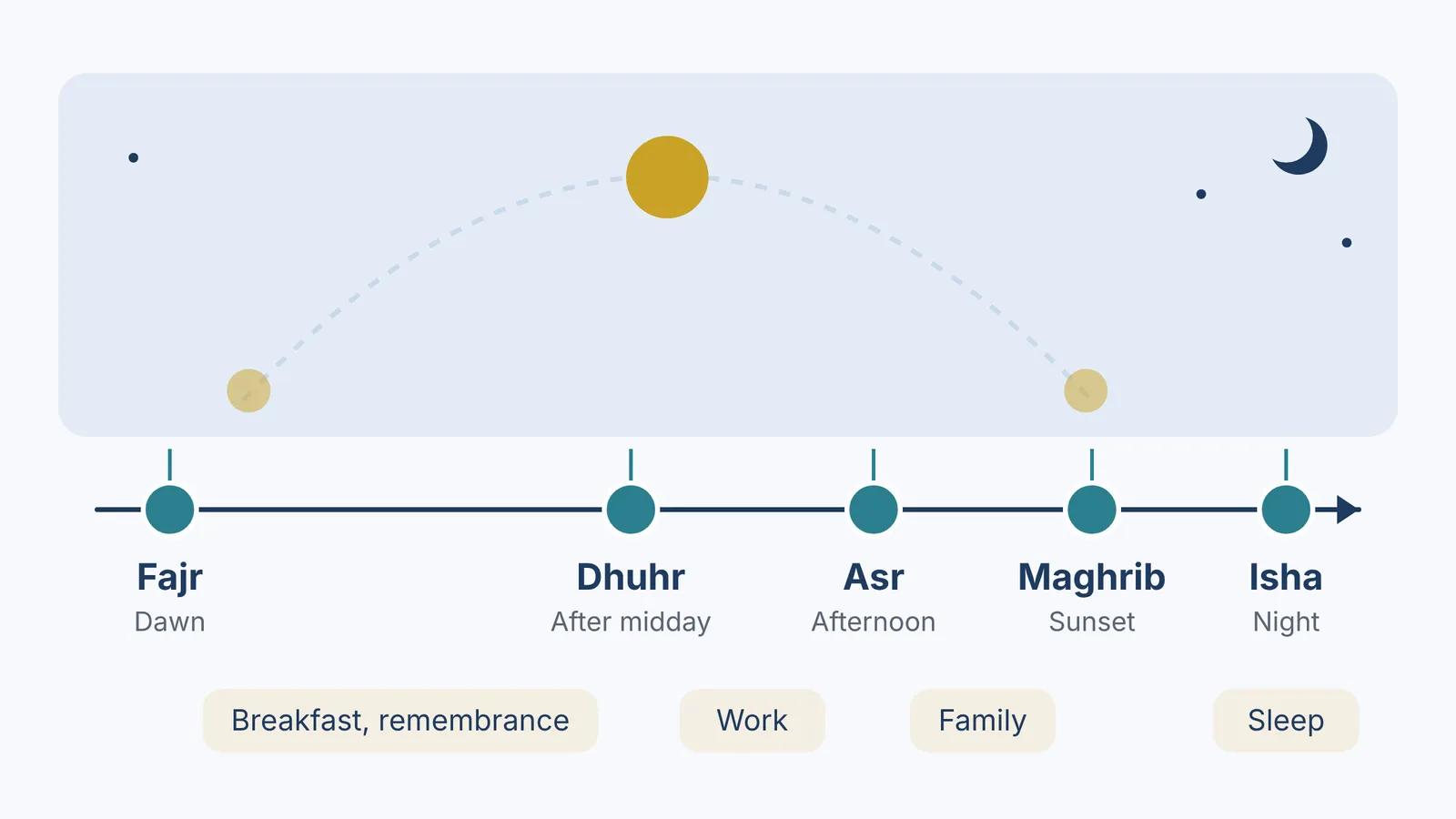
Before following the rest of the day, here is its skeleton. The five daily prayers are tied to the movement of the sun, not to the clock, so their times shift gently through the year and from place to place. The Qur'an says: prayer has been prescribed for the believers at fixed times4.
- Fajr: from true dawn until sunrise (2 units).
- Dhuhr: from just after midday, when the sun passes its highest point (4 units).
- Asr: the afternoon (4 units).
- Maghrib: just after sunset (3 units).
- Isha: after the last light of dusk has gone (4 units).
Each prayer has a window, usually of several hours, except that Maghrib's is shorter. Each takes roughly five to ten minutes. Added together, that is well under an hour in a day of twenty-four.
The Prophet ﷺ compared the five prayers to a river flowing past your door in which you bathe five times a day: would any dirt remain on you? So the five prayers wipe away sins11. That is how many Muslims experience them: not as interruptions, but as five chances to rinse off whatever the last few hours left on them.
Morning: remembrance and breakfast
After Fajr, some people read a page of the Qur'an; others sit for a few minutes repeating short phrases of remembrance, such as subhan Allah (glory be to God), al-hamdu lillah (praise be to God) and Allahu akbar (God is greater). The Qur'an encourages glorifying God in the evening and in the morning8. Some go back to sleep for a while. Islam does not make the morning heroic; it makes it mindful.
At breakfast you say bismillah, "in the name of God", before eating. The Prophet ﷺ taught a boy at his table: "Mention God's name, eat with your right hand, and eat from what is in front of you"12. Three small habits: gratitude, dignity and good manners at a shared table.
What is on the plate? Almost anything. In Islamic law, food is permitted by default, and the prohibitions are few and clear: pork, blood, animals that died without being slaughtered, and what was dedicated to other than God5, along with alcohol and other intoxicants. The Qur'an's general instruction is simple: eat of what is on the earth, lawful and good1. Bread, eggs, fruit, vegetables, fish and dairy are all lawful. Meat needs a little more attention, and you soon learn which shops and labels to trust.
Work: honesty as worship
You leave for work. Here faith is less visible but just as present. The Prophet ﷺ said that no one has ever eaten better food than what he earns by the work of his own hands13. Earning an honest living is not a distraction from religion; it is part of it.
That honesty is concrete. When he found a merchant hiding wet grain beneath dry, he said: "Whoever cheats is not of me"14. So you do not inflate your hours, hide a defect from a customer or take credit for a colleague's work. With the right intention, the whole working day counts for you, because "actions are only by intentions"15.
Around midday comes Dhuhr. You find a quiet corner: an empty meeting room, a prayer room if your workplace has one, or simply a clean spot on the floor with a small mat. Ten minutes later you are back at your desk, a little calmer than before. In the late afternoon, Asr fits into a break or the end of the workday. The Qur'an even describes this rhythm: when the prayer is over, disperse in the land and seek God's bounty9. Prayer and work are not rivals.
Evening: family and the sunset prayer
You come home. Islam gives enormous weight to what happens here. When Aishah was asked what the Prophet ﷺ did at home, she said he used to serve his family, and when the time for prayer came, he went out to pray16. The most influential man of his community helped in the house.
The Qur'an places kindness to parents right after the command to worship God alone7. A man asked who most deserves his good companionship; the Prophet ﷺ said: "Your mother", three times, then "your father"17. So you might call your mother on the way home, even if she does not share your faith. Especially if she does not.
At sunset comes Maghrib, often prayed together at home. Then dinner, homework, conversation, perhaps a walk or a series on the sofa. None of this is "less Islamic" than the prayer. A Muslim's life is not divided into sacred and secular hours.
Night: Isha and sleep
When the sky is fully dark, you pray Isha, the last prayer of the day. Some add a few extra voluntary units, especially late at night, but these are optional.
Before bed there is a small set of habits the Prophet ﷺ taught. He told a companion: when you go to bed, make wudu as you would for prayer, lie on your right side, and say a short supplication entrusting yourself to God18. He would say: "In Your name, O God, I die and I live"10. Another supplication for lying down calls on God as the First, with nothing before You, and the Last, with nothing after You19.
You fall asleep having begun and ended the day with God. Between those two points was an ordinary day: work, traffic, meals, a phone call, a tired evening. That is the point.
A glimpse of Ramadan
For one month of the year the day changes shape. In Ramadan, Muslims fast2 from dawn to sunset: no food, drink or marital relations during daylight hours. You wake before dawn for a meal called suhur; in the Prophet's time one call to prayer came before dawn so that people could still eat, and they stopped at the second20. At sunset you break the fast, often with dates and water, and often with others.
The fast is not only from food. "Whoever does not give up false speech and acting on it, God has no need of his giving up his food and drink"21. And the reward is great: whoever fasts Ramadan out of faith and seeking its reward has his previous sins forgiven22. Those who are ill, travelling, pregnant or nursing have concessions; the same verse that commands the fast says: God wants ease for you, not hardship3.
A Muslim's day is not a religious day squeezed into a normal one. It is a normal day with five windows open to God.
"Five prayers a day would wreck my working life"
It is a fair concern, especially if you picture long rituals. But each prayer takes about five to ten minutes, and the windows are wide: Dhuhr and Asr together cover most of the afternoon. Most people fit them into breaks they already take. You can pray in almost any clean place, and in genuine hardship, such as travel, scholars permit combining certain prayers. The same Prophet who commanded prayer said: "Make things easy and do not make them hard"23.
Many Muslims in demanding jobs, nurses, engineers, drivers, students in exams, pray five times a day. They will tell you that the hardest part was the first few weeks of building the habit. After that, the prayers became the fixed points the rest of the day arranged itself around. (The page Habits and learning gradually shows how people usually get there.)
"This sounds like a life of constant rules and no freedom"
Look again at the day you have just read. Most of it was not regulated at all: what you studied, what job you do, what you cooked, which book you read, how you spent your evening. Islamic law is built on permission; the forbidden is a short list, and the permitted is everything else.
What Islam adds is rhythm and intention. And it explicitly warns against overdoing religion. Three men once vowed to pray all night, fast every day and never marry. The Prophet ﷺ answered: "I fast and I break my fast, I pray and I sleep, and I marry women; whoever turns away from my way is not of me"24. When a companion neglected his family for worship, another told him that his Lord, his own self and his family each had a right over him, and the Prophet ﷺ agreed25. Balance is not a compromise of faith. It is the faith.
Not every day looks like this
This page describes a good day. Real life includes days when you oversleep and pray Fajr late, when you rush a prayer, when your mind wanders through all four units. That happens to Muslims of every age and level.
A companion named Hanzalah once feared he had become a hypocrite, because the intense awareness he felt in the Prophet's presence faded when he returned to his wife, children and work. The Prophet ﷺ reassured him: if you stayed in that state all the time, angels would shake your hands in the street, "but, Hanzalah, an hour and an hour"26. There are hours of focus and hours of ordinary life, and both belong.
Questions you may have
What if I can't pray at the exact time?
Each prayer has a window rather than a single moment, so you rarely need to pray at an exact minute. If you miss a prayer through sleep or forgetfulness, you pray it as soon as you remember. Missing a prayer deliberately is serious, but the remedy is always the same: return and pray.
Do I need to know Arabic to pray?
The prayer itself is in Arabic, and new Muslims begin by learning al-Fatihah and a few short phrases. It is less than it sounds, and many manage it within days or weeks. Your personal supplications, especially in prostration, can be in any language.
Do Muslims pray alone or in a mosque?
Both. Praying in congregation carries extra reward, and men are especially encouraged to attend the mosque; the Friday midday prayer in congregation is an obligation for men. But a Muslim can pray at home, at work or outdoors; most daily prayers for most people happen wherever they are.
Picture your own typical day. Where in it might five short pauses fit, and which part of your day would you most want to change?
Show a thought
Many people discover that their day already has five natural pauses: waking, lunch, mid-afternoon, coming home and bedtime. Islam does not ask you to rebuild your life from scratch; it asks you to turn those pauses towards God. And the part you most want to change is often exactly where the prayer begins to help.
We followed one ordinary day: an alarm in the dark, a breakfast, a job, a phone call to a mother, a tired evening and a quiet supplication before sleep. Nothing in it was dramatic. What made it a Muslim's day was not that it was unusual, but that it was held together: five appointments with God and small words of remembrance threaded through everything else.
If you can picture yourself living that day, imperfectly and gradually, you are closer than you may think.
Your next step
Sources (26)
- Qur'an 2:168 (al-Baqarah)
- Qur'an 2:183 (al-Baqarah)
- Qur'an 2:185 (al-Baqarah)
- Qur'an 4:103 (al-Nisa')
- Qur'an 5:3 (al-Ma'idah)
- Qur'an 17:78 (al-Isra')
- Qur'an 17:23 (al-Isra')
- Qur'an 30:17 (al-Rum)
- Qur'an 62:10 (al-Jumu'ah)
- Sahih al-Bukhari 6312
- Sahih al-Bukhari 528; Sahih Muslim 667
- Sahih al-Bukhari 5376; Sahih Muslim 2022
- Sahih al-Bukhari 2072
- Sahih Muslim 102
- Sahih al-Bukhari 1
- Sahih al-Bukhari 676
- Sahih al-Bukhari 5971; Sahih Muslim 2548
- Sahih al-Bukhari 247; Sahih Muslim 2710
- Sahih Muslim 2713
- Sahih al-Bukhari 617; Sahih Muslim 1092
- Sahih al-Bukhari 1903
- Sahih al-Bukhari 38; Sahih Muslim 760
- Sahih al-Bukhari 69
- Sahih al-Bukhari 5063; Sahih Muslim 1401
- Sahih al-Bukhari 1968
- Sahih Muslim 2750