Are you afraid Islam will ask you to change your whole life in a single night?
Imagine sitting down one evening and writing on a sheet of paper everything you think would change if you became Muslim: weekend nights out with friends, the drink you are used to, food you are unsure about, the mortgage, a job with parts you are unsure about, your sleep, and prayers you don't know how to perform. You look at the sheet and it looks like a mountain. You tell yourself: I can't do all of this now.
But the real question is not whether you can do all of it now. It is: has anyone asked you to carry the whole mountain tonight?
Three things we lump together
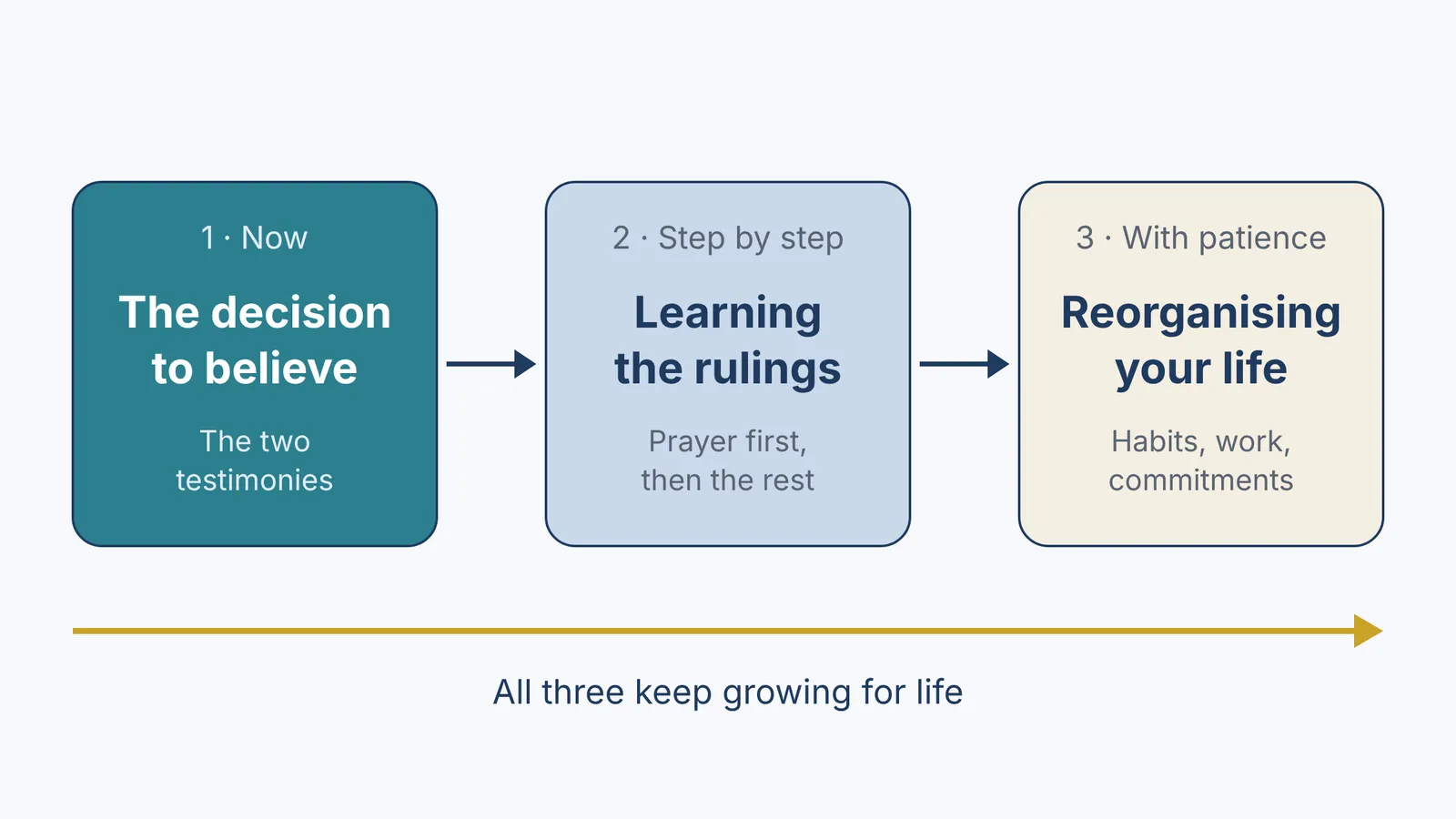
When people think about Islam, many put three different things into one basket:
- The decision to believe: believing that God is One with no partner, that Muhammad is His Messenger, and sincerely testifying to it. This is a decision of the heart, and it is the door.
- Learning the rulings: how to pray, what to eat, what is lawful and unlawful in money and relationships. This is knowledge you gain over time.
- Reorganising your life: rearranging your day, habits and responsibilities in the light of what you have learned. This takes patience and gradual steps.
Mixing these three is what turns the sheet into a mountain. A person thinks he has no right to believe until he has learned everything, and no right to learn until he has changed everything. In fact the order starts with faith, learning follows, and change follows both, and all three keep growing for the rest of your life.
The Companions themselves did not know every ruling on the day they became Muslim. Many accepted Islam before much of the law had been revealed, and learned it as it came, year after year, asking the Prophet ﷺ about what they did not know without embarrassment. You are not starting behind them. You are walking the same road.
What did the Prophet ﷺ tell Mu'adh?
When the Prophet ﷺ sent Mu'adh ibn Jabal to Yemen to teach its people Islam, he did not hand him a long list to deliver in one day. He gave him a clear order: call them first to testify that there is no god but God and that he is God's Messenger; "if they accept that", teach them that God has made five prayers obligatory every day and night; if they accept that, teach them that God has made obligatory a charity taken from their rich and given back to their poor9.
Notice the phrase "if they accept that". Each step waits for the one before it to settle. Faith first, because everything is built on it. Then prayer, the daily connection with God. Then what follows.
And the Prophet ﷺ told those who teach people: "Make things easy and do not make them hard; give good news and do not drive people away"10. Anyone who throws every ruling at you at once and makes you feel like a failure before you begin is not following that guidance.
Revelation itself came gradually
The Qur'an did not come down as a finished book in one night. It was revealed over about twenty-three years, and it gives the reason: a Qur'an We have divided, so that you may recite it to people at a measured pace, and We sent it down in stages4. When opponents asked why it was not sent down all at once, the answer came: so that We may strengthen your heart with it5.
In the early years in Mecca, most of what was revealed concerned belief in God, the Last Day and good character. The details of worship and transactions came little by little, much of it in Medina. Aishah, may God be pleased with her, summed up the wisdom: the first passages revealed mentioned Paradise and the Fire; once people had turned to Islam, the lawful and the unlawful were revealed. Had the first thing revealed been "Do not drink wine," they would have said, "We will never give up wine"11.
Another page on this site traces how wine was prohibited in stages. But we must be precise here. Gradualness in legislation ended when the religion was completed: what is forbidden today is forbidden for every Muslim, and no one can make it lawful. Gradualness in learning and practice remains. You learn one thing after another, leave what you are able to leave, and keep striving where it is hard.
What do you need first?
Back to your sheet. Here is a practical order that many who came before you have followed:
- Understand the two testimonies: what does "there is no god but God" mean, and what does "Muhammad is the Messenger of God" mean? This is the foundation for everything else.
- Learn the prayer: ablution (wudu'), the times of the five prayers, the movements and the recitation required. Begin with what you can; don't wait until you have memorised everything. The Prophet ﷺ said: "Pray as you have seen me pray"12. Prayer is learned by watching and doing.
- Leave what you can of the clear prohibitions: some you will leave on your first day, others take longer effort. The prophetic rule is: "When I forbid you something, avoid it; and when I command you to do something, do of it what you are able"13.
- Then the rest, at a steady pace: fasting when Ramadan comes, zakat if it becomes due on you, and the details of transactions as you need them.
The measure for all of it is God's words: So be mindful of God as much as you are able7, and God does not burden any soul beyond its capacity1. God does not ask what you cannot do. He asks you to give, sincerely, what you can.
Responsibilities you cannot change overnight
Some items on your sheet are not personal habits but commitments that involve other people: a job with a part that is not permitted, a loan with interest you signed years ago, a family that depends on your income. Here some new Muslims make one of two mistakes. Either they tear their lives down in a day, quitting work with no alternative and harming those who depend on them, or they despair: since I can't, there's no point.
The middle road is to put your situation to a trusted scholar or guide, who can help you tell apart what must be left at once, what you can leave with a plan, and what a person is excused in because of genuine necessity. The Shari'ah is merciful and does not want harm for you. And trust God's promise: Whoever is mindful of God, He will make a way out for him8. Many have begun with one small, sincere step, and found doors opened for them from where they never expected.
Old habits: a struggle, not a scandal
There will be days when you slip back into an old habit, grow lazy about a prayer, or feel you have not changed as fast as you hoped. A voice inside will say: you are not a real Muslim.
Don't believe it. The Prophet ﷺ said: "Every son of Adam errs, and the best of those who err are those who repent"14. God describes the mindful as people who, when they do wrong or wrong themselves, remember God and ask forgiveness for their sins2. He did not describe people who never fall, but people who come back.
The habit you are fighting is not proof of failure; it is proof that you are on the road. Someone who is not trying does not struggle at all. God has promised: Those who strive for Us, We will surely guide them to Our ways6. And God is more pleased with His servant's repentance than a man who lost his camel in a desert and then found it15.
There are practical tools that many have found helpful in this struggle:
- Change the setting before blaming yourself: many habits are tied to a place, a group or a time. The Prophet ﷺ compared a good companion to someone carrying musk and a bad one to a blacksmith's bellows17. One good friend can change your whole week.
- Put something in the gap: someone who drops an evening out without replacing it usually goes back. A class, exercise or time with new friends fills the space.
- Ask God for help: in your own language and your own words. He is closer to you than you think.
- Count steps, not perfection: a week without that habit is a victory, and a day you fell and got up again is another.
"Gradualness is just a trick to postpone commitment"
Someone, Muslim or not, might say: all this talk of gradualness waters the religion down, and anyone who hears it will put everything off forever.
The answer is that the gradualness we mean does not change the ruling; it takes account of human capacity. What is forbidden stays forbidden and what is obligatory stays obligatory. No one tells a new Muslim that wine is lawful for him for six months. He is told: work at leaving it from today; if you fall, get up and seek forgiveness; and do not let your fall become a reason to drop your prayer as well.
The Prophet ﷺ said: "The religion is ease, and no one overburdens himself in the religion but it overwhelms him; so aim for what is right, come as close as you can, and receive glad tidings"16. Being too hard on yourself at the start often ends in giving up. Steady steps arrive.
"If I can't break my habit, my Islam is worthless"
This objection usually comes from a sincere heart that is afraid for itself. But it rests on a mistaken idea: that sin takes a person out of Islam.
The creed of Ahl al-Sunnah wal-Jama'ah is that a Muslim who commits a sin, even a major one, does not leave Islam by it, as long as he does not declare it lawful or deny its ruling. His faith decreases with sin and increases with obedience, but he remains a Muslim, and his affair is with God. The Companions pledged to the Prophet ﷺ to avoid associating partners with God, theft, adultery and more, and he said: whoever fulfils it, his reward is with God; and whoever falls into any of it and God conceals it, his affair is with God: if He wills He pardons him, and if He wills He punishes him18.
Your Islam is not a prize for those who have finished with every habit. It is the beginning of a relationship with a Lord who knows your weakness: God wants to lighten your burden, for the human being was created weak3.
No one is asking you to carry the whole mountain tonight. Pick up the first stone.
What this means for you
Go back to your sheet, and don't tear it up. Draw a line across it: above the line, the decision to believe; below it, everything else. The first does not require you to solve what lies beneath it. Then choose one item from below the line to begin with this week. Most often, it will be prayer.
If you need help putting your priorities in order, that is exactly what guides do with new Muslims every day.
Questions you may have
Should I wait until I've given up a certain habit before becoming Muslim?
No. Faith is not postponed until you are free of every habit; the testimony itself is the strongest help in leaving them. Enter Islam, then work on that habit as a Muslim.
Do I have to leave my job if part of it is forbidden?
The answer depends on the job, the nature of the forbidden part and your circumstances. Don't make a hasty decision that harms you and your family, and don't ignore the question either. Put your case to a trusted scholar who can guide you to a suitable way out.
How long does it take a new Muslim to learn the prayer?
It varies. Many start praying in their first days with what they have memorised and complete the rest within weeks. What matters is to begin, not to wait for perfection.
If you chose just one item from your "sheet" to begin with this week, what would it be, and why that one?
Show a thought
One sincere step weighs more than a grand plan that never starts. What you choose today opens the way to what comes next, because one good deed draws another. And remember that God looks at the sincerity of your effort, not the speed of your arrival.
We began with a sheet of paper that looked like a mountain. Islam does not tell you the mountain is not there. It tells you that you are not asked to carry it all at once, and that you do not carry it alone. Faith first, then prayer, then what follows, just as the Prophet ﷺ taught Mu'adh fourteen centuries ago.
This is a religion that was revealed at a measured pace to strengthen hearts, and it treats its followers with the same gentleness. If you are convinced of it, don't let the list of habits stand between you and the door. Come in, and learn on the way.
Your next step
Sources (18)
- Qur'an 2:286 (al-Baqarah)
- Qur'an 3:135 (Al 'Imran)
- Qur'an 4:28 (al-Nisa')
- Qur'an 17:106 (al-Isra')
- Qur'an 25:32 (al-Furqan)
- Qur'an 29:69 (al-'Ankabut)
- Qur'an 64:16 (al-Taghabun)
- Qur'an 65:2 (al-Talaq)
- Sahih al-Bukhari 1395 (also Muslim 19)
- Sahih al-Bukhari 69
- Sahih al-Bukhari 4993
- Sahih al-Bukhari 631
- Sahih al-Bukhari 7288 (also Muslim 1337)
- Jami' al-Tirmidhi 2499
- Sahih Muslim 2747 (also al-Bukhari 6309)
- Sahih al-Bukhari 39
- Sahih al-Bukhari 2101
- Sahih al-Bukhari 18