Does becoming Muslim mean you stop being you?
Imagine your name as your grandmother says it when she calls you from the kitchen, in an accent no one else quite has. Imagine the song your mother sang you to sleep with, the food your family gathers around on holidays, the clothes people from your country wear on special days. None of this is a small detail. This is you.
Then a worrying question comes: if I enter Islam, will I be asked to leave all of this? To carry a name I don't know, speak a language I don't understand, and live as if I had been born somewhere else?
Three questions inside one
Worry about "identity" is really three separate questions, each with a different answer:
- Your name: do I have to change it?
- Language: do I have to learn Arabic, and how much?
- Culture: what remains of my customs and way of life?
The short answer to all three: Islam does not ask you to erase yourself. It asks you to worship God alone. Whatever does not conflict with that stays yours. Let us take the questions one at a time.
Your name: it usually stays
It may surprise you that most of the Companions, may God be pleased with them, kept the names their parents gave them before Islam: Umar, Uthman, Ali, Khalid, Hamzah and many more. They were not asked to take new "Islamic" names, because their names had good or neutral meanings.
But the Prophet ﷺ did change some names, for two clear reasons:
- If the name expresses servitude to other than God, such as a name meaning "servant of" an idol or of a god other than God. The scholars agreed that every name expressing servitude to other than God is forbidden13, because servitude belongs to God alone, and that is the heart of the testimony you will make.
- If the name has an ugly or bad meaning. Umar ibn al-Khattab had a daughter called 'Asiyah, "disobedient", and the Prophet ﷺ renamed her Jamilah, "beautiful"7.
If your name is one of these two kinds, changing it is part of completing your belief in God's oneness, and you may well find it a relief rather than a burden. If it is not, your name stays as it is, and your Islam is no less for it.
If you would like a new name you love, one to be known by among Muslims, that is permitted and there is no harm in it, but it is a choice, not a duty. One point scholars stress: do not change your lineage. If you change your first name, keep your father's name as it is, because the Qur'an commands that people be called by their fathers' names: Call them by their fathers; that is more just in the sight of God3. Your father remains your father, whether or not he becomes Muslim.
Arabic: the language of prayer, not a condition of faith
Faith does not require Arabic. You can understand the meaning of the two testimonies in your own language, believe them in your heart, and then say them in Arabic as someone helping you teaches you; they are two short sentences. You can call on God in your own language, at any time, in your own words. God hears every language, and He made their diversity one of His signs2.
You can read the meanings of the Qur'an translated into your language, understand its message and reflect on it. God sent every messenger in the language of his people, to make things clear to them1; the message is meant to be understood.
The prayer has words of remembrance and recitation said in Arabic, the most important being the Opening chapter, al-Fatihah. The Prophet ﷺ said: "There is no prayer for whoever does not recite the Opening of the Book"8. It is seven short verses. The Arabic you need for prayer is actually small: al-Fatihah and a few short phrases for bowing, prostration and the sitting. Most new Muslims learn them within weeks, by listening and repeating.
Some practical ways that many have found helpful:
- Start with the meaning: read a translation of al-Fatihah in your language first. When you know what you are saying, memorising is easier and the heart is present.
- Listen a lot: one recording by one reciter, repeated on your way to work, is enough for your tongue to grow used to the words.
- One verse at a time: learn a verse a day, and pray with what you know.
- Find a companion: a Muslim who listens and gently corrects you will shorten the road a great deal.
And if you have not memorised it yet, do not put off praying. A man came to the Prophet ﷺ and said: "I cannot learn anything of the Qur'an, so teach me something that will suffice me." He said: "Say: Subhan Allah, al-hamdu lillah, la ilaha illa Allah, Allahu akbar, wa la hawla wa la quwwata illa billah"9. From this the jurists said: whoever cannot yet recite al-Fatihah remembers God with these words in his prayer until he learns it.
God describes the Qur'an: We have made the Qur'an easy to remember; so is there anyone who will remember?6. Many Muslims around the world do not speak Arabic, yet they pray in it every day, love its words, and some learn it over the years out of love rather than obligation.
Your culture: a scale, not an eraser
Islam does not come to your culture with an eraser, but with a scale. God says: O people, We created you from a male and a female and made you nations and tribes so that you may know one another. The most noble of you in God's sight is the most mindful of Him5. Notice that it is God who made people into nations, and He made the purpose that they know one another, not that they dissolve into a single people. His only measure of honour is mindfulness of Him, not language, colour or country.
He also says: Among His signs are the creation of the heavens and the earth and the diversity of your languages and your colours2. The variety of languages and colours is not a problem religion has to solve. It is one of God's signs, mentioned alongside the creation of the heavens and the earth.
Muslim scholars took custom into account in their rulings: a ruling can differ with time, place and custom where the matter allows it14. That is why Muslims in Indonesia, Turkey, Senegal and Bosnia dress, eat and celebrate their weddings in very different ways, and all of them are Muslims.
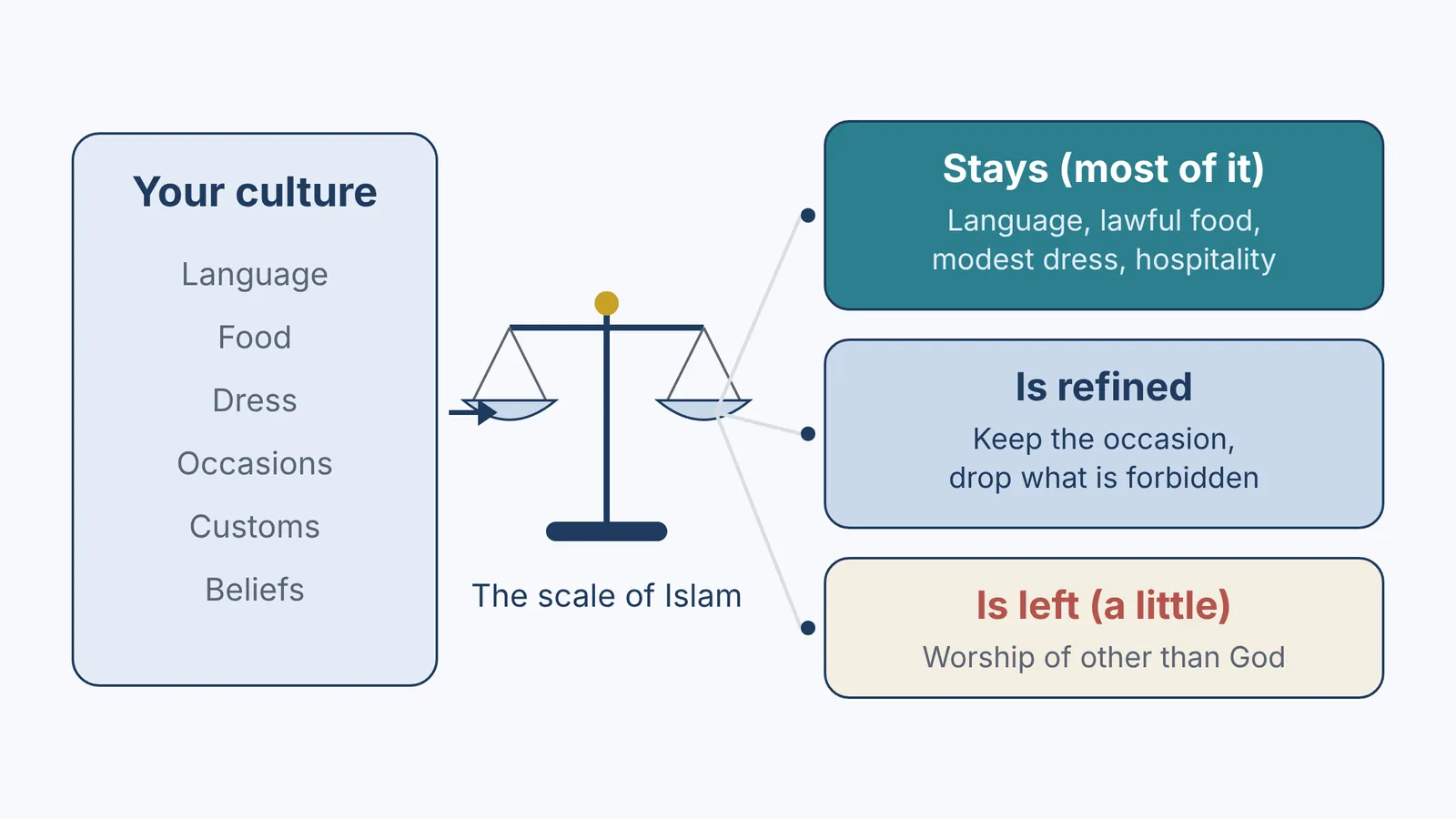
Put your customs on that scale and you will find three kinds:
- What stays as it is, which is most of it: your language, your lawful foods, the proverbs and music of your tongue, your way of hosting guests, respect for elders, and much of your art and dress as long as it is modest.
- What is refined: a lovely social occasion that has something forbidden in it, such as alcohol. The occasion stays and the forbidden part goes.
- What is left: the small part, such as worshipping other than God, religious rites of other faiths, or a custom involving injustice or harm.
Muslim, not Arab
One of the most widespread ideas is that Islam is "the religion of the Arabs". The facts contradict it. Most Muslims in the world today are not Arabs, and the most populous Muslim countries are not Arab. The Prophet ﷺ was sent to all people: We have sent you only to all of humanity, as a bearer of good news and a warner4.
In the very first generation, the Companions included Bilal the Abyssinian, Salman the Persian and Suhayb the Roman. The lands they came from stayed in their names, and no one told them they were lesser Muslims for not being Arabs. Bilal was the Prophet's own caller to prayer.
Reason points the same way. If Islam were a national religion, honour in it would come from being Arab. But the Prophet ﷺ said: "God does not look at your forms or your wealth, but at your hearts and your deeds"10. Islam does not ask you to change your nationality, but to turn your heart to God.
Yes, Arabic gathers Muslims in their prayer, so an Indonesian, a Nigerian and a Bosnian can stand in one row reciting the same Fatihah. But that is a shared language of worship, not a replacement identity. When the prayer ends, each goes back to his own language, home and food, and what binds them is faith, not ethnicity.
"If I become Muslim, I'll lose my identity"
In its strongest form this objection says: my identity is my history, my language, my family and my country, and religion is part of that identity. If I change my religion, I cut myself off from my roots.
The answer is that identity is not a single layer. You are your family's child, your country's child, your language's child, and all of that remains. What changes is your answer to one question: whom do you worship? That question goes deeper than all the other layers, but it does not cancel them.
In fact, many new Muslims say they feel closer to themselves after Islam. Islam speaks of the fitrah, the natural disposition every person is born with, and sees belief in the One God as a return to it rather than a departure11. You do not become a stranger to yourself. You find what was in you from the beginning.
"But some Muslims tell me to change everything"
This can happen, and honesty means admitting it. Some Muslims mix their religion with their culture, thinking their country's dress is "Islamic dress", their food "Islamic food", and that everyone who becomes Muslim should live as they do.
That is their confusion, not a ruling of the religion. Always separate two questions: is this a command of God and His Messenger, or is it the custom of a particular group of Muslims? The first you commit to; the second you may take or leave. If something is unclear, ask a scholar who knows the difference.
The Prophet ﷺ instructed those who teach people: "Make things easy and do not make them hard; give good news and do not drive people away"12. Whoever loads you with what God has not required has gone against that instruction.
Islam does not come to your culture with an eraser, but with a scale.
What this means for you
Your name will most likely stay. Of Arabic, you learn what your prayer needs at a steady pace, and you call on God in your own language whenever you like. Your culture stays with you, except what goes against the worship of God or His rulings, and that is the smaller part.
You will be a Muslim as you are: with your language, your family, your mother's cooking and the name your grandmother calls you by. And to all of it you will add the most beautiful thing that can be added: knowing your Lord and worshipping Him alone.
Questions you may have
Do I have to change my name on official documents?
No. If your name has a good or neutral meaning, you need not change it at all. If it expresses servitude to other than God, change what you are called by; changing official documents is a practical matter you weigh according to your circumstances and your country's law.
Is my prayer valid before I have memorised al-Fatihah?
Yes. Pray as you are able, and remember God with glorification, praise, the declaration of His oneness and "God is greatest" in place of the recitation until you have learned it9, and work on learning it as soon as you can.
Do I have to learn Arabic fully?
No. What is required is to learn what your prayer needs, such as al-Fatihah and the short phrases. Learning Arabic beyond that is a great blessing, because it opens the Qur'an to you in its own language, but it is a path you walk according to your time and energy, and your Islam is not lessened if you never master it.
Do I have to dress like Arabs?
No. What is required in dress is that it covers what the Shari'ah requires to be covered and that it is not a religious emblem of another faith. Within those limits, you can wear the clothes of your own country and people.
Pick three things you love about your culture. If you put them on the "scale", where would each one land?
Show a thought
Most people find that what they love in their culture lands in "what stays": language, food, generosity, family ties. What is refined or left is usually small, and often it is something they themselves were never happy with. Perhaps the fear of losing your identity is much bigger than what Islam actually asks.
We began with a grandmother calling her grandchild's name from the kitchen. God willing, that call will stay just as it is. Islam does not ask you to be someone else. It asks you to be yourself, a servant of God alone.
A religion that calls the diversity of languages a sign, and made nations so they could know one another, will not be too narrow for your language or your culture. And if you want to know what the first step means, it is two sentences you can understand in your own language and say from your heart.
Your next step
Sources (14)
- Qur'an 14:4 (Ibrahim)
- Qur'an 30:22 (al-Rum)
- Qur'an 33:5 (al-Ahzab)
- Qur'an 34:28 (Saba')
- Qur'an 49:13 (al-Hujurat)
- Qur'an 54:17 (al-Qamar)
- Sahih Muslim 2139
- Sahih al-Bukhari 756 (also Muslim 394)
- Sunan Abi Dawud 832 (also al-Nasa'i 924)
- Sahih Muslim 2564
- Sahih al-Bukhari 1358 (also Muslim 2658)
- Sahih al-Bukhari 69
- Ibn al-Qayyim, Tuhfat al-Mawdud bi-Ahkam al-Mawlud, chapter on names
- Ibn al-Qayyim, I'lam al-Muwaqqi'in, chapter on rulings changing with time, place and custom