What if the door you have been standing in front of has no lock and no gatekeeper?
Imagine someone who has been reading about Islam for months. The ideas make sense to them, and something in them has quietly settled. Yet they keep postponing. They assume there must be an appointment to book, an exam to pass, a ceremony with officials, perhaps a new name and a long list of things to give up first.
Then one evening they learn that the step itself is a single sentence, said with understanding and meant with the heart. The real question was never "Am I allowed in?" It was "Do I know what I am saying?"
This page is about that sentence: what it affirms, what it rejects, and what you should understand before you say it.
What the word "Islam" means
The Arabic word islam means to submit, to surrender yourself willingly. A Muslim is simply "one who submits" to God. It is not named after a person, a tribe or a place. It describes a relationship.
When the angel Gabriel came to the Prophet ﷺ in human form and asked him about Islam, the answer began with the testimony: to bear witness that there is no god but God and that Muhammad is the Messenger of God, then to pray, to give zakat, to fast Ramadan and to make the pilgrimage if you are able. He then asked about faith (iman), and the answer was to believe in God, His angels, His books, His messengers, the Last Day and destiny, its good and its bad9.
So Islam has an outward side, what you say and do, and an inward side, what you believe. The two testimonies sit where both meet. They are the first pillar of the five10, and they put into words the faith the six pillars describe. (Each of those pillars has its own page on this site.)
The two testimonies, word by word
Here is the sentence itself:
أشهد أن لا إله إلا الله، وأشهد أن محمدًا رسول الله
Ash-hadu an lā ilāha illā-llāh, wa ash-hadu anna Muḥammadan rasūlu-llāh.
"I bear witness that there is no god but God, and I bear witness that Muhammad is the Messenger of God."
Notice the verb. You do not say "I think" or "I hope". You say ash-hadu, "I bear witness". A witness speaks about what he knows. That is why the Qur'an puts knowing first: Know that there is no god but God8. The testimony is not a password. It is a statement of conviction, made by someone who has understood.
"God" here translates Allah, which is simply the Arabic name of the one God, the Creator. Arab Christians use the same word in their Bibles and prayers. You are not adopting a new deity. You are affirming the One you may have believed in all along, but now in the way He taught.
"There is no god but God": a no and a yes
The first testimony has two halves, and both matter.
The no: lā ilāha, "there is no god". In Arabic, ilah means one who is worshipped: the one you pray to, rely on, love above all, fear and hope in. This half rejects every claim to that place: idols, saints, prophets, money, fame, your own desires. None of them deserves worship.
The yes: illā-llāh, "except God". Everything the no swept away is now given to its rightful owner. Your prayer, your trust and your deepest love go to Him alone.
The Qur'an describes the same structure: whoever rejects false objects of worship and believes in God has grasped the firmest handhold, which will never break1. First the letting go, then the holding on.
This also shows what the testimony does not mean. It is not only "I believe a Creator exists". Many people have believed that and still prayed to others beside Him. The testimony is about worship: who receives it, and who does not. It is also the message the Qur'an says every messenger brought: We sent no messenger before you without revealing to him that there is no god but Me, so worship Me5.
"Muhammad is the Messenger of God"
The second testimony also says yes and no.
It affirms that Muhammad ﷺ was truly sent by God; that he was truthful in what he conveyed; that following him is how you come to know what God asks of you; and that you worship God in the way he taught, not in ways people invent. The Qur'an ties love of God to following him: Say: if you love God, follow me, and God will love you and forgive your sins3.
It rejects two opposite mistakes. The first is denying him. The second is raising him above his rank. He said: "Do not exaggerate in praising me as the Christians exaggerated about the son of Mary; I am only His servant, so say: the servant of God and His Messenger"11. Muslims love him deeply, but they never pray to him. He also described himself as the final brick in a building the prophets had raised together, the seal of the prophets12, so no new prophet comes after him7.
If you come from a Christian or Jewish background, this second testimony does not ask you to drop the prophets you love. Belief in all of God's messengers, including Moses and Jesus, is part of Islamic faith. The Prophet ﷺ said that whoever testifies that there is no god but God and that Muhammad is His servant and messenger, and that Jesus is the servant of God and His messenger, and that Paradise and Hell are real, God will admit to Paradise13.
What to understand before you say it
You do not need to know Islamic law, memorise the Qur'an or speak Arabic before becoming Muslim. But you should understand what you are saying. Muslim scholars, explaining the testimony, said that it must be said with knowledge of its meaning, with certainty rather than doubt, with sincerity towards God rather than to please someone, with truthfulness of the heart, with acceptance and willingness to follow, and with love for what it means.
Put simply, ask yourself three honest questions:
- Do I believe that God is One, with no partner, and that He alone deserves worship?
- Do I believe that Muhammad ﷺ is His Messenger, and that the Qur'an is God's word?
- Am I willing to live by this, learning and growing step by step, even if imperfectly at first?
If your answer to these is yes, you have what you need. Questions about details, prayer, food, family or the past can be learned after the door, not before it.
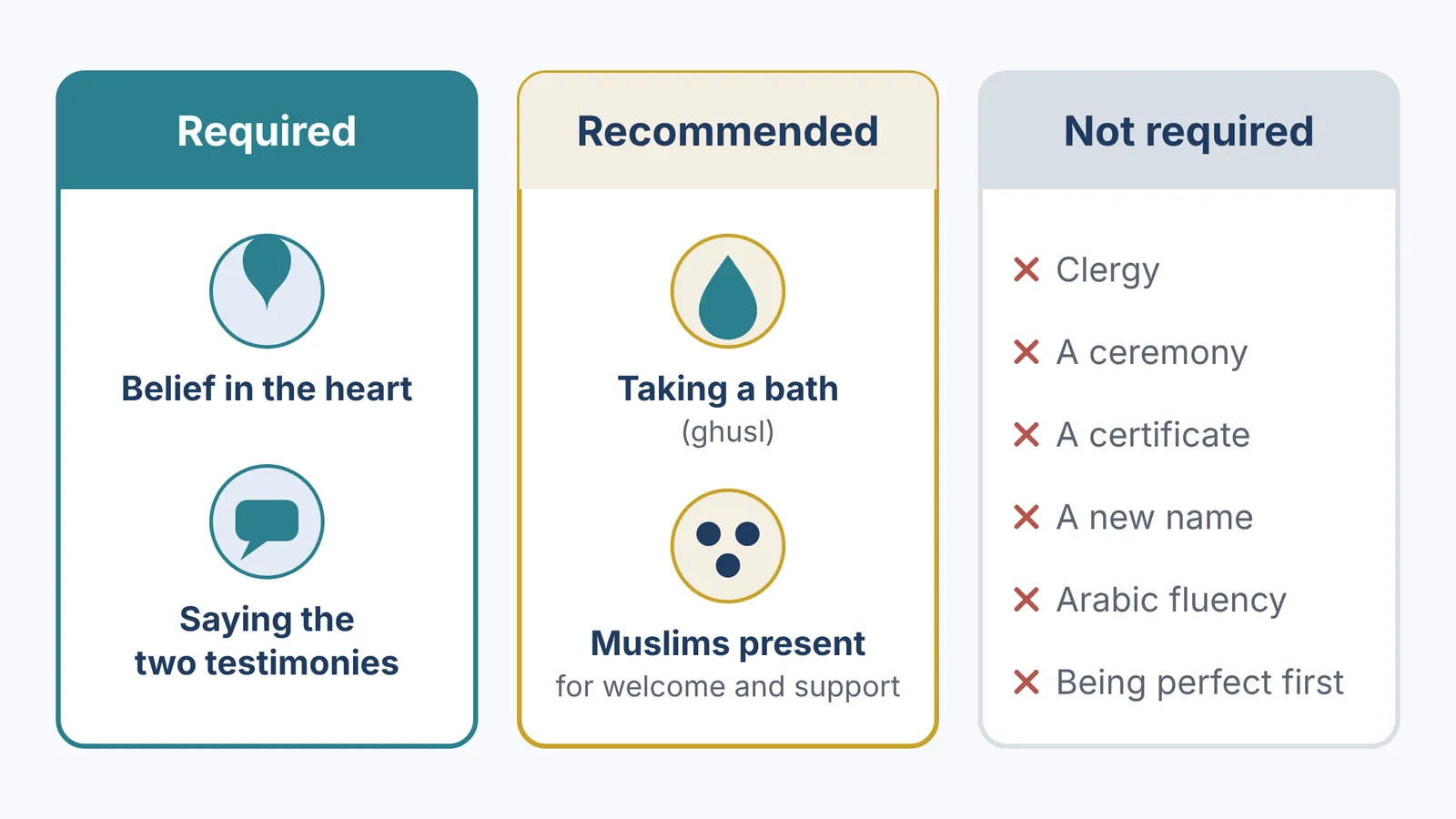
No priest, no ceremony
There is no clergy in Islam who admits people in. No baptism, no sacrament, no fee and no waiting period. A person who sincerely says the two testimonies, even alone in a room, has entered Islam. The relationship is between you and God.
That said, two things are recommended.
Saying it in front of Muslims. It is good to say the testimony with a few Muslims present, at a mosque, an Islamic centre or with a friend. This is not a condition of validity. It helps you: people can welcome you, answer your first questions and support you. A certificate from an Islamic centre can help with practical matters later, but it records your Islam; it does not create it.
Taking a bath (ghusl). A man named Qays ibn Asim came to the Prophet ﷺ wanting to embrace Islam, and he told him to bathe with water and lote-tree leaves14. Most scholars consider this ghusl recommended; some consider it obligatory. Either way it is not a condition for entering Islam, and you should never delay your testimony in order to bathe first. You can bathe afterwards, and it becomes a quiet, physical sign of a new beginning.
Many things people assume are required are not. You do not have to change your name, unless its meaning is clearly contrary to Islam. You do not have to adopt the clothes or culture of any particular country. You do not have to announce your decision to everyone at once.
A clean page
One of the most moving moments in early Islam involves a man named Amr ibn al-As. When he came to give his pledge, he suddenly drew back his hand. The Prophet ﷺ asked why. Amr said he wanted to set a condition: that his past be forgiven. The Prophet ﷺ replied: "Do you not know that Islam wipes out what came before it?"15
The Qur'an says the same to those who stop and turn back: what is past will be forgiven them4. It even speaks of those who repent, believe and do good, whose bad deeds God replaces with good ones6.
And the good you did before is not lost. A companion asked whether his acts of charity and kindness before Islam counted for anything. The Prophet ﷺ said: "You have embraced Islam along with the good you did before"16. Embracing Islam does not erase who you are. It erases your sins and keeps your good.
"What if I can't keep it up? I'd rather wait until I'm ready"
This is perhaps the most common hesitation, and it comes from taking the step seriously, which is a good sign. The fear runs like this: "If I become Muslim and then fail to pray five times a day or give up a habit, I will be a hypocrite. Better to wait until I can do it all."
But no one starts complete. When the Prophet ﷺ sent Muadh to Yemen, he told him to begin with the testimony; if people accepted that, then teach them the five prayers; if they accepted that, then teach them zakat17. That is a path, not a single leap.
The Qur'an says that God does not burden a soul beyond what it can bear2, and the Prophet ﷺ said that the religion is ease, and that whoever makes it harsh on himself will be overwhelmed by it18. A Muslim who struggles is still a Muslim. Mistakes are met with repentance, and the door of repentance stays open for life. Waiting until you are perfect means waiting for a day that never comes. (The page Must I be perfect first? goes into this more deeply.)
"Isn't believing in my heart enough? Why say anything?"
Faith in the heart is the core; without it, the words are empty. But the testimony is how that faith becomes a commitment. Serious commitments are spoken: a promise, a vow, a signature. Saying "I bear witness" turns a private agreement into a stance you take before God.
The testimony needs no audience. If your circumstances make it hard to tell anyone, you can say it sincerely on your own, and you are a Muslim. What matters is that the belief is there and that you have said it.
The real question was never "Am I allowed in?" It was "Do I know what I am saying?"
Your first steps after the testimony
The first days do not need to be overwhelming. A sensible order looks like this:
- Learn the prayer. Start with how to make ablution (wudu) and how to pray, and learn the opening chapter of the Qur'an, al-Fatihah, which is recited in every prayer19. Until you have memorised it, scholars allow you to remember God with simpler words of praise while you learn.
- Find people. A local mosque, an Islamic centre or a trustworthy teacher online can guide you and answer questions as they come.
- Learn gradually. Food, fasting, family and finances can each be learned when they become relevant. You do not need to master them in a week.
- Keep your relationships kind. Islam commands good treatment of parents and family, even if they do not share your faith.
Questions you may have
Do I have to say the testimony in Arabic?
It is best to say it in Arabic, because these are the words the Prophet ﷺ taught, and a Muslim can help you pronounce them. You should also know their meaning in your own language. If someone truly cannot pronounce the Arabic, saying it sincerely in their own language is valid.
Do I have to tell my family immediately?
No. There is no obligation to announce it to everyone at once. Many new Muslims choose the right time and way to tell their families, with wisdom and gentleness. What you must not do is deny your faith or abandon its basics; how and when you share the news is a matter of wisdom.
Will my past relationships, job or habits suddenly be "illegal"?
Some things will change over time, and you will learn which ones as you go. Most of your life, your work, your friendships, your hobbies, your care for your family, remains as it is, now with a deeper intention behind it. If something specific worries you, ask a knowledgeable Muslim; many fears turn out smaller than they seemed.
Read the two testimonies again slowly. Which half do you already believe, and which one still raises a question for you?
Show a thought
Many people find they already believe in one God and that the open question is about the Prophet ﷺ, or the reverse. Knowing exactly where your question lies is a real step forward. A clear question can be answered; a vague hesitation can last for years.
We began with someone standing in front of a door they assumed was locked. In Islam the door has no gatekeeper, because the relationship it opens is directly with God. What it asks for is understanding and sincerity: a clear no to everything that does not deserve worship, and a clear yes to the One who does, along with trust in the Messenger who taught us how.
If you feel ready, a Muslim can sit with you, explain anything still unclear and say the testimony with you. If you are not yet ready, that is honest too. Keep your question clear, and keep walking.
Your next step
Sources (19)
- Qur'an 2:256 (al-Baqarah)
- Qur'an 2:286 (al-Baqarah)
- Qur'an 3:31 (Al 'Imran)
- Qur'an 8:38 (al-Anfal)
- Qur'an 21:25 (al-Anbiya')
- Qur'an 25:70 (al-Furqan)
- Qur'an 33:40 (al-Ahzab)
- Qur'an 47:19 (Muhammad)
- Sahih Muslim 8 (the hadith of Gabriel)
- Sahih al-Bukhari 8; Sahih Muslim 16
- Sahih al-Bukhari 3445
- Sahih al-Bukhari 3535; Sahih Muslim 2286
- Sahih al-Bukhari 3435; Sahih Muslim 28
- Sunan Abi Dawud 355; Jami' al-Tirmidhi 605
- Sahih Muslim 121
- Sahih al-Bukhari 1436; Sahih Muslim 123
- Sahih al-Bukhari 1395; Sahih Muslim 19
- Sahih al-Bukhari 39
- Sahih al-Bukhari 756; Sahih Muslim 394