Are you afraid your decision will cost you the people closest to you?
Imagine an ordinary evening at the family table. Your mother puts down the dish you have loved since childhood, your father asks about work, your younger brother teases you as he always does. Inside you, one sentence has been repeating for weeks: "I believe Islam is true." But you don't say it. You look at their faces and wonder: would this scene stay the same if I did?
That fear is not weakness, and it is not a sign that your faith is lacking. It is a sign that you love your family. This page will not ask you to give up that love. It will show you what Islam says about it.
What are you afraid of losing?
You may fear your mother's sadness, your father's anger, or being seen as a traitor to your ancestors' faith and customs. You may be worried about your marriage, or about a close relationship you want to keep. Or you may fear becoming a stranger in your own community.
Name your fear precisely, because each has a different answer: some Islam settles with a clear ruling, some need wisdom in timing, and some need a scholar who can hear your details.
If your fear is about your safety, or real harm that could come to you, there is a separate page on this route for that, and it should come first.
Islam commands kindness to parents, even when they disagree
It may surprise you that the Qur'an speaks about your exact situation: a believing child with parents of another faith who are pressing him to abandon the worship of God alone. What does it say? In meaning: If they strive to make you associate with Me something of which you have no knowledge, do not obey them; but keep them company in this world with kindness8.
Notice the order. These parents are not just disapproving; they are "striving", making every effort to pull their child away from his faith. Even so, the Qur'an does not say: cut them off, or shun them. It says: do not obey them in associating partners with God, and keep their company with kindness. The verse just before it reminds us of the mother who carried her child in weakness upon weakness, and tells us to be grateful to God and to our parents together7. Another surah repeats it: We have enjoined on the human being goodness towards his parents6.
Then the Qur'an widens the circle to everyone who has not fought Muslims over their faith: God does not forbid you from being good to them and acting justly towards them10. The word used for "being good", birr, is the same high word used for devotion to one's parents.
So if you imagine that Islam will make you harder on your family, the texts say the opposite. A Muslim is commanded to be kinder to his parents after Islam than before. When a man asked the Prophet ﷺ who most deserved his good companionship, he answered: "Your mother," then "Your mother," then "Your mother," then "Your father"14. And when a man came wanting to join him in battle, he asked: "Are your parents alive?" The man said yes. "Then strive in serving them"15.
Asma' and her mother
In Medina lived Asma', daughter of Abu Bakr, one of the earliest people to accept Islam. During the truce between the Muslims and Quraysh, her mother, who was still a polytheist, came to visit her, hoping for her kindness. It was not a simple moment for Asma'. She went to the Prophet ﷺ and asked: "My mother has come to me, hoping for my kindness. Shall I keep ties with my mother?" He said: "Yes, keep ties with your mother"12.
He did not say: wait until she becomes Muslim. He said: keep ties with her. Some narrators of the report mention that the verse about being good to those who have not fought Muslims was revealed about this very situation12.
In another account, Abu Hurayrah kept inviting his mother to Islam and she kept refusing; one day she said something hurtful to him about the Prophet ﷺ. He came to the Prophet weeping, not to complain about her, but to ask him to pray for her. The Prophet ﷺ said: "O God, guide the mother of Abu Hurayrah." Abu Hurayrah went home and found that she had bathed and testified that there is no god but God13.
In neither story did anyone cut off a parent. The road was patience, prayer and kindness. You cannot put guidance into anyone's heart, not even someone you love5, but you can be the most beautiful picture of Islam in your own home.
When should you tell your family, and how?
Islam does not require you to announce your faith to your family on the first day. Your faith is between you and God, and it begins when you sincerely testify that there is no god but God and that Muhammad is His Messenger. Telling your family is a question of wisdom and timing, not a condition for your Islam to be valid.
The Qur'an teaches the way of calling others: Invite to the way of your Lord with wisdom and good counsel3. In your case, wisdom means practical questions:
- Who is most likely to understand? Many people start with one family member, a brother, a sister or an understanding relative, before telling everyone.
- When is the right moment? Not in a moment of anger, not in the middle of a crowded family occasion, and not in a short text message that can easily be misread.
- What will you say? Start with what has not changed: "I am still your son (or daughter). I love you, and I am staying with you." Then explain calmly why you became convinced, without attacking what they believe.
- What should you expect? The first reaction may be sadness, anger or silence. It often softens when they see their child has become kinder, not more distant.
Meanwhile you can pray quietly in your room, learn your religion without fuss, and wait for the right moment to talk. That is not hypocrisy or lying; it is wisdom, and God knows what is in your heart. But if making your faith known could put you in real danger, get private advice before taking any step.
Questions about marriage and close relationships
This is the most delicate part, so let us be clear and humble.
If you are a man married to a Christian or Jewish woman, your marriage stands after you become Muslim, because the Qur'an permits a Muslim man to marry chaste women of the People of the Book2. You do not need a new contract. Men accepted Islam in the Prophet's time with wives they had married before Islam, and those marriages were recognised without being renewed16.
If you are a woman married to a man who is not Muslim, the ruling held by the great majority of Muslim scholars is that a Muslim woman is not the wife of a non-Muslim man, based on the verse: They are not lawful for them, nor are they lawful for these women11. But this does not mean your home collapses the moment you say the testimony of faith. Most scholars hold that, if the marriage has been consummated, it is suspended for the waiting period ('iddah); if the husband accepts Islam within it, they remain on their original marriage. Some major scholars, such as Ibn Taymiyyah and Ibn al-Qayyim, took a wider view: marital relations stop, but the wife may wait for her husband, and if he accepts Islam, even after the waiting period, she may return to him by the first contract as long as she has not married someone else19.
These rulings have details. Was the marriage consummated? What about the children? What is the husband's position? What does the law of your country say? That is why your case should not be settled by a web page. Sit with a trusted scholar or guide and share only what is needed. And most important: do not let the marriage question postpone your faith itself. Belief in God does not have to wait until every issue is resolved.
If you are in a close relationship outside marriage, Islam is clear that intimacy belongs only within marriage. We know this can be hard, and many people have faced it before you. Do not carry it alone. Talk it through with a guide who understands your situation and can help you find a realistic next step.
Belonging: will I become a stranger?
One honest fear is standing alone between two worlds: your family no longer quite understands you, and Muslims do not know you yet.
But Islam does not ask you to swap one family for another. It adds a new belonging without tearing away the old. The Qur'an says: The believers are but brothers9, and the Prophet ﷺ described believers in their mutual mercy as one body: when one part aches, the whole body responds17. That brotherhood is something you live in. It does not erase the brother born to your own mother and father.
Many cities today have mosques and centres with programmes for new Muslims: classes in your language, people who have been through the same experience, and someone to walk with you through your first weeks. Look for at least one good companion. The Prophet ﷺ compared a good companion to someone carrying musk: you never leave his company without something good18.
"If I become Muslim, I betray my family and their history"
This objection deserves respect, because it comes from loyalty. In its strongest form it says: my parents raised me and sacrificed for me, and this faith is theirs and their ancestors'. How can I leave it without being ungrateful?
But think about it: does loyalty to the people you love mean hiding from them what you see as true? Your parents themselves raised you to be honest and to choose what is right even when it is hard. When you follow what you have become convinced of after real searching, you are acting on the deepest thing they taught you.
And Islam turns your loyalty to them into worship. Being good to your parents after Islam is not social politeness; it is obedience to God, and you are rewarded for it. Look at Abraham, peace be upon him, when his father opposed and threatened him. He answered: Peace be upon you. I will ask my Lord to forgive you4. He differed from his father in faith, but never stepped outside courtesy and love.
"I'll wait until everyone accepts my decision"
It sounds gentle, but what if that day never comes? Pleasing everyone is a goal no one reaches, and other people's hearts are not in your hands.
There is an important difference between two things. Postponing telling your family until the right time is wisdom. Postponing your faith itself until someone else approves makes your relationship with God hang on another person's decision. The first is legitimate and understandable. The second loses you what you believe is true, and it does not guarantee their approval in the end.
Just as no one has the right to force you into a religion1, you should not let anyone force you out of one. The decision to believe is yours.
Islam will not ask you to love your family less, but to love them more truly.
What this means for you
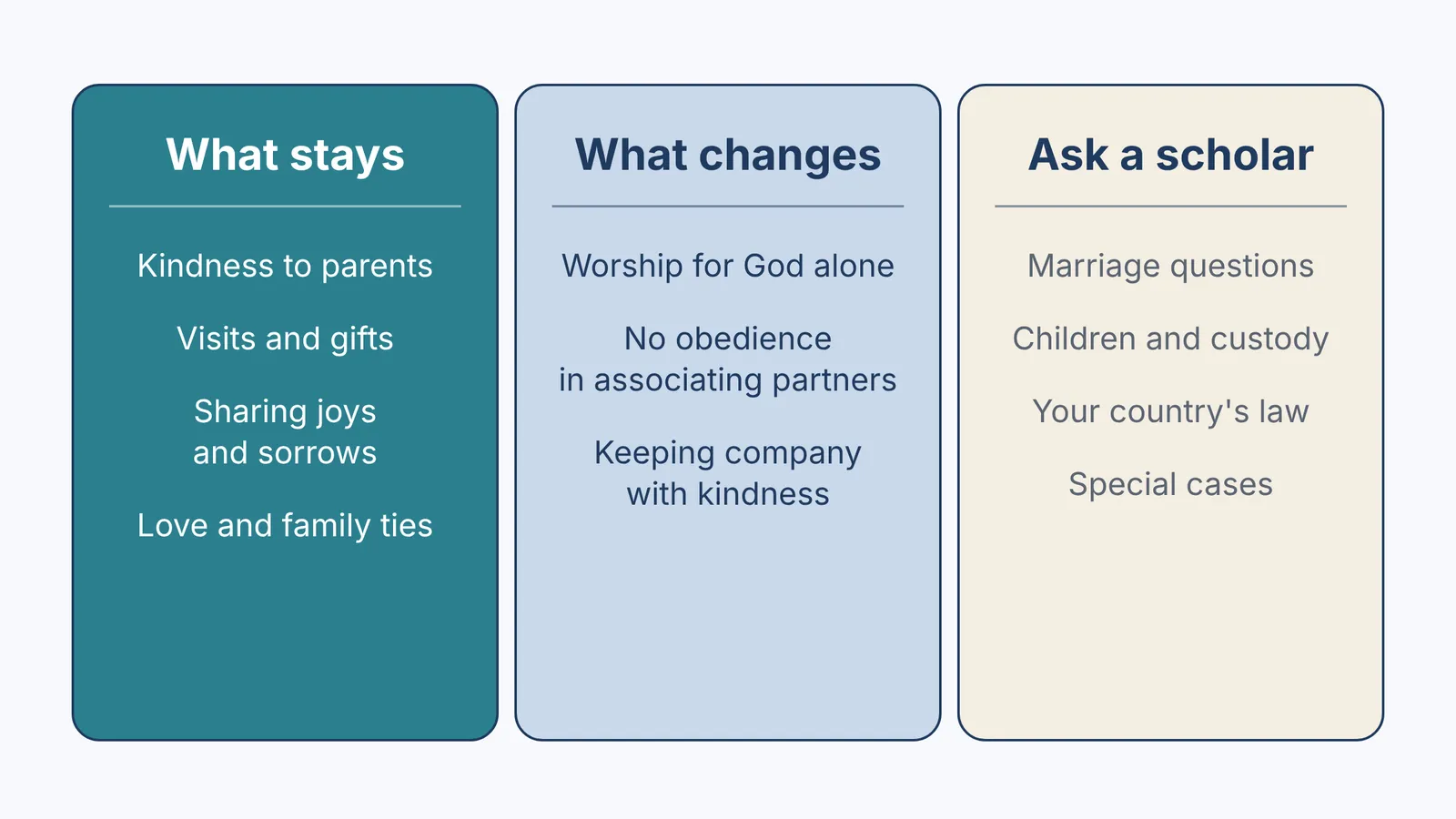
Your relationship with your parents and family remains, and it even becomes an act of worship. What changes is that you worship God alone and obey no one in disobeying Him. What needs detail, such as marriage and special circumstances, you ask someone who knows your situation.
You do not have to solve all of this in one day. Begin with faith, then take one step at a time at home, with patience and prayer, as those before you did.
Questions you may have
Do I have to tell my family as soon as I become Muslim?
No. Your Islam does not depend on announcing it to your family. Choose the time and the manner wisely, and start, if you like, with someone you trust to understand. If you fear real harm, get private advice first.
Can I still join family occasions, visit my family and eat with them?
Yes, in most things. You can visit them, eat lawful food with them, give and accept gifts, share their family celebrations and stand with them in their grief. What you avoid is taking part in the religious rites themselves. For the details of a particular occasion, ask a guide you trust.
Is it all right to love my parents if they are not Muslim?
Yes. A child's love for his parents is natural, and Islam does not blame you for it. God said to His Prophet about a relative he loved: You cannot guide whomever you love5. Love them, be good to them, and pray for their guidance as Abu Hurayrah did for his mother.
If your family learned of your Islam a year from now, what would you hope they had noticed in you during that year?
Show a thought
Many people find that what convinces their families most is not argument but the change they see: more honesty, more patience, a kindness they had not seen before. That is exactly what Islam asks of you. You may be, through your character, the first page of this religion they ever read.
We began with a family table and a sentence left unsaid. That sentence may stay in your chest for a while, and that is all right. Islam has not asked you to overturn the table, but to stay at it as a kinder son or daughter, a gentler sibling and a more honest person.
The religion that told Asma' "keep ties with your mother" does not come to take your family from you. It comes to teach you how to love them while standing on the truth. And if you need someone to hear the details of your situation, someone is waiting for your question.
Your next step
Sources (19)
- Qur'an 2:256 (al-Baqarah)
- Qur'an 5:5 (al-Ma'idah)
- Qur'an 16:125 (al-Nahl)
- Qur'an 19:47 (Maryam)
- Qur'an 28:56 (al-Qasas)
- Qur'an 29:8 (al-'Ankabut)
- Qur'an 31:14 (Luqman)
- Qur'an 31:15 (Luqman)
- Qur'an 49:10 (al-Hujurat)
- Qur'an 60:8 (al-Mumtahanah)
- Qur'an 60:10 (al-Mumtahanah)
- Sahih al-Bukhari 2620 (see also 5978; Muslim 1003)
- Sahih Muslim 2491
- Sahih al-Bukhari 5971 (also Muslim 2548)
- Sahih al-Bukhari 3004 (also Muslim 2549)
- Jami' al-Tirmidhi 1128 (also Ibn Majah 1953)
- Sahih al-Bukhari 6011
- Sahih al-Bukhari 2101
- Ibn al-Qayyim, Ahkam Ahl al-Dhimmah, chapter on one spouse accepting Islam