Does your faith count if no one is allowed to know about it?
Imagine someone reading late at night with the screen turned down low. They have been reading about Islam for months. Something in them has already said yes. But every time a door opens in the house, they close the tab, and their heart races a little. At home, or at work, or in the country where they live, saying "I believe" out loud could cost them far more than an awkward conversation.
They are not asking for drama. They are asking two quiet questions: does God accept a faith that has to stay hidden for now? And who can I ask without being exposed?
If something in that picture is close to yours, this page is written for you. Read it calmly. You do not have to decide anything tonight.
Faith lives in the heart first
In Islam, faith is not a membership card that other people issue. It begins as conviction in the heart, is expressed by the tongue, and grows into a way of living. The decisive part, the part no one else can see or confirm, is the heart.
The Prophet ﷺ pointed to this when he said that there is a morsel of flesh in the body: if it is sound, the whole body is sound, "and it is the heart"6. He also said that God does not look at your appearance or your wealth, but at your hearts and your deeds7.
So the first thing to know is simple: becoming Muslim does not depend on a ceremony, a building or a crowd. A person who sincerely testifies that there is no god but God and that Muhammad is His Messenger has entered Islam, even if they say it alone, quietly, in their own room. Witnesses and certificates help with practical matters later, such as marriage or burial. They are not what makes you a Muslim before God. If you want to understand what the testimony means before you say it, that is a page of its own on this site.
When saying it openly is dangerous
The Qur'an speaks directly about believers who live under pressure. One verse says, in meaning, that whoever disbelieves after believing is under God's anger, except one who is forced while his heart is at rest in faith3.
Commentators such as Ibn Kathir mention that this verse came down concerning Ammar ibn Yasir, an early Muslim in Mecca who was tortured until he said what his persecutors demanded, and who came to the Prophet ﷺ distressed, while his heart had not changed9. The verse did not blame him. It drew a clear line: what is forced out of you under real threat is not the same as what you choose with your heart.
The Qur'an also tells of a man from Pharaoh's own household, a believing man who was concealing his faith4. Notice how it describes him: a believer. His faith was hidden, and it was still faith. When the moment came, he spoke up wisely to defend the truth, but the Qur'an never treats his earlier silence as hypocrisy.
A third verse, about where a believer's loyalty lies, makes an exception for those who need to guard themselves against real harm2. Ibn Kathir explains it as protecting oneself outwardly while the heart and intention stay as they are9.
These texts need to be read carefully, the way mainstream Sunni scholars read them:
- They concern real danger: a genuine threat to your life, your body, your freedom or something of that weight. Not mere embarrassment, or the fear of an uncomfortable dinner.
- They allow you to keep your faith private, and under true coercion they excuse words forced out of you. They do not turn lying into a general habit, and they do not permit harming an innocent person to protect yourself.
- They describe a temporary state. The heart stays with God, and the believer keeps looking for a safer path.
Your safety is part of your religion
Some people assume that a "real" believer must announce their faith at any cost. Islam does not ask that of you. Among the things the Shari'ah was revealed to protect, scholars count life and body among the most essential10. Protecting yourself is not a step away from religion. It is one of its aims.
The Qur'an says, in meaning, God does not burden a soul beyond what it can bear1, and be mindful of God as much as you are able5. The Prophet ﷺ, whenever he was given a choice between two matters, chose the easier one as long as it was not sinful8.
In practice, this means:
- You can learn quietly, at your own pace, and keep what you learn to yourself.
- You can pray and remember God privately. Prayer does not need an audience, and there are legitimate allowances for real hardship that a knowledgeable person can explain for your situation.
- What you truly cannot do now is not held against you. God knows the difference between someone who refuses and someone who is prevented.
And remember that some of the greatest acts of worship are the ones nobody sees: remembering God in your heart, and calling on Him in your own words, in any language you know, at any time, even while sitting among people who have no idea what is passing between you and your Lord. No house, law or watcher can close that door.
This is one of the quiet beauties of Islam: it meets you where you actually are, not where a stranger imagines you should be.
Privacy online: share only what is needed
When you write to anyone online, including us, the safest rule is the one in the page's own introduction: say only as much as is needed to understand your request. You do not owe anyone your full story to deserve help.
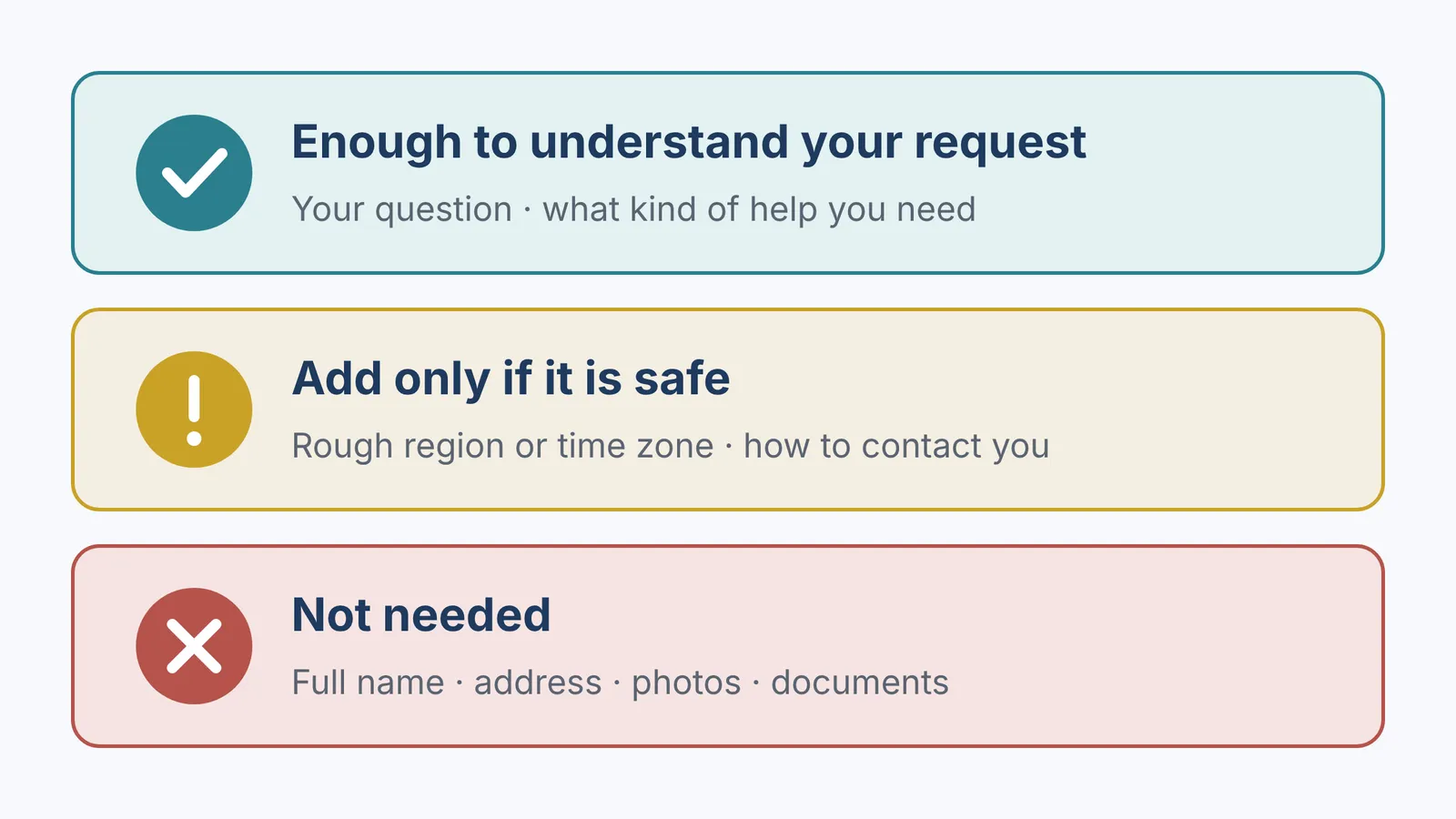
A few practical habits help:
- Use a device and an account that only you control. If you share a phone or computer, use a private browsing window and sign out when you finish.
- A first name or a nickname is enough. You do not need to give your full name, your address, your workplace, or the names of people around you.
- Avoid sending photos, documents or screenshots that could identify you or others.
- Tell the person helping you what is safe: for example, "messages only, no calls," or "only in the evenings." That is a reasonable request, and a good helper will follow your lead.
Be realistic as well. No website or app can promise perfect secrecy. Before you send anything, ask yourself one question: if this message were seen by the wrong person, would I be harmed? If the answer is yes, shorten it.
How the centre can help, quietly
You can ask for help in a way that fits your circumstances. A short message is enough. For example:
- "I believe, but my situation at home is difficult. How can I pray without being noticed?"
- "I want to understand Islam more before I decide, but I can only read, not talk."
- "I said the testimony on my own. Is that enough? What should I learn first?"
You choose how much to say and how often to write. You can ask for slow, written answers instead of a conversation. You can stop at any time. You do not have to explain why you cannot talk or call; "my circumstances do not allow it" is a complete and respected answer. The person who replies is there to answer your questions and support your learning, not to push you to announce your faith, confront your family or take any step you are not ready for.
If your concern is mainly about family, a partner or a close relationship, there is a separate page on that, and the da'i can talk with you about it gently.
If you are in danger right now
Some situations are not about privacy but about immediate harm: threats, violence, being locked in, or being afraid for your life. If that is your situation, please contact your local emergency services or a trusted authority where you live as soon as you safely can. A website cannot protect you physically, and neither can a person writing to you from far away.
Do not wait for religious permission to protect yourself. You already have it. Islam commands you to guard your life, and seeking help from those who can keep you safe is part of that. If there is a trusted person near you, a friend, a relative, a neighbour, consider letting them know what is happening.
When you are safe, we will still be here, and your questions will still be welcome.
"Hiding my faith is cowardice, even hypocrisy"
You might feel this strongly: "If I really believed, I would say it no matter what. Keeping quiet feels like lying, maybe even like hypocrisy."
That feeling comes from a sincere place, but it mixes up two different things. In the Qur'an, hypocrisy means showing faith outwardly while hiding disbelief inside. What you are describing is the opposite: faith inside, protected by silence outside. The Qur'an calls a man in exactly that position a believing man4, and it excused Ammar for words forced out of him3.
Courage in Islam is not recklessness. Walking into harm you could avoid, without any benefit to anyone, is not what God asks of you. Some believers in history chose to bear hardship openly, and they were honoured for it. Others protected themselves, and they were excused. Both kept their hearts with God. What matters is that your heart stays true and that you keep looking, with wisdom, for a safer way to live your faith more fully.
Your faith does not need an audience to be real. It needs a sincere heart, and a safe path to grow.
Questions you may have
Is my Islam valid if no one knows about it?
Yes. Entering Islam is between you and God, through sincere belief and the testimony of faith. Others knowing about it is not a condition. Over time it helps to have at least one trustworthy Muslim you can learn from, even if only in writing, because faith grows with knowledge and support.
Do I have to tell my family?
Not as a condition of being Muslim, and not before it is safe or wise. Many people take time, learn first, and choose their moment carefully. The page on family, belonging and relationships looks at this in more detail, and you can discuss your situation privately with a da'i.
Can I say the testimony of faith now, on my own?
Yes. If you believe in your heart, you do not have to wait for a mosque or a witness. If you would like someone to guide you through the words and their meaning, you can ask in writing, in a short message that reveals nothing about you. What matters is that you understand what you are testifying to, and that you say it sincerely.
What if I cannot pray at the right times or in the usual way?
Prayer remains important, and it can be done quietly in a private corner. Islam also has allowances for genuine hardship. Because these depend on your exact situation, ask a knowledgeable person rather than guessing, and remember: God does not burden a soul beyond what it can bear1.
What is one thing you could do this week for your faith that is completely safe in your situation?
Show a thought
Perhaps it is a short supplication before sleep, reading one page, or writing one careful question. Small, safe steps are not "less" faith. They are faith practised with wisdom, and God sees every one of them.
You may feel alone with this, as if your faith has to hide in a corner. But the Qur'an tells of believers who lived exactly like that, and it called them believers. Your heart is seen by the One who matters most, and He does not ask of you more than you can bear.
Take care of yourself first. Learn at your pace. When you are ready to ask something, ask it simply, and share only what is needed. We will meet you there.
Your next step
Sources (10)
- Qur'an 2:286 (al-Baqarah)
- Qur'an 3:28 (Al 'Imran)
- Qur'an 16:106 (al-Nahl)
- Qur'an 40:28 (Ghafir)
- Qur'an 64:16 (al-Taghabun)
- Sahih al-Bukhari 52
- Sahih Muslim 2564
- Sahih al-Bukhari 3560
- Ibn Kathir, Tafsir al-Qur'an al-'Azim, on 16:106 and 3:28
- Abu Ishaq al-Shatibi, al-Muwafaqat (the essential objectives of the law)