If someone told you tomorrow, "God spoke to me last night," what would you ask first?
Imagine a colleague you respect comes to your desk, eyes shining. He had a dream, he says, and in it a voice told him clearly that you should lend him your car for a month. He is sincere. He is not lying about the dream. You may even believe the dream felt holy to him.
Would you hand him the keys?
Probably not. And you would not need to call him a liar to refuse. You would simply sense that his experience, however real, does not oblige you. Now ask the harder question: what would it take for a message received by one person to oblige everyone?
One word, several meanings
In Arabic, wahy originally means a swift, hidden communication. The Qur'an uses it in that broad sense more than once. It says that your Lord inspired the bee to build its homes in mountains and trees6. It says that God inspired the mother of Moses to nurse her baby and, when she feared for him, to place him in the river7.
Notice that the mother of Moses was not a prophet, and the inspiration she received was for her own action in a moment of danger. It did not bind anyone else. Nobody was commanded to follow it.
Then there is revelation in the full, prophetic sense: God's message to a chosen messenger, which he is commanded to convey to others. The Qur'an names its channels: It is not for any human being that God should speak to him except by inspiration, or from behind a veil, or by sending a messenger who reveals by His permission what He wills10. Inspiration placed in the heart, speech from behind a veil as with Moses, and the angel sent with the message: these are the modes of prophetic revelation.
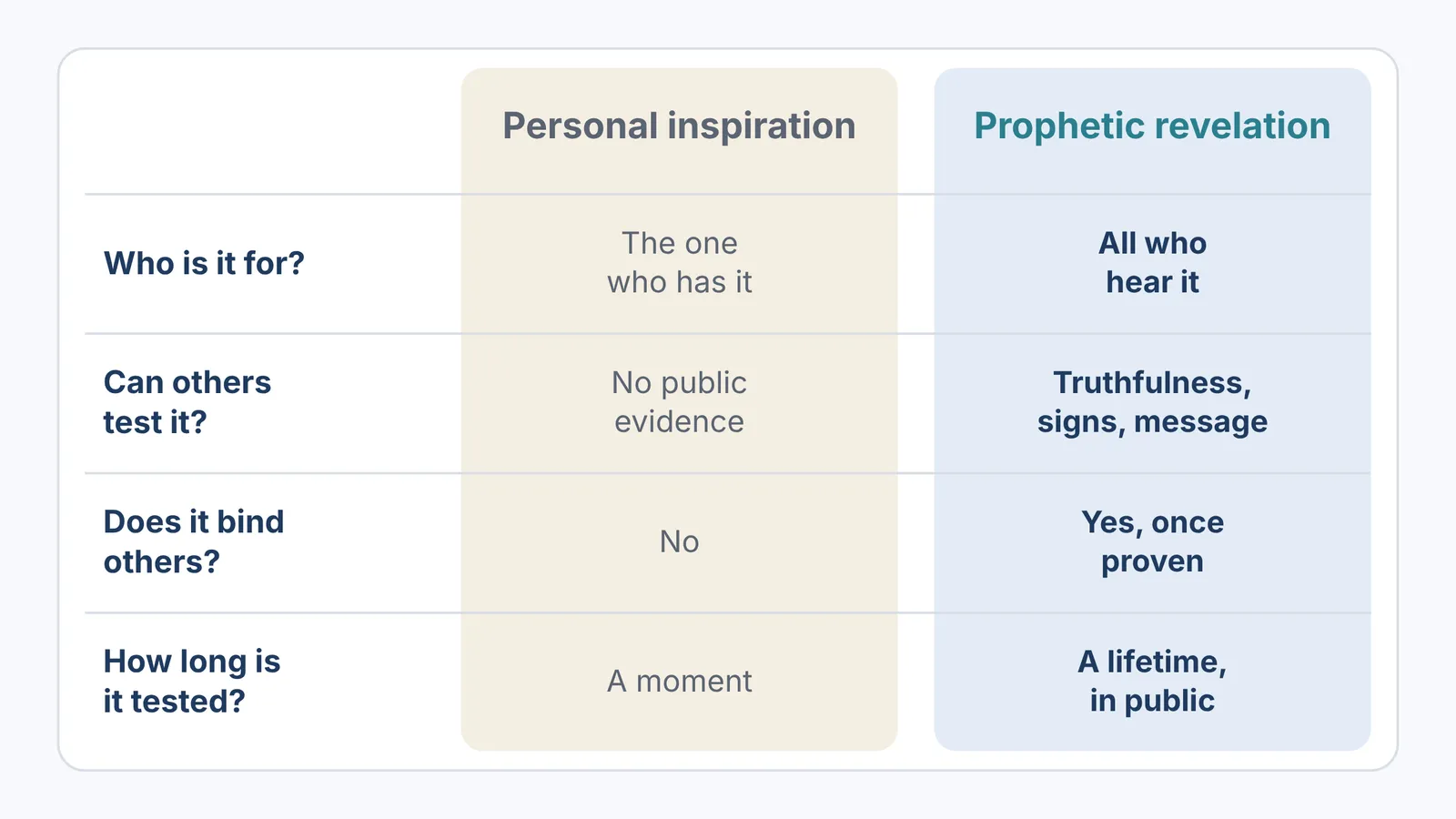
The difference between the two is not the intensity of the feeling. It is the scope of the claim. "I felt guided" is a claim about yourself. "God has sent me to you" is a claim about everyone who hears it.
Dreams and inspiration: real, but private
Islam does not dismiss dreams or inner promptings. The Prophet ﷺ said that dreams are of three kinds: a good dream that is glad tidings from God, a distressing dream that is from Satan, and a dream that comes from what a person has been thinking about16.
That short hadith says a great deal. A dream can be a gift. It can also be a disturbance, or just the mind replaying its day. And from the inside, all three can feel vivid and important. A good dream is glad tidings for the one who sees it; it is not a law for anyone else.
Prophets are different. The dream of Abraham, in which he saw himself sacrificing his son, was a command he and his son understood as binding9. But that was because Abraham was already an established prophet, and a prophet's dream is revelation. The authority came from the prophethood, not from the dream itself.
So Sunni scholars hold that no dream, inspiration or vision of anyone after the prophets can create a belief or a law that obliges others. It can comfort you, warn you, or encourage you. It cannot command your neighbour. And the same rule protects the dreamer first: no one can be drawn into harming himself or others because of a dream or an inner voice.
What makes a claim binding on others?
If a message from one person is to oblige all people, it needs more than the sincerity of the one who received it. Reason asks for at least four things.
A truthful messenger. Is the person known for honesty before his claim? Does he gain wealth, power or pleasure from it? A liar about God would be committing the gravest lie possible, and the Qur'an says so: Who is more unjust than one who invents a lie against God, or says "It was revealed to me" when nothing was revealed to him?4. A claim that serious calls for a life that can bear the inspection.
Signs beyond human ability. If God sends someone, it is reasonable that He supports him with evidence that no ordinary person could produce, so that the claim does not rest on his word alone.
A message worthy of God. Does the content describe God without flaws? Does it agree with sound reason and with what was truly revealed before? Is it free from contradiction? The Qur'an invites exactly this test of itself2.
Consistency over time. A passing experience lasts an evening. A genuine mission lasts years, in public, through success and defeat. Does the messenger's conduct match his message? Does he ever bend the message to suit himself?
None of these can be applied to a private experience, because a private experience comes with no public evidence. All of them can be applied to a prophet.
How revelation came to the Prophet ﷺ
Look now at how revelation actually began for Muhammad ﷺ, as his wife Aishah reported it. He used to retreat to the cave of Hira to worship. One day the angel came to him and said, "Read." He answered, "I am not a reader." The command was repeated until the first verses were given. He returned home with his heart trembling, saying "Cover me, cover me", and told Khadijah that he feared for himself. She reassured him by naming his character: he kept family ties, carried the burdens of the weak, honoured guests, and helped people in hardship; God, she said, would never disgrace him. She then took him to her cousin Waraqah, a learned Christian, who recognised in his account the same angelic messenger who had come to Moses15.
Notice what is missing from this account. He was not seeking a vision. He did not announce a new religion out of an ecstatic moment. He was afraid, and he asked others whether something was wrong with him. That is not how self-made prophets usually describe their calling.
When a companion later asked him how revelation came, he said: "Sometimes it comes to me like the ringing of a bell, and that is the hardest on me; then it leaves me and I have retained what was said. Sometimes the angel takes the form of a man and speaks to me, and I retain what he says." Aishah added that she had seen revelation descend on him on a bitterly cold day, and when it lifted his forehead was dripping with sweat14. The Qur'an itself had said: We will cast upon you a weighty word12.
And what came was not a mood but words, precise words that he recited exactly. In the early days he moved his tongue quickly to keep up with the angel, and God told him: Do not move your tongue with it in haste. It is upon Us to gather it and to recite it. So when We have recited it, follow its recitation13. When his opponents asked him to bring a different Qur'an or change it, he was told to reply: It is not for me to change it of my own accord; I only follow what is revealed to me5.
Then that revelation was tested in public for twenty-three years: in poverty and power, persecution and victory, grief and joy. It even corrected the Prophet ﷺ himself on occasion, something a man composing his own scripture would hardly do. This is what the Qur'an means when it says of him: He does not speak from his own desire; it is only a revelation revealed11.
When private visions become scripture
The distinction between private experience and tested revelation matters most when a personal vision becomes the foundation of a religion others are asked to follow.
Consider an example many Christians will know well. Paul did not accompany Jesus during his ministry, yet his letters make up a large part of the New Testament and shaped Christian doctrine deeply. His authority rests on a revelation he says he received personally: "For I neither received it of man, neither was I taught it, but by the revelation of Jesus Christ" (Galatians 1:12, KJV). Christians point out that the other apostles later accepted him (Galatians 2:9). The fair question remains: what evidence, open to others, shows that this private revelation came from God?
The same question applies to every modern founder who announces "God has revealed to me" and builds a following. Islam's answer here is protective. Muhammad ﷺ is the seal of the prophets8, and the religion has been completed3. No one after him can claim a revelation that binds you. No guru, preacher or visionary can say "God told me" and rewrite what God has said. Your faith is anchored to a text that was tested in public, not to anyone's private experience, including your own.
"My inner experience of God is as valid as any prophet's"
This objection deserves respect, because it usually comes from someone who has felt something real. "I have felt God's presence. I know He loves me. Why should a man in seventh-century Arabia have more access to God than I do?"
First, Islam does not deny your experience. God is near; He answers whoever calls on Him1. A moment of nearness, of being heard, of peace, may well be a mercy from Him.
But "valid for me" and "valid for everyone" are different claims. If every sincere experience were equal to prophecy, then experiences that contradict each other would all be true at once: one person feels God is three, another that He is one, another that everything is God. They cannot all be revelation. Something must decide between them, and a feeling cannot decide between feelings.
Second, the prophets did not ask to be believed because of the intensity of their experiences. They came with evidence others could examine: a life of truthfulness, signs, and a message that held together. Your experience has no such public evidence, not because it is worthless, but because it was never meant to carry that weight.
Third, consider what your experience may be pointing to. A real sense that God is near and loving is exactly what the Qur'an describes. Perhaps it is not a rival to the Prophet's message, but an invitation to it.
A dream may comfort you. Only a tested revelation can command others.
Questions you may have
Do Muslims believe God still inspires people today?
Yes, in the general sense. A believer may be granted a true dream, a sudden clarity or a sense of guidance. But none of it adds to the religion or binds anyone else, and all of it is weighed by the Qur'an and the authentic Sunnah.
How can I tell whether a dream I had was from God?
You cannot be certain from the dream alone. If it encourages good and agrees with what God has revealed, take it as glad tidings and be grateful. If it frightens you or pushes you towards something God has forbidden, the Prophet ﷺ taught that such dreams are from Satan and should not be followed16.
Were the Prophet's companions convinced only by his experiences?
No. They knew him for decades as truthful before revelation, heard a text they could not match, and watched his life for years. His experience of revelation was the source; the evidence was public.
Think of a moment when you felt close to God. If you wanted someone else to believe what you learned in that moment, what evidence could you give them?
Show a thought
Most of us realise we could share the feeling but not prove it. That is not a weakness of your experience; it shows why God sent messengers with public evidence. Your experience may be where your search began; a tested revelation is where it can find solid ground.
We began with a colleague and his dream about your car. You did not need to doubt his sincerity to know that his dream did not bind you. That same good sense is what Islam applies to every claim of revelation.
The beauty of the Islamic position is that it honours your inner life without handing it to anyone else's control, including your own moods. It welcomes the true dream and the moment of nearness, and anchors both in a revelation that came with evidence, was tested in public for a lifetime, and can still be examined today.
Your next step
Sources (16)
- Qur'an 2:186 (al-Baqarah)
- Qur'an 4:82 (al-Nisa')
- Qur'an 5:3 (al-Ma'idah)
- Qur'an 6:93 (al-An'am)
- Qur'an 10:15 (Yunus)
- Qur'an 16:68 (al-Nahl)
- Qur'an 28:7 (al-Qasas)
- Qur'an 33:40 (al-Ahzab)
- Qur'an 37:102 (al-Saffat)
- Qur'an 42:51 (al-Shura)
- Qur'an 53:3–4 (al-Najm)
- Qur'an 73:5 (al-Muzzammil)
- Qur'an 75:16–18 (al-Qiyamah)
- Sahih al-Bukhari 2
- Sahih al-Bukhari 3
- Sahih Muslim 2263