What would it take for you to believe that a man had been sent by God?
Imagine a stranger at your door. He says: "I bring a message from your father, who lives far away." You do not slam the door, and you do not hand over your house keys. You ask questions. Who is this man? Has anyone known him to lie? Does the message sound like your father? Does he know things only your father could know? And what does he want from you?
Without noticing, you have just used the method this page is about. Faith in a prophet is not meant to be a leap in the dark. It is meant to be the conclusion of questions like these, asked honestly.
A claim must come with evidence
Anyone who says "God sent me" is either lying, sincerely mistaken, or telling the truth. The page on the qualities of prophets (B024) explains how character helps tell these apart. Here we widen the view: what kinds of evidence can show that a claim is true?
The Qur'an never asks people to accept a messenger on his word alone. It says: لَقَدۡ أَرۡسَلۡنَا رُسُلَنَا بِٱلۡبَيِّنَٰتِ
10, We sent Our messengers with clear proofs. Ibn Taymiyyah explained that God's wisdom requires the signs of a true messenger to be clear enough for those he addresses and for anyone who examines his claim fairly17.
A prophetic claim has several sides. It is made by a particular person, it carries a particular message, it is accompanied by particular signs, and it unfolds as a public mission in history. So the evidence can concern any of these four: the claimant, the message, the signs, and the mission18.
Six lines of evidence
Muslim scholars, from Ibn Taymiyyah to later writers on the "proofs of prophethood", gathered these into several lines1718:
- Character. Was he truthful before the claim, and did he stay so after it? Did he gain wealth, power or pleasure from it? Did he live by what he taught? A liar usually wants something; a deluded man drifts and contradicts himself. The Qur'an invites people to judge the Prophet ﷺ calmly, away from the crowd:
قُلۡ إِنَّمَآ أَعِظُكُم بِوَٰحِدَةٍۖ أَن تَقُومُواْ لِلَّهِ مَثۡنَىٰ وَفُرَٰدَىٰ ثُمَّ تَتَفَكَّرُواْۚ مَا بِصَاحِبِكُم مِّن جِنَّةٍۚ
8, Stand for God, in pairs or alone, then reflect: there is no madness in your companion. - The content of the message. Does it call to the worship of the one God, in line with the prophets before? Is it coherent, morally upright, free of contradiction3? This test comes first, because a message that leads away from God cannot be from Him, however impressive its messenger. The Bible states the same principle: if a prophet gives a sign or a wonder and it comes to pass, yet he says "Let us go after other gods", Thou shalt not hearken unto the words of that prophet (Deuteronomy 13:1-3, KJV)19.
- Signs (miracles). An act beyond human power, linked to the claim, that no one can match. When Moses feared that people would not believe him, God gave him the staff that became a serpent, That they may believe that the LORD God of their fathers… hath appeared unto thee (Exodus 4:5, KJV)19. The Prophet ﷺ said: "There was no prophet among the prophets but he was given signs the like of which people believed in; what I have been given is a revelation"15. The Qur'an itself is the sign that remains.
- Fulfilled foretelling. Statements about the future, or about hidden things, that a man could not know by himself, and that came true. When the Byzantines had just been defeated, the Qur'an announced: The Romans have been defeated in the nearest land, and after their defeat they will be victorious within a few years7.
- Earlier glad tidings. Did earlier prophets speak of him? The Qur'an says he is described in the Torah and the Gospel4, and that Jesus announced a messenger to come after me, whose name is Ahmad12. The page B031 examines this line.
- The outcome of the mission. Did the message survive opposition, transform people for the better, and leave a lasting community of worship? The Qur'an states a principle: God has written: I and My messengers will surely prevail11.
None of these lines works alone. Exceptional honesty might be explained as rare virtue; one prediction as a lucky guess; success as political talent. The force lies in their convergence. Lifelong truthfulness, no worldly motive, a message of pure monotheism, signs, fulfilled predictions and a lasting outcome, all in one person, place a heavy burden on any explanation that says "liar" or "deluded"18. How independent pieces of evidence strengthen one another has its own page (BA19).
Heraclius: a test from an opponent's mouth
One of the clearest examples of this method comes not from a Muslim, but from the Byzantine emperor Heraclius. Al-Bukhari records it at the very beginning of his Sahih14.
When the Prophet's ﷺ letter reached him, Heraclius summoned Arabs who were in his lands. Among them was Abu Sufyan, at that time the Prophet's leading opponent. Heraclius placed him in front and his companions behind him, and told them: if he lies, say so. Abu Sufyan later admitted that only fear of being exposed as a liar stopped him from lying about the Prophet ﷺ.
Then Heraclius asked, one by one: What is his lineage among you? Did anyone among you make this claim before him? Was any of his forefathers a king? Do the nobles follow him or the weak? Are they increasing or decreasing? Does anyone leave his religion out of displeasure with it after entering it? Did you accuse him of lying before he made his claim? Does he betray? Have you fought him, and how did it go? What does he command you?
Each answer was weighed. No forefather was a king, so he was not trying to recover a throne. No one before him had made the claim, so he was not imitating. They had never accused him of lying, and Heraclius concluded: "I knew that he would not refrain from lying about people and then lie about God"14. He did not betray. His followers kept growing, and those who entered did not leave out of dislike. And he commanded them to worship God alone, without partners, and to pray, be truthful, be chaste and keep family ties.
Notice what Heraclius did. He did not ask for a miracle. He examined character, motive, message and the pattern of the mission, using an enemy as his witness. These are rational, public questions that anyone can ask. The same report also carries an honest warning: when Heraclius sensed his nobles' hostility, he drew back. Knowing where the evidence points and following it are two different things.
One scale for every prophet
Now comes the question of consistency, and it deserves to be asked with respect.
How does a Jewish believer know that Moses was a prophet? He did not see the staff or the sea. He accepts Moses because of the message of the one God, the signs reported by the community that witnessed them, and a tradition that carried those reports across the generations. How does a Christian know the miracles of Jesus? Through the testimony recorded in the Gospels. In both cases, the reasons are the same kinds of reasons listed above: character, message, signs known through testimony, and the effect of the mission.
Muslims accept Moses and Jesus too, and honour them deeply. But we ask: if these criteria are sound enough to accept Moses and Jesus, what happens when the same criteria are applied to Muhammad ﷺ? His character is known in unusual detail, through named witnesses, including enemies. His message is pure monotheism, exactly the content test of Deuteronomy 13. His signs and predictions were reported through chains of named transmitters, examined by a discipline built precisely to sift reports16. His central sign, the Qur'an, is still in our hands.
Consistency leaves two honest options. Either the criteria are valid, and then Muhammad ﷺ must be examined by them as seriously as Moses and Jesus were. Or they are not valid, and then the grounds for accepting the earlier prophets fall too. What cannot be justified is to use the criteria up to a certain prophet and then switch them off. The Qur'an asks believers to say: We make no distinction between any of them2.
A test the Qur'an invites
There is something beautiful in a revelation that hands you the tools to examine it. The Qur'an does not say "do not ask". It says: If you are in doubt about what We sent down to Our servant, then produce a chapter like it1. It says: Will they not reflect on the Qur'an? Had it been from other than God, they would have found much contradiction in it3. And it tells you to think it over alone or with one companion8, away from the pressure of crowds, family and habit.
It also makes the stakes plain. The Qur'an says that if the Prophet ﷺ had invented anything in God's name, God would have seized him13. A message that so openly exposes itself to testing is not the behaviour of a fraud.
This fits what Islam says about faith in general: faith built on knowledge9, and a call made with clear insight5. God gives proofs because He respects the mind He created, and because He wants your faith to be your own conclusion, not someone else's pressure.
"Miracles can't be verified today"
The strongest form of the objection: I cannot rerun a miracle in a laboratory. Every religion has ancient stories of wonders. Reports can be exaggerated or invented. So miracles cannot count as evidence for anyone living today.
Part of this is correct, and Islam's own scholarship admits it. For later generations, sensory miracles are not seen; they are known through testimony, and their weight depends on the authenticity of the reports18. But look at what follows.
First, almost all history is known through testimony. You did not see the Roman Empire, and you do not doubt it existed. The real question is not "Did I see it?" but "How good is the testimony?" Many independent witnesses, public events before hostile audiences, early recording and named chains of transmitters make testimony strong. Muslim scholars built an entire science to check exactly these things.
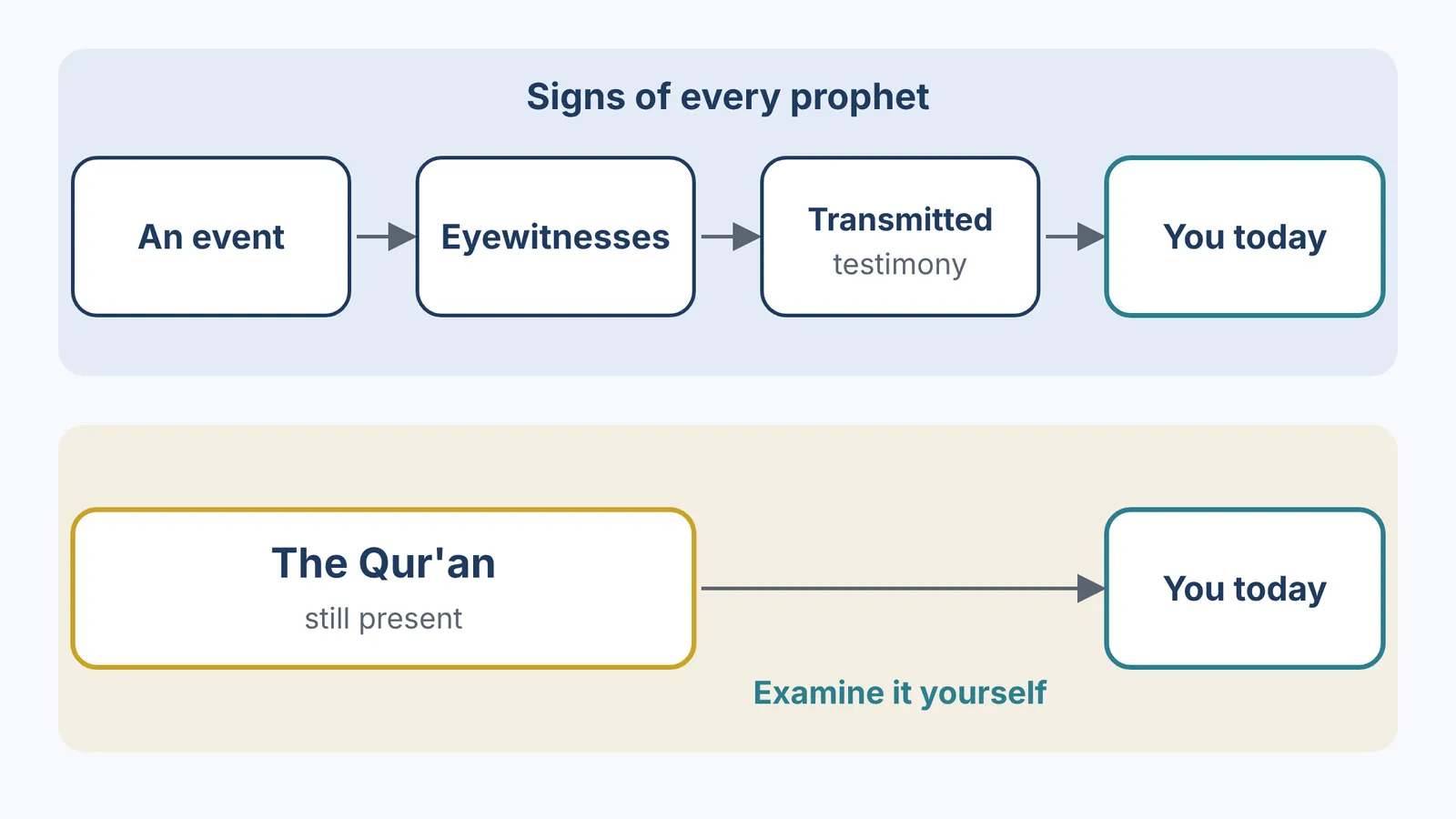
Second, the objection cuts equally against every prophet. Whoever accepts the miracles of Moses or Jesus accepts them through testimony. If testimony is never enough, those must be dropped as well. If it can be enough, the reports about Muhammad ﷺ deserve the same examination.
Third, not every sign is in the past. The Qur'an is present. Its challenge1 still stands, and you can read it, test its coherence and compare it with any text you like. Its predictions, such as the victory of the Romans7, can be checked against history.
Fourth, miracles are one line among six. Even if you set every sensory miracle aside, character, message, fulfilled foretelling and the outcome of the mission remain. A cumulative case does not collapse when one strand is questioned.
Finally, if someone decides in advance that no report of a miracle could ever be true, that is not neutrality. It is a prior commitment that the conclusion is already "no". Honest inquiry keeps that door open and weighs the evidence.
Faith in a prophet is not a leap in the dark. It is the conclusion of honest questions, asked with the same fairness for every prophet.
Questions you may have
What is the difference between a miracle and magic?
Magic is a learned skill: others can learn it, match it or undo it, and it is usually practised for gain. A prophet's sign is tied to his claim, comes with a challenge that no one meets, and belongs to a man whose life and message are otherwise upright. Moses' contest with Pharaoh's magicians, who ended up prostrating and believing6, is the Qur'an's own example of the difference.
Is one line of evidence ever enough?
For some people one line is decisive: the Qur'an itself, or the Prophet's ﷺ character. But the strongest position is the cumulative one, because each line answers a different alternative explanation. The page BA19 explains how independent evidence combines.
Which of the six lines of evidence would matter most to you if you were judging a man who claimed to be a prophet? Would you apply it equally to every prophet you already accept?
Show a thought
Most people find that their real standard is a combination: a truthful man, a sound message, and something beyond ordinary human ability. That is exactly the standard the Qur'an invites. The only demand it adds is fairness: the same scale for every claimant.
The stranger at your door can be tested. So can a man who says God sent him. Islam does not fear that test. It sets it out, applies it to every prophet, and invites you to apply it to Muhammad ﷺ yourself.
The next steps follow from here: how separate pieces of evidence combine into one case, what rational conclusions they support, and what the evidence for Muhammad's ﷺ prophethood actually contains.
Your next step
Sources (19)
- Qur'an 2:23
- Qur'an 2:136
- Qur'an 4:82
- Qur'an 7:157
- Qur'an 12:108
- Qur'an 20:70
- Qur'an 30:2–4
- Qur'an 34:46
- Qur'an 47:19
- Qur'an 57:25
- Qur'an 58:21
- Qur'an 61:6
- Qur'an 69:44–47
- Sahih al-Bukhari 7
- Sahih al-Bukhari 4981; Sahih Muslim 152
- Sahih Muslim, Introduction: saying of Abdullah ibn al-Mubarak on the isnad
- Ibn Taymiyyah, al-Nubuwwat
- Ibrahim Elshahat, The Rational Sunnah-Based Proofs of Prophet Muhammed's Truthful Prophethood (PhD thesis, University of Malaya): evidence concerning the claimant, the message, the signs and the mission; cumulative convergence; the limits of testimony for later generations
- The Bible, King James Version: Exodus 4:5; Deuteronomy 13:1-3 (quoted as the object of comparison, not as an authority for Islam)