If someone asked you right now, "Are you happy?", what would you measure your answer by?
Imagine two days of your life. The first is a perfect day off. You sleep in, eat food you love, buy something you have been waiting for, and laugh with friends until evening. Then you lie down at night, switch off the light, and a vague emptiness creeps in. You cannot say where it comes from.
On the second day you are worn out. You sat up with a sick relative, or spent the whole day helping a friend through a crisis, and never found time for a proper meal. Yet when your head touches the pillow you feel a deep stillness, as if something inside you has settled into place.
Which day was happier? If you hesitate, it is because "happiness" is a word we use for several different things, and we mix them up every day.
Four layers under one word
When we say "I'm happy" we may mean one of four things, and each has its own nature.
Pleasure is a pleasant sensation that usually comes from outside: a taste, a sound, a view, a new purchase, a notification on your phone. It is real and good, but it is short-lived, and it weakens the more it is repeated.
Satisfaction is your judgement that life is going as it should. It is not a passing sensation but an assessment: my job is fine, my home is stable, things are reasonable. It lasts longer than pleasure, but it is heavily shaped by comparison with others and by what you expected.
Meaning is the sense that what you do is worth doing, that it connects to something larger than you. A mother sitting up with her baby does not enjoy the sleepless night, but she does not see it as pointless. Meaning can coexist with fatigue; often it is born from it.
Tranquillity is the stillness of the heart before the big questions: Who am I? Why am I here? Where am I going? Am I safe? It is not loud joy. It is a quiet settledness deep down that stays even when the surface is shaken.
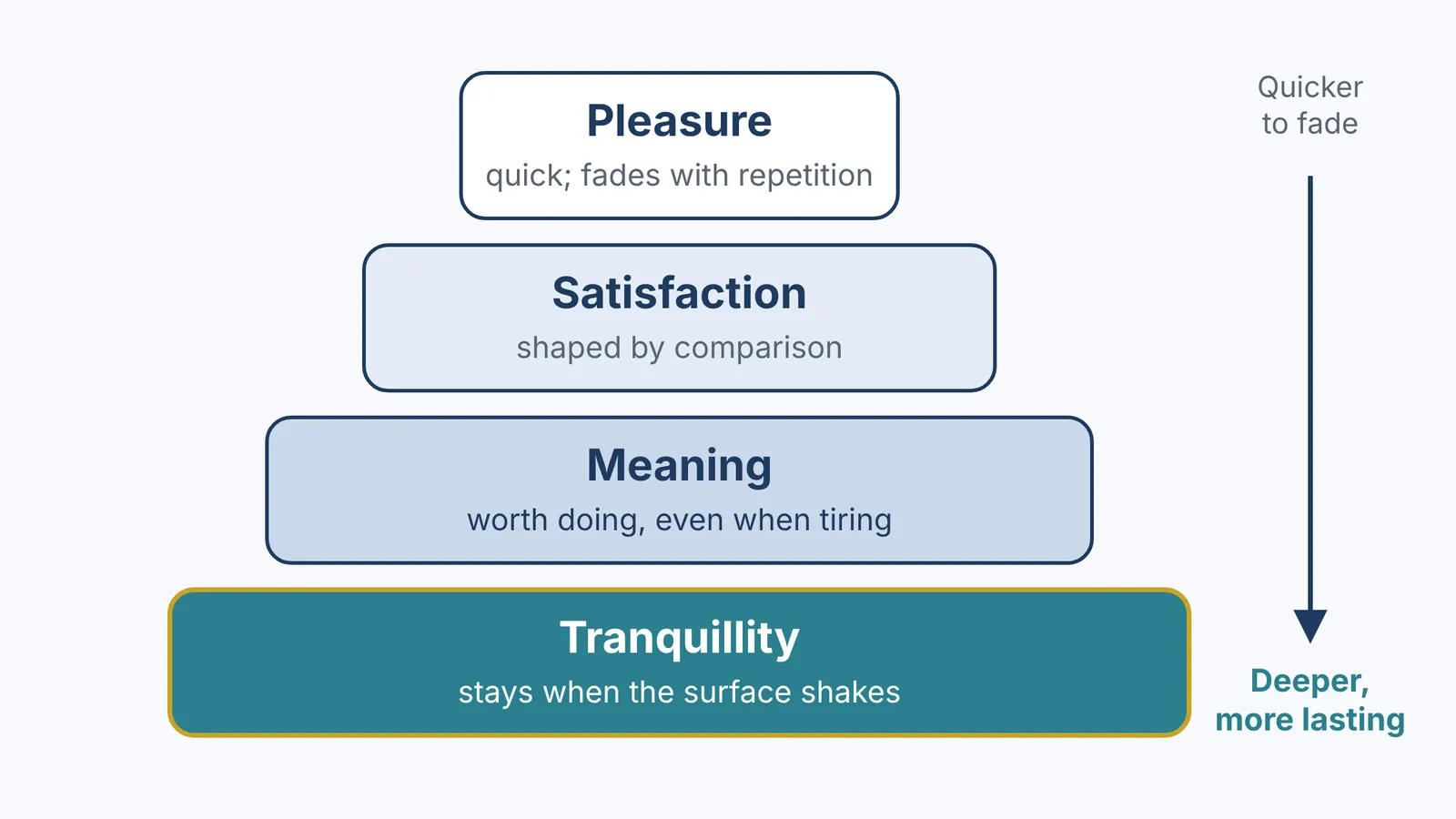
Go back to the two days. On the first, pleasure was plentiful, but the deeper layers were empty. On the second, pleasure was almost absent, but meaning was there, and with it some tranquillity. That is why the second night gave you what the first could not.
The "and then what?" question
Try a simple exercise. Take anything you are working towards and ask yourself: and then what?
I want to buy this phone. And then what? I'll enjoy it. And then what? I'll get used to it and wait for the next one. I want a promotion. And then what? I'll feel better about myself. And then what? I'll want the next promotion, or one day I'll retire. I want to raise a family. And then what? The children will grow up and go their own way. And then what?
Notice what happens. Each layer asks the one beneath it, "What for?" Pleasure needs satisfaction to justify it, satisfaction needs meaning to support it, and meaning itself needs a final answer about where a human life is heading. If the chain ends in something that passes away, the last question hangs in the air, and the heart senses that the ground beneath it is not quite solid.
This does not mean pleasure is bad or satisfaction an illusion. It only means each layer rests on the one below. Building happiness on the top layer alone is like building a beautiful upper floor with no foundation: it looks wonderful in calm weather and shakes at the first strong wind.
That is why you meet people with plenty of pleasure and the kind of outward success others envy, who still describe an emptiness they cannot explain. And you meet others with far less of this world who carry a striking calm. The difference is usually not the amount of pleasure. It is the depth of the foundation.
"A good life": what the Qur'an promises, and what it doesn't
The Qur'an speaks about happiness with remarkable precision. It does not promise believers a life without pain. It promises a good life. In meaning: Whoever does righteous deeds, male or female, while being a believer, We will surely give them a good life4.
Ibn Kathir, in his commentary, gathers what the early Muslims said about this "good life": some said lawful, wholesome provision; some said contentment; some said happiness; and he concludes that the good life includes all of these11. Notice that contentment is not something you can buy. It is a state of the heart. The promise is not more things; it is living well with what you have.
The Qur'an then names the place of tranquillity clearly: Surely in the remembrance of God do hearts find rest2. It does not say hearts "rejoice" or "are entertained". It says they find rest. Remembering God speaks to the deepest layer, the stillness of the heart before the big questions. Whoever knows they have a merciful, wise Lord, who sees what they go through and will repay it, has an answer to "and then what?" that does not break.
In contrast, the Qur'an describes the one who turns away from this remembrance: Whoever turns away from My remembrance will have a life of narrowness5. Ibn Kathir explains that this narrowness is felt in this world too: such a person has no tranquillity and no ease of heart, even if outwardly they enjoy themselves and eat and wear whatever they wish11. It is an exact description of what many people report today: a full surface and a cramped depth.
How faith rearranges the layers
The beauty of Islam here is that it does not ask you to demolish the upper layers to reach the deep one. It asks you to put each in its proper place.
Pleasure becomes a gift to be thanked for. A Muslim eats, drinks, dresses well and enjoys what God has made lawful, but sees all of it as a gift from his Lord. Gratitude changes the taste of pleasure itself: someone who sees a thing as a present enjoys it more than someone who sees it as something owed. And God promises the grateful more: If you are grateful, I will surely give you more3.
Satisfaction is freed from comparison. In the usual picture, satisfaction depends on comparing yourself with others, so it wobbles whenever you see someone higher. In Islam, contentment rests on trust in God's wisdom in what He apportions. The Prophet ﷺ said: "How wonderful is the affair of the believer; all of it is good, and that is for no one except the believer: if something good happens to him he is grateful, and that is good for him; if harm befalls him he is patient, and that is good for him"7. Here the good does not depend on what kind of day you have, but on how you receive it. That is a profound shift: your happiness is no longer hostage to what happens to you.
Meaning reaches every detail. In Islam an ordinary daily task can become worship through intention: feeding your children, doing your job well, a kind word to a neighbour. The Prophet ﷺ said, "Actions are only by intentions"8. No corner of a believer's life is left outside the circle of meaning.
Tranquillity finds its anchor. At the end of the road, the Qur'an addresses the soul that lived on this foundation: O tranquil soul, return to your Lord, well-pleased and well-pleasing6. Look at those two words. Pleased, and pleasing: contentment running both ways. The soul is content with its Lord, and its Lord is content with it. What happiness could be more complete?
None of this means a believer never grieves. The Prophet ﷺ wept when his infant son Ibrahim died, and said: "The eye weeps and the heart grieves, and we say only what pleases our Lord"9. Tears on the surface, contentment in the depths. Both layers live in a single heart.
"Happiness is just brain chemistry"
This is a serious objection, and it is often made with scientific confidence: everything you call happiness is nothing but chemicals and neural activity. Psychiatric medication really does change mood. So why talk about "meaning" and "tranquillity" as if they floated above the body?
Start with what is true in it. Yes, every feeling has a trace in the brain, and the body is a real partner in our mental state. Islam does not deny this. It encourages treatment, and the Prophet ﷺ said: "God has not sent down any disease without also sending down a cure for it"10. Someone with depression or a clinical anxiety disorder should seek specialist care; it is legitimate and wise, and it does not conflict with faith.
But notice what the objection misses. That a feeling has a chemical side does not make it "just" chemistry. A piece of music you love has a physical explanation in vibrating air, yet no one says its beauty is "just" sound waves. Chemistry describes how we feel. It does not tell us what is worth feeling, or why.
Chemistry also responds to meaning. The same news, understood in two ways, produces two different reactions in the body. The same exhaustion crushes someone who sees it as pointless and is carried lightly by someone who does it for a person they love. The story you hold about your life reaches all the way to your nerves.
Finally, ask yourself honestly: if a machine could keep you in permanent euphoria while you lay still, doing nothing, loving no one for real and knowing nothing true, would you agree to live in it for the rest of your life? Most people refuse. We do not only want to feel happy; we want our happiness to be real: real love, true meaning, safety that is actually there. That refusal is itself evidence that happiness is larger than chemistry.
What remains when the upper layers fall?
Here is the real test of any account of happiness: what is left of it on a bad day?
When you fall ill, pleasure fades. When you lose your job, satisfaction shakes. When the person you lived for leaves or dies, meaning can crack. If all your happiness sits in those layers, you lose everything at once.
But whoever has set tranquillity on a foundation that does not change still has something when what is above it collapses. They still have a Lord who knows, sees and shows mercy; their pain is not wasted; the story is not over yet. That is why faith is not only an ornament for good days. It is support for hard ones.
Pleasure visits the surface; tranquillity lives in the depths.
Questions you may have
Does this mean non-believers can't be happy?
No. Many people without faith enjoy real pleasures, genuine satisfaction, and meaning in their families and work. The question is not whether you can be happy without faith. It is what holds up the deepest layer when the others are tired, and whether "and then what?" ever reaches a final answer.
Doesn't faith make people give up the pleasures of this world?
No. The Qur'an asks, in meaning, who has forbidden the adornment God brought forth for His servants and the good things of provision1. Islam forbids what harms and leaves the door wide open to what benefits and delights. The aim is that pleasure should never become your master, not that you should abandon it.
If I believe and still feel sad, is my faith weak?
Not necessarily. Sadness is part of being human; the Prophet ﷺ grieved and wept. Tranquillity does not prevent sadness, but it keeps sadness from turning into despair. If sadness is long and heavy, seek help from specialists; that too is taking the means God has provided.
Think of the happiest moment of your past year. Which layer did it belong to: pleasure, satisfaction, meaning or tranquillity?
Show a thought
Many people discover that their best moments were not the most pleasurable but the most meaningful or the most still. If that is true for you, you have found a trace of what the Qur'an says: the heart is looking for rest, not only for more things. The next question is where that layer can find a foundation that does not change.
We began with two days: a day full of pleasure that ended in emptiness, and a tiring day that ended in stillness. The difference was not how much you received, but how deep you reached.
Islam does not ask you to hate life in order to love God. It invites you to know God so that life becomes good: to enjoy with gratitude, to be content with trust, to work with intention, and to rest in the One who holds all things. That is the "good life", and its door is open to anyone who knocks. If you would like to know more about the One in whose remembrance hearts find rest, the next step is in your hands.
Your next step
Sources (11)
- Qur'an 7:32 (al-A'raf)
- Qur'an 13:28 (al-Ra'd)
- Qur'an 14:7 (Ibrahim)
- Qur'an 16:97 (al-Nahl)
- Qur'an 20:124 (Ta Ha)
- Qur'an 89:27–28 (al-Fajr)
- Sahih Muslim 2999
- Sahih al-Bukhari 1
- Sahih al-Bukhari 1303
- Sahih al-Bukhari 5678
- Ibn Kathir, Tafsir al-Qur'an al-'Azim, on 16:97 and 20:124