Have you ever, in your whole life, seen something appear out of nothing?
Imagine you are walking alone through a wide desert, with no road and no house in sight. Then, on a rock, you find a lit lamp. The glass is warm and the wick is burning quietly. You stand in front of it with one question you cannot silence: who put this here?
It will not cross your mind that the lamp came from nowhere, or that it made itself and then lit its own wick. Your mind throws out the first two options before you have even thought about them.
That quick movement in your mind is what this page is about. The question is not "Is a reasonable person allowed to believe in God?" It is "Can a reasonable person who thinks all the way through actually avoid it?"
"Allowed" versus "necessary"
Many people today say, kindly enough, "Belief in God is a personal choice." Reason permits it, the way it permits a favourite colour.
Believers do not build their certainty on that. There is a big difference between an idea that is permitted, which reason neither rules out nor requires, and an idea that is necessary, which reason leads to and cannot escape. That your neighbour has a brother in another city is permitted. That your neighbour has two parents is necessary, even if you have never met them.
The claim on this page is of the second kind: that a self-sufficient Creator is not a pleasant possibility but a conclusion reason reaches when it follows one simple question to the end. Where did this come from?
Three options, and no fourth
Two short verses of the Qur'an carry this whole argument. In meaning: Were they created from nothing, or are they the creators of themselves? Or did they create the heavens and the earth? No, they lack certainty5.
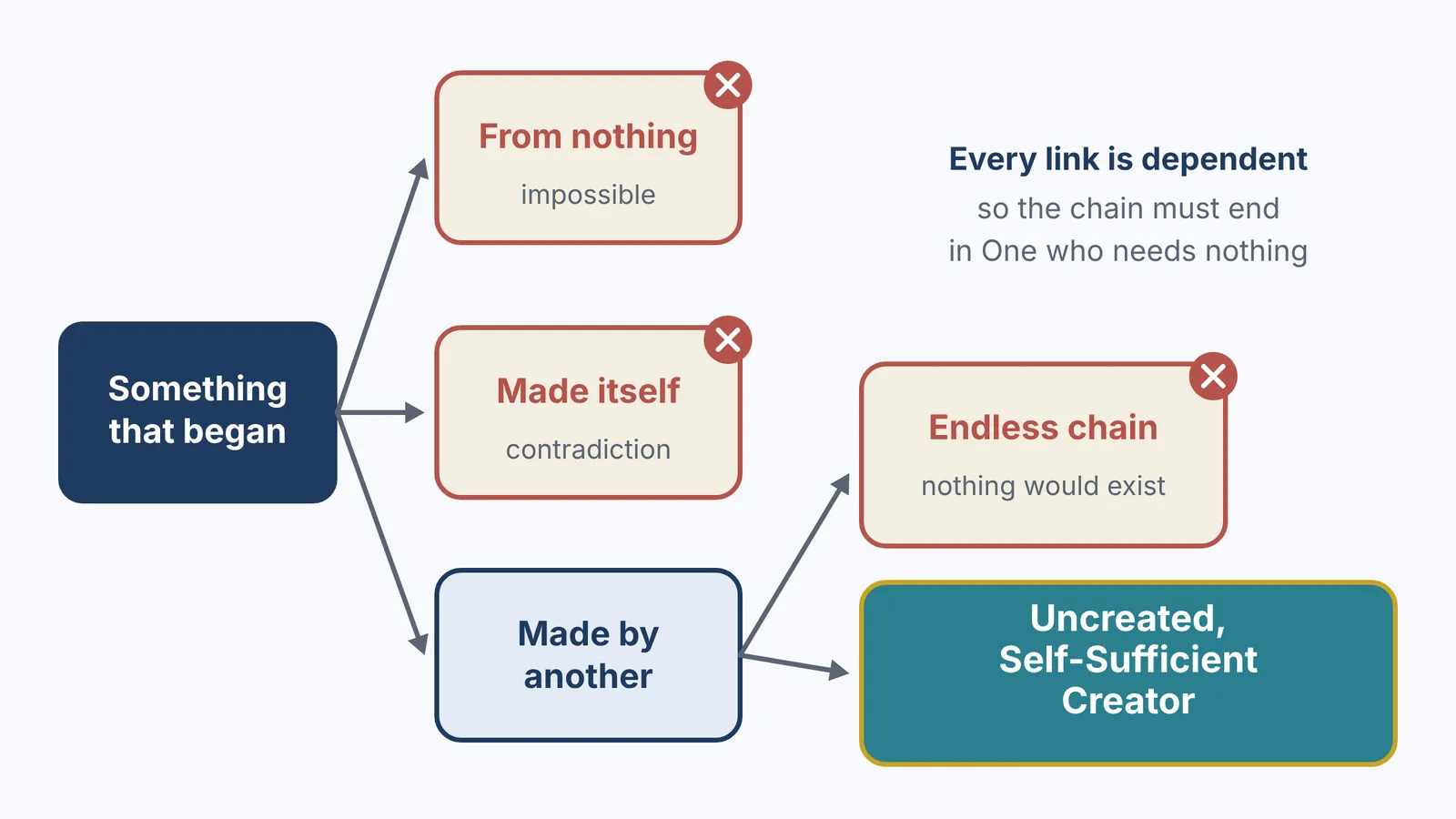
The verses do not hand you a ready answer. They put a choice in front of you. You exist, and a few decades ago you did not. How did you come to be? There are only three options:
- You came from nothing: no cause, no one who brought you about. Reason rejects this just as it rejected the lamp appearing from nowhere. Nothing is not a thing at all, so it has nothing to produce anything with.
- You created yourself: stranger still. To make yourself you would have to exist before you existed, existing and not existing at once. That is a contradiction.
- Something other than you brought you into being: the only option left standing.
Then the second verse widens the frame. If someone says humans came from other causes in nature, did those people create the heavens and the earth? Nobody claims that. And it closes with a precise diagnosis: they lack certainty6. The problem is not missing evidence; it is a missing willingness to let the evidence settle the matter.
Ibn Kathir explains the meaning this way: were they brought into being without anyone bringing them into being, or did they bring themselves into being? Neither; it is God who created them9. The verse lists the possibilities and then drops the false ones one by one.
The chain of the dependent
That leaves the third option: something else brought you about. But the question does not stop there. Your parents also came to exist after not existing. The earth that carried them has a history that began. The sun that powers it has an age. Every link we know in this chain shares one feature: it is dependent.
The centre's course material puts it clearly: everything in the universe has limits and properties, and if the causes that hold it in existence were removed, it would vanish. It is always in need of something beyond itself, and unable to go past its own measure13.
Now look at the whole chain at once. If every link is dependent, piling up dependent things does not produce an independent one. A thousand people in debt do not become a lender by standing together. The whole chain must rest on a being of an entirely different kind: one that needs nothing else to exist, whose existence hangs on nothing, and on whom everything else hangs.
The Qur'an names this in a single word, al-Ghani, the Self-Sufficient. In meaning: O people, you are the ones in need of God, and God is the Self-Sufficient, the Praiseworthy4. The need here is not about money. It is need in existence itself. Everything around you carries that need inside it, and points to the One who needs nothing.
Why an endless chain doesn't help
Someone might ask: why must the chain end? Perhaps every cause has an earlier cause, forever.
Muslim scholars answered with a simple picture13. Imagine a soldier ordered to carry out a sentence. He says, "I won't act until my commander orders me." His commander says, "I won't order it until my superior orders me." And so on, each one waiting for permission from above, with no end. Will the sentence ever be carried out? No. Every link is waiting on the one before it, and no link starts on its own.
So if you see that the sentence has in fact been carried out, you know for certain that the chain ended with someone who did not wait for anyone's permission.
The universe is the same. Things exist, right now, in front of you. If every existing thing were waiting to receive existence from an earlier thing, endlessly, nothing would exist at all. That is why scholars counted the impossibility of an endless chain of causes among the first principles of reason12. A longer chain does not solve the problem. It postpones it. And postponing a question a thousand times is not answering it.
Where do these premises come from?
You have every right to ask: all of this rests on the principle that "whatever begins has a cause". What guarantees that principle?
The answer is that this principle is not a conclusion we argue our way to. It is one of the foundations we argue from. Ibn Taymiyyah gave a well-known example: if a small boy is struck from behind while he is not looking, he spins round and says, "Who hit me?" Tell him "Nobody hit you," and his mind will not accept it13. He never learned that principle at school. He was born with it.
That is why Muslim scholars place causality alongside principles like the impossibility of contradiction, among the innate standards a person is born with and does not need to be taught12. It fits the Prophet's ﷺ words that every child is born upon the fitrah, the original sound nature8.
But fairness means examining the principle, not just announcing it:
- Is causality just a habit we picked up from repetition? If it were, scientists would have no grounds to trust that every result in the lab has a cause worth looking for. All of science stands on this principle, and nobody can live a single day without acting on it.
- Does the principle say everything that exists has a cause? No. Stated precisely: whatever began after not being, or whatever depends on something else for its existence, has a cause. That difference matters, and we will come back to it.
- What about physics talking about things "coming from nothing"? What some theories call "nothing" is in fact a vacuum with energy and laws, in other words something with properties. We go through this on the physics and cosmology pages, so we will not repeat it here.
Believers add a neighbouring argument: the universe does not just exist, it is ordered and finely made, and fine craftsmanship is an act that only comes from a knowing, wise maker13. But even before looking at order, dependent existence on its own is enough to lead reason to the Self-Sufficient.
A faith that starts with proof
You might expect a religion to tell its followers: believe and don't ask. The Qur'an does the opposite. To anyone making a religious claim it says: Bring your proof, if you are truthful1. It criticises following one's forefathers simply because they are forefathers: What, even if their fathers understood nothing and were not guided?2
Notice how the Qur'an addresses people in those two verses of Surat al-Tur. It does not say, "Believe because I say so." It asks questions and lets your mind answer.
The Qur'an praises those who reflect on the creation of the heavens and the earth, and makes that reflection a road to remembering God: those who remember God standing, sitting and lying on their sides, and reflect on the creation of the heavens and the earth: "Our Lord, You did not create all this without purpose"3. In Islam, reason is not faith's opponent. It is faith's front door.
That is why Ibn Taymiyyah devoted an entire work to showing that sound reason never contradicts authentic revelation10. The argument on this page is a case in point: the reasoning a philosopher reaches after long reflection is sitting in two verses that a Muslim may recite in his prayer.
And there is a particular beauty here. The God this argument arrives at is not a cold idea in a philosophy book. He is the Self-Sufficient on whom everything depends, you included. Once you realise that your existence at this very moment rests on Him, the argument turns from an equation in your head into a sense of nearness and gratitude.
"If everything has a creator, who created God?"
This is the strongest and most common objection: "You say everything has a cause. If God exists, He must have a cause too. And if you make an exception for Him, why not make an exception for the universe and be done with it?"
Start by correcting the premise. The argument never said "everything that exists has a cause." It said that whatever began after not existing, and whatever depends on something else to exist, has a cause. That is not a verbal trick; it is the substance of the argument.
Then look at the question itself: "Who created the Creator?" It assumes the Creator is created, then asks who created Him. The contradiction is built into the question11. It is like asking, "What is the name of the bachelor's wife?"
More importantly, the argument itself supplies the answer. We saw that the chain of dependent things cannot go on forever, or nothing would exist. So it must end with a being that is uncreated and depends on nothing. If you say that being has a creator, then it was not the end of the chain, and you are back where you started. "Who created God?" does not knock the argument down. It sends you back to its first step13.
As for "why not make an exception for the universe?": the universe does not have the features of something self-sufficient. Every part of it is limited, changing and dependent on other things, and it had a beginning, as rational and scientific evidence strongly suggests. A whole made of dependent parts is itself dependent. God, by contrast, is as He describes Himself, in meaning: He is the First and the Last, the Manifest and the Hidden, and He has knowledge of all things7. The First, before whom there is nothing, is not asked about His beginning.
A thousand people in need do not add up to one who needs nothing.
Questions you may have
Does this argument prove that the Creator is the God Muslims worship?
It proves an uncreated, self-sufficient, powerful Creator who acts by will and on whom everything depends. Those are core attributes of God as Islam describes Him. Knowing His names and attributes in detail, and how to worship Him, comes through other routes that complete one another: the fitrah, revelation, and the truthfulness of the Prophet ﷺ. You can follow that thread on the page "Who is God?".
Couldn't the universe itself be eternal and need no creator?
Even if we assumed that, the question would remain: is the universe self-sufficient or dependent? Something that lasts a long time does not thereby exist by itself. Everything we know about the universe shows it is made of limited, changing parts. The physical evidence that the universe had a beginning is covered on the physics and cosmology pages.
If belief is natural, why does a believer need an argument at all?
A sound fitrah knows its Lord without a philosophical formula, just as the boy knows that a blow had someone behind it. But the fitrah can be covered over by doubts and habits. A rational argument removes the cover; it does not create something new. It reminds you of what you already knew.
Think of one thing you own or love: a glass of water, a tree on your street, even the breath you are taking now. How many links of "dependence" can you trace back before you reach a question the chain cannot answer about itself?
Show a thought
You will find that every link points to the one before it and never explains itself. That is not a failure of your search; it is the heart of the argument. The dependent points to the Self-Sufficient. Many people who reach this point do not feel they have won a debate. They feel something quieter: that their existence did not come about for nothing.
We began with a lamp on a rock in the desert. You did not need to see who put it there to know that someone did. Your mind answered before you asked.
The Qur'an asks no more of you than to treat the universe the way you treated that lamp, and to follow the question honestly to its end. If you arrive at the Self-Sufficient on whom everything rests, you have reached the start of a road, not its end: who is this Creator, what does He want from you, and how can you know Him? Those questions are worth following.
Your next step
Sources (13)
- Qur'an 2:111 (al-Baqarah)
- Qur'an 2:170 (al-Baqarah)
- Qur'an 3:190–191 (Al 'Imran)
- Qur'an 35:15 (Fatir)
- Qur'an 52:35–36 (al-Tur)
- Qur'an 52:36 (al-Tur)
- Qur'an 57:3 (al-Hadid)
- Sahih al-Bukhari 1358
- Ibn Kathir, Tafsir al-Qur'an al-'Azim, commentary on Surat al-Tur 35–36
- Ibn Taymiyyah, Dar' Ta'arud al-'Aql wa al-Naql
- Islam Q&A — Who Created Allah? (islamqa.info/en/answers/6660)
- Centre course material: Sources of knowledge (innate standards: non-contradiction, causality, impossibility of circularity and endless regress)
- Centre course material: Causality, origination, dependence and objections