If the history of life were a book, what would you make of one short chapter in which most of the main characters walk on stage?
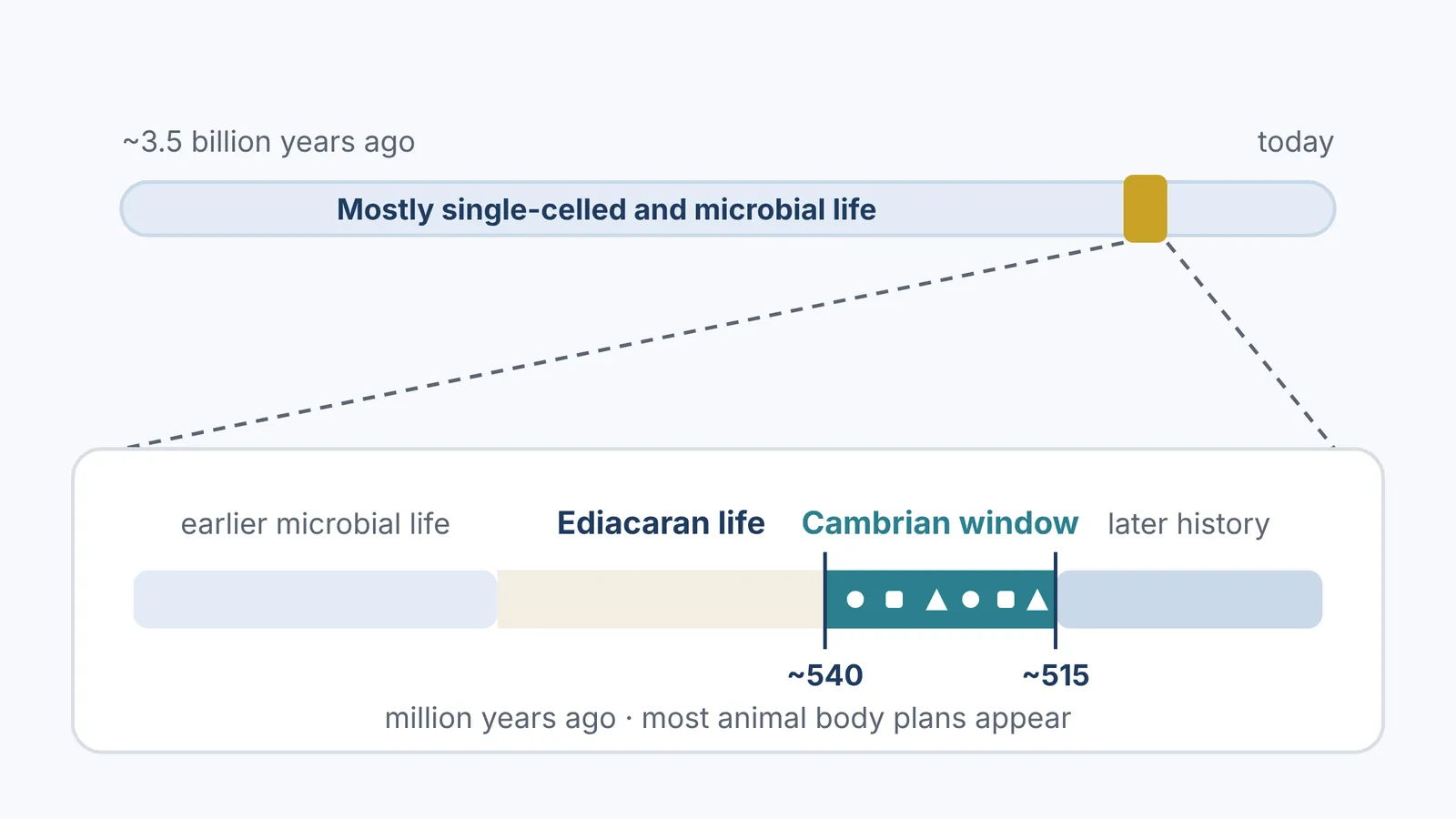
Imagine that book with one page for every million years. Life appears early, and for well over three thousand pages almost everything is microscopic: single cells, thin films of microbes on the sea floor, then simple many-celled organisms. Near the end come some strange soft-bodied forms, hard to place.
Then, within about twenty or thirty pages, the cast fills up. Bodies with jointed legs, shells, guts that run from mouth to exit, eyes, nerve cords, and early relatives of animals with backbones. The rest of the book, all the way to the present, is largely variation on the designs introduced in those pages.
That chapter is what scientists call the Cambrian explosion. It is real, it is fascinating, and it is often used as a slogan by both sides of the evolution debate. This page tries to look at it without the slogans.
What the "explosion" refers to
Geologists divide the history of the earth into periods. The Cambrian period began about 540 million years ago. In rocks from its early part, over a span of roughly twenty million years or a little more, the fossil record shows the appearance of most of the major animal body plans that have left fossils at all.
A body plan is the basic architecture of an animal: whether it is symmetrical, how many tissue layers it has, whether it is segmented, how its gut, nervous system and skeleton are laid out. Biologists group animals with a shared body plan into a phylum. Arthropods (insects, crabs and their relatives) are one phylum; molluscs (snails, clams, octopuses) another; chordates, which include animals with backbones, another. Many of these phyla appear in the fossil record during this window.
Some of the evidence is remarkable. Rock formations such as the Burgess Shale in Canada and the Chengjiang deposits in China preserve not only shells and hard parts but soft bodies: guts, gills, limbs, sometimes even traces of nerves and eyes.
Three points of accuracy matter here. First, life did not begin in the Cambrian; microbial life is far older. Second, there was earlier complex life: the Ediacaran organisms, soft-bodied forms that lived in the tens of millions of years before the Cambrian, and whose relationship to later animals is still debated. There are also burrows and tracks suggesting that some small mobile animals existed shortly before. Third, "explosion" is a geologist's metaphor. Nothing happened overnight. The appearances were spread over millions of years, in stages.
Why it has puzzled people since Darwin
Darwin's theory pictured life branching slowly, through countless small steps. On that picture you would expect a long, finely graded series of ancestors leading up to each major group of animals, and the differences between groups growing gradually over vast stretches of time.
Darwin knew that the fossil record of his day did not show this before the Cambrian. He acknowledged it in his own book as a difficulty for his theory, and he hoped that further discoveries, and the imperfection of the rock record, would account for it.
A century and a half of searching has filled in a great deal. We now know the Ediacaran organisms and the earlier microbial world. Palaeontologists have found Cambrian creatures that seem to combine features of different later groups, which they read as early side branches near the base of those groups. These are genuine findings.
Yet the basic pattern Darwin worried about has not gone away. Many palaeontologists have noted that the large differences between body plans appear early, while much of later history is diversification within plans that already exist. Clear, step-by-step precursors for most of the phyla have not been found in the rocks beneath them. That is why the Cambrian remains a live research question rather than a closed file7.
The explanations on the table
Scientists have proposed several explanations. Each captures something real, and they are often combined.
- Preservation. Soft bodies rarely fossilise. If early animals were small and soft, they may simply have left little trace, and the "explosion" may partly be the moment when animals began to grow hard parts that preserve well.
- Rising oxygen. Larger, active animals need more oxygen. Evidence suggests that oxygen levels in the oceans and atmosphere changed around this time, which may have opened the door to bigger bodies.
- Developmental gene networks. Animals share a "toolkit" of genes that switch other genes on and off during development and lay out the body: head to tail, back to belly, where limbs go. Changes in how these networks are wired could, in principle, produce new arrangements.
- Ecological arms races. Once animals began to hunt and be hunted, there was strong pressure for shells, spines, eyes, speed and burrowing. Each new strategy invites a counter-strategy.
- Hidden earlier ancestry. Comparisons of genetic sequences across living animals ("molecular clocks") suggest that the main animal lineages split well before the Cambrian, perhaps by tens of millions of years. On this view, the ancestors were there, small and hard to fossilise, and the Cambrian is when they became visible.
These are serious proposals backed by real evidence, and several are probably true. The question is whether, together, they explain what most needs explaining.
Conditions are not a blueprint
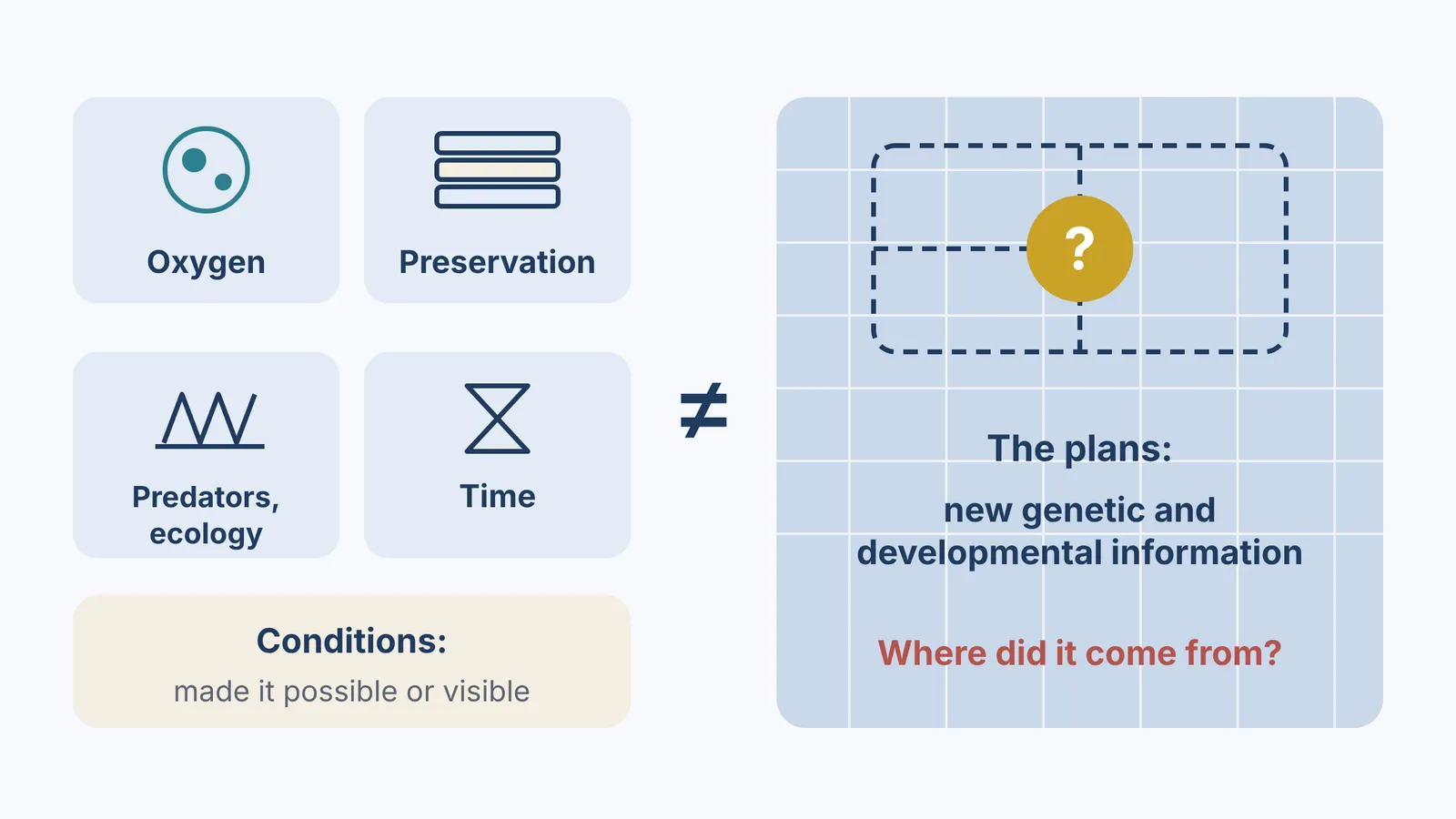
Look at what each explanation actually supplies. Preservation explains why we see animals from this point on. Oxygen explains why large animals became possible. Arms races explain why certain designs became useful. Hidden ancestry explains why the timing in the rocks may be misleading.
All of these are about conditions: the stage, the lighting, the incentives, the visibility. None of them, by itself, tells you where the plans came from.
And plans are what a new body requires. To build an animal with a new architecture you need new cell types, new tissues and organs, and above all a developmental program that tells a single fertilised cell, step by step, how to become that body: which cells divide, when, where, into what. That program is information, written in genes and in the networks that regulate them7.
Think of a factory. Electricity is essential; without it nothing runs. A market is essential; without it nothing gets built. But neither the power supply nor the market writes the engineering drawings for a new engine. Oxygen and predators may explain why the time was right for new animals. They do not explain where the instructions for building them came from.
Why body plans are the hard part
There is a further difficulty, and it concerns the developmental gene networks themselves.
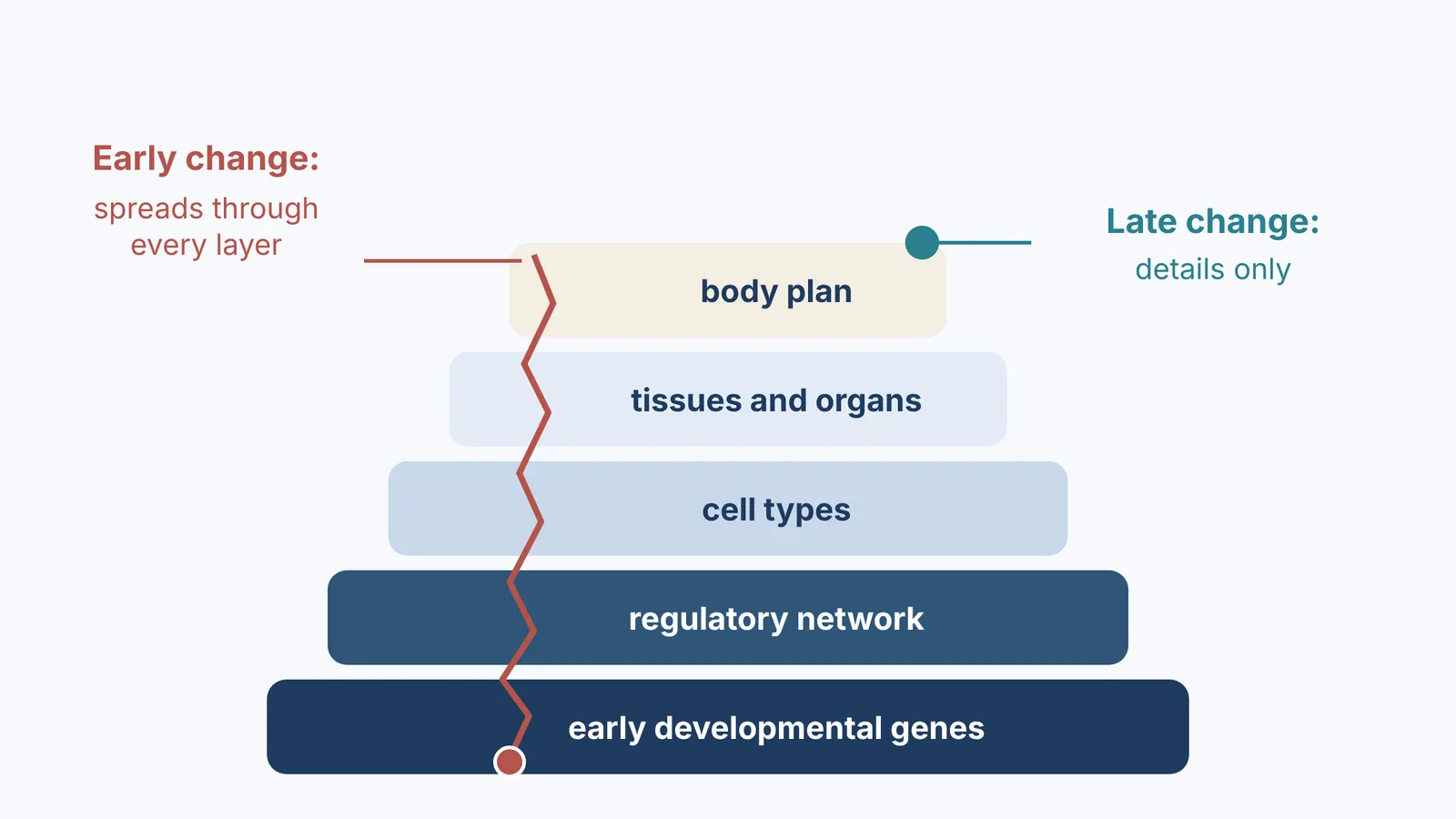
The genes that act earliest in an embryo's development set up the basic layout of the body. Everything later depends on them, as the upper floors of a building depend on its foundations. This is why, in the laboratory, changes to early-acting developmental genes usually have drastic effects, and those effects are very often fatal or crippling. Changes to late-acting genes are far more likely to be tolerated, but they affect details, not the basic plan.
So the very place where a change would have to happen to produce a new body plan is the place where changes are hardest to survive. Critics of the standard account argue that this makes the rapid origin of many new plans especially hard to explain by small, unguided steps9.
Biologists reply that regulatory networks can be rewired in subtler ways, by changing when and where a gene is switched on rather than the gene itself, and that early networks may have been simpler and more flexible than today's. They also point out that much of the genetic toolkit seems to have existed before the Cambrian. That is a fair reply, but notice what it does: it moves the question back in time. If the toolkit was already in place, where did that toolkit, with its finely coordinated switches, come from? The puzzle is relocated, not dissolved.
What the Cambrian does, and does not, show
Honesty here cuts both ways, so do not claim more than the evidence allows. The Cambrian explosion does not, on its own, prove that God exists or that each phylum was created separately. The fossil record is incomplete, new finds keep arriving, and serious scientists are still debating the timing and the causes. Anyone who tells you "the Cambrian destroys evolution" is overselling. Anyone who tells you "the Cambrian is fully explained" is overselling too.
What it does show is the limit of a particular story: the confident claim that blind processes, given enough time, can be relied on to produce whatever we find. Here we find a great deal of new biological design appearing in a relatively short window, and our best explanations account well for the setting but much less clearly for the source of the design10.
That fits naturally with a world in which the rise of life's forms has a purpose and an Author, whatever means He uses. Such a view does not need the Cambrian, but it is not surprised by it.
"He creates whatever He wills"
The Qur'an speaks about the variety of living things with a striking simplicity: God has created every moving creature from water. Some of them crawl on their bellies, some walk on two legs, and some on four. God creates whatever He wills. Truly God has power over all things3. The variety of body forms is not an embarrassment in this view. It is a display.
It also describes God as the One who begins creation, then brings it back, and that is easier for Him6, and as the One who created everything and determined it with precise measure4. Beginnings, order and proportion all belong to Him. Such a world would show both stable patterns that science can study and moments where something genuinely new enters the story.
The Qur'an does not give a fossil chronology, and it is not a biology textbook. On how other living things came into their present forms, contemporary Sunni scholars have differed, and this page does not try to settle that. What they agree on is decisive: whatever happens in nature happens by God's creation, knowledge and will, not by blind chance; and the human being is a special creation. Adam, peace be upon him, was created directly by God from earth and is the father of all people18.
Travel through the earth, and look
There is a verse that a palaeontologist might read with a particular kind of pleasure: Say: Travel through the earth and see how He began creation5. The Qur'an does not ask you to avoid the question of beginnings. It sends you out to look.
Elsewhere it praises people of understanding who reflect on the creation of the heavens and the earth and conclude: Our Lord, You did not create this without purpose2. That is a very different posture from either fear of science or worship of it. You may dig, measure, date and argue as hard as the evidence demands. And when you stand in front of a rock that holds the first eyes and the first jointed limbs, you are free to feel what most people feel: wonder. Islam tells you that the wonder is pointing at something real.
This is part of the beauty of the Islamic position. It does not stake its faith on any gap in the record, and it does not need the record to stay mysterious. Every layer of rock, explained or not, is a page in a book whose Author is known.
"It took twenty million years. That's plenty of time. Calling it a problem is just a gap in our knowledge, and filling it with God is 'God of the gaps'."
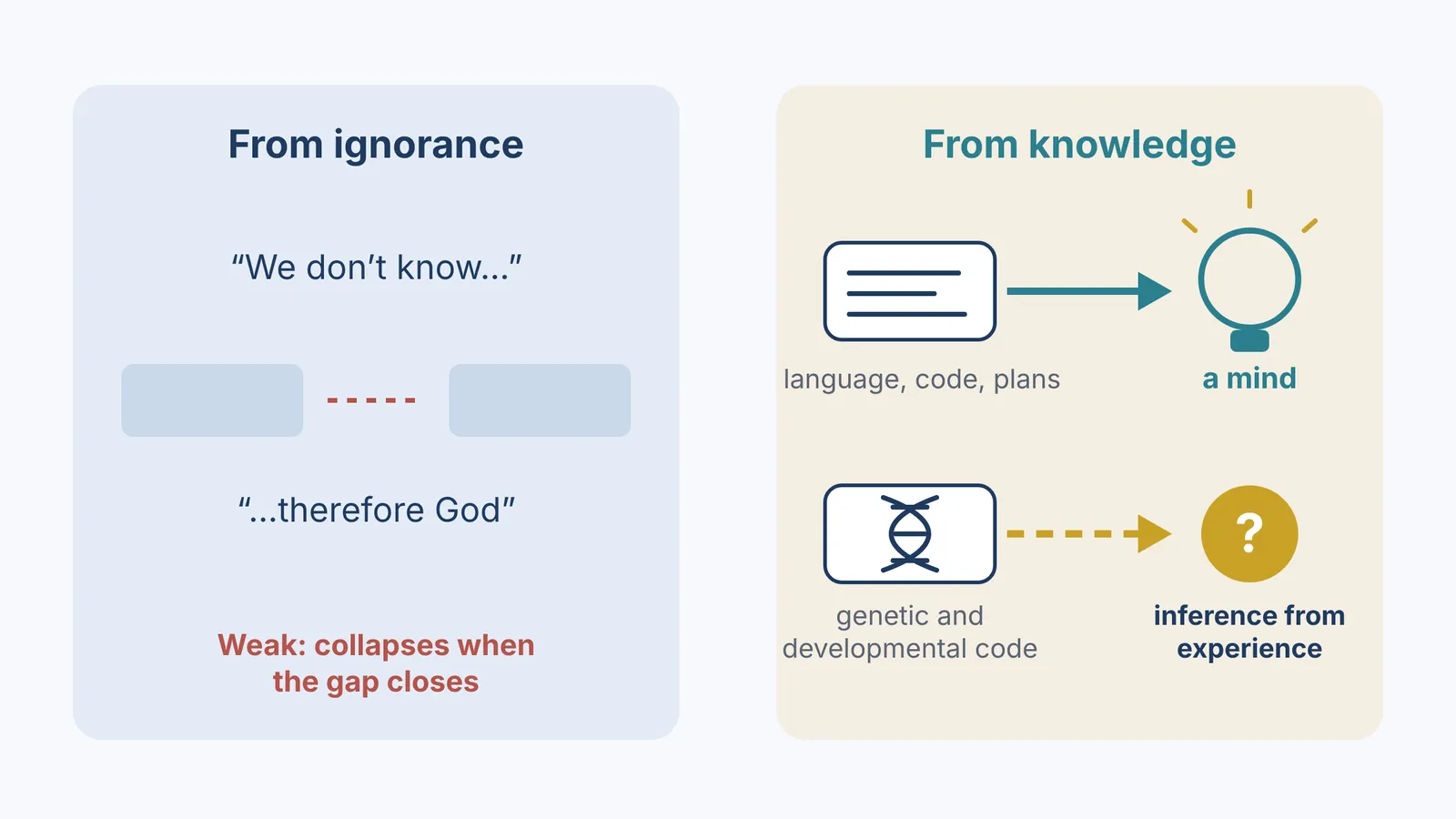
This objection deserves to be heard in full. Twenty million years is an enormous span, far longer than human history. Fossilisation is rare, and the early animals may have been tiny and soft. Pointing at what we do not yet know and saying "therefore God" is a weak argument, and history is full of such arguments that collapsed.
Much of that is fair. The Cambrian is not a single night, and nobody should build their faith on a missing fossil.
But the argument here is not "we don't know, therefore God". It is drawn from what we do know. The question is not whether twenty million years sounds long; it is whether the proposed mechanism can produce the specific amount of new, coordinated information required, within that time. That is a question of rates and probabilities, and it is argued over with evidence, not assumed either way. And in every case where we do know the origin of large amounts of new, functional, coded information, such as a language, a program or an engineering plan, its source is a mind. To notice this is to reason from experience, not from ignorance7.
There is also a deeper point. The Islamic belief in God does not live in the gaps at all. If tomorrow every Cambrian ancestor were found and every step described, a Muslim would still say that God created through those steps, as He sends rain through clouds and wind. The question the Cambrian raises sharply is one that remains even when the mechanism is known: why does nature contain the kind of information that builds bodies, eyes and minds? That question is not a gap. It is the foundation.
Oxygen can explain why the time was right for new animals. It cannot write the instructions for building them.
Questions you may have
Does the Cambrian explosion disprove evolution?
No, and it is not honest to say so. It is a real and debated puzzle about the origin of animal body plans, and scientists continue to propose and test explanations for it. What it does is challenge the confidence of the claim that unguided processes are known to be sufficient for producing new body plans. That is a narrower but more defensible point.
Did all animals appear in the Cambrian?
No. Microbial life is far older, and Ediacaran organisms came before. Some animal groups, such as sponges, may well be older than the Cambrian, and some phyla appear in the fossil record later. The Cambrian is notable because so many of the major body plans first show up there, within a relatively short span.
Why does a Muslim care about this at all, if Islam does not depend on it?
Because Islam asks you to look at the world honestly and to follow evidence where it leads5. If the materialist story is presented as complete when it is not, that matters for anyone deciding what to believe. The Cambrian is one place where you can see clearly the difference between the conditions science describes and the deeper question of where design comes from.
When you look at something intricate that suddenly appears, such as a new invention or a piece of music, what makes you ask not only "under what conditions?" but "who wrote this?"
Show a thought
We rarely confuse the conditions for something with its author. A good studio does not compose a symphony. If that instinct is sound in everyday life, it is worth asking why it should be switched off when we look at the most intricate structures we know, living bodies.
We began with a book in which most of the main characters walk on stage within a few pages. Scientists have offered good explanations for the stage, the lighting and the timing of that chapter. What remains open is the question of who wrote the characters.
Islam does not ask you to fear that question or to hide behind a gap. It invites you to travel through the earth and look at how creation began, and to read what you find as signs from the One who creates whatever He wills. If the history of life reads like a book, it is at least worth asking whether it has an Author, and what He might want you to know.
Your next step
Sources (10)
- Qur'an 3:59 (Al 'Imran)
- Qur'an 3:190–191 (Al 'Imran)
- Qur'an 24:45 (al-Nur)
- Qur'an 25:2 (al-Furqan)
- Qur'an 29:20 (al-'Ankabut)
- Qur'an 30:27 (al-Rum)
- Centre course material: Biology, evolution and human significance (claimed evidence including the fossil record; scientific and philosophical critique; origin of biological information)
- Yaqeen Institute, Human Origins, Part 1: Theological Conclusions and Empirical Limitations
- Sapience Institute, Book Review: Darwin Devolves
- Yaqeen Institute, Is Darwinism Compatible with Islam? (lecture)