What are you for?
Imagine a young doctor sitting at her kitchen table late at night, two letters in front of her. One offers a comfortable post in her home city, near her family, with a good salary. The other invites her to a clinic in a poor, remote region where there is no one else to treat the sick. She has to answer both by morning.
A friend, trying to help, says: "Biologically speaking, you're here to survive and pass on your genes. Pick whichever serves that best." He means it kindly. But she looks at him as if he had answered a different question.
He did. She was not asking how her body works. She was asking what her life is for. This page asks whether biology can answer that question, or whether it leaves it open for you.
Three meanings of "for"
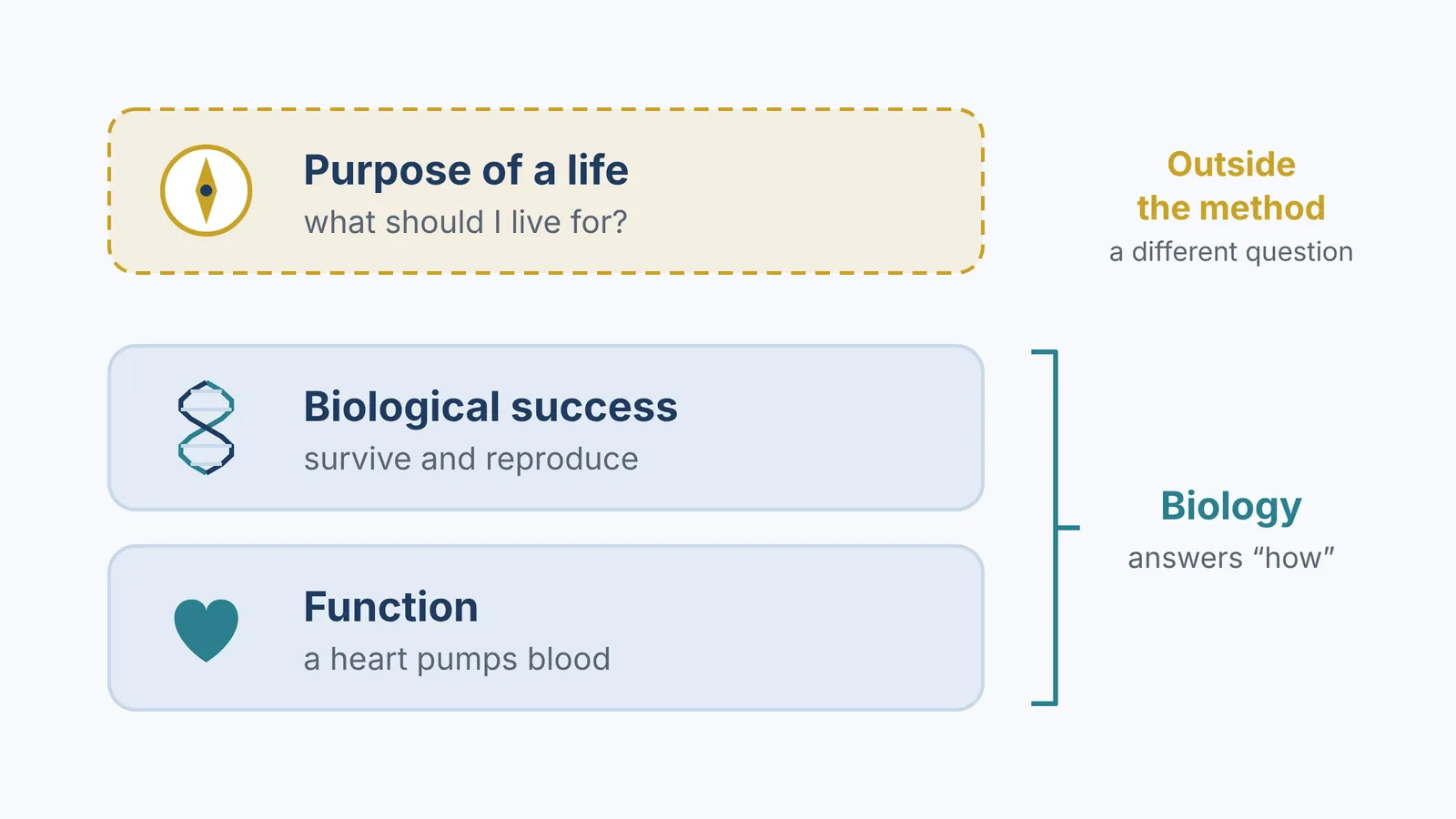
The little word "for" does three different jobs, and much confusion comes from mixing them.
Function. "The heart is for pumping blood." "Feathers are for flight." Biologists use this language all the time, and rightly. It describes the role a part plays in keeping an organism alive.
Biological success. "Living things are 'for' surviving and reproducing." This is a summary of what natural selection tracks: variants that leave more offspring become more common. It describes a pattern in populations over generations.
The purpose of a life. "What should I live for? What would make my life well spent or wasted?" This is the doctor's question at her kitchen table. It is about direction, value and choice.
The first two are scientific. The third is not, and not because scientists are timid. The scientific method, by design, describes causes and mechanisms. It does not ask whether a mechanism was intended, or what a person ought to do with the life it produced. The centre's material makes exactly this distinction: science grasps function; purpose is what a function exists for or is used for, and that lies outside its method15.
What the biology actually says
Be fair to the science first. Living things vary; traits are inherited; some variants help an organism survive and reproduce in its environment and so spread through a population. This kind of change within populations has been observed many times, and nothing in Islam asks you to deny it15.
Most biologists go further and hold that all living things share common ancestry through such processes over immense periods. Serious questions are raised about that larger claim: whether small observed changes can be extended that far, where the information that living things depend on came from, and whether natural selection, which removes what fails, is enough to explain the creation of what is new. Biologists answer with their own evidence and arguments, and other pages on this site weigh both sides15,17.
Among contemporary Sunni scholars there is a difference of opinion about the history of plants and animals. On two points there is no difference. Whatever happens in nature happens by God's creation, knowledge and will, not by blind chance. And human beings were created specially: Adam, peace be upon him, was created directly by God from dust1, and every human being descends from him.
But this page does not depend on settling those debates. Grant a complete and correct account of every biological process that ever happened. It would still be an account of how, and the doctor would still be sitting at her table with two letters.
The kettle on the stove
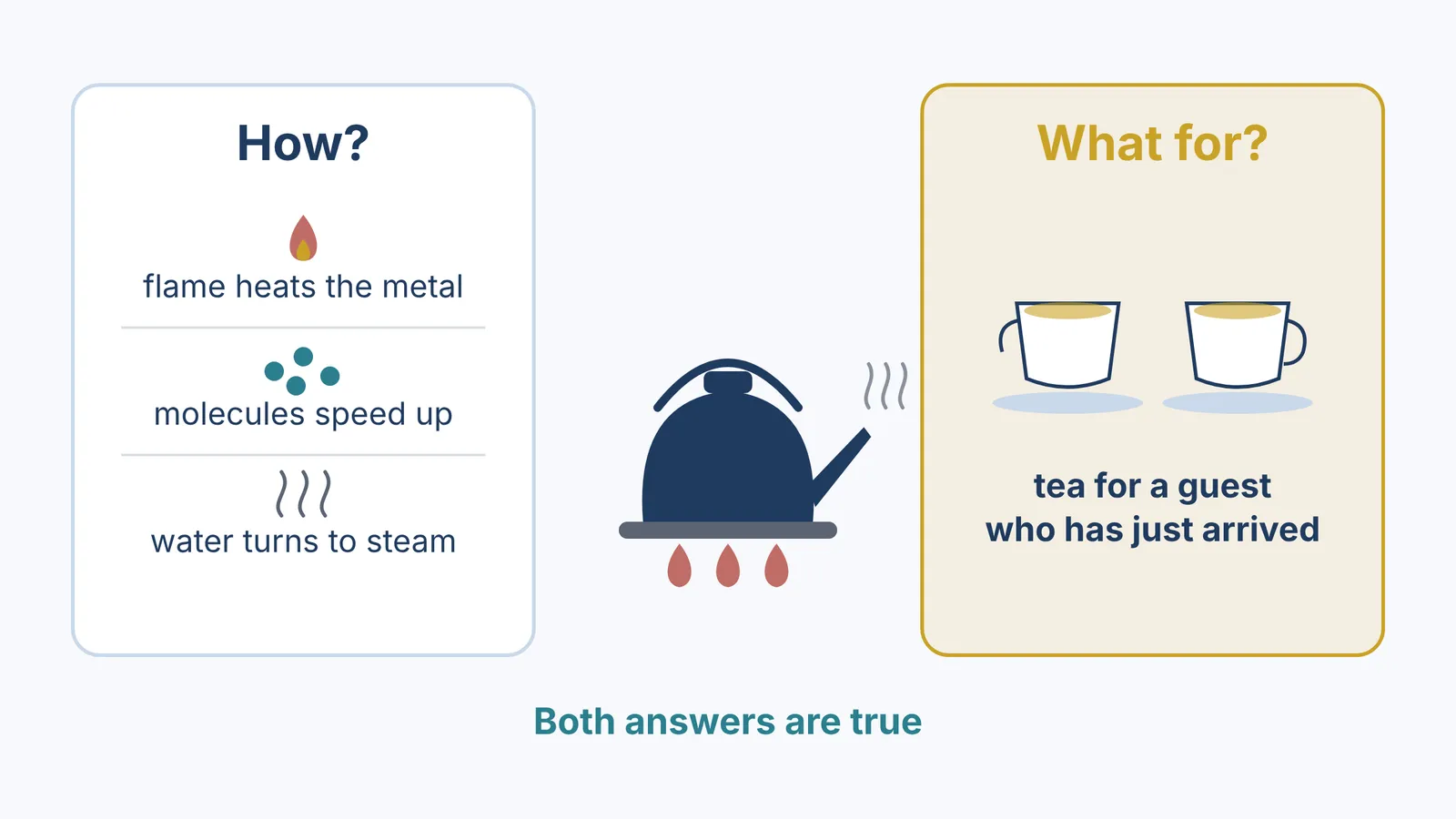
Picture a kettle beginning to whistle in an empty kitchen. Someone asks, "Why is the water boiling?"
One answer: the flame heats the metal, the metal heats the water, the molecules move faster until they escape as steam. Every word is true.
Another answer: someone is making tea for a guest who has just arrived. Every word of that is true as well.
The two answers do not compete. The first is about mechanism; the second is about purpose. You could measure the flame to a hundredth of a degree and still not learn that a guest has come.
Now apply that to human life. Biology gives the first kind of answer, often brilliantly. When someone says "evolution shows that life has no purpose", they have not discovered an absence of purpose in the data. They have used a method that was built not to look for purpose, and then reported that it found none. That is a philosophical conclusion, not a scientific result15,18.
Darwinism as a worldview, the claim that life is the product of blind, unguided processes with no Creator and no purpose behind it, is this kind of conclusion. It has to be argued for as philosophy; it cannot borrow the authority of the laboratory. Muslim scholars long held that sound reason never truly contradicts authentic revelation14; what conflicts with revelation here is not a measurement but an extra step taken beyond it.
If your purpose were to copy your genes
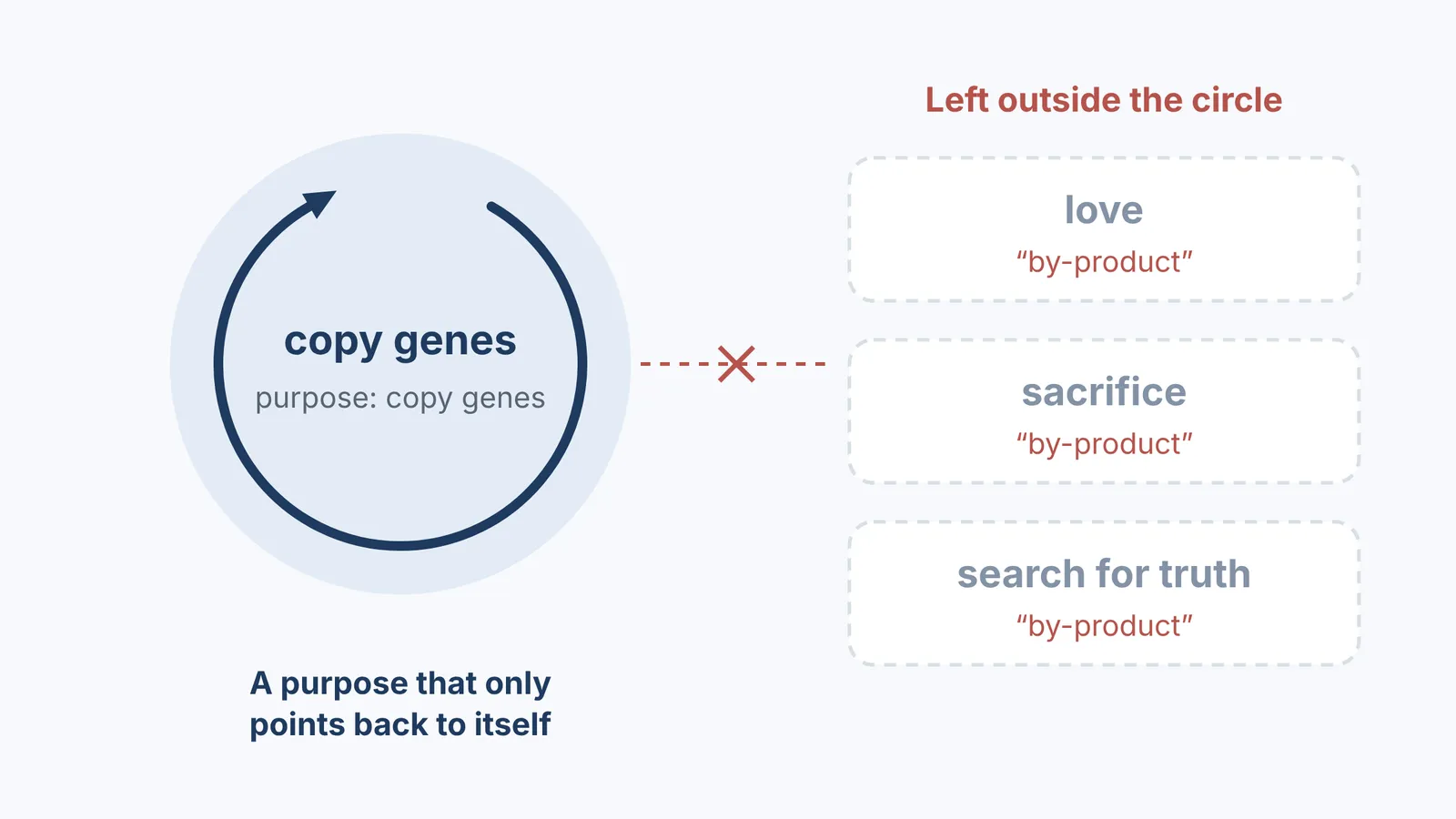
Some popular science writers have taken that extra step openly. Living bodies, they say, are vehicles built by genes, and the only thing a living thing is "for" is making more copies of those genes15.
Many biologists would say this is a vivid metaphor for how traits spread, not a recipe for living. That is fair. But suppose someone takes it literally, as the friend at the kitchen table did. Look at what follows.
First, it goes in a circle. The process is gene copying, and the purpose of the process is gene copying. That is like saying the purpose of a river is to flow downhill. It describes what happens; it does not tell anyone what is worth doing.
Second, look at what it does to the things you care about most. Your love for your children becomes a strategy your genes use. Your love for a friend, or for a stranger you will never see again, becomes a misfiring of that strategy. The doctor who goes to the remote clinic and never has children has, by this measure, failed at the only thing she was "for". Her compassion is an accident.
Third, look at your search for truth. You are reading this page because you want to know what is true, not merely what would help your genes. If your mind were shaped only to survive, why trust it on questions, like this one, where survival is not at stake? Some answer that true beliefs usually help us survive, and for finding food or avoiding danger that is plausible. But it is hard to see what survival advantage hangs on getting the purpose of the universe right. Yet you still want the real answer.
Here is the honest test. Almost no one can live as if this were the whole truth. People who believe it in theory still sacrifice for others, still admire the doctor who chose the clinic, still feel that a life spent only on oneself is wasted. They live as if purpose were real. That may be the most important evidence in the room.
The hunger is itself a clue
Human beings are the only creatures we know of who ask "What is my life for?" We ask it in every culture, and most sharply at the edges of life: at a birth, at a deathbed, after a loss.
Hunger does not prove that a particular meal is waiting for you. But a creature that feels hunger is made for a world in which food exists. Thirst points to water. The longing for purpose, in the same way, is at least a clue that you were made for a purpose. It is evidence to be weighed, not a feeling to be explained away.
Someone may reply that this longing too has an evolutionary explanation. Perhaps it does; but explaining how a desire arises does not tell you whether its object is real. Your eyes also have a history, and the things they show you are still there. A separate page on this site looks at evolutionary explanations of religion itself.
Islam names this longing. The Qur'an calls it the fitrah, the natural disposition upon which God created people6, and the Prophet ﷺ said that every child is born upon it11. On this view, your question "What am I for?" is not a glitch. It is the part of you that remembers it was made16.
"Then I'll make my own purpose"
The strongest reply deserves to be stated fairly. "Fine: there is no purpose written into the universe. But that does not leave me empty. I choose my purpose: my family, my art, justice, kindness. A purpose I choose is truly mine."
There is something admirable here, and people who say this often live with courage and generosity. Islam agrees that a purpose has to become truly yours, not inherited without thought. But a purpose that is only chosen has three weaknesses.
It is arbitrary. If purpose is whatever you choose, then a life given to caring for refugees and a life given to collecting expensive watches are equally successful, as long as each was chosen. You may prefer one; you cannot say the other has missed anything. Yet everyone believes a life can be wasted.
It cannot command you when it costs. A purpose you invented can be revised the moment it becomes inconvenient. That is exactly when a purpose is needed. Rules you make for yourself bind you only as long as you agree with them, which means they do not really bind you at all.
It cannot reach past death. A self-chosen purpose ends with its chooser. It may comfort you while you live. It has nothing to say at the bedside, when the projects are over and the question "Was it worth it?" is asked for the last time.
A purpose that is clear, and wide
Islam does not ask you to invent your purpose or to settle for a function. It tells you plainly why you exist: I did not create jinn and humans except to worship Me7. Ibn Kathir explains that God created people to worship Him, and that He has no need of them; the next verse says He wants no provision from them13,8. The purpose is for your good, not His.
Your life is not in vain: Did you think that We created you without purpose, and that you would not be returned to Us?5. It is a meaningful trial, not a lottery: He created death and life to test which of you is best in deeds9. And it is the life of an honoured being: We have honoured the children of Adam4. You were not produced by a process that did not know you were coming. You were intended.
"Worship" here is far wider than ritual. The Qur'an teaches the believer to say: My prayer, my sacrifice, my living and my dying are for God, Lord of the worlds2. Living, not only praying. The Prophet ﷺ said: "Actions are only by intentions"10. Work done honestly, a parent cared for, children raised well, knowledge sought, a neighbour helped: each becomes worship when it is done for God. He also said: "Strive for what benefits you, seek God's help, and do not be helpless"12. Islam does not ask you to leave the world. It gives the whole world a direction.
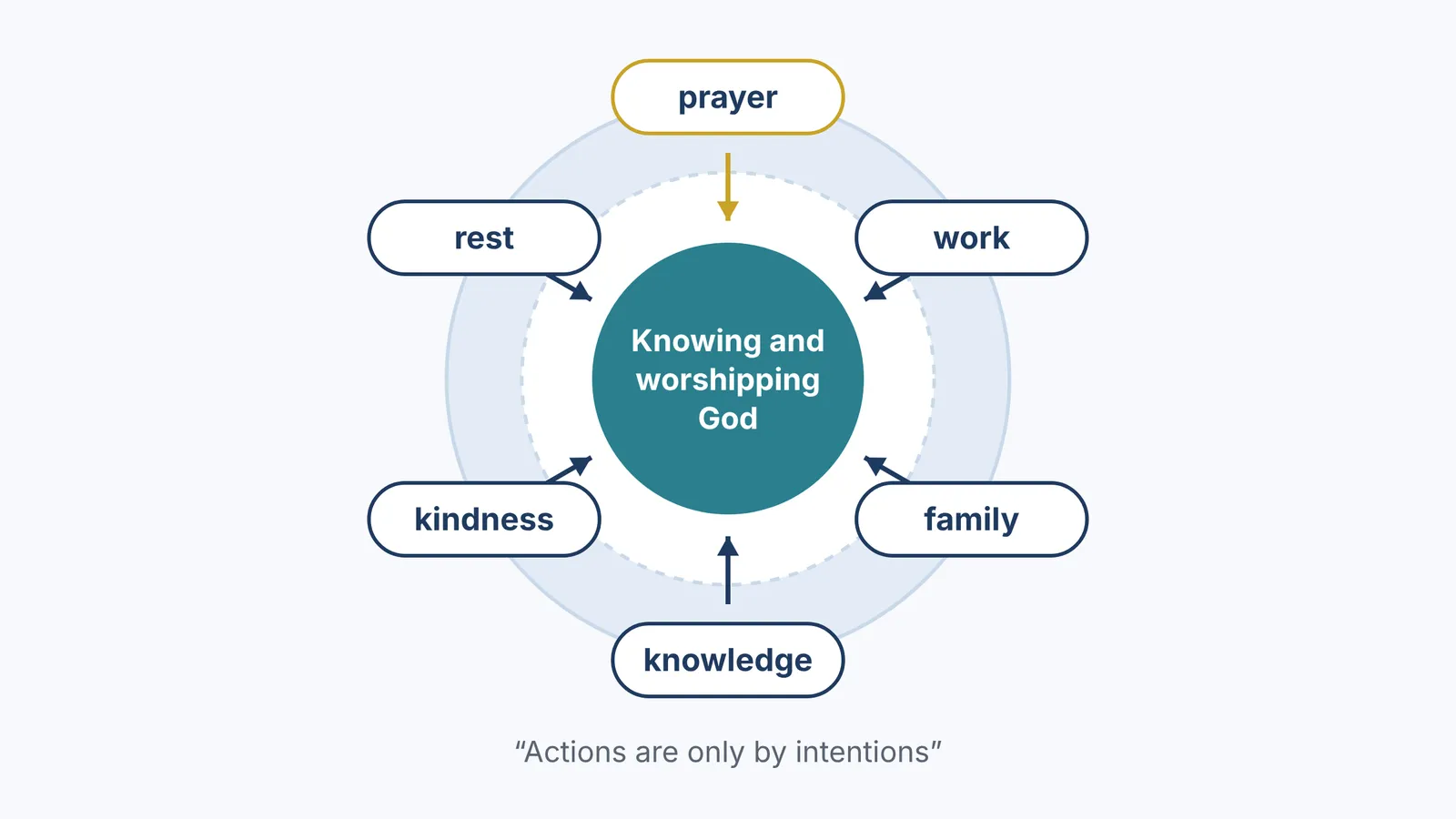
Now return to the kitchen table. For the doctor, Islam does not answer every detail; both letters may lead to a good life. But it gives her a question that her friend could not: which choice, made sincerely, will make her life best in deeds before the One who made her? That question can guide a career, a marriage, a sacrifice, an illness. It does not run out.
And it brings something a chosen purpose cannot: rest. Truly, in the remembrance of God do hearts find rest3. A purpose anchored in the One who does not change does not need to be rebuilt every time your circumstances change.
"Purpose is a human invention. The universe doesn't owe us meaning, and that's liberating."
Here is the objection at full strength: "You keep looking for a purpose handed down from above. But the universe owes us nothing. Accepting that is not despair; it is freedom. No one can tell me what I am for. No cosmic boss, no rulebook. I am free to live as I choose."
Some of this is right, and Islam agrees. Freedom from purposes imposed by other people, by rulers, markets, fashions or a crowd, is real freedom. In fact this is one of the deepest themes of Islam: to worship God alone is to be freed from serving anything else. No human being, no appetite and no system has the right to own you.
But look closely at the rest.
Liberating is not the same as true. If believers are told that a comforting belief is not true just because it comforts, the same rule applies here. A belief is not true because it feels freeing either. The question remains: is there a Creator who intended you, or not?
Freedom needs a direction. Being free from every purpose is like being handed a ship with no destination: you can sail anywhere, and nowhere is better than anywhere else. Most people do not want freedom from purpose. They want freedom for something.
The objection quietly assumes a purpose. "Live authentically", "be free", "don't let anyone own you": these are presented as the right way to live, better than living as a slave to others. But if the universe has no purpose, nothing is the right way to live. The objection borrows the very thing it denies.
And Islam does not script every hour of your life. It tells you what the story is about, and leaves you to write the chapters with your gifts, your work and your choices.
Knowing how the water boils will never tell you who the tea is for.
Questions you may have
Does Islam say nature works by blind chance?
No. Whatever happens in nature happens by God's creation, knowledge and will. Muslims study the causes in nature freely; they hold that those causes are themselves created and sustained. On the biological history of plants and animals, contemporary Sunni scholars differ; on human beings they agree that Adam was created directly by God1.
If God created me to worship Him, am I just a tool?
A tool exists to meet its owner's needs. God needs nothing from you; the Qur'an says He wants no provision from His servants8. The purpose He gives is for your good: to know Him, to live well and to return to Him with a life that was worth living. That is the opposite of being used.
If you had to write one sentence answering "What is my life for?", what would you write? And what makes that answer more than a choice you could change tomorrow?
Show a thought
Many people find that their honest answer points beyond themselves: to people they love, to truth, to goodness. That is worth noticing. If those things really matter, and not only because you decided they do, then your purpose may not be something you invent at all, but something you were made for.
We began with a doctor at a kitchen table and a friend who answered the wrong question. Biology could tell her how her heart beats and why her species has survived. It could not tell her which letter to answer, or why it mattered.
Islam answers that question without asking you to deny anything true in the science. You were created on purpose, honoured, and given a life whose every honest effort can be directed to the One who made you. If that is true, then your hunger for purpose was never a mistake. It was an invitation.
Your next step
Sources (18)
- Qur'an 3:59 (Al 'Imran)
- Qur'an 6:162 (al-An'am)
- Qur'an 13:28 (al-Ra'd)
- Qur'an 17:70 (al-Isra')
- Qur'an 23:115 (al-Mu'minun)
- Qur'an 30:30 (al-Rum)
- Qur'an 51:56 (al-Dhariyat)
- Qur'an 51:57 (al-Dhariyat)
- Qur'an 67:2 (al-Mulk)
- Sahih al-Bukhari 1
- Sahih al-Bukhari 1358
- Sahih Muslim 2664
- Ibn Kathir, Tafsir al-Qur'an al-'Azim, on 51:56–57
- Ibn Taymiyyah, Dar' Ta'arud al-'Aql wa al-Naql
- Centre course material: Biology, evolution and human significance (function and purpose; evolution and the purpose of human life)
- Centre course material: Foundations of belief, fitrah, divine perfection and human need
- Yaqeen Institute, Human Origins, Part 1: Theological Conclusions and Empirical Limitations
- Yaqeen Institute, Is Darwinism Compatible with Islam? (lecture)