Have you ever run a scientific experiment without realising it?
Imagine a pot of basil on your kitchen windowsill. One morning its leaves are hanging limp. You touch the soil: it is dry. "It needs water," you think. You water it, and by evening the leaves have lifted again.
A week later it droops once more. You water it straight away, but this time it gets worse. Now you are puzzled. Was your first explanation wrong, or only incomplete?
Without a lab coat or a single instrument, you have just walked through the main steps of science: you noticed something, guessed a cause, tested your guess and met a result that forced you to think again. So what exactly is this method that we all use a little and scientists use with great care? And how far can we trust what it tells us?
From a drooping plant to a method
Let us slow the basil story down and name each step.
Observation. The leaves are limp. This is the starting point: something you can see, and that someone else could see too.
Question. Why are they limp? A good question is specific. "Why is this plant drooping?" can be investigated. "Why do plants exist?" is a different kind of question.
Hypothesis. A possible answer that could turn out to be wrong: "The plant is short of water."
Prediction. If the hypothesis is right, something definite should follow: "If I water it, the leaves will rise within a few hours." A hypothesis that predicts nothing cannot be tested.
Test. Now you check. A careful gardener would do better than water one pot and hope. She would take two similar plants in the same light, water only one, and compare. Changing one thing at a time is what lets you say which cause made the difference.
Repeatable result. One recovery could be luck. If the same thing happens again and again, and happens for other people with other plants, you can start to trust it.
Publication and criticism. A scientist does not stop at "it worked for me". She writes down exactly what she did, so others can repeat it, and she sends it to other experts who look for mistakes before it is published. Then the wider community tries it too.
Revision. And when the second drooping does not respond to water, the explanation is improved, not abandoned. Perhaps too much water rots the roots, and rotting roots also leave a plant limp. The model becomes richer: "too little water, or too much, both cause wilting."
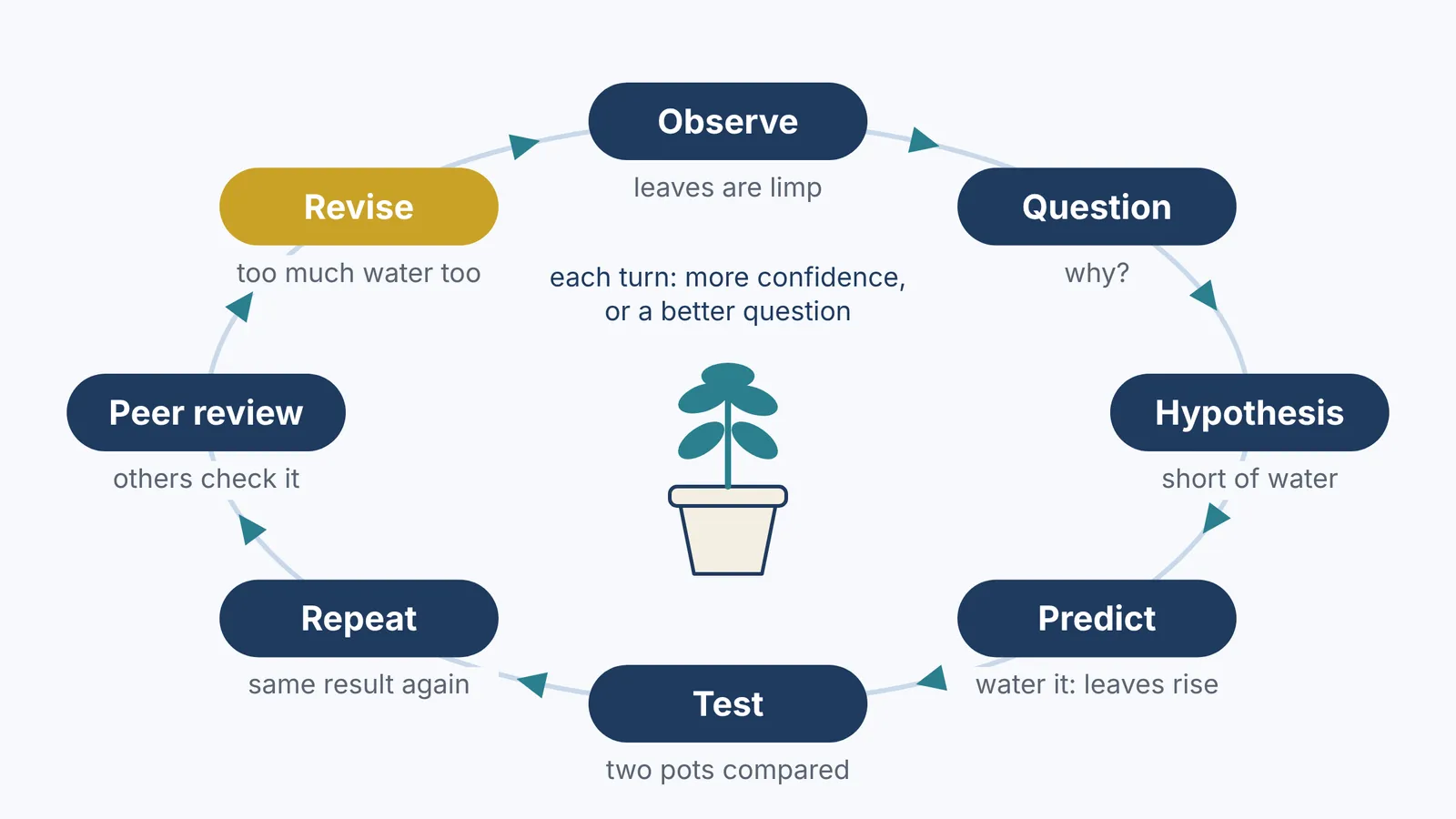
This loop is the heart of what is called empirical science: explaining natural events by natural causes, through claims that can be tested, that make predictions and that give the same result when others check them10.
Not every "science says" is equally strong
When a news report begins with "Scientists say…", it can mean very different things. It helps to sort scientific claims into a few kinds.
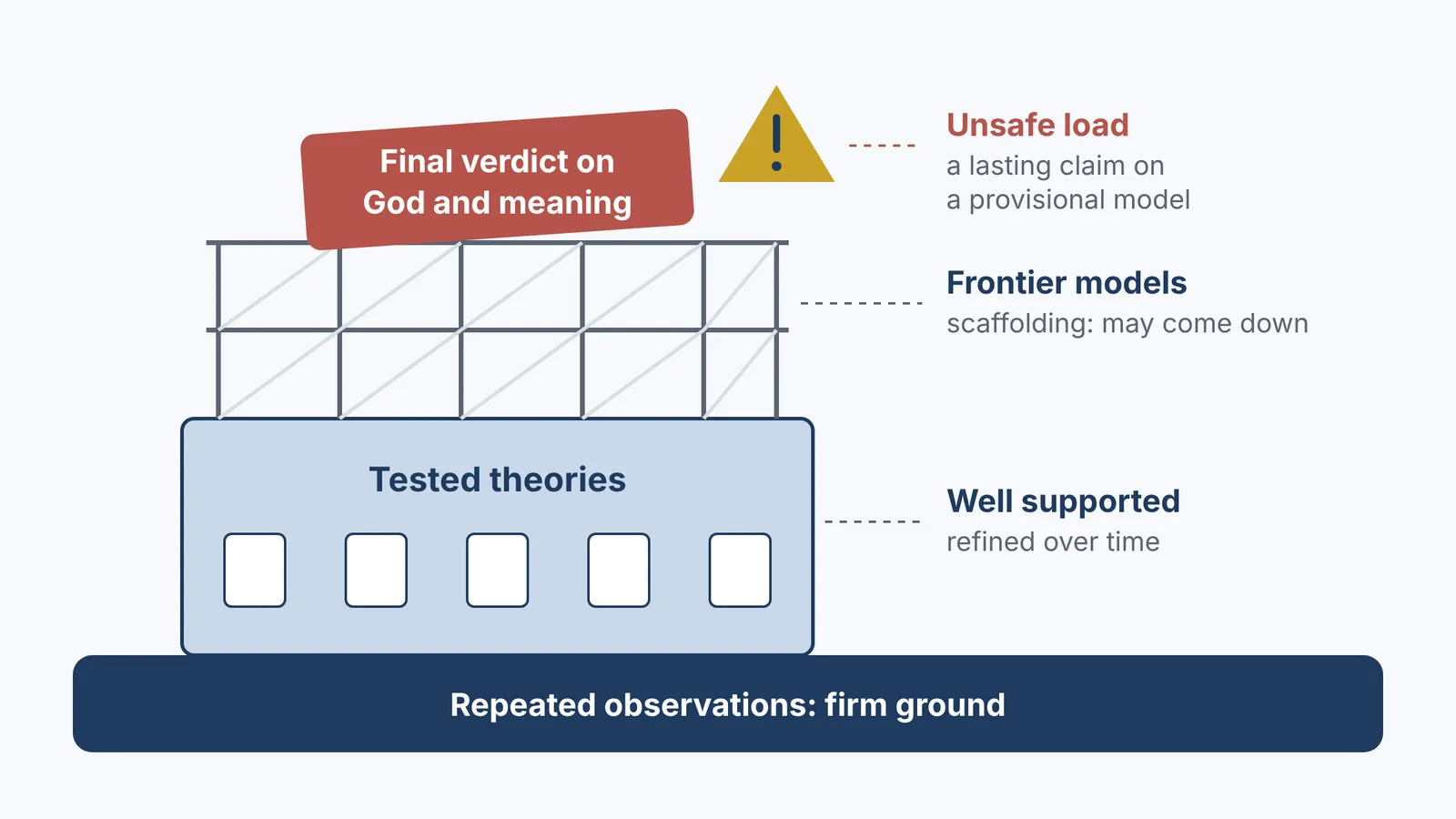
Established observations. Water boils at a lower temperature high in the mountains than at sea level. This has been measured countless times by countless people, in kitchens and laboratories. No future discovery is going to make it untrue that, up a mountain, your pan boils sooner and your pasta takes longer.
Explanatory theories. Why does it happen? Because there is less air pressure pressing down on the water, so the water needs less heat before it can turn to vapour. This explanation is very well supported. But notice that it is a different kind of statement: it is an account of what lies behind the observation, not the observation itself.
Models at the frontier. Further out are pictures of things nobody can observe directly or repeat at will: what happened in the earliest moments of the universe, or exactly how the brain produces our inner experience. Here scientists themselves often hold several competing models at once and openly expect some of them to be replaced.
The same word, "science", covers all three. A sensible person gives each claim the confidence its evidence has earned. That is not doubting science. It is how good scientists think.
Why experience never gives absolute certainty, and why that is fine
Most scientific knowledge comes by induction: we see a pattern many times and conclude that it holds in general. Every time the gardener waters a dry plant, it recovers; so she concludes that dry plants recover when watered.
But however many cases you have seen, the next one is still not guaranteed by them. Some day there is a plant whose roots are already rotting, and water does nothing. Induction can give very strong confidence. On its own, it cannot give the kind of certainty that admits no exception.
Muslim scholars had precise words for this long before modern philosophy of science. They graded what is in the mind by the strength of its evidence: doubt, where possibilities feel equal; conjecture, where you lean one way but could be wrong; strong likelihood, where error is remote; and certainty, where conclusive evidence leaves no serious room for error9.

Seen this way, most well-tested science lives in the zone of strong likelihood, some of it very close to the top. Frontier models often sit lower, in reasoned conjecture. Certainty in the full sense belongs to things like the truths of logic and mathematics, or the knowledge that you exist, which do not depend on counting cases at all.
That is not a weakness to be ashamed of. You cross a bridge on strong likelihood. You take medicine on strong likelihood. Acting on well-grounded likelihood is rational; what is irrational is pretending it is something more, or something less, than it is.
Self-correction: a strength that comes with a warning
The most admirable feature of science may be this: it is built to find its own mistakes. A result must survive other people trying to break it. A model that keeps failing its tests is eventually dropped, however famous its author. Few human institutions have that kind of honesty designed into them.
But follow the thought one step further. If science can correct itself, then some of what "science says" today will be said differently tomorrow. Not the boiling pan up the mountain, but quite possibly some of the large explanatory models built on top of such observations.
So there is a wise rule here: do not build a final conclusion about the whole of reality on a model that science itself holds provisionally. If someone says, "The latest theory of the early universe shows there is no need for a Creator," they are resting a permanent claim about existence on exactly the kind of scientific statement most likely to change. The same rule applies to Muslims: tying the meaning of a verse of the Qur'an to the latest theory, and calling it proof, puts revelation on scaffolding that may be taken down next decade.
What science does well, and where its edges are
Its strengths are real and worth naming. Precision: it measures rather than guesses, and states how large its uncertainty is. Testability: its claims stick their necks out by predicting something that could fail. Shared checking: no result belongs to one person; anyone with the skill and equipment can try to repeat it.
Its limits come from the same features. It studies what can be measured and repeated. A one-off event in the distant past, the meaning of a life, whether an action is just or cruel: these do not sit on a laboratory bench10. And every experiment quietly presupposes things it cannot test: that nature is orderly, that our reasoning is reliable, and that nature behaves the same way tomorrow as today. Without these, no result would mean anything; yet no result could prove them, because every result already assumes them. Another page on this site looks at these foundations more closely.
None of this belittles science. A ruler is superb for length and useless for weighing. Knowing what a tool is for is part of using it well.
A world made with measure, and an invitation to look
Why should the world be orderly at all? Why should water always behave like water, and plants respond to light and soil in patterns we can learn? Science has to assume this. Islam explains it.
The Qur'an says, in meaning: We have created everything in due measure5. And of God it says that He created everything and determined it with precise measure3. A universe made by a Wise Creator, with measure and proportion, is exactly the kind of universe in which science should work. The regularity the scientist relies on every morning is, for a Muslim, a sign of the One who set it.
The Qur'an does not keep this order at a distance; it sends you to look at it. In the creation of the heavens and the earth, and the alternation of night and day, are signs for people of understanding, who remember God and reflect on the creation of the heavens and the earth1. It even invites a kind of repeated checking: look at the heavens, it says; do you see any flaw? Then look again, and again6. Careful study of creation, done with this awareness, is not a distraction from worship. It is part of it.
The scientific habit has deep roots in Islam
The core habit of good science is simple: do not accept a claim until you have checked it. The Qur'an teaches the same habit for news: if someone of corrupt character brings you a report, verify it, lest you harm people out of ignorance and then regret what you have done4. It also forbids following what you have no knowledge of, and holds your hearing, sight and heart accountable2.
The Prophet ﷺ said: "It is enough of a lie for a person to pass on everything he hears"8. Muslim scholars took warnings like this so seriously that they built a whole discipline around them, examining the chains of people who transmitted each report and their reliability. It is not laboratory science, but it shares its spirit: claims must survive scrutiny.
There is also a hadith that speaks to the honest error every researcher knows. The Prophet ﷺ said: "When a judge strives to reach a judgment and is right, he has two rewards; and if he strives and errs, he has one reward"7. This hadith is about a qualified judge doing his utmost in a case, someone with the knowledge needed to judge; it is not a reward for careless guessing, and it says nothing directly about laboratories. But it shows something beautiful about the spirit of Islam that carries over, by analogy, to every honest inquirer: what is asked of you is sincere, competent effort. An honest mistake made while seeking the truth is not a disgrace.
So Islam gives the scientist three things science cannot give itself: a reason to expect order, a moral duty to check claims carefully, and an assurance that honest effort counts even when it falls short.
"Science corrects itself and religion never changes, so science wins"
Here is the objection at full strength: science updates when the evidence changes; that is why we trust it. Religion claims to have the final truth and never admits a mistake; that is why we should not. A method that learns must beat a creed that cannot.
There is something right in this. A refusal ever to reconsider anything would be a bad sign. But look more closely at three points.
First, what does science correct? Our human models of the world, not the world itself. Water did not change its boiling point when scientists understood air pressure; our explanation improved. Correction is a sign that our pictures were incomplete. It is not a reason to think the newest picture is final.
Second, Islam also has a revisable part. It distinguishes between its fixed revealed foundations, such as the oneness of God, the prophethood of Muhammad ﷺ and the core moral commands, and the large area of human understanding and ijtihad, the scholar's effort to apply the sources to particular questions. That second area is openly revisable: scholars differ, correct one another and change their views when they find stronger evidence. The hadith of the judge assumes that such effort will sometimes be wrong7.
Third, science also has a part it cannot correct by experiment. Its foundations, order in nature, reliable reason and the uniformity of nature, are not up for testing, because every test assumes them. So the real comparison is not "a system that changes against a system that doesn't". Both have a fixed core and a revisable surface. The honest question is whether each fixed core is true.
And something that never changes is not a defect if it is true. That two and two make four has never been revised. Nobody calls mathematics backward for it.
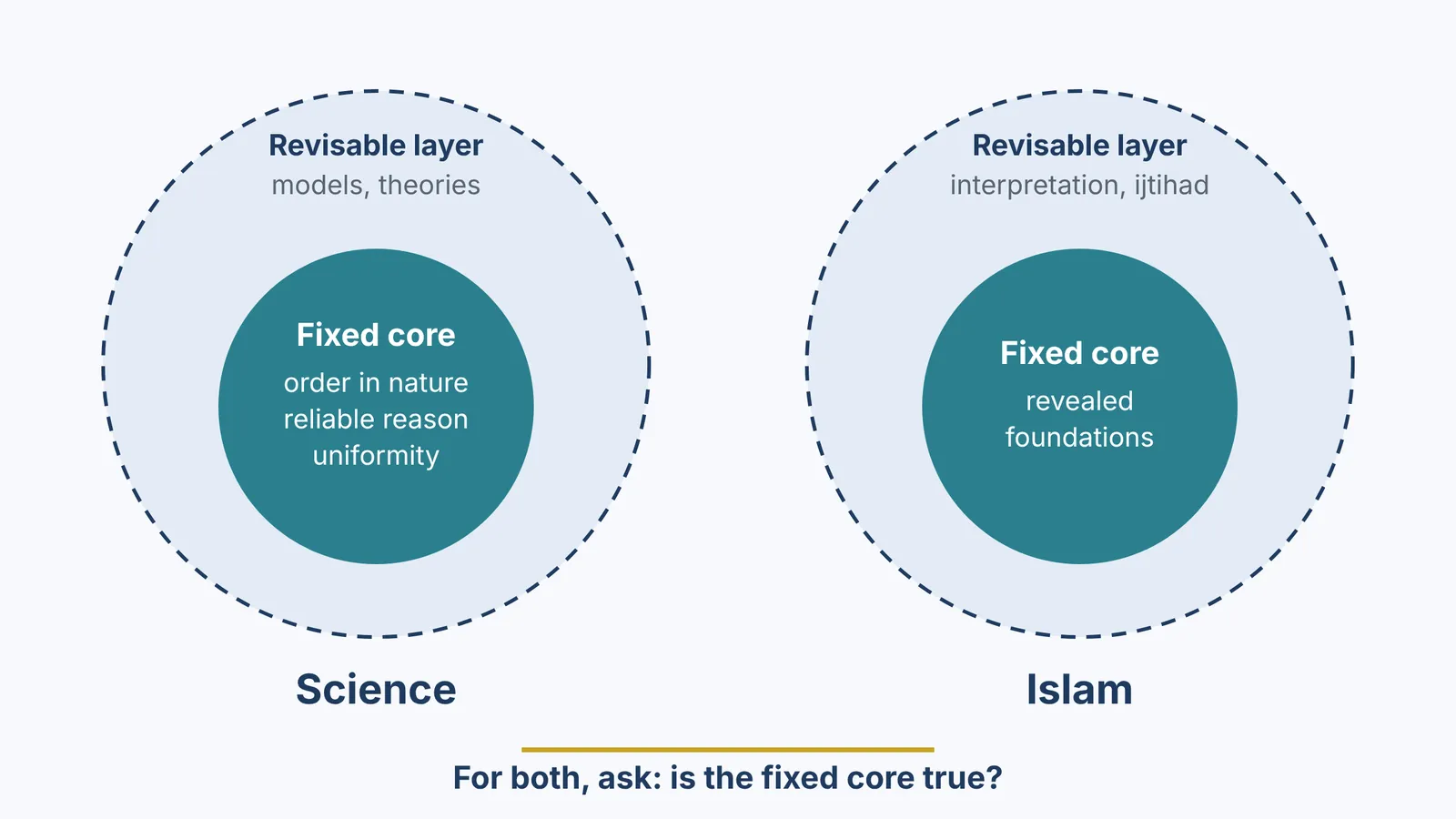
Science corrects our pictures of the world. It cannot, by experiment, correct the ground it stands on.
Questions you may have
Does Islam ask Muslims to reject scientific theories they find uncomfortable?
No. Muslim scholars hold that firmly established knowledge and an authentic, clearly understood text do not truly conflict, because the One who made the world also revealed the Book10. When a tension appears, the right response is to ask whether the scientific claim is truly settled, and whether the text is being read in a way it actually requires. That calls for patience and care, not rejection or panic.
Should Muslims use science to prove the Qur'an?
With great caution. The Qur'an is a book of guidance, and its truth does not wait on the latest paper. Linking a verse to a theory that may later be revised risks making the verse look wrong when only the theory was. Established observations can be appreciated as signs of order; provisional models are a poor foundation for any claim of proof.
If science cannot give absolute certainty, can religion?
Certainty depends on the kind of evidence, not on the subject. Some things are known with certainty by reason itself, such as the impossibility that something exists and does not exist at the same moment. Others are known through reports passed on by so many independent people that error is ruled out9. The case for God and for the Prophet ﷺ draws on such evidence: rational argument, the natural sense we are born with, and reliable report. It is a different route from induction, which is exactly why it can reach a different kind of certainty.
Think of one thing you say "science has proven". Is it a repeated observation, a well-tested theory, or a frontier model?
Show a thought
Sorting it may change how firmly you hold it, and what you feel entitled to build on it. That is not losing faith in science; it is using science the way good scientists do. And it raises a further question: which of your beliefs about life itself rest on solid ground, and which on scaffolding?
We began with a drooping basil plant and a puzzled gardener. Her method was simple and honest: look, guess, test, check again, and change her mind when the plant disagreed with her. Science is that honesty made patient, precise and shared, and it deserves real respect.
Islam honours that honesty. It tells you the world was made with measure, so it is worth studying; it tells you to verify what you hear; and it tells you that sincere effort is rewarded even when it errs. What it adds is a sense of proportion: give every claim the confidence it has earned, do not ask a ruler to weigh, and do not build your final answer about God and the meaning of your life on scaffolding. Those questions deserve firmer ground, and Islam invites you to examine the ground it offers.
Your next step
Sources (10)
- Qur'an 3:190–191 (Al 'Imran)
- Qur'an 17:36 (al-Isra')
- Qur'an 25:2 (al-Furqan)
- Qur'an 49:6 (al-Hujurat)
- Qur'an 54:49 (al-Qamar)
- Qur'an 67:3–4 (al-Mulk)
- Sahih al-Bukhari 7352 (also Sahih Muslim 1716)
- Sahih Muslim, Introduction, hadith 5
- Centre course material: Sources of knowledge (levels of apprehension: doubt, conjecture, strong likelihood, certainty; innate rational principles; mass-transmitted report)
- Centre course material: Empirical science, revelation and their relationship (definition, characteristics and scope of empirical science)