How many hours did you spend comparing options before you bought your last phone? And how many have you spent on the question: is Islam true?
Imagine you are looking for a flat to live in for one year. You visit it twice, test the taps, ask the neighbours about noise at night, and read the lease line by line. Nobody accuses you of overdoing it.
Now imagine a question about your whole life, and whatever comes after it, if anything does: why you exist, who made you, and what is waiting for you. How many visits does that question deserve?
We will not ask you to believe just in case
You may have heard of "Pascal's wager": believe in God just in case; if He exists you gain everything, and if not you lose little. It sounds clever, but it is not what we are saying.
The reason is simple: Islam does not accept that kind of faith. Faith in Islam is not a lottery ticket you buy as a hedge. It is a sincere conviction of the heart, followed by action. The Prophet ﷺ said that God does not look at your appearance or your wealth, but at your hearts and your deeds16. He also said, "Actions are only by intentions"15. Someone who declares faith while thinking "I'm only doing this to be safe" shows one thing outwardly, and God knows what is inside.
This is also why there is no compulsion in this religion: There is no compulsion in religion; the right way has become distinct from error3. The path God wants is that the truth becomes clear to you and you choose it, not that you are pushed into it by fear or by a business calculation.
So what are we asking for? Something smaller and fairer: that you ask yourself this question honestly, and give it the time and attention it deserves.
The size of the question sets the size of the search
We all live by a rule we rarely name: the bigger the consequences of a decision, the more we look into it first. You choose a restaurant in a minute and a new job after weeks of comparing. And if a doctor told you that you had a serious illness, you would ask for a second opinion and talk to people who had been through it. Nobody calls that paranoia; it is common sense.
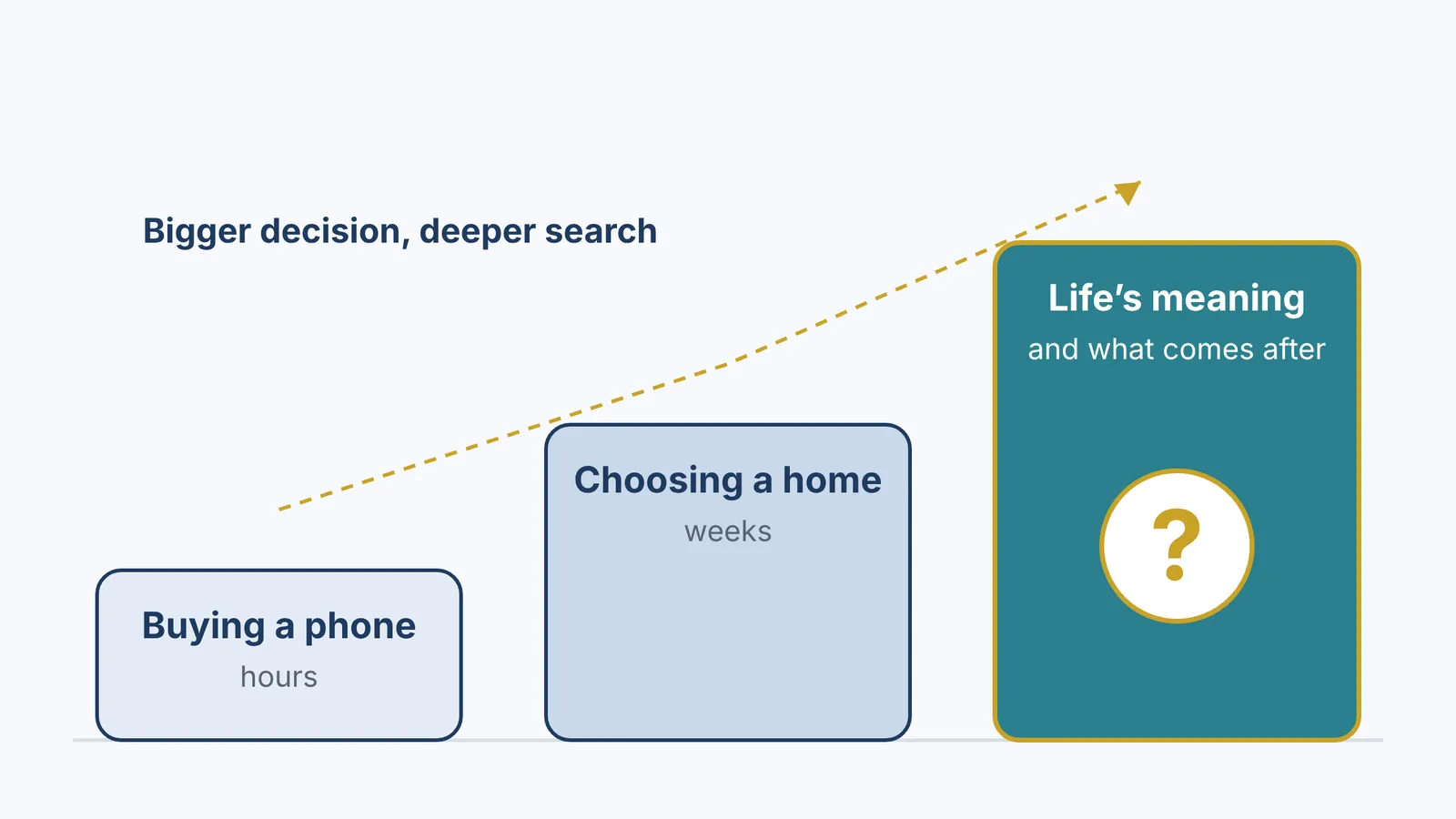
Now apply the same rule to the question "What if Islam is true?" Three things set this question apart.
First, it touches everything. If Islam is true, it changes how you understand yourself, your relationships, what success and failure mean, and your pain. It is not a decision in one corner of your life but at its centre.
Second, it reaches beyond death. Most decisions end with our lives. This question claims that death is not the end. You may reject that claim, but its serious possibility makes this bigger than any other decision.
Third, it cannot be put off forever. You can postpone renting the flat, but nobody knows how much time they have left. And not deciding this question is, in practice, a decision: you are living your life on the assumption that the answer is "no".
We are not saying, "Islam is true, so believe." We are saying: if the possibility is serious, and Islam offers evidence that deserves a hearing, reason itself asks you to search in proportion to the stakes. Searching is not surrender. It is respect, for the question and for yourself.
If Islam is true, what does it mean for you?
Let us honestly imagine the answer. If Islam is true, here is some of what becomes true about you.
Your life has a purpose. You are not a passing accident in a silent universe. God says, I did not create jinn and humans except to worship Me12. Worship here is not withdrawal from life; it is living all of it in connection with the One who made you. And the Qur'an asks a question worth sitting with: Did you think that We created you without purpose, and that you would not be returned to Us?7
Your Creator knows you, and He is merciful. You are not a number in a statistic. We are closer to him than his jugular vein11. He knows what you tell yourself at night and have never told anyone. This is not cold surveillance; it comes with an open door: Say: O My servants who have wronged themselves, do not despair of God's mercy. Indeed God forgives all sins. He is the Forgiving, the Merciful10. Whatever your past, the address is to you, and it calls you "My servants".
Death is not the end. The people you loved and lost have not become nothing, and the good you did unseen has not been wasted. A short life becomes the opening of a longer story.
Justice is complete. How many of the wronged died without ever being put right? If Islam is true, none of this is lost: So whoever does an atom's weight of good will see it, and whoever does an atom's weight of evil will see it13. A scale that does not err and cannot be bribed.
The way is clear. You are not left guessing what your Creator wants from you. He sent messengers, sealed them with Muhammad ﷺ, and revealed a book you can read for yourself. The question "how should I live?" finds a detailed and merciful answer.
What would it ask of you, and what would it give you?
It is only fair to tell you plainly: if Islam is true, it will ask things of you.
It will ask for sincerity: to believe in God alone, with no intermediaries between you and Him, and for your faith to be genuine, not a show. It will ask for prayer: five pauses a day in which you return to your Creator, like taking a breath in the middle of a crowded day. And it will ask for character: honesty, trustworthiness, mercy towards the weak, kindness to your parents, and leaving what harms you and harms others.
From a distance this may look heavy. But look at what comes in return. You give some time from your day and receive meaning for all of it. You give up some of what you crave and gain freedom from things that controlled you. You acknowledge that you are a servant of God, and you are freed from servitude to other people's opinions and to anxiety about the future. And you gain a direct relationship with your Lord, whom you can call on at any moment, in any language, without anyone's permission: When My servants ask you about Me, I am near. I answer the call of the caller when he calls on Me2.
Most importantly, God does not judge you by your appearance or your wealth, but by your heart and your deeds16. This is a religion that starts from the inside.
An honest word about the hereafter
We will not hide part of the picture from you. Islam teaches that there is a reckoning, and that each person is responsible for their choices. But that reckoning rests on complete justice, not on whim or surprise.
One of the clearest signs of that justice is this verse: And We never punish until We have sent a messenger6. God does not punish anyone before the message has reached them. Nobody is held to account for something they were never given the chance to know, and God alone knows whose ears the message truly reached and whose it did not.
We do not mention this to frighten you, but because it is part of the truth as Islam presents it, and it treats you as a responsible adult, not a child who is never asked about anything. Accountability is itself a form of dignity: what you do matters, and so it counts.
"Every religion says: what if we're right?"
This is the strongest objection to this page, and it deserves to be put in full: "By your logic, I would have to ask this about every religion. The Christian says: what if we're right? So does the Hindu, and others. I don't have enough lifetimes to investigate them all, so it's easier to leave them all."
The objection is understandable, but it proves less than it seems to. Think of a patient faced with hundreds of doctors and treatments. Does he say, "I can't try them all, so I won't get treated at all"? No. He starts with what has the strongest evidence and the clearest foundation, and sets aside whatever fails the first check.
You can do the same here. You do not need to study every belief in equal depth. Start with a few questions that sort out a great deal:
Does it offer one Creator that reason can accept? One perfect God, unlike His creation, who is not born, does not die and needs nothing? Islam presents a pure monotheism summed up in these words: Say: He is God, the One. God, the Self-Sufficient. He neither begets nor is begotten, and there is none comparable to Him14.
Does it have a preserved book you can examine? A text you know has come down as it was, not conflicting accounts of unknown origin. The Qur'an says of itself: It is We who sent down the Reminder, and We will surely preserve it5. And it puts a test in front of you: Do they not reflect on the Qur'an? Had it been from anyone other than God, they would have found much contradiction in it4.
Does it have a clear, final message? A prophet whose life is well known and recorded, and a message that says it is the last, so you are not left waiting for something new in every generation9.
These questions do not settle the search alone, but they shorten the road. This site has a section comparing religions on these criteria fairly; we ask you not to take our word for it, but to compare.
Besides, the objection assumes Islam says, "Believe out of fear that we might be right." As you have seen, Islam rejects that. It says: look at the evidence, and the burden of proof is on whoever makes a claim1. Religions are not made equal simply because all their followers say "we're right". They are told apart by the evidence they bring.
A small practical step
If you have read this far and feel that the question deserves more than you have given it, here are three steps that will not cost you much.
Read the Qur'an with an open question. Read a translation of its meanings, not to prove it wrong or right, and ask: could these words have come from a human being? Start with the short chapters and note what makes you stop.
Ask a Muslim. One who knows his religion and respects your questions. Ask about whatever troubles you most; a button on this page connects you with a real person.
Ask your Creator, sincerely. You do not need to be a believer to do this. It is enough to say, privately, in your own language and your own words: "My Creator, if this is the truth, guide me to it, and if it is not, turn me away from it." This is not a set text we are binding you to; it is a suggestion from one heart to another, the prayer of an honest seeker. And the Qur'an has a promise for those who search in earnest: As for those who strive for Us, We will surely guide them to Our ways8.
We do not ask you to believe just in case. We ask you to search as hard as the question deserves.
Questions you may have
Isn't this just Pascal's wager in other words?
No. Pascal's wager says: believe, because the possible loss is small and the gain is large. What we are saying is: do not believe except out of conviction, but do search, because the question is large. It is the difference between buying insurance you don't believe in and examining the matter until it is clear. Islam rejects the first and invites you to the second15.
What about my family members who died without knowing Islam?
This question carries a lot of love, and it deserves a merciful answer. The Qur'an states that God does not punish anyone before the message reaches them6. God knows best the situation of every person, what reached them and what did not, and He is far too just to wrong anyone. Your question now is about yourself, and about what is in front of you.
And if I search seriously and am still not convinced?
Then you have done what reason asks of you, and God knows how sincere your search was. But do not make the search a single evening's event; many people have needed time. Keep asking, and go back to the specific point that did not convince you rather than rejecting the whole picture.
If you knew for certain that Islam is true, what is the first thing that would change in the way you see your life? And what is stopping you, right now, from looking into it seriously?
Show a thought
If your answer to the first question is something good, such as feeling that your life has meaning, that alone is reason enough to search. And if your answer to the second is "I haven't had time" or "I don't know where to start", those are obstacles that a small step can solve, not a big decision.
We began with a flat you would live in for a year, and how carefully you checked it. The question in front of you now is bigger than every flat and every lease.
We will not tell you, "Believe so that you are saved." We are saying: if there is a merciful Creator who knows you, and wants purpose, justice and a good ending for you, then you, before anyone else, have the right to know it. Search as hard as the question deserves, and ask Him to guide you if this is the truth. He is closer to you than you think.
Your next step
Sources (16)
- Qur'an 2:111 (al-Baqarah)
- Qur'an 2:186 (al-Baqarah)
- Qur'an 2:256 (al-Baqarah)
- Qur'an 4:82 (al-Nisa')
- Qur'an 15:9 (al-Hijr)
- Qur'an 17:15 (al-Isra')
- Qur'an 23:115 (al-Mu'minun)
- Qur'an 29:69 (al-'Ankabut)
- Qur'an 33:40 (al-Ahzab)
- Qur'an 39:53 (al-Zumar)
- Qur'an 50:16 (Qaf)
- Qur'an 51:56 (al-Dhariyat)
- Qur'an 99:7–8 (al-Zalzalah)
- Qur'an 112:1–4 (al-Ikhlas)
- Sahih al-Bukhari 1
- Sahih Muslim 2564