Who gave you the right not to be humiliated?
Imagine a small island of a thousand people, with an elected parliament, courts and a constitution. One day, after open debate and a clean vote with no fraud at all, nine hundred of them decide that the remaining hundred may no longer own property or go to school. Every procedure was followed. The majority is clear.
Has the decision become just because it passed a vote?
Most people would say at once: no. But notice what you did when you said "no". You appealed to something higher than the vote, higher than the law, higher than the state. What is that something? That is the question of this page.
Three big words
We hear the words dignity, rights and justice so often that they almost lose their meaning. Let us define them simply.
Dignity is about what you are: that you have a worth that cannot be bought or sold, that you are not a tool for someone else to use and throw away.
Rights are about what you are owed by others because of that dignity: that your life, property and good name are not violated, and that you are treated fairly.
Justice is giving everyone their due and putting things in their proper place, without the judge leaning towards the strong, the related or the well-liked.
The three are bound together. If a human being has no real dignity, their rights mean little; if they have no rights, justice towards them means little.
Where do rights come from?
Ask "Where do your rights come from?" and four answers usually appear. Each has some truth in it, so let us weigh them fairly.
The majority: rights are whatever most people agree on. The island shows the problem: what a majority grants, it can withdraw. And those who most need rights are usually a minority.
The state and the law: rights are what the constitution says. Law is essential for protecting rights, but laws themselves can be unjust. And when we call a law unjust, we are measuring it against a standard above it.
The social contract: rights are an agreement by which each person protects themselves. But what about those who cannot negotiate: the newborn, the severely ill, the generations not yet born?
Nature: rights are part of our biological make-up. But nature on its own describes what is; it does not say what ought to be. We discussed this on the page "What is life's ultimate value?".
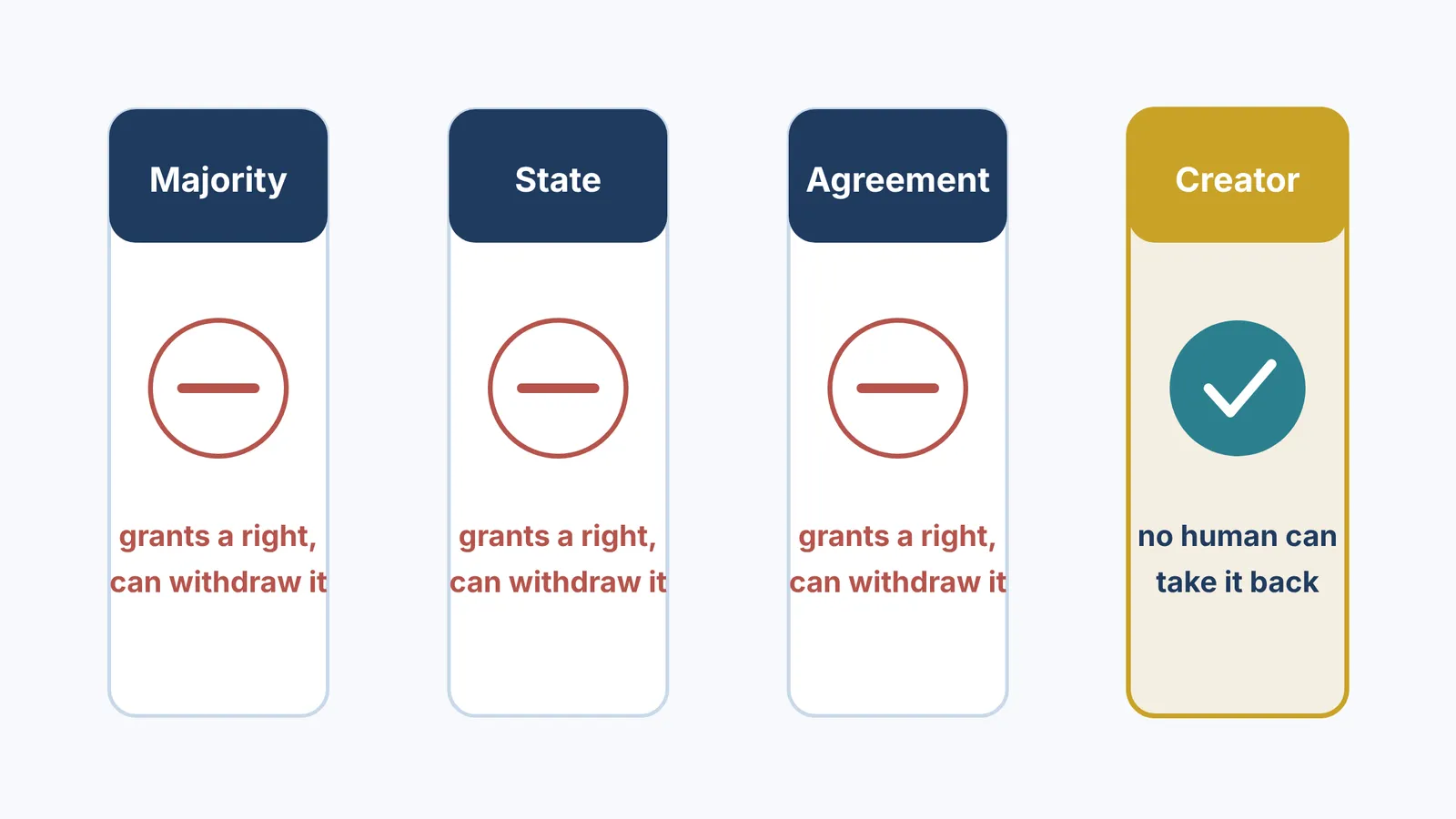
The point is not that these answers are worthless. It is that they all describe ways of protecting rights, not a ground for their existence. A right granted by one party can be withdrawn by that party, and then it is no longer a right at all but a temporary permission.
Dignity is a gift, not a reward
Islam offers an answer that differs at the root: your dignity was not given to you by people, so people cannot take it away. God says: We have honoured the children of Adam7.
Look at the words "children of Adam". The verse does not say "We honoured the believers", or "the strong", or "those who are useful to society". It includes every human being: Muslim and non-Muslim, the brilliant and the frail, the baby who has not yet spoken, the elderly man who has lost his memory. Dignity here is not a reward for achievement. It is a gift that comes before any achievement.
Equality follows from the same root: O people, be mindful of your Lord, who created you from a single soul2. All humans are one family, from one father and one mother. And again: We created you from a male and a female and made you peoples and tribes so that you may know one another. The most honoured of you in the sight of God is the most God-conscious of you8.
Notice the wisdom of this verse. Differences of people and colour exist so that we may know one another, not so that we may rank one another. The only measure of rank is God-consciousness, something in the heart that God alone can see. In other words, the verse takes out of every human hand the power to grade other humans. No race above a race, no colour above a colour, and judging hearts is not your job.
What does this mean in daily life? It means the street cleaner and the minister stand before God on the same ground. It means that someone who has lost the ability to work, to speak or to think clearly has lost none of their dignity, because it was never built on their abilities in the first place. The Prophet ﷺ said: "God does not look at your forms or your wealth, but at your hearts and your deeds"13. The measures by which people rank one another in markets and offices, money, looks and family name, carry no weight on the scale that decides a person's true worth.
There is deep relief in this. You do not have to prove every day that you deserve to exist, nor fear a day when someone decides you are no longer "useful" enough. Your dignity comes before your performance, and it outlasts it.
Three sanctities
At the Farewell Pilgrimage, before a vast crowd, the Prophet ﷺ declared: "Your blood, your property and your honour are sacred to you, like the sanctity of this day of yours, in this land of yours, in this month of yours"10. A person's life, wealth and reputation: he placed all three under the same sanctity as the holiest day and place his listeners knew.
The Qur'an's regard for life reaches a startling height: Whoever kills a soul, unless for a soul or for corruption in the land, it is as if he had killed all of humanity; and whoever saves one, it is as if he had saved all of humanity5. Every single life carries, in God's scale, the weight of all mankind.
Muslim scholars drew from the texts of the Shari'ah that it came to protect five essentials: religion, life, intellect, lineage and property, a framework set out by Abu Hamid al-Ghazali and later developed by Abu Ishaq al-Shatibi. Protecting human beings is not a side issue in Islamic law; it is among its highest aims.
There is a beautiful touch here. Islam often speaks about rights in the language of duties. Your right to safety is someone else's duty before God not to harm you. God says in a hadith qudsi: "O My servants, I have forbidden injustice for Myself and made it forbidden among you, so do not wrong one another"11. And the Prophet ﷺ taught that rights will be paid to those owed them on the Day of Resurrection, even the hornless sheep will be given its due from the horned one12. No right is lost, even if it was lost in the courts of this world.
Justice even towards those you dislike
It is easy to be fair to people you love. The real test comes with an opponent. Here the Qur'an says: Do not let hatred of a people lead you to be unjust. Be just: that is closer to God-consciousness4.
Then it goes further: justice even against yourself and those closest to you. Stand firm for justice as witnesses for God, even against yourselves, your parents or your relatives. Whether the person is rich or poor, God is closer to both3. Do not testify for the rich out of hope, nor for the poor out of pity, but for the truth alone.
All of this is gathered in one verse: God commands justice and excellence6. Justice is the floor you may not sink below; excellence (ihsan) is giving more than what is owed.
"And what about Muslims' own injustice?"
A fair question, and it must not be dodged. Muslim history and the Muslim present contain much injustice: rulers who became tyrants, societies that failed the weak, women and strangers, individuals who did harm in the name of religion.
But the right question is: by what standard do we call this injustice? When a Muslim reads the verses above, he finds that they condemn this injustice before anyone else does. The verse that commands justice "even against yourselves" puts Muslims on trial first. Islam never promised that its followers would be flawless. It gave them a standard to be judged by, and to judge themselves by.
That is an important difference between a religion and its followers. If you see a doctor smoking, you do not conclude that medicine recommends smoking. You conclude that the doctor is going against what he knows.
"Human rights came from the secular Enlightenment, not religion"
Here is the objection at its strongest: "Modern human rights charters, equality before the law and freedom of conscience all developed in the modern period, often in struggle against religious authorities. How can you credit religion with rights?"
There is truth here that should be acknowledged. The modern legal formulation of human rights and its international institutions did develop in recent centuries, and people of many backgrounds, religious and not, contributed to them. A Muslim has no need to deny this.
But consider three points.
First, the history of how a document was drafted is one thing; the ground of its truth is another. The question is not "Who wrote the declaration?" but "What makes its contents true, rather than merely agreed?" If the whole world agreed tomorrow to scrap it, would torture become acceptable? If you say no, you believe human dignity is deeper than any agreement.
Second, many founding texts of that very era reached for a ground above human beings. The American Declaration of Independence states that people are "endowed by their Creator" with unalienable rights. Even at the height of the Enlightenment, its authors sensed that a right needs a Giver whose gift humans cannot revoke.
Third, what you have read on this page, the honouring of every child of Adam, the single origin of humankind, justice towards enemies, the sanctity of life, property and honour, was revealed in the Qur'an and proclaimed by the Prophet ﷺ many centuries before the modern era. We do not mention this to boast about who came first, but to show that religion, at least in its Islamic form, is not the enemy of human dignity. It is one of its deepest sources.
What humans grant, humans can withdraw; the dignity God gave every child of Adam is in no one's hand to take.
Questions you may have
Does Islam protect the rights of non-Muslims?
Yes. The honour in the verse belongs to all "children of Adam"7, justice is required even towards those we dislike4, and kindness and fairness are asked of Muslims towards peaceful non-Muslims9. Life, property and honour are protected for everyone living under the security and covenant of Muslims.
Does equality in Islam mean being identical in everything?
Equality in Islam is equality in dignity and worth, and before the law and the courts. Justice, though, may sometimes require different treatment according to different circumstances and responsibilities, just as a patient's treatment differs from a healthy person's diet. The details of such questions deserve calm conversation with people of knowledge, not quick verdicts.
What about freedom of belief?
The Qur'an says: There is no compulsion in religion1. The faith God wants is the faith of a heart that chooses, and coercion cannot produce faith. That is why calling people to Islam is a matter of explanation and evidence, not force.
If the whole world agreed tomorrow that one group of human beings had no dignity, would you accept it? And if not, what standard would you be appealing to?
Show a thought
Most people feel that human dignity does not wait for a vote. That deep conviction is saying something: that your worth and the worth of others stands above every human agreement. Islam gives the source of that worth its name: God, who honoured the children of Adam.
Back to the island. When you rejected the majority's decision, you were voicing a certainty you cannot give up: that a human being is too great to have their dignity put to a vote.
Islam does not ask you to give up that certainty. It gives it ground to stand on: dignity from God, equality in origin, justice that does not bend even for an opponent, and a reckoning in which no right is lost. And that same standard judges Muslims before it judges anyone else.
Your next step
Sources (13)
- Qur'an 2:256 (al-Baqarah)
- Qur'an 4:1 (al-Nisa')
- Qur'an 4:135 (al-Nisa')
- Qur'an 5:8 (al-Ma'idah)
- Qur'an 5:32 (al-Ma'idah)
- Qur'an 16:90 (al-Nahl)
- Qur'an 17:70 (al-Isra')
- Qur'an 49:13 (al-Hujurat)
- Qur'an 60:8 (al-Mumtahanah)
- Sahih al-Bukhari 1739 (also Muslim 1679)
- Sahih Muslim 2577
- Sahih Muslim 2582
- Sahih Muslim 2564