Have you ever shared something before knowing who actually said it?
Imagine scrolling late at night when an image lands in your family group chat. A dark background, a dignified man with a white beard, a harsh sentence in bold, and underneath: "Said by a famous scholar." Hundreds of reactions, dozens of angry comments.
You feel the anger before you think. And before you ask who this scholar is, or where he said it, your thumb is already on "share".
Much of what people believe about religion and science is formed in moments like this. How do we meet them with a clear head?
Where our views come from now
A generation ago, people learned about a religion from a book, a neighbour or a lecture. Today many learn from a thirty-second clip, a quote card, a screenshot, or a stranger's thread.
Shortness is not the problem. What falls off along the way is: who said it, when, and what came before and after. The fragments pile up into an "impression", the impression hardens into a position, and soon you can't remember where it came from.
Four gaps misinformation slips through
One: context that has been cut. Almost any statement can be made to say its opposite if you cut it in the right place. Arabic speakers have an old joke about this: read the Qur'an's words do not approach prayer2 and stop, and prayer seems forbidden. The verse continues: while you are intoxicated2. A few missing words reversed the meaning.
Two: the borrowed name. A sentence with a famous name attached travels far faster than the sentence alone, which is why so many "famous quotes" are credited to scientists, philosophers and writers who never said them.
Three: edited images and audio. Doctored photos are old news. What is new is AI that produces convincing images and voices of people saying and doing things they never did. "I saw it with my own eyes" no longer settles the matter.
Four: the algorithm. Many platforms rank what they show you by what keeps you watching and reacting, and content that angers, frightens or confirms you tends to do exactly that. You react, you get more, you react more, until the world starts to look like your screen.

Five questions before you believe or share
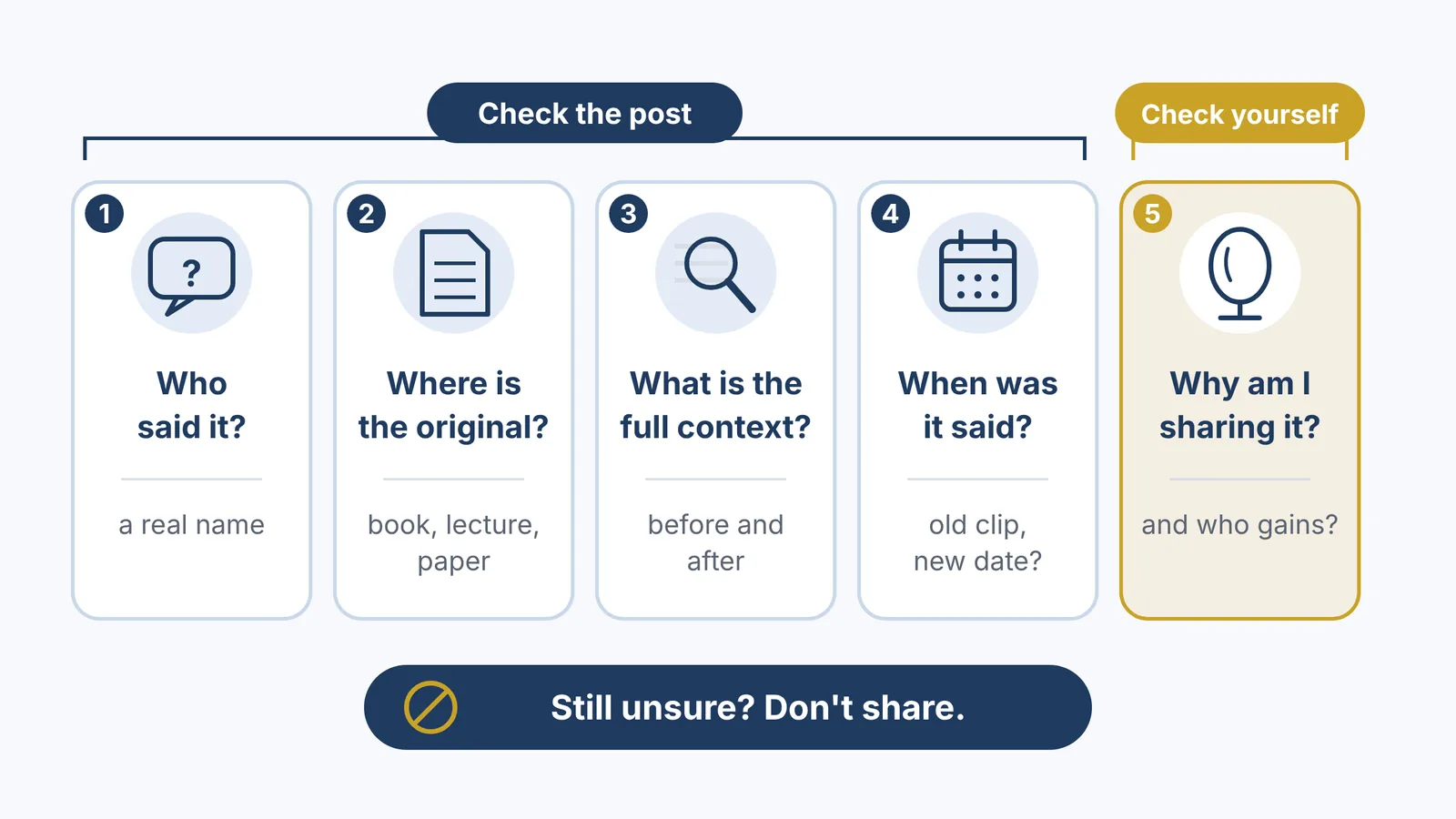
You don't need to be a professional fact-checker, just five questions and one minute:
- Who said it? A specific name, not "a famous scholar", "a new study" or "experts say".
- Where is the original? The book, the full lecture, the published paper. With no original to go back to, the claim hangs in mid-air.
- What is the full context? What came before and after? Who was it said to, and in what situation?
- When was it said? An old clip posted as today's news, or a photo from elsewhere tied to a new event, is one of the commonest tricks.
- Why am I sharing it, and who gains? Because it is true and useful, or because it proves me right, or made me angry? And who benefits if it spreads?
The first four examine the post. The fifth examines you, and it is the hardest, because we all go easy on claims we want to be true.
Try it: the card that arrived tonight
Back to the card from the start. Suppose, purely as a made-up example, that it reads: "Whoever is not with us in everything is our enemy in everything." Underneath: "Said by a famous scholar."

Before reading on, run the five questions yourself, then compare:
- Who said it? Unknown. "A famous scholar" is not a name; claiming fame while hiding the name is itself a warning sign.
- Where is the original? No book, no page, no lecture. Nothing to check, and no one to hold to it.
- What is the context? Even if someone said it, he may have been quoting an opponent in order to refute him.
- When? No date, no occasion.
- Why would I share it? The deciding question. If it is to say "look how religious people think", or "look how our opponents think", your anger is deciding, not the evidence.
Verdict: the card deserves neither belief nor disbelief, only a pause. Not sharing it costs you nothing. Sharing it, if it is false, makes you a link in a chain carrying a lie to thousands.
The same scale, both ways
The five questions are worthless if we only use them on what we dislike. Try them on two clips pulling in opposite directions.
A clip attacking Islam. Imagine a video showing kill them wherever you find them1 as proof that the Qur'an orders killing anyone who disagrees. Ask for the context. The verse just before says, in meaning: Fight in the cause of God those who fight you, but do not transgress; God does not love transgressors. The verse just after says: But if they stop, then God is Forgiving, Merciful1. It concerns people already at war with the Muslims, with an explicit ban on aggression. You may still have fair questions about Islam's rules of war, but a view built on half a verse is not worth holding.
A clip praising Islam. Now imagine stirring music and a caption: "Western scientists have finally discovered what the Qur'an said fourteen centuries ago, and the whole team converted." No scientist named, no paper cited. The same questions apply with the same strictness.
This is asked of Muslims too. A Muslim who spreads an exaggerated story because it "helps the faith" goes against the faith itself. The truth needs no lie to prop it up, and every inflated claim later exposed makes people doubt the true ones too.
Checking is worship, not just a skill
You might expect these questions to come from a modern media-literacy course. Their core has been in the Qur'an for fourteen centuries.
God says, in meaning: Believers, if someone untrustworthy brings you news, verify it, lest you harm people out of ignorance and then regret what you have done7. Notice the order: news arrives, verification comes before action, and the cost of skipping it is harming innocent people and regretting it too late. That is what happens whenever a false post spreads about a person or a group.
When a false rumour attacked the honour of Aisha, the Prophet's innocent wife, the Qur'an described how it spread: when you received it with your tongues and said with your mouths what you had no knowledge of, thinking it trivial, while with God it was serious6. News passed from tongue to tongue without ever passing through a mind: sharing without reading, centuries before the phone. And thinking it trivial: just one tap.
And the general rule: Do not follow what you have no knowledge of; your hearing, your sight and your heart will all be questioned about it5. The ears that heard the clip, the eyes that saw the image, the mind that decided: all accountable.
Then a saying of the Prophet ﷺ that reads like a diagnosis of our age: "It is enough lying for a person to pass on everything he hears"8. He did not say "to invent lies". Relaying everything that reaches you, unsorted, means relaying falsehood along with truth.
This is where Islam's view is beautiful. Honesty with information is not just a technical skill; it is character you will answer for before God, and be rewarded for. Truthfulness, the Prophet ﷺ taught, leads to goodness and goodness to Paradise, while lying leads to wickedness9. And for whatever stays uncertain he gave a merciful rule: "Leave what makes you doubt for what does not make you doubt"10. No one is held to account for a rumour they never passed on.
A religion that built a science to check its own sources
After the Prophet ﷺ died, Muslims faced a problem like ours: many sayings attributed to him, some authentic, some honest mistakes, some deliberate fabrications. How to tell them apart?
The answer was a rigorous method: the science of isnad and the criticism of narrators. Every report came with a chain of transmitters, so-and-so from so-and-so, back to the Prophet ﷺ. Having a chain was not enough; scholars examined every link. Was this narrator honest? Was his memory precise? Did he actually meet the person he quoted? Did his report clash with what more reliable narrators transmitted? These rules for accepting and rejecting reports were set down in dedicated works, a well-known one being al-Khatib al-Baghdadi's al-Kifayah fi 'Ilm al-Riwayah12.
Abdullah ibn al-Mubarak said, more than twelve centuries ago: "The isnad is part of the religion; were it not for the isnad, anyone could say whatever he wished"11. Hold that next to the "famous scholar" card: words without a chain.
Nor were all reports treated alike. A report passed on by so many that their agreeing on a lie is practically impossible gives certainty; below that level, the confidence it deserves falls through strong likelihood to doubt13. Exactly what anyone scrolling needs: not only "true or false?" but "how much confidence does this deserve?"
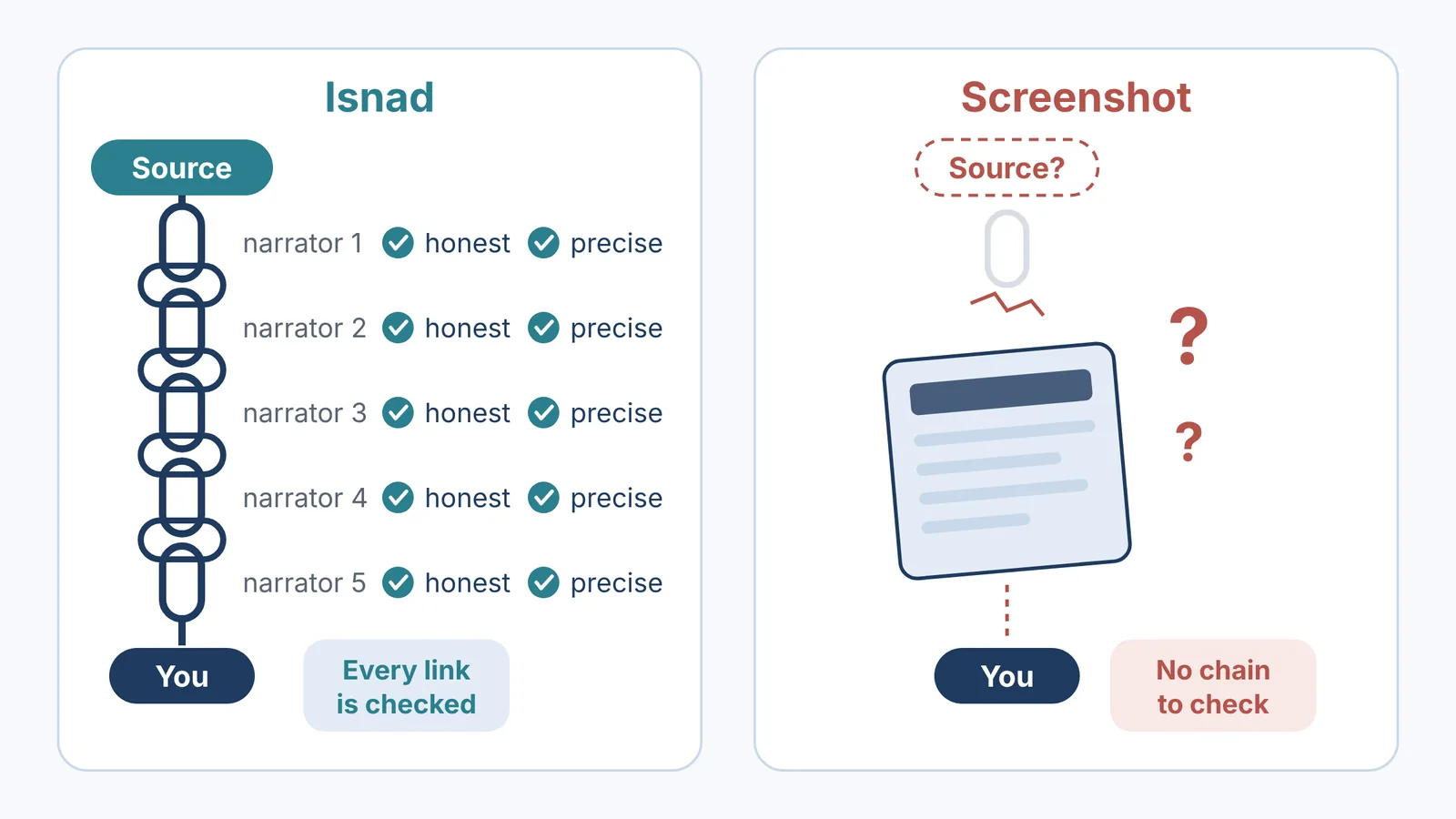
Contemporary Muslim researchers see in this heritage a practical foundation for what we now call information literacy14. And it carries an invitation. A religion that built a whole discipline to check its own sources, and applied it first to its own Prophet's words, is not afraid of being checked by you. It asks you to. So don't take your picture of Islam from a cropped clip, or an over-excited one. Ask it the same five questions.
"Everyone, religious people first of all, only fact-checks what they dislike"
A strong objection, with much truth in it. Religious people scrutinise every report criticising their faith, then happily share any story flattering it; others do the reverse. Isn't fact-checking just a weapon aimed at the other side?
The honest answer: yes, that is human nature. We all believe what we want more easily and demand hard proof for the rest, religious, atheist or educated alike.
But Islam confronts this nature head-on. The Qur'an's command to verify makes no exception for news believers find pleasing7. It tells them to stand firm for justice and bear witness even against yourselves, your parents and your relatives3. And it says: Do not let hatred of a people lead you to be unjust. Be just: that is closer to piety4.
Hadith scholars lived this. They rejected many fabricated reports about the rewards of good deeds, however "nice" the message, because the chains did not hold, and wrote whole books exposing fabrications. Sound transmission, not attractive content, was the standard.
So the objection is right about people, not about the method. A method demanding the same scale both ways is exactly what overcomes that tendency. And if you see a Muslim failing at it, judge him by his own religion's standard.
The truth does not need a lie to prop it up, and a falsehood does not become true because it made you angry.
Questions you may have
Do I have to check everything I read?
No; that is impossible. But two moments call for care: before you share, and before you build an important view. Whatever you scroll past, file it as "I don't know yet" rather than letting it settle as fact.
How do I check a verse or hadith I see online?
For a verse: find its number, read what surrounds it, and check a recognised commentary. For a hadith: ask which collection it is in and how scholars graded it; one with neither gets the "famous scholar" treatment. Or ask a knowledgeable Muslim you trust.
With AI-generated images and audio, can I trust anything any more?
Yes, but differently. Seeing will no longer be enough; you will lean more on reliable originals and several independent sources. The old principle holds: a report carried by many independent people outweighs one from a single unknown source, however convincing it looks.
Think of the last post about religion, or about any group, that made you really angry. Did you ask it the five questions? Would you have done so if it had pleased you?
Show a thought
If you were softer on what pleased you, you have found what every honest person finds in themselves. That is not a mark against you but an opportunity. The Qur'an says "verify", and does not add "except for what you like".
We began with a thumb hovering over "share" late at night. No one expects you to be a flawless fact-checking machine. One minute, five questions, and honesty with yourself on the last one is enough.
Islam says the same in its own words: verify, do not follow what you have no knowledge of, do not pass on everything you hear. And it did not exempt itself; it built a whole science to examine its own reports. A religion that asks this honesty of you deserves the same honesty in return: read it from its sources, not from a cropped clip.
Your next step
Sources (14)
- Qur'an 2:190–192 (al-Baqarah)
- Qur'an 4:43 (al-Nisa')
- Qur'an 4:135 (al-Nisa')
- Qur'an 5:8 (al-Ma'idah)
- Qur'an 17:36 (al-Isra')
- Qur'an 24:15 (al-Nur)
- Qur'an 49:6 (al-Hujurat)
- Sahih Muslim, Introduction, hadith 5
- Sahih al-Bukhari 6094 (also Muslim 2607)
- Jami' al-Tirmidhi 2518 (graded sahih)
- Sahih Muslim, Introduction: saying of Abdullah ibn al-Mubarak on the isnad
- al-Khatib al-Baghdadi, al-Kifayah fi 'Ilm al-Riwayah
- Centre course material: Sources of knowledge (reports and their levels, from mass transmission to conjecture)
- Yaqeen Institute, Finding Truth in the Age of Fake News: Information Literacy in Islam