Must you choose between living your life to the full and preparing for what comes after it?
Imagine two travellers on a long road to a distant city. The first is so fixed on arriving that he refuses to eat, rest or speak to anyone, and he collapses halfway. The second is charmed by the markets and inns along the way; he buys, settles in, stays up late, until he forgets he was ever travelling.
Neither will arrive as he should. The first wronged the road; the second wronged the destination. The Prophet ﷺ described himself in this world as a rider who took shade under a tree, then moved on and left it24. The rider really does rest in the shade. He just never forgets that he is a rider. That picture holds Islam's whole position.
Two opposite roads
Human history has known two extreme answers to the question of how we should relate to this world.
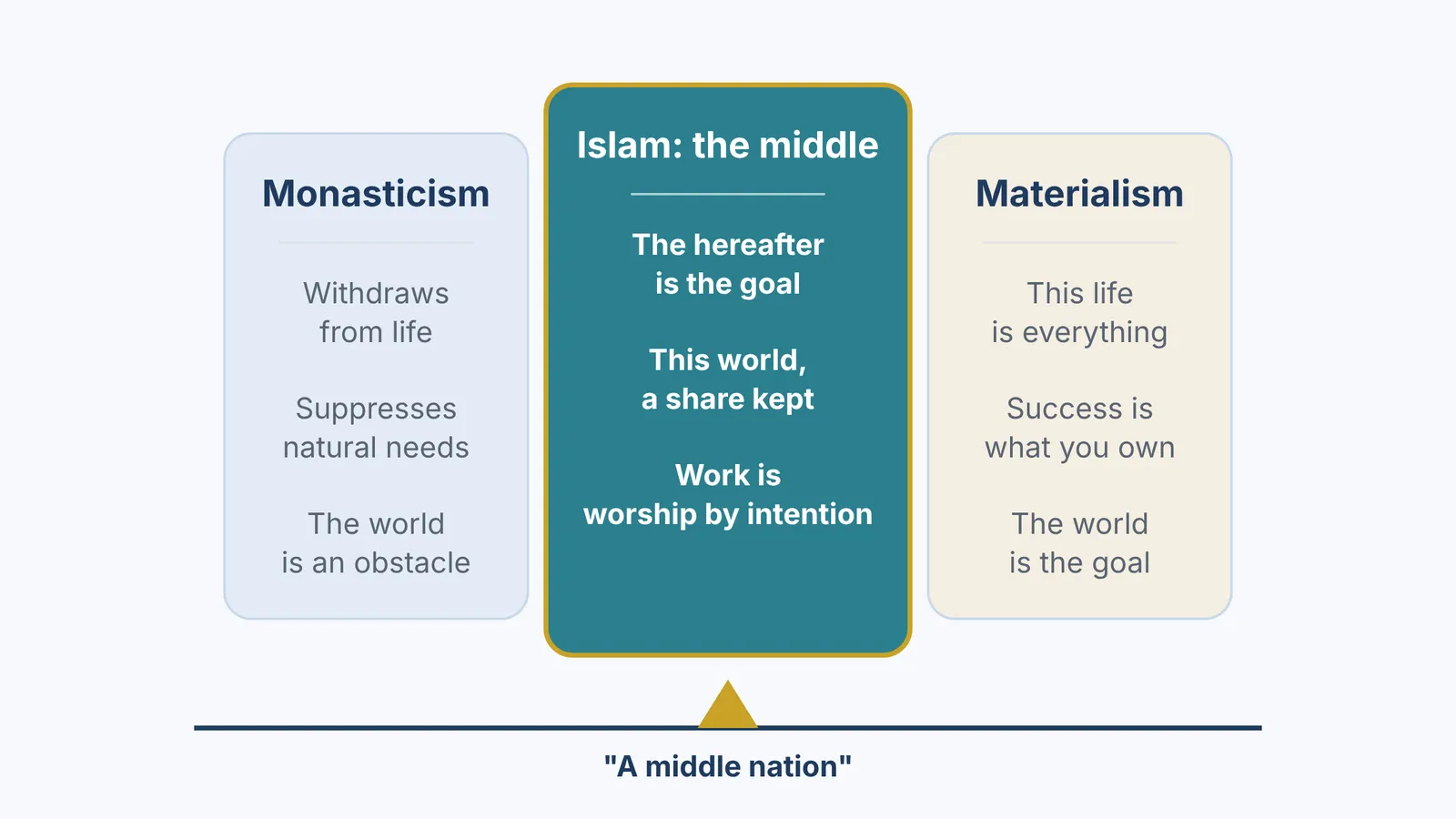
Withdrawal and monasticism. In many religious traditions, sincere people concluded that the road to God, or to salvation, runs through leaving the world. Christian history produced monasticism: monks and nuns withdrawing to a monastery or the desert, under vows of celibacy, poverty and obedience. Hinduism has the stage of renunciation, leaving home and family, for those seeking liberation; Buddhism has monastic orders built on giving up desire as the path out of suffering. We respect the sincerity of many who chose this, and their longing for purity.
Materialism. At the other end stands the view that this life is everything. Sometimes it is an explicit philosophy: only matter exists, and there is nothing after death. Sometimes it is a way of life that never says so aloud but measures a person's success by what he owns, consumes and enjoys. The Qur'an recorded this view long ago: They say: there is nothing but our life in this world; we die and we live, and nothing destroys us but time9.
The first sees the world as an obstacle; the second sees it as the goal. Where does Islam stand?
What the Qur'an says about monasticism
The Qur'an speaks of the followers of Jesus, peace be upon him, with striking fairness: We placed in the hearts of those who followed him compassion and mercy. And monasticism, they invented it; We did not prescribe it for them, except that they sought God's pleasure; yet they did not observe it as it should be observed10.
Read it carefully. It praises the compassion and mercy in their hearts and acknowledges that they wanted God's pleasure. But it states two facts: monasticism was not legislated by God but invented, and most could not sustain it as it deserved. That is natural. Whoever commits himself to living against the nature God created in him loads himself with more than he can carry.
The Prophet ﷺ met the same impulse among his own Companions. Three men asked about his worship and, as if they found it little, resolved: one to pray all night forever, one to fast every day, one never to marry. He said: "By God, I am the most fearful of God among you and the most mindful of Him; yet I fast and break my fast, I pray and I sleep, and I marry women. Whoever turns away from my way is not of me"18.
The Qur'an asks a question that exposes the error of forbidding good things in the name of religion: Say: who has forbidden the adornment God has brought forth for His servants, and the good things of provision?4 The One who created beauty, food and marriage did not create them so that avoiding them would be the way to come near Him.
So Islam has no class of "full-time holy people" above ordinary believers. The scholar and the devout worshipper marry, work and mix with people. The most honoured in God's sight is the most mindful of Him, whether in the prayer niche, the market or at home among his children.
And what does materialism lose?
A materialist can be a generous, upright person; we see that in real life. But the question is not about individuals; it is about foundations. If this life is all there is, what makes sacrifice better than selfishness? Who gives justice to the oppressed person who died before seeing any? And why do things, however many, never fill the emptiness in a human chest?
Try it in your own life. How often have you bought something you waited for, enjoyed it for a few days, and then felt exactly as before? That loop is not a flaw in you. It is a sign that a person has a need that things cannot fill. Materialism treats thirst with salt water: the more you drink, the thirstier you become.
The Qur'an describes the condition precisely: They know the outward surface of the life of this world, while they are heedless of the hereafter7. Note that it does not deny their knowledge. They know how things work; they simply never ask why things exist or where they are going.
Monasticism robs a person of his share in this world; materialism robs this world of its meaning.
The middle nation
Against both extremes the Qur'an says: Thus We have made you a middle nation, so that you may be witnesses over mankind1. "Middle" here is not a pale half-measure. It means just and best, like a level scale.
The clearest verse on this balance is: Seek, through what God has given you, the home of the hereafter, and do not forget your share of this world; and do good as God has done good to you6. The hereafter is the goal, this world is a share not to be forgotten, and doing good is the bridge between them.
So one of the most frequent prayers on a Muslim's lips is: Our Lord, give us good in this world and good in the hereafter, and protect us from the punishment of the Fire2. He neither asks for this world alone nor despises it.
Look at the Friday prayer. The Muslim leaves his business to pray, and is then told at once: When the prayer is ended, disperse through the land and seek God's bounty, and remember God much11. From the mosque to the market, with remembrance on both roads.
Worldly work itself becomes worship through intention. The Prophet ﷺ said: "No Muslim plants a tree or sows a crop, and then a bird, a person or an animal eats from it, but it is charity for him"17. The farmer in his field is worshipping. And when Salman saw his friend Abu al-Darda' neglecting his family through constant fasting and night prayer, he told him: "Your Lord has a right over you, your self has a right over you, and your family has a right over you; so give everyone who has a right his right." The Prophet ﷺ said: "Salman has spoken the truth"16.
Ethics at the heart of the faith
In Islam ethics is not an appendix to belief; it is at the core of the message. The Prophet ﷺ said: "I was sent only to perfect righteous character"15, and his Lord described him: Truly you are of a magnificent character12. Asked about righteousness, he said: "Righteousness is good character"23.
These ethics are not vague generalities; they reach into the details of life. "Jibril kept urging me to treat the neighbour well until I thought he would make him an heir"21. "The one who strives for the widow and the poor is like the one who strives in the path of God"19. And the whole community is one body: "You see the believers in their mutual mercy, love and kindness like one body: when one limb complains, the rest of the body joins it in sleeplessness and fever"20.
The essential difference is that these ethics are anchored in God, not in the mood of an era. Honesty is not a virtue because society votes for it today, but because God commands it and sees you when you are honest and when you lie. That gives morality a stability that neither fashion nor self-interest can shake. The moral system is explored in detail on its own page.
A faith that builds civilisation
The first word of the Qur'an to be revealed was a command to read: Read in the name of your Lord who created13, followed by mention of the pen and of teaching14. The Qur'an asks: Are those who know equal to those who do not know?8 And it makes developing the earth a human task: He produced you from the earth and settled you in it to build it5.
From these seeds grew a civilisation stretching from al-Andalus to Central Asia, built by Arabs, Persians, Turks, Berbers and many others. Its scholars translated the heritage of Greece, Persia and India, and did not stop at preserving it; they critiqued it and added to it. The word "algebra", used in European languages today, comes from the title of al-Khwarizmi's book on mathematics, and the numerals that originated in India reached Europe through Muslims. Ibn Sina's Canon of Medicine remained a textbook in European universities for centuries, and Ibn al-Haytham wrote a book on optics that shaped those who came after him. Many star names in modern astronomy are still Arabic in origin.
Nor was this civilisation only learning; it was organised mercy. The Prophet ﷺ said that a person's deeds end at death except for three things, the first being ongoing charity22. From that meaning grew the system of endowments (awqaf): people dedicated property to schools, hospitals, drinking water, and care for the poor and the stranger, and these kept working for generations after their founders died.
The great Muslim cities had hospitals (bimaristans) that treated the public, many of them funded by endowments, so that the poor could be treated too. That is a natural extension of a religion that makes mercy to the weak an act of worship.
This is what balance produces: faith in the hereafter did not prevent building this world. It drove it.
"But Islamic civilisation is over, and the West is the one that advanced"
A blunt objection deserves a blunt answer. Yes, Muslims declined in later centuries while others advanced in science and technology. But every civilisation rises and falls, and that does not cancel the principles it was built on.
The right question is: when did Muslims advance, and when did they fall behind? They advanced when they held to the command to read, to justice and to developing the earth; they fell behind when that weakened in them. Decline is an argument against Muslims, not against Islam. A medicine is not to blame when the patient stops taking it. The page "Is Islam backward?" takes this question further.
"Isn't Islamic asceticism just monasticism in other clothes?"
Asceticism (zuhd) in Islam lives in the heart, not the hand: the world in your hand, not in your heart, so you own wealth and it does not own you. The Prophet ﷺ lived simply and slept on a mat that left its mark on his side24; yet he married, worked, led a community and a state, and urged his Companions to earn and to do good.
The difference is large. The monk leaves the world to be free for worship. The Muslim ascetic lives in the middle of the world and turns all of it into worship.
Don't flee life to reach God, and don't drown in it until you forget Him; cross through it towards Him.
Questions you may have
Does balance mean a time for religion and a time for the world?
Not exactly. Some acts of worship have set times, like prayer, but the idea goes deeper: that all of life belongs to God through intention, so your work, sleep, meals and kindness to your family become worship when you do them for His sake.
Is Islam against enjoyment and comfort?
No. Good things are permitted and beauty is loved. The Qur'an says: Eat and drink, but do not waste3. What is forbidden is the unlawful and excess, and letting pleasure become a master instead of a blessing you thank God for.
Did Muslim scholars treat the natural sciences as part of religion?
They saw the pursuit of all beneficial knowledge as worship when the intention is sound, because the universe is full of God's signs, studying it deepens knowledge of the Creator, and benefiting people with it draws one near to Him.
Looking at your past week, which traveller were you closer to: the one who forgot the road, or the one who forgot the destination?
Show a thought
Most of us lean towards one side or the other at different times. Balance is not reached once; it is regained every day. Islam gives you the tools: a prayer that returns you to the destination five times a day, and work that becomes worship when the intention is right.
We return to the rider resting under a tree. He did not refuse the shade, and he did not build a palace beneath it and forget his road. That is how Islam wants you: to eat, work, love and build, honest and generous in all of it, with a heart that knows there is a more lasting home beyond the tree.
That balance produced a civilisation that joined knowledge to mercy. It can still produce a balanced human being in a world swinging between spiritual emptiness and material excess.
Your next step
Sources (24)
- Qur'an 2:143 (al-Baqarah)
- Qur'an 2:201 (al-Baqarah)
- Qur'an 7:31 (al-A'raf)
- Qur'an 7:32 (al-A'raf)
- Qur'an 11:61 (Hud)
- Qur'an 28:77 (al-Qasas)
- Qur'an 30:7 (al-Rum)
- Qur'an 39:9 (al-Zumar)
- Qur'an 45:24 (al-Jathiyah)
- Qur'an 57:27 (al-Hadid)
- Qur'an 62:10 (al-Jumu'ah)
- Qur'an 68:4 (al-Qalam)
- Qur'an 96:1 (al-'Alaq)
- Qur'an 96:4–5 (al-'Alaq)
- Musnad Ahmad 8952 (graded sahih)
- Sahih al-Bukhari 1968
- Sahih al-Bukhari 2320; Sahih Muslim 1553
- Sahih al-Bukhari 5063; Sahih Muslim 1401
- Sahih al-Bukhari 5353; Sahih Muslim 2982
- Sahih al-Bukhari 6011; Sahih Muslim 2586
- Sahih al-Bukhari 6014; Sahih Muslim 2624
- Sahih Muslim 1631
- Sahih Muslim 2553
- Jami' al-Tirmidhi 2377 (graded hasan sahih)