How would you bet on a man who stood alone against his whole world?
Imagine a map of seventh-century Arabia. To the north and east lie two great empires, Byzantium and Persia, with their armies, churches and fire temples. Across the peninsula, tribes worship idols and guard their fathers' customs fiercely. In one small valley town, a single man stands up and tells all of them, empires and tribes alike, that what they worship is not God.
He has no army, no kingdom and no wealth to offer. Within a few years his own tribe will boycott his family until they go hungry, and his city will plot to kill him. Any sensible observer would have predicted that his message would die with him.
It did not. This page asks how that can be explained, and why the answer matters more than the bare fact of success.
He began alone, and broke with everyone
The call began quietly, with his wife Khadijah, a few friends and some young people and slaves. When the Prophet ﷺ was commanded to warn his clan openly, he climbed the hill of al-Safa and called the families of Quraysh. They admitted they had never known him to lie; then, when he warned them, his own uncle Abu Lahab cursed him in front of everyone19.
What made his position so lonely was not only his small numbers, but his message. He did not flatter any group to win it over. To the idol-worshippers of Mecca he was told to say: Say: O disbelievers, I do not worship what you worship17. To everyone he declared: He is only One God, and I am free of what you associate with Him4. He corrected the beliefs of Jews and Christians about God, and he addressed his message not to one tribe but to all people11.
The leaders of Quraysh tried to bargain. The sira reports that they sent 'Utbah ibn Rabi'ah to offer him wealth, leadership, even kingship, if he would stop29. The Qur'an itself records how hard they pressed him to compromise on revelation, and that God kept him firm8. He refused. A man seeking power would have taken the offer. A man carrying a message he did not own could not.
Besieged, hungry and driven out
When persuasion failed, pressure followed. Quraysh and their allies swore a pact against the Prophet's clans, Banu Hashim and Banu al-Muttalib: no one would marry them or trade with them until they handed the Prophet ﷺ over20. The sira reports that his family was confined for two to three years in the narrow valley of Abu Talib, and that their hunger became severe29.
Then the boycott ended, but the losses did not. His uncle and protector Abu Talib died, and so did Khadijah. He sought support in al-Ta'if and was turned away21. Finally Mecca plotted to kill him, and he left his birthplace by night. The Qur'an speaks of your town which drove you out13, and it gives permission to fight only to those who were expelled from their homes without right, only because they said: Our Lord is God9.
Later, the Qur'an reminded the believers of exactly how weak they had been: Remember when you were few, oppressed in the land, afraid that people would snatch you away; then He gave you shelter and strengthened you with His help5.
He announced the outcome while he was weak
This is the point where the story stops being an ordinary story of persistence. While he was still in Mecca, few and persecuted, the Qur'an he recited made confident promises about the future.
In a Meccan surah it says: We will surely help Our messengers and those who believe, in the life of this world and on the day the witnesses stand12. In another Meccan surah, at a time when the Muslims could not even protect themselves, it says of the united Meccan forces: The assembly will be defeated, and they will turn their backs14. In Medina, still surrounded by enemies, the Qur'an declares: God has written: I and My messengers will surely prevail15, and promises the frightened believers that their fear would be replaced with security10.
When his companion Khabbab, tortured for his faith, begged him in the shade of the Ka'bah to pray for help, he answered that this matter would be completed until a rider could travel across Arabia fearing none but God, "but you are hasty"22. (Specific prophecies about Persia and Rome have their own page, BA80.)
A man who invents a religion can hope; he cannot guarantee. Staking everything on public promises, made while weak, is a very costly bet for a liar: the first failure would expose him.
Then the promise came true
Within about two decades, the man who had been boycotted returned to Mecca. Years after the boycott, during his pilgrimage, he chose to camp at the very spot where Quraysh had sworn their pact against his family: "Tomorrow we will camp at Khayf Bani Kinanah, where they swore an oath upon disbelief"20. He did not come for revenge. On the day Mecca opened to him, he announced: "Whoever enters the house of Abu Sufyan is safe, whoever lays down his weapon is safe, and whoever locks his door is safe"23.
Before his death the Qur'an could say: Today I have perfected your religion for you, completed My favour upon you, and chosen Islam as your religion3. And a promise whose words recur three times in the Qur'an was being fulfilled before people's eyes: He is the One who sent His Messenger with guidance and the religion of truth, to make it prevail over all religion, even if the idolaters dislike it6.
The thesis on which this section is built summarises the pattern carefully: a messenger who began without inherited kingship or an established army confronted his own society, endured persecution and migration, survived repeated threats to his community's existence, and completed the public delivery of a message that continued after his death32.
And the message stayed as he brought it
Many movements change after their founder dies. Their founder is gradually raised above the human level, or their core teaching is redefined by later councils and leaders.
Watch what happened at the Prophet's death. When the news spread, some companions could not accept it. Abu Bakr came, uncovered the Prophet's face and kissed him, then went out and said: "Whoever among you worshipped Muhammad, Muhammad has died; and whoever worshipped God, God is Ever-Living and does not die," and he recited the verse revealed after Uhud: Muhammad is only a messenger242. At the very moment when a community is most tempted to deify its founder, his closest friend closed that door.
The Qur'an he brought was gathered in writing within a few years, then copied into standard copies sent to every region2526, and it is recited today in the same words. The Qur'an had said it would be so: It is We who sent down the Reminder, and it is We who will preserve it7. The creed he proclaimed at al-Safa, that there is no god but God, and his own status as servant and messenger, are exactly what Muslims affirm today.
A false claimant would not be allowed this
The Qur'an makes a striking claim about itself: Had he invented some sayings in Our name, We would have seized him by the right hand, then cut his life-artery16. It is a test anyone can apply. A man who lied about God would not be granted twenty-three years of growing, lasting support for his lie.
History has seen many who claimed prophethood. The Prophet ﷺ himself foretold that some thirty impostors would come, each claiming to be God's messenger27. Musaylimah in his own lifetime and others after him gathered followers for a time; their movements faded and their words are not recited by anyone. Ibn Taymiyyah observed in al-Nubuwwat that no one ever falsely claimed prophethood without his ignorance, lies and corruption becoming exposed31.
What makes this beautiful, not just impressive, is how the victory was received. At the moment of triumph, the Qur'an did not tell him to celebrate himself: When the help of God comes, and the victory, and you see people entering God's religion in crowds, then glorify the praise of your Lord and ask His forgiveness18. He left the world with his armour mortgaged to a Jewish neighbour for some barley28. The message prevailed; its messenger stayed a servant.
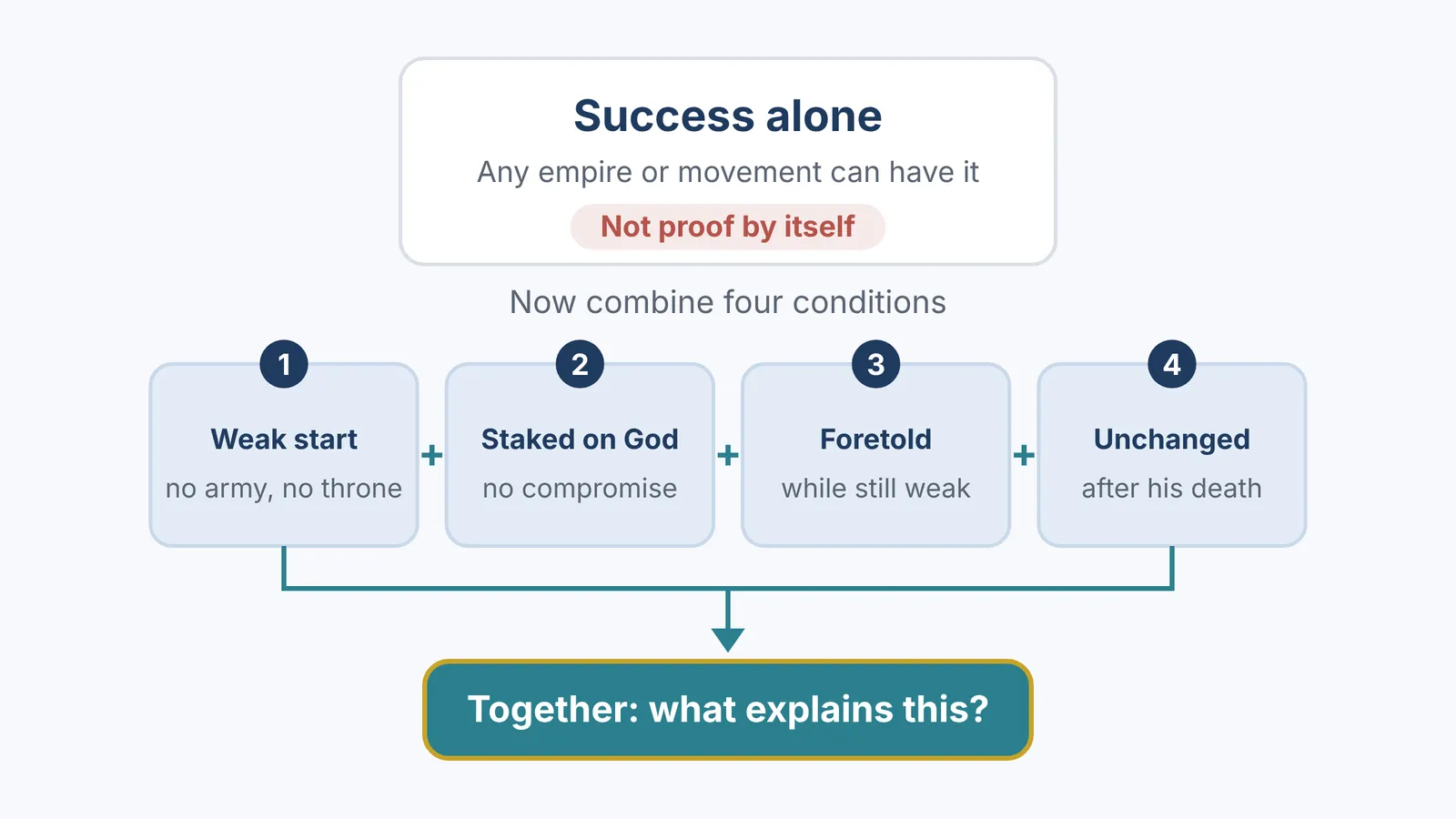
"Plenty of empires and religions have spread. Success proves nothing"
That is correct, and the thesis states it plainly: historical success does not on its own prove divine approval, since false or unjust movements can also gain power32. Conquerors built vast empires; many beliefs have won millions of followers.
The argument here is not "it succeeded, therefore it is true". It is that four things came together in this one case. He began weak, without kingship, army or wealth. He staked everything on God, refusing every compromise that could have made the road easier. He announced the outcome publicly while he was weak, when it could still be falsified. And after his death the message did not drift; it remained exactly as he brought it. Each of these is a clue; together they form a pattern that ambition, luck or political skill struggles to explain.
Political wisdom and his companions' sacrifices certainly played their part, and Muslims do not deny it. But political skill does not explain refusing a kingdom when it was offered, or making promises in Meccan verses that only the future could confirm.
"It spread by the sword"
For the first thirteen years, in Mecca, the Muslims did not fight at all; they were the ones being beaten and starved. Many people of Medina accepted Islam before he ever arrived there. The Qur'an itself states the principle: There is no compulsion in religion1.
Battles were fought, and states expanded, as states did in every age. But conquest of land does not make people believe, and it certainly does not keep their great-grandchildren believing. Large regions of the world came to Islam over centuries through traders, teachers and neighbours, with no army involved. A faith imposed by force tends to be shed when the force is gone. This one was not.
The message prevailed; its messenger stayed a servant.
Questions you may have
Isn't it circular to use the Qur'an's own promises as evidence?
No. The promises are not used as proof of themselves. They are dated, public statements made at a time of weakness. The question is simply whether what they announced then actually happened later, which can be checked against history.
Does "prevail over all religion" mean everyone will become Muslim?
Classical commentators explained that the prevailing is first by proof and clarity, and also by strength and standing at times God wills30. It does not mean compulsion, which the Qur'an forbids1, nor that all people will accept it.
If God supported him, why did he suffer so much?
Because in Islam a prophet is a human servant who is tested, not an untouchable hero. The boycott, the hunger and the exile are part of why the outcome is so telling: it came after everything ordinary had failed.
If you had stood in that valley during the boycott, hungry, with your whole city against you, what would have convinced you to stay with him?
Show a thought
The people who stayed were not promised quick rewards. They stayed because they trusted that he was telling the truth about God. Looking back, you have something they lacked: you can see that what he promised in weakness came to pass, and that what he brought was kept unchanged.
We began with a man standing alone against his world. The usual ending to that story is a footnote in history. Here the ending is a message recited today in the same words, by people on every continent, affirming the same thing he said on the hill of al-Safa.
Success alone would not be enough to convince you, and it should not be. But a weak beginning, an unbending trust in God, promises made in hardship and kept in history, and a message preserved as it was given: that pattern asks for an explanation. Muslims find the simplest one in his own words: he was the messenger of God.
Your next step
Sources (32)
- Qur'an 2:256 (al-Baqarah)
- Qur'an 3:144 (Al 'Imran)
- Qur'an 5:3 (al-Ma'idah)
- Qur'an 6:19 (al-An'am)
- Qur'an 8:26 (al-Anfal)
- Qur'an 9:33 (al-Tawbah; also 48:28, 61:9)
- Qur'an 15:9 (al-Hijr)
- Qur'an 17:73–74 (al-Isra')
- Qur'an 22:40 (al-Hajj)
- Qur'an 24:55 (al-Nur)
- Qur'an 34:28 (Saba')
- Qur'an 40:51 (Ghafir)
- Qur'an 47:13 (Muhammad)
- Qur'an 54:45 (al-Qamar)
- Qur'an 58:21 (al-Mujadilah)
- Qur'an 69:44–46 (al-Haqqah)
- Qur'an 109:1–2 (al-Kafirun)
- Qur'an 110:1–3 (al-Nasr)
- Sahih al-Bukhari 4770: the call from al-Safa
- Sahih al-Bukhari 1590 (also Muslim 1314): Khayf Bani Kinanah, where Quraysh swore the boycott
- Sahih al-Bukhari 3231 (also Muslim 1795): the day of al-Ta'if
- Sahih al-Bukhari 3612: Khabbab, "this matter will be completed…"
- Sahih Muslim 1780: the amnesty at the conquest of Mecca
- Sahih al-Bukhari 1241–1242: Abu Bakr at the Prophet's death
- Sahih al-Bukhari 4986: the first collection of the Qur'an
- Sahih al-Bukhari 4987: the standard copies under Uthman
- Sahih al-Bukhari 3609: about thirty impostors
- Sahih al-Bukhari 2916: his armour mortgaged at his death
- Ibn Hisham, al-Sirah al-Nabawiyyah: the boycott in the valley of Abu Talib; 'Utbah's offer
- Ibn Kathir, Tafsir al-Qur'an al-'Azim, on 9:33
- Ibn Taymiyyah, al-Nubuwwat
- Ibrahim Elshahat, The Rational Sunnah-Based Proofs of Prophet Muhammed's Truthful Prophethood (PhD thesis, University of Malaya), section 3.3.5.6: providential outcomes and historical vindication, and the limits of the argument from success