If one sentence from you could end the worst crisis your home had ever faced, would you wait a month to say it?
Imagine a man whose whole town is passing round talk about his wife's honour. His enemies whisper and smile, some of his own friends repeat what they have heard, and his wife lies ill in her father's house, weeping day and night. Everyone is watching him: what will he say?
And this man says that God speaks to him through revelation. His followers accept every word he recites to them as the word of God. All he has to do is stand up and say, "It has just been revealed to me that she is innocent," and the fire goes out within the hour.
He did not do it. A day passed, then a week, then a full month, and no verse came. Why?
What happened during that month?
This time the scene is not imagined. It is an event narrated by Aishah herself, may God be pleased with her, in the collections of al-Bukhari and Muslim12. She was travelling with the Prophet ﷺ and fell behind the caravan while searching for a necklace she had lost. When she came back, the army had moved on. One of the Companions later passed by, let her ride his camel, and led it until they caught up with the others.
That was all. But the hypocrites of Medina, led by Abdullah ibn Ubayy, saw an opportunity. They spread talk about her honour, and some Muslims took it up on their tongues. Aishah fell ill for a month without knowing what was being said; when she found out, her tears would not stop.
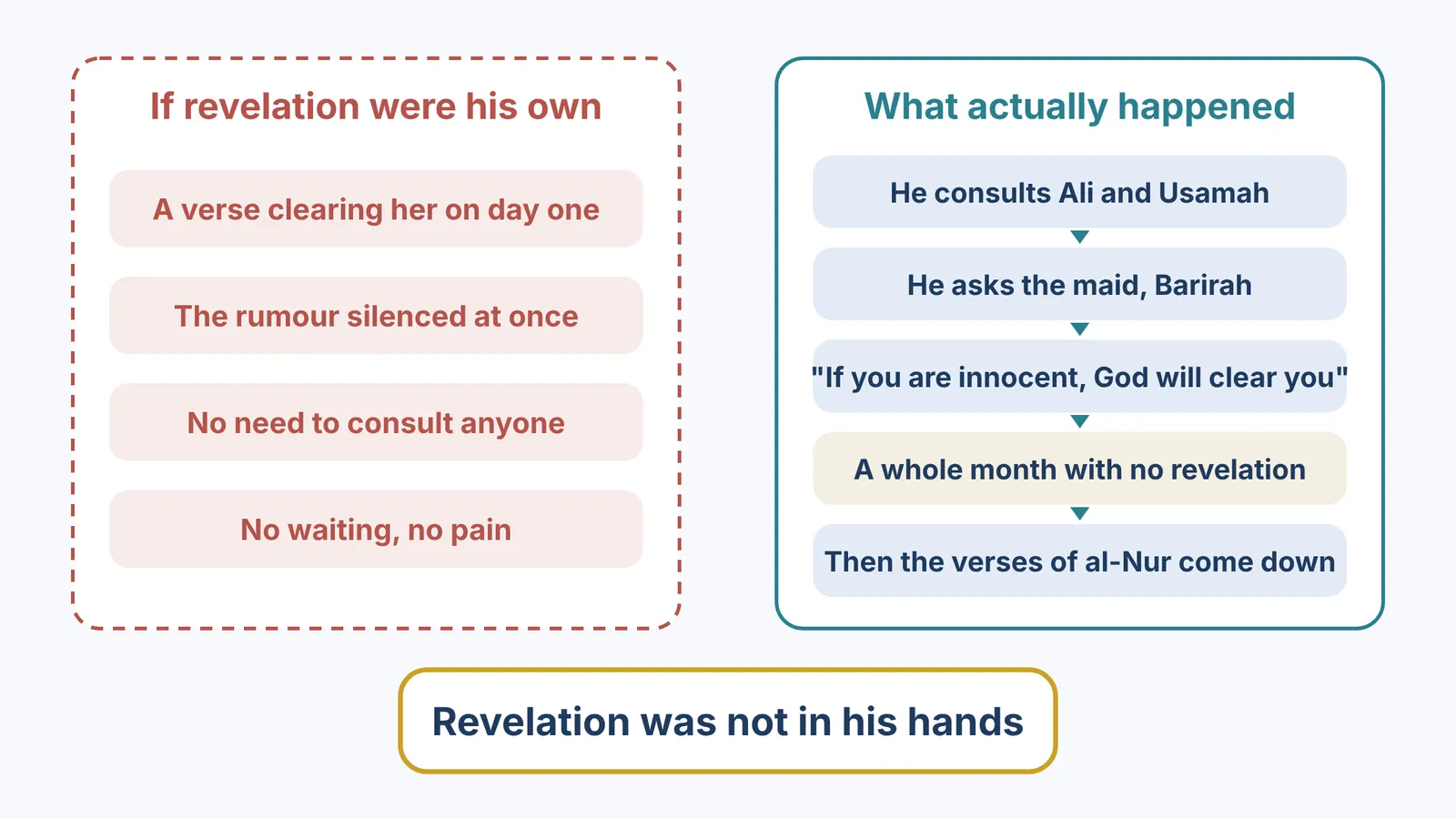
Meanwhile the Prophet ﷺ did not act like a man who held the answer. He consulted Ali and Usamah ibn Zayd about her. He asked her maid, Barirah, what she knew of her, and Barirah said she knew nothing but good. Then he stood on the pulpit, complained of the man who had hurt him through his family, and said he knew nothing but good about his family12.
Then he went to Aishah and sat with her. She notes that nothing had been revealed to him about her for a month. He said, in meaning: "Aishah, such and such has reached me about you. If you are innocent, God will declare your innocence. If you have slipped into a sin, ask God's forgiveness and turn to Him"1217.
Read that sentence slowly. Here is a man who does not know the unseen. He hopes she is innocent, but will not declare as certain what he does not know. He leaves the verdict to God.
Aishah says she never expected God to reveal verses about her that would be recited; she thought herself too small for that. She only hoped the Prophet ﷺ might see a dream in which God would clear her. Then revelation came to him in that very sitting. When it lifted from him he was laughing, and his first words were: "Aishah, as for God, He has declared your innocence"12. The verses of Surat al-Nur came down, beginning, in meaning: Those who brought forward the slander are a group among you. Do not think it bad for you; rather, it is good for you7.
When her mother told her to get up and go to him, she said: "By God, I will not get up to him, and I will praise no one but God"12. Even the woman at the centre of it understood that her vindication had not come from her husband, but from above him.
The question that cannot be skipped
If you want to explain the life of a man who claims to be a prophet, you basically have three options. Either he is lying on purpose; or he is sincere but deluded, mistaking his own thoughts for revelation; or he is truthful, and revelation really comes to him from God17. The slander affair puts the first two to a hard test.
If he was lying, composing the Qur'an himself, the month makes no sense. The verse clearing his wife was available to him on day one. It would have protected his home, silenced the hypocrites and relieved obvious pain. A liar does not sit through a month of public scandal when one sentence would get him out.
If he was deluded, hearing his own wishes as revelation, then a heart that loved his wife and thought well of her would almost certainly have produced an "inspiration" of her innocence very quickly. The deluded hear what they long for. He longed for a month and heard nothing.
If revelation came from outside him, every detail fits. Here is a man investigating as any fair judge would: consulting, asking, waiting patiently, attributing nothing to God that God had not sent, until the verdict arrived at the time God chose, not the time he chose.
Not a single incident
One incident, you might say, proves little. Fair enough; so look at the pattern.
The three who were left behind. Ka'b ibn Malik and two companions stayed behind from the Tabuk expedition without an excuse. When the Prophet ﷺ returned, they told him the truth instead of making false excuses as the hypocrites did. He deferred their case and told people not to speak to them. They lived like that for fifty nights, until the earth, wide as it is, felt narrow to them; then their repentance was accepted in revelation132. He loved them and knew they were honest, yet he did not pardon them on his own authority.
The direction of prayer. After the migration he prayed towards Jerusalem for sixteen or seventeen months. He longed to face the Ka'bah and would turn his face towards the sky, waiting, until this came down, in meaning: We have seen the turning of your face towards the heaven, and We will surely turn you to a direction that will please you114. He wished it, yet did not change it until commanded.
"What keeps you from visiting us more?" The Prophet ﷺ once asked the angel Gabriel, "What prevents you from visiting us more often than you do?" Then the verse was revealed, in meaning: We do not descend except by the command of your Lord515. He himself wished for more revelation, and the answer was that the matter belonged neither to him nor to the angel.
The pause before Surat al-Duha. Ibn Kathir, in his commentary, cites al-Bukhari's report that the Prophet ﷺ fell ill and did not rise for night prayer for two or three nights, and a woman mocked him, saying his "devil" had abandoned him. Then came, in meaning: By the morning brightness, and by the night when it grows still, your Lord has not forsaken you, nor is He displeased1116. Had he controlled revelation, he would not have let that taunt stand for a single night.
Quraysh's questions. Some reports in the biographical literature, cited by Ibn Kathir in his commentary on Surat al-Kahf, say that Quraysh asked him about the spirit and about young men who disappeared in ancient times. He said, "I will tell you tomorrow," without adding "if God wills", and revelation was delayed for days16. Hadith scholars have reservations about the chain of this report, so we do not lean on it alone. But the verse itself is firmly in the Qur'an, with a direct instruction to him: Never say of anything, "I will certainly do that tomorrow," without adding, "if God wills"4.
A crisis at home, honest companions, a form of worship he loved, his longing for revelation, his opponents' mockery: in every case he waited, and could not hurry it.
Revelation as a trust he carried, not speech he owned
The Qur'an describes this relationship plainly. When his opponents asked him to bring a different Qur'an or to change it, he was told to answer, in meaning: It is not for me to change it of my own accord; I only follow what is revealed to me3. And it says of him: Nor does he speak from his own desire; it is only revelation sent down to him9.
When the Qur'an came to him, he used to move his tongue quickly to memorise it, and he was told: Do not move your tongue with it to hasten it10, and Do not hasten with the Qur'an before its revelation to you is completed6. He receives, and is even taught how to receive.
There is a beauty here. Islam does not present a prophet who shapes religion to suit himself and then demands obedience. It presents a man who is the first to submit to revelation, who waits for it as his companions wait. That is why obeying him is obeying God, not his personal wishes.
Look, too, at what came out of that ordeal. The verses did not only clear Aishah. They brought a whole ethic for dealing with rumours: to think well of one another, and not to pass on with our tongues what we have no knowledge of, thinking it trivial when with God it is grave8. Had the vindication come on day one, the community would never have learned so deeply what a false word can do.
"Perhaps he delayed it on purpose, to look more convincing"
This is the sceptic's strongest move: a clever man knows an instant verse would look suspicious, so he holds it back.
But count the cost of that "plan". For a whole month the hypocrites attacked the honour of his wife, the daughter of his closest friend. Some Muslims repeated the talk. Medina was so divided that, as Aishah relates in the same hadith, two clans of the Ansar nearly came to blows in the mosque12. Nobody pays that price, in his honour, his home and the unity of his community, to buy a credibility his followers had already given him.
And a man with a plan knows the ending in advance. Why, then, would he say to his wife, "If you have slipped into a sin, ask God's forgiveness"? Those words wounded her and nearly damaged what was between them. Only someone who truly did not know the unseen, and was careful in judgment, would say them.
Above all, the pattern does not fit a plan. If delay were a tactic, he would use it only where it helped him. Yet we see him longing for revelation, asking Gabriel to come more often, turning his face to the sky for the direction of prayer, and enduring his opponents' taunts when revelation paused. That is not a man controlling the timing. It is a man waiting for it.
"Perhaps his followers invented these stories to prove his sincerity"
Perhaps later narrators produced stories of waiting to defend their prophet?
But this story does not read like invented praise. It records that some Muslims joined in the gossip, that the Prophet ﷺ said something to his wife that hurt her, that the Companions split in the mosque, and that Aishah refused to get up to him after she was cleared. Nobody invents a story to glorify his own community and then fills it with that community's failures.
Besides, it is the Qur'an itself, not only the narrators, that records the event and rebukes the believers who passed the rumour along8. And the Qur'an was recited in the mosque to the very people who had lived through it. Had the facts been otherwise, they would have known.
He could have ended the crisis with one sentence, if revelation had been his. He waited a month, because it was not.
Questions you may have
Why did God not reveal her innocence at once, if she was innocent?
The Qur'an itself answers: Do not think it bad for you; rather, it is good for you7. In that month the hypocrites were exposed, the sincerity of the believers was tested, and rulings and manners concerning rumours and false accusation were revealed that have guided Muslims ever since. And it became clear, then and now, that the Prophet ﷺ did not control revelation.
Did the Prophet ﷺ doubt Aishah?
He said from the pulpit that he knew nothing but good about his family12. But thinking well of someone is one thing; claiming certainty about the unseen is another. He acted as a just person acts: he did not accuse without evidence, did not acquit on the basis of what he could not know, and left the final verdict to God.
Are all these accounts of delayed revelation authentic?
The slander affair, the three who were left behind, the change of the direction of prayer and his asking Gabriel to visit more often are all in al-Bukhari and Muslim. The story of Quraysh's questions about the spirit and the people of the cave comes from biographical reports whose chains hadith scholars have questioned, which is why we mention it with caution. The verse forbidding him to promise without "if God wills" stands firmly on its own.
If you were in his place, and you could silence a whole town about the person you love most with one sentence attributed to God, would you wait a month? And what does his waiting tell you about the source of his words?
Show a thought
Most of us would not last a day; pain at home is unbearable. His patience is hard to explain unless he simply did not have that sentence to give. And when a man is this honest at his weakest moment, it becomes only fair to ask: who, then, was speaking to him?
We began with a man who needed only one sentence to end the ordeal in his home. We have seen that he did not say it, not because he lacked words, but because he would not say about God what God had not sent.
This is the Prophet ﷺ Islam presents to you: a human being who hurts, waits and investigates, and then recites what comes to him exactly as it comes. And if that revelation truly came from outside him, then these words are not the opinion of a seventh-century man. They are a message from your Lord, and they deserve to be read and heard with the same seriousness.
Your next step
Sources (17)
- Qur'an 2:144 (al-Baqarah)
- Qur'an 9:118 (al-Tawbah)
- Qur'an 10:15 (Yunus)
- Qur'an 18:23–24 (al-Kahf)
- Qur'an 19:64 (Maryam)
- Qur'an 20:114 (Ta Ha)
- Qur'an 24:11 (al-Nur)
- Qur'an 24:15 (al-Nur)
- Qur'an 53:3–4 (al-Najm)
- Qur'an 75:16 (al-Qiyamah)
- Qur'an 93:1–3 (al-Duha)
- Sahih al-Bukhari 4750; Sahih Muslim 2770 (the hadith of the slander)
- Sahih al-Bukhari 4418; Sahih Muslim 2769 (the hadith of Ka'b ibn Malik)
- Sahih al-Bukhari 399; Sahih Muslim 525
- Sahih al-Bukhari 4731
- Ibn Kathir, Tafsir al-Qur'an al-'Azim (commentary on Surat al-Duha and on al-Kahf 18:23–24)
- Ibrahim Elshahat, The Rational Sunnah-Based Proofs of Prophet Muhammed's Truthful Prophethood (PhD thesis, University of Malaya): delayed revelation and the absence of autonomous control (section 3.3.5.1); the liar / deluded / truthful alternatives