If someone had written a description of you centuries before you were born, would your life match it?
Imagine a young scholar of the generation after the companions, 'Ata' ibn Yasar, meeting a companion known for learning and for writing things down: Abdullah ibn Amr ibn al-As. He asks him straight out: tell me about the description of the Messenger of God ﷺ in the Torah.
Abdullah answers: "Yes, by God, he is described in the Torah with some of his description in the Qur'an"9. Then he lists specific traits: not harsh, not coarse; he does not repay evil with evil, but pardons and forgives.
This page does not ask you to accept the report because it is in a Muslim book. It asks something simpler: put the description beside the life, and see whether they match.
The text of the report
Al-Bukhari records that 'Ata' ibn Yasar asked Abdullah ibn Amr, who replied: "Yes, by God, he is described in the Torah with some of his description in the Qur'an: 'O Prophet, We have sent you as a witness, a bearer of good news and a warner'5, and a refuge for the unlettered. You are My servant and My messenger; I have named you al-Mutawakkil, the one who relies on God. He is neither harsh nor coarse, nor loud in the markets. He does not repay evil with evil, but pardons and forgives. And God will not take him until He has straightened through him the crooked creed, so that they say: there is no god but God; and through it He will open blind eyes, deaf ears and covered hearts."9
Notice three things before we start:
- Abdullah said "with some of his description in the Qur'an". He himself separates what is in the Qur'an from what is in the Torah, and he quotes phrases that are not in the Qur'an word for word, such as "loud in the markets" and "I have named you al-Mutawakkil".
- The traits are not ones of power or wonders. They are traits of character: gentleness, calm, forgiveness, reliance on God.
- The report makes a claim about the future: God will not take him until the creed is set straight and people say "there is no god but God".
We should also be precise. This is a companion's report of what he knew as the Prophet's description in the Torah. It does not assume that every word appears verbatim in the Bibles in circulation today, and the academic study this page draws on says so explicitly21. The argument rests on the match between the reported description and the observed life.
The description beside the life
Take the traits one at a time and set beside each what is established about his life ﷺ.
"You are My servant and My messenger." This is the very title he chose when he forbade his companions to exaggerate about him: "I am only His servant, so say: the servant of God and His Messenger."10
"I have named you al-Mutawakkil." In the cave, with the pursuers at the entrance, he told his companion: "Abu Bakr, what do you think of two when God is their third?"11 Under the tree, with a sword raised over him, he said: "God."12
"Neither harsh nor coarse." The Qur'an itself testifies to this: "By a mercy from God you were gentle with them; had you been harsh and hard of heart, they would have scattered from around you"1. It even uses the same two Arabic words, fazz and ghaliz. His servant Anas served him for ten years, and he never once said "uff" to him, nor "why did you do that?" about anything he had done13.
"Nor loud in the markets." The Arabic word describes someone who shouts and quarrels. The Prophet ﷺ did walk in the markets like everyone else, so much that his opponents mocked him for it: "What kind of messenger is this, who eats food and walks in the markets?"3 But he was never loud or quarrelsome there. When a Bedouin yanked his cloak so hard that it left a mark on his shoulder, and rudely demanded money, he turned to him, laughed, and ordered that he be given something14.
"He does not repay evil with evil, but pardons and forgives." Aishah said he never took revenge for himself, unless something God had made sacred was violated15. When the people of Ta'if rejected and hurt him, and he was offered their destruction, he said: "Rather, I hope that God will bring from their descendants people who worship God alone."16 A woman served him a poisoned sheep; asked "Shall we not kill her?", he said no17. Asked to curse the polytheists, he said: "I was not sent as one who curses; I was sent only as a mercy."18
"God will not take him until He has straightened through him the crooked creed." He began alone and hunted, and he did not die until Arabia had turned to the worship of one God, and these words came to him: "When the help of God comes, and the victory, and you see people entering the religion of God in crowds"8.
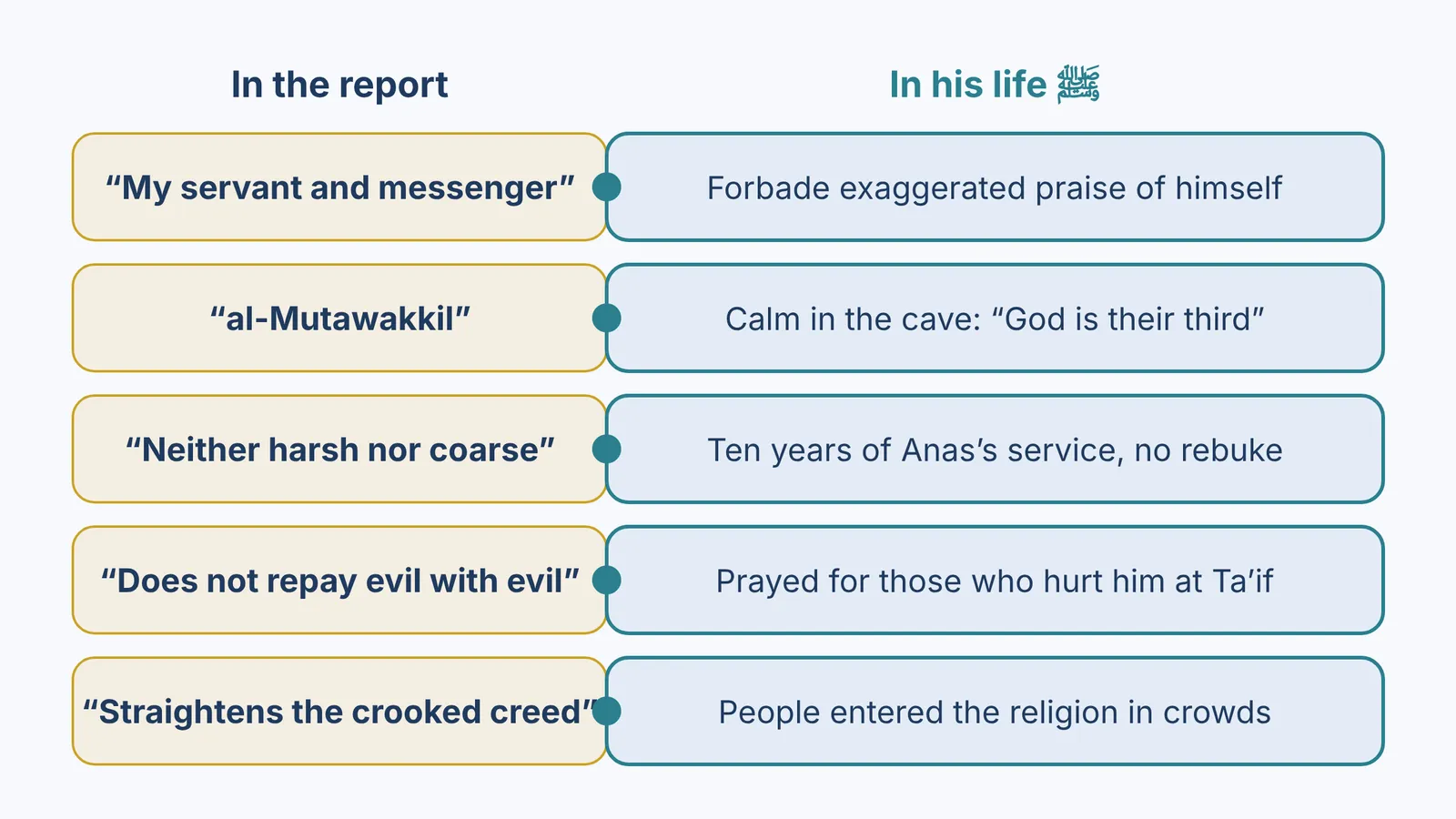
Followers inventing a "prophecy" would more likely describe strength, triumph and spectacular miracles. This describes a gentle, quiet man who meets insult with pardon. And it is a description any contemporary could test, and expose if he saw the opposite.
The Qur'an: they find him written with them
Abdullah ibn Amr was not the first to say this. The Qur'an describes the Prophet's followers as those who follow "the Messenger, the unlettered Prophet, whom they find written with them in the Torah and the Gospel"2. It says Jesus, peace be upon him, gave good news of him: "and bringing good news of a messenger who will come after me, whose name is Ahmad"7. And it says of his companions: "that is their likeness in the Torah, and their likeness in the Gospel"6.
Consider how bold this is. A man addresses the Jews of Medina and the Christians of Arabia, who are reading their scriptures with their own hands, and tells them: you find me written with you. Had there been nothing in it they recognised, refuting him publicly would have been easy. The Qur'an goes further: "Is it not a sign to them that the scholars of the Children of Israel know it?"4 And some of their scholars did recognise him and accept Islam; that is the subject of the next page.
The beauty of Islam here is that it does not present its prophet as cut off from those before him. He is a link in one chain: he confirms Moses and Jesus, peace be upon them, and those who read their books sincerely could know him. One message, one God, and the prophets as brothers.
What do we find in the Bible today?
Here we must be honest. The Bible in circulation today does not name "Muhammad", and Muslims hold that these books suffered change and loss over the centuries. Even so, a number of Muslim scholars point to passages with a striking resemblance to his description. Here are the best known, presented with care and with their own readers' interpretations.
Isaiah 42. In the King James Version: "Behold my servant, whom I uphold; mine elect, in whom my soul delighteth; I have put my spirit upon him: he shall bring forth judgment to the Gentiles. He shall not cry, nor lift up, nor cause his voice to be heard in the street. A bruised reed shall he not break, and the smoking flax shall he not quench... He shall not fail nor be discouraged, till he have set judgment in the earth: and the isles shall wait for his law." (Isaiah 42:1-4)20
Compare it with the report. "My servant" matches "You are My servant and My messenger". "He shall not cry... nor cause his voice to be heard in the street" is very close to "nor loud in the markets". "A bruised reed shall he not break" is a picture of gentleness to the weak. "He shall not fail... till he have set judgment in the earth" matches "God will not take him until He has straightened through him the crooked creed". Verse 7 has "To open the blind eyes", and the report has "He will open blind eyes". Then verse 11 mentions "the villages that Kedar doth inhabit", and in Genesis Kedar is a son of Ishmael (Genesis 25:13), an ancestor of the Arabs20.
Fairness requires us to add that Christians read this passage as a prophecy of Jesus, peace be upon him; Matthew's Gospel applies it to him (Matthew 12:17-18). Many Jewish readers take the servant to be Israel, since shortly before it says: "But thou, Israel, art my servant" (Isaiah 41:8)20. The question is debated between the faiths, and we do not claim it is settled by an explicit text.
Deuteronomy 18. God says to Moses: "I will raise them up a Prophet from among their brethren, like unto thee, and will put my words in his mouth; and he shall speak unto them all that I shall command him." (Deuteronomy 18:18)20 Muslim scholars argue that the "brethren" of the Israelites are the descendants of Ishmael, and that a prophet like Moses, bringing a law and leading his community, with God's words placed in his mouth to recite as he heard them, fits Muhammad ﷺ best. Christians read it as referring to Jesus (Acts 3:22); many Jews read it as the line of prophets after Moses.
What do we gain? Not a settled proof, but the knowledge that Abdullah ibn Amr's report is not alien to the scriptures of the People of the Book: the picture of a chosen, quiet servant who does not shout in the streets and establishes justice on earth is there in their tradition. And the Prophet ﷺ taught a fair method for what the People of the Book relate: "Do not believe the People of the Book and do not disbelieve them"19; we suspend judgment where we have no evidence either way.
"Maybe Abdullah projected the Qur'an's description onto the Torah"
A reasonable suspicion: a companion who loved his Prophet and knew the Qur'an might have blurred the two.
But the report partly answers this itself. Abdullah clearly distinguished, saying "with some of his description in the Qur'an", and then quoted phrases that are not in the Qur'an, such as "loud in the markets" and "al-Mutawakkil", which are strikingly close to Isaiah's wording. And the report is in Sahih al-Bukhari with a sound, connected chain.
More importantly, even if we set aside the question of source, the description itself remains testable. It is not a vague portrait that fits anyone; it is a set of specific traits that can be checked against a documented life. And his life matched it at home, in the market, in war and in power.
"The Bible we have does not name him"
True, and we do not claim otherwise. Islam holds that the earlier scriptures were not preserved as the Qur'an was, so it is no surprise that some phrases are missing or altered. And biblical prophecies usually describe rather than name, and their own readers disagree on how to apply them, as you saw with Isaiah 42.
The deeper questions are these. Why would an unlettered man say in the Qur'an that the People of the Book find him in their scriptures, exposing himself to refutation by those who held the books? And why did some of their scholars, who knew those books best, believe in him? Those questions deserve more thought than the search for a name in a late manuscript.
They did not describe him by miracles or power, but as one who is not loud in the markets, who does not repay evil with evil, but pardons and forgives. Then his life came to match it.
Questions you may have
Who was Abdullah ibn Amr ibn al-As?
A distinguished companion who accepted Islam before his father, known for his devotion and for writing down what he heard from the Prophet ﷺ. The man who narrated from him, 'Ata' ibn Yasar, was one of the senior, trustworthy scholars of the next generation. The report is in Sahih al-Bukhari, the most authentic hadith collection for Muslims.
Do Muslims believe today's Torah is the Torah revealed to Moses?
Muslims believe God revealed the Torah to Moses, peace be upon him, with guidance and light in it. But they hold that the copies in circulation today underwent change and loss over history. So they neither accept nor reject all of it, but weigh it against the Qur'an19.
Does belief in his prophethood depend on these prophecies?
No. Earlier prophecies are one indication among many; stronger still are the Qur'an itself, his life and his character. But they carry weight, especially when they give a precise moral description that a documented life then matches.
Suppose you lived in Medina at the time. Someone read you this description, and then you spent years around the Prophet ﷺ. Which trait would you test first?
Show a thought
Most people would test the forgiveness, because it is the hardest trait for the human ego. Those around him saw him pardon the man who took his sword, the woman who poisoned him and the people who hurt him at Ta'if. When the hardest trait matches the life at its hardest moments, the question becomes: where did this description come from, and who shaped this life to fit it?
We began with a simple question: does the description match the life? You have seen that it matches almost line by line: the servant, the one who relies on God, the gentle, the forgiving, the one who did not die until people said "there is no god but God".
Islam does not ask you to settle every debate about ancient texts before you believe. It is enough to see that this man came in the manner of the prophets, and brought what they brought: the worship of God alone. If Moses and Jesus, peace be upon them, called to the One God, here is their brother, calling you to the same God.
Your next step
Sources (21)
- Qur'an 3:159
- Qur'an 7:157
- Qur'an 25:7
- Qur'an 26:197
- Qur'an 33:45
- Qur'an 48:29
- Qur'an 61:6
- Qur'an 110:1-2
- Sahih al-Bukhari 2125 (also 4838): the Prophet's description in the Torah, reported by Abdullah ibn Amr
- Sahih al-Bukhari 3445: "say: the servant of God and His Messenger"
- Sahih al-Bukhari 3653 (also Muslim 2381): "what do you think of two when God is their third?"
- Sahih al-Bukhari 2913 (also Muslim 843): "Who will protect you from me?" — "God."
- Sahih al-Bukhari 6038 (also Muslim 2309): Anas's ten years of service
- Sahih al-Bukhari 3149 (also Muslim 1057): the Bedouin who yanked his cloak
- Sahih al-Bukhari 3560 (also Muslim 2327): "he never took revenge for himself"
- Sahih al-Bukhari 3231 (also Muslim 1795): "I hope that God will bring from their descendants…"
- Sahih al-Bukhari 2617 (also Muslim 2190): the woman who served the poisoned sheep
- Sahih Muslim 2599: "I was not sent as one who curses"
- Sahih al-Bukhari 4485: "Do not believe the People of the Book and do not disbelieve them"
- The Bible, King James Version: Genesis 25:13; Deuteronomy 18:18; Isaiah 41:8; 42:1-4, 7, 11; Matthew 12:17-18; Acts 3:22 (quoted as the object of comparison, not as religious authority)
- Ibrahim Elshahat, The Rational Sunnah-Based Proofs of Prophet Muhammed's Truthful Prophethood (PhD thesis, University of Malaya): correspondence between the reported description and observed conduct, and the limits of the report