When you hold a baby born a few hours ago, do you see a sinner who needs someone to pay for a sin he never committed?
Imagine a father in a hospital room, holding his first child. Tiny fingers close around his finger; the eyes barely open. This child has not yet told a lie, hurt anyone, or chosen anything at all.
Now imagine someone whispering to the father: "This child already carries the sin of his first ancestor, and needs to be saved." You may have heard this in church since childhood, and you may have believed it sincerely. This page sets before you a different answer, the one Islam gives, and leaves the comparison to you.
The doctrine as Christians state it
Fairness means presenting the doctrine as its believers explain it. Christians generally believe that the disobedience of Adam and Eve in the garden brought sin and death into the world, and that all humanity was affected by this fall.
They differ, however, on what it means. In the Catholic Church and most Protestant churches, every person inherits "original sin": a fallen nature inclined to evil, and, many hold, a state of guilt before God, which is one reason the Catholic Church baptises infants. The Eastern Orthodox churches speak rather of "ancestral sin": people inherit its consequences, such as death and weakness, but not the guilt itself.
For most Christians it follows that human beings cannot save themselves, so Christ, whom they believe to be God the Son incarnate, died on the cross as a sacrifice for the sins of humanity. They cite the Letter to the Hebrews: "without shedding of blood is no remission" (Hebrews 9:22)23. Whoever believes in him is saved. The churches explain the meaning of this atonement in several ways, but they agree that the cross is the way to forgiveness.
Adam in the Qur'an: a sin, then repentance, then forgiveness
The Qur'an tells the same story with a different ending. Adam and his wife ate from the tree they had been forbidden: Adam disobeyed his Lord and went astray7. But the story does not stop there. Both regretted it and said: Our Lord, we have wronged ourselves; if You do not forgive us and have mercy on us, we will surely be among the losers6.
Then came the ending: Then his Lord chose him, accepted his repentance and guided him8. And elsewhere: Then Adam received words from his Lord, and He accepted his repentance. He is the Ever-Accepting of repentance, the Most Merciful2. The matter between Adam and his Lord closed in complete forgiveness. No debt was left hanging, waiting for someone to settle it thousands of years later.
Nor was Adam's descent to earth an act of revenge. Before creating him, God told the angels that He would place a successor on the earth1. The earth was humanity's home from the start, and the place of its test.
So Adam became a model for all his children, not in sin but in repentance. The Prophet ﷺ said: "Every son of Adam errs, and the best of those who err are those who repent"21. Making mistakes is part of being human; repentance is the road God taught your first father.
No one carries another's sin
The Qur'an lays down a clear rule of justice and repeats it in several places: No bearer of burdens bears the burden of another, and a person has only what he strives for12. No soul carries another's sin, and each person answers only for what he did. The Qur'an even says that a soul weighed down with sins, if it begged someone to carry part of the load, would have nothing carried for it, even if it were a close relative9.
That is why, in Islam, a person is born innocent. The Prophet ﷺ said: "Every child is born upon the fitrah; then his parents make him a Jew, a Christian or a Magian"14. Fitrah here means a sound, natural readiness to know God and turn to Him, not inherited guilt.
Strikingly, the same rule appears in the Bible. In Ezekiel: "The soul that sinneth, it shall die. The son shall not bear the iniquity of the father, neither shall the father bear the iniquity of the son: the righteousness of the righteous shall be upon him, and the wickedness of the wicked shall be upon him" (Ezekiel 18:20). And Deuteronomy says that fathers shall not be put to death for their children, nor children for their fathers; every man for his own sin (Deuteronomy 24:16).
Then consult your conscience. If a judge sentenced a child to prison because his grandfather stole something a century ago, you would call it injustice without hesitation. How, then, can we attribute to the Most Just what we recognise as injustice in ourselves? God says: "O My servants, I have forbidden injustice for Myself"17.
This rule gives you something precious: you are responsible for yourself alone. You inherit no sin you did not commit, and you do not lean on someone else's deeds to be saved. Your page is in your hands; you write it with your deeds, and God erases its wrongs when you repent. That is human dignity at its deepest.
Islam's position on the crucifixion
We know that for Christians the cross is not a detail but the heart of faith and the symbol of God's love. So we set out Islam's position calmly and respectfully, with no disregard for what you hold dear.
The Qur'an says of Jesus: They did not kill him, nor did they crucify him, but it was made to appear so to them4, and then: Rather, God raised him up to Himself; and God is Almighty, Wise5. Muslims believe that God saved His messenger and raised him up, and that those who thought they had crucified him were mistaken. Qur'anic commentators differed on the details of how it was made to appear so, but they agree on the core: Jesus was neither killed nor crucified.
More important than the historical event is its meaning. Islam does not need the cross to explain forgiveness, because forgiveness in Islam does not rest on punishing an innocent in place of the guilty. God's love shows itself in Islam another way: He welcomes you when you return to Him, with no intermediary and no sacrifice.
God forgives by His mercy
In the Qur'an God addresses those with the most sins, not the fewest: Say: O My servants who have transgressed against themselves, do not despair of God's mercy. God forgives all sins10.
In a hadith qudsi God says: "O son of Adam, as long as you call upon Me and hope in Me, I will forgive you whatever you have done, and I do not mind. O son of Adam, if your sins reached the clouds of the sky and you then asked My forgiveness, I would forgive you"22. And the Prophet ﷺ said that God is more delighted with His servant's repentance than a man who lost his camel, carrying his food and drink, in a deadly desert, and then suddenly found it19.
The Prophet ﷺ also told of a man who had killed ninety-nine people. He asked a worshipper whether he could repent; told no, he killed him too, making a hundred. Then he asked a scholar, who said: "Who can stand between him and repentance?", and directed him to a land where people worshipped God. He set out repentant, died on the way, and the angels of mercy took him20. If the door of repentance did not close on that man, it will not close on you.
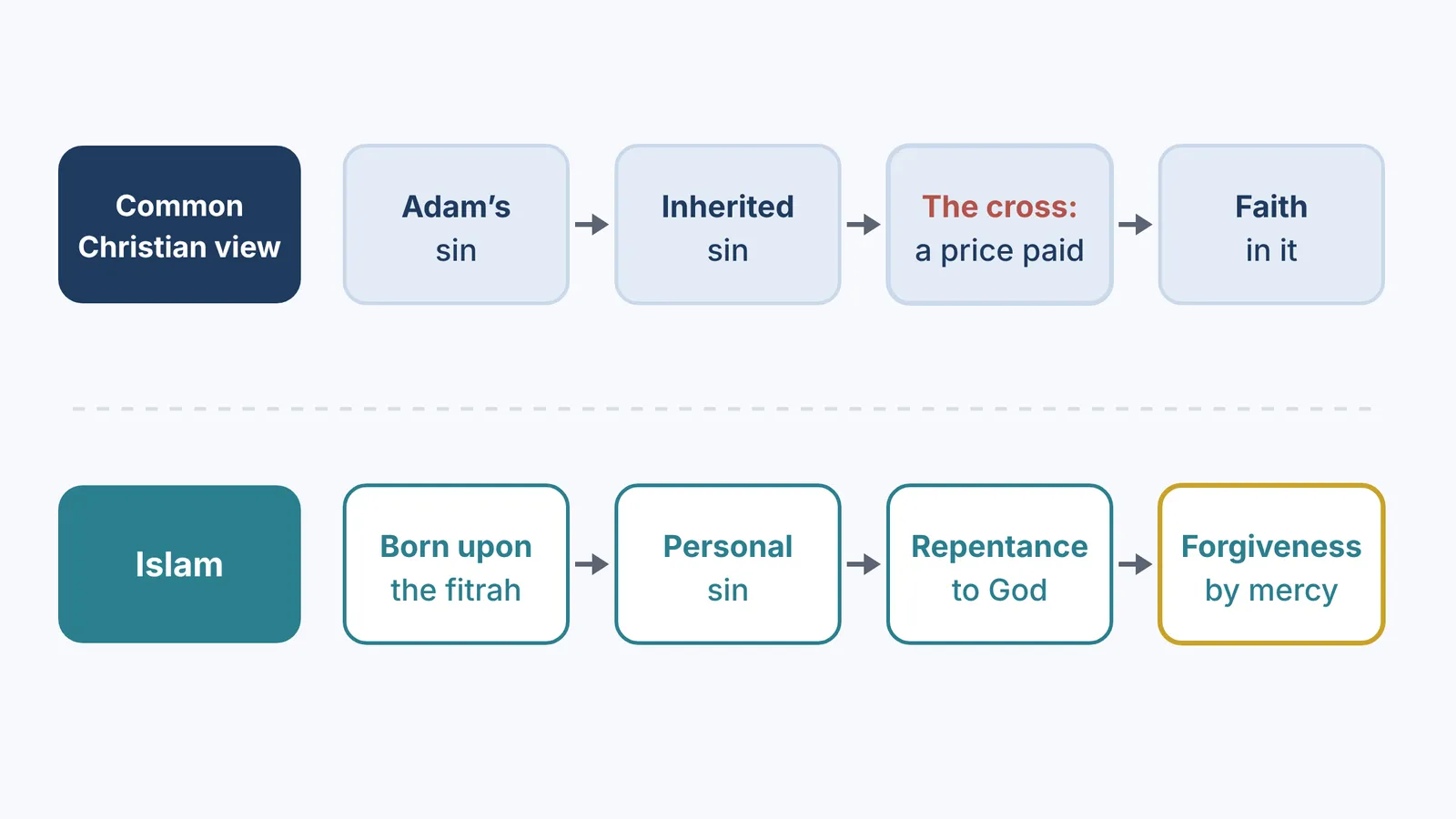
Repentance in Islam is not a complicated ritual: regret what you did, stop it, resolve not to return to it, and restore people's rights if the wrong was against a person. No priest hears your confession, and no particular place is required. You say in your prostration or in your heart, "My Lord, forgive me", and you are heard by the One who is the All-Hearing, the All-Seeing11.
That is the beauty of forgiveness in Islam: no barrier remains between you and your Lord, and no one has to die so that you may live. Coming back is enough.
"But God's justice requires a payment for sin"
This is the deepest objection, and it deserves to be put with its full force: God is just and holy, and sin is an offence against His holiness. If He forgave without a price, He would be indulgent towards evil. Sin must be punished, and mercy is shown in that God Himself bore the punishment for us. Hence, "without shedding of blood is no remission."
The answer comes from several directions. First: justice is not achieved by transferring punishment to an innocent. If you punish an innocent person for a guilty one, you add a second injustice to the first. Ezekiel himself denies it: "The son shall not bear the iniquity of the father."
Second: forgiveness, by its very meaning, is letting go of what is owed, not collecting it. If a creditor collects your debt from someone else, he has not forgiven you; he has been paid. If he forgives you, he has cancelled it. God is the One whose right is at stake between you and Him, and He may waive it out of His generosity; no one can bind Him to a price.
Third: the Bible itself speaks of forgiveness without blood. Hosea says: "For I desired mercy, and not sacrifice" (Hosea 6:6). Ezekiel says that if the wicked turns from his sins and does what is right, he shall live: "All his transgressions that he hath committed, they shall not be mentioned unto him" (Ezekiel 18:21-22). And the people of Nineveh repented, and God spared them (Jonah 3).
Fourth: Islam does not drop justice. Every soul is repaid for its deeds: "It is only your deeds that I record for you and then repay you for"17. And the rights people hold against one another are not lost; they are paid in full on the Day of Resurrection18. Justice is preserved, mercy is open, and repentance joins the two.
No one has to die so that you may live. Coming back to God is enough.
Questions you may have
If we don't inherit sin, why does every human being sin?
Because human beings were created free, with a will to choose, and with weaknesses and desires. The hadith says, "Every son of Adam errs"21; it does not say "is guilty from birth". The difference is large: the first describes a free creature who errs and repents; the second declares guilty someone who has done nothing.
Doesn't easy forgiveness make sin seem light?
Sincere repentance is not a word you say; it is regret that burns in the heart and a real break with the sin, and God knows what is in every heart. And whoever knows that his Lord rejoices at his return feels more ashamed to disobey Him than someone who believes his sins were paid for in advance.
If Jesus did not die as a ransom for humanity, what was his mission?
The mission of every prophet: to call people to worship God alone. The Qur'an reports him saying: confirming what came before me of the Torah, and to make lawful for you some of what was forbidden to you3. He came confirming Moses, lightening some of the burdens laid on the Children of Israel, and giving good news of a messenger to come after him13. His value in Islam lies in his message and his example, not in his death.
What about my past sins if I become Muslim?
The Prophet ﷺ said that Islam wipes out what came before it16. You begin a clean page, as on the day you were born upon the fitrah.
If your child wronged you and then came to you truly sorry, would you insist that someone else be punished before you forgave?
Show a thought
Most parents forgive their children without any such condition, and rejoice at their return. And God, as the Prophet ﷺ said, is more merciful to His servants than a mother to her child15. If our limited mercy can forgive without a price, what of the One whose mercy encompasses all things?
We began with a baby in his father's arms who had done nothing yet. Islam says to that father: your child was born innocent, upon the fitrah; he will answer only for what he does; and if he errs one day, the door of repentance is open to him until his last breath.
This message is not foreign to the prophets you love: Moses, Ezekiel, Jesus. It is the message of a just God who wrongs no one, and a merciful God who shuts His door on no one. You will not have to give up your love for Jesus; you will know him as he described himself: God's servant and messenger. And if you carry a weight from your past, the next page was written for you.
Your next step
Sources (23)
- Qur'an 2:30 (al-Baqarah)
- Qur'an 2:37 (al-Baqarah)
- Qur'an 3:50 (Al 'Imran)
- Qur'an 4:157 (al-Nisa')
- Qur'an 4:158 (al-Nisa')
- Qur'an 7:23 (al-A'raf)
- Qur'an 20:121 (Ta Ha)
- Qur'an 20:122 (Ta Ha)
- Qur'an 35:18 (Fatir)
- Qur'an 39:53 (al-Zumar)
- Qur'an 42:11 (al-Shura)
- Qur'an 53:38–39 (al-Najm)
- Qur'an 61:6 (al-Saff)
- Sahih al-Bukhari 1358 (see also 1385; Sahih Muslim 2658)
- Sahih al-Bukhari 5999 (also Sahih Muslim 2754)
- Sahih Muslim 121
- Sahih Muslim 2577 (hadith qudsi)
- Sahih Muslim 2582
- Sahih Muslim 2747 (also Sahih al-Bukhari 6309)
- Sahih Muslim 2766 (also Sahih al-Bukhari 3470)
- Jami' al-Tirmidhi 2499 (hasan)
- Jami' al-Tirmidhi 3540 (hasan; hadith qudsi)
- The Bible, King James Version: Deuteronomy 24:16; Ezekiel 18:20-22; Hosea 6:6; Jonah 3; Hebrews 9:22 (quoted as the object of comparison, not as religious authority)