Would a hundred reasons convince you more than three good ones?
Imagine you open a page titled "100 Reasons to Embrace Islam". At first the length impresses you. Then, somewhere around reason 30, you notice that number 12 said "the Qur'an has never been changed", number 27 said "the Qur'an is perfectly preserved", and number 30 said "the Qur'an today is the same as in the Prophet's time". Three numbers, one claim.
You keep reading with a new question in mind. Not "How many?" but "How many different things are being said here, and how strong is each one?" That question is the subject of this page.
Counting is not weighing
A list can be long for two very different reasons. It can be long because there really are many independent pieces of evidence. Or it can be long because one idea has been sliced, reworded and repeated. From the outside, both look the same: a big number.
Think of a court case. Ten witnesses who each saw the event with their own eyes are strong. Ten people who all heard the story from the same one witness are, in the end, one witness. The number of voices did not change the number of sources.
Reasons for a belief work the same way. Before asking whether the reasons are many, you ask whether they are independent: does each rest on a different fact, or are they all leaning on the same one?
Three kinds of reasons that lists often mix
Most long lists also mix reasons of quite different types, and it helps to separate them:
- Reasons that Islam is true: evidence that God exists, that the Qur'an is from Him, that Muhammad ﷺ was His Messenger.
- Reasons that Islam is good: its ethics, its family values, its care for the poor, its effect on people's lives.
- Reasons that Islam is attractive to you: its peace, its simplicity, the beauty of its prayer or its recitation.
All three matter, and none should be dismissed. But they do different jobs. The first kind tells you whether Islam is true. The second and third tell you what you would find in it if it is true, and whether it fits human nature as you would expect the Creator's guidance to fit. A list that counts "prayer is good for discipline" and "the Qur'an cannot be imitated" as two equal reasons has put a supporting reason and a foundational one on the same shelf.
Five families of evidence
When you sort the reasons in any honest list, most fall into a few families. Each family answers a different question:
- Reason and human nature: Is there a Creator, and is He one? This family draws on the universe, its order, and the inborn sense in people that they were made.
- The revelation: Could the Qur'an have come from a human being? This family looks at the book itself: its challenge, its consistency, its preservation.
- The Prophet ﷺ: Was the man who brought it truthful? This family looks at his character, his life and the testimony of those who knew him, including his enemies.
- The law: Does what he brought look like the work of someone serving himself, or like guidance that serves human beings?
- The effect: What happens to people and societies who live by it?
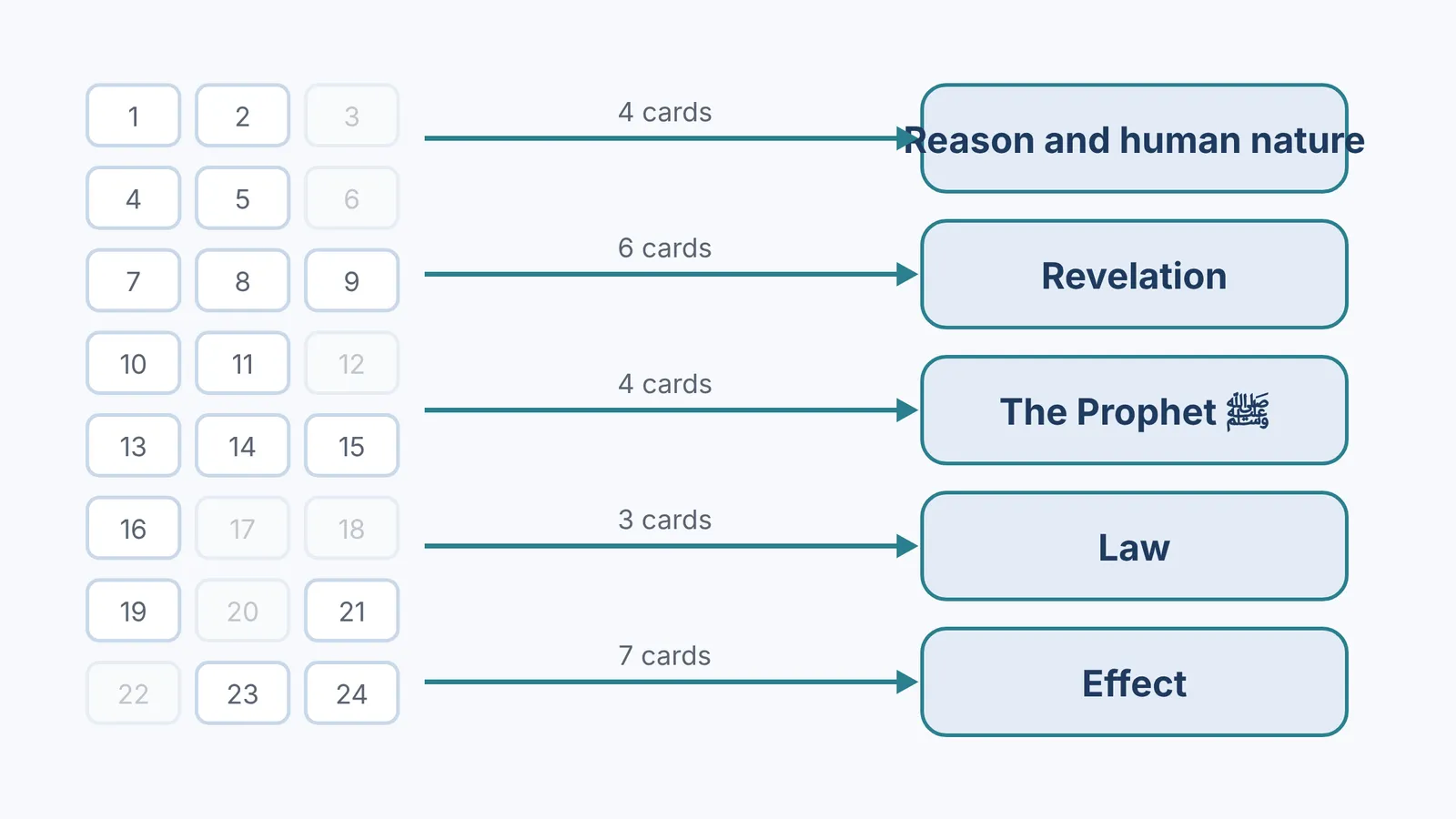
A good test of any list is to ask: how many of these families does it actually cover? Fifty reasons from the "effect" family are weaker, taken together, than one strong reason from each of the five, because the fifty can all be answered with one reply: "other beliefs have good effects too." Five independent families cannot be answered with one reply.
How to test a single reason
You do not need to be a scholar to examine a reason. Four questions do most of the work:
- Is the premise true? Every reason rests on a fact. Check the fact first. "The Qur'an has been preserved" is a historical claim; it can be examined.
- Does the conclusion follow? Even a true fact may not prove what is claimed. "Many people are converting" is a fact about numbers, not about truth. The Qur'an itself warns that most people often follow conjecture4.
- How far does it reach? Some reasons prove that there is a Creator; that is shared with other monotheists. Some prove that a revelation came from God. Only some point specifically to Islam. Know which level each reason reaches.
- Is it new? Does it rest on a different source of evidence from the reasons you have already counted, or is it the same idea in new words?
Try it on two examples.
"My Muslim colleague is the most honest person I know." The premise may well be true. But the conclusion does not follow far: one honest person shows that Islam can produce honesty, not that it is from God, and you may also know dishonest Muslims. This is a supporting reason from the effect family. Keep it, but do not lean your weight on it.
"The Qur'an challenged its listeners to produce even one chapter like it, and they could not"1. The premise is historical: the challenge is in the text, and the poets of the Prophet's own people, who had every motive to meet it, did not. The conclusion reaches far: if no human has matched the book, its source needs explaining. And it is independent: it rests on the text itself, not on anyone's character or experience. This is a foundational reason, and it deserves careful study.
A sample of strong reasons, one from each family
Here is one strong example from each family. Each could fill its own page, and on this site most do.
Reason. The Qur'an asks: Were they created by nothing, or were they the creators of themselves?7 Neither option works, which leaves a Creator. A man named Jubayr ibn Mutim, before he was Muslim, heard the Prophet ﷺ recite these verses and said his heart almost flew8. The argument is short and rests on a principle everyone uses: things do not come from nothing.
Revelation. Besides the challenge, the Qur'an invites its own scrutiny: had it been from other than God, they would have found much inconsistency in it3. A book revealed over twenty-three years, through war and peace, grief and victory, that invites people to look for contradictions, is making a testable claim.
The Prophet ﷺ. When the Byzantine emperor Heraclius questioned Abu Sufyan, then a leading enemy of the Prophet ﷺ, he asked whether they had ever accused him of lying before his claim. Abu Sufyan had to say no. Heraclius concluded that a man who would not lie about people would not begin by lying about God9. The testimony comes from an opponent, which is what makes it strong.
The law. Muslim scholars observed that the law aims to preserve five things for people: their religion, life, intellect, family line and property13. Zakat, for example, is taken from the rich and returned to the poor of the same community10. And the man who brought this law did not use it to enrich himself: he died with his armour pledged for some barley11.
The effect. The Prophet ﷺ described the believer's way of meeting life: grateful in good times, patient in hard ones, so that every state is good for him12. On its own this proves little, since a comforting belief could be false. But if the other families hold, this is exactly what you would expect guidance from your Creator to produce.
Notice what this sample does. It does not ask you to accept one hundred claims. It asks you to examine five, each answering a different question, each resting on different ground.
Why God gave more than one kind of sign
The Qur'an does not rest faith on a single thread. It points to signs in the horizons and in themselves6: the universe outside you and the nature within you, alongside the book and the life of the one who brought it.
And it asks for evidence rather than numbers. To people making religious claims it says: Bring your proof, if you are truthful2. It forbids following what you have no knowledge of5. A religion that sets this standard for others invites you to apply the same standard to its own reasons. Testing them is not disrespect. It is doing what the Qur'an asks. (The page A body of evidence and a single reason shows how independent lines of evidence combine.)
Don't ask how many reasons there are. Ask how many different things they rest on.
"A huge list is just propaganda designed to overwhelm me"
Sometimes, yes. A list that inflates its number by repeating itself, or mixes weak claims with strong ones, can feel like pressure rather than argument. You are right to be wary of that, and Islam does not need you to be impressed by a number.
But the fair response to a bad list is not to dismiss the case. It is to ask for the best version of it. Strip out the repetitions, sort what is left into families, and test the strongest member of each. If the case is weak, this will show it quickly. If it is strong, you will have found that out for yourself, which is worth far more than being told.
"I can't check a hundred reasons. I'm not a scholar"
You do not need to. No one checks every reason for anything they believe; you have not personally verified every claim behind the medicine you take or the history you accept. What you can do is check a few strong reasons from different families, using the four questions above.
If the Creator argument holds for you, the Qur'an's challenge resists every explanation you can find, and the Prophet's truthfulness is confirmed even by his opponents, then you have three independent lines converging. That is enough to act on reasonably, and the rest of the list becomes what it should have been all along: supporting detail, not the foundation.
Questions you may have
Are lists of "100 reasons" useless, then?
No. They can be a good starting point, a map of ideas to explore. The problem is only when the number is treated as the argument. Use a list to find topics, then test the strongest items one by one.
Which family should I start with?
Start where your own doubt is. If you are unsure whether God exists, start with reason. If you believe in God but doubt that He spoke through Muhammad ﷺ, start with the Qur'an and the Prophet. Evidence that answers your actual question will move you more than evidence for a question you never had.
What if one strong reason fails when I test it?
Then note it honestly and move to the next family. Independent families do not stand or fall together; that is what makes them independent. One failed reason weakens the case by one reason, not entirely.
Think of the reason for Islam that has struck you most so far. Which family does it belong to, and which of the four questions has it not yet faced?
Show a thought
Many people find their strongest reason comes from the effect or attraction family: a person they met, a recitation they heard. That is a real beginning. The next step is to look for one reason from a different family, so that your conviction stands on more than one leg.
We began with a page of a hundred reasons and the moment you noticed three of them were one. That moment was not a problem. It was the beginning of thinking clearly.
Islam does not ask you to be dazzled by a count. It asks you to look at the universe, at the book, at the man who brought it, at the law and at its fruits, and to test each honestly. A few strong, independent reasons, examined carefully, are worth more than any number of repeated ones. And if they hold, the decision they point to deserves the same seriousness you gave the testing.
Your next step
Sources (13)
- Qur'an 2:23 (al-Baqarah)
- Qur'an 2:111 (al-Baqarah)
- Qur'an 4:82 (al-Nisa')
- Qur'an 6:116 (al-An'am)
- Qur'an 17:36 (al-Isra')
- Qur'an 41:53 (Fussilat)
- Qur'an 52:35 (al-Tur)
- Sahih al-Bukhari 4854
- Sahih al-Bukhari 7
- Sahih al-Bukhari 1395; Sahih Muslim 19
- Sahih al-Bukhari 2916
- Sahih Muslim 2999
- Abu Hamid al-Ghazali, al-Mustasfa min 'Ilm al-Usul