Could your love for Jesus be your first step towards Islam?
Imagine a woman who grew up in church, who loves Jesus sincerely. One quiet evening she is reading the Gospel of Mark, and comes to Jesus saying that the first of all the commandments is: "Hear, O Israel; The Lord our God is one Lord." She stops, reads it again, and asks herself a question she had never quite dared to ask: how can He be one and three at once?
This page is about the road that can begin with a question like that.
About this page
The centre will attach to this page a documented testimony from someone raised as a Christian who later embraced Islam, told in their own words, with their permission and with its source. We will not publish a story we have not verified, and we will not put a sentence in anyone's mouth that they did not say. In Islam truthfulness is the road to righteousness30, and passing on everything one hears, unchecked, is a kind of lie32. These testimonies are now being filmed on video and will be added to this page soon, God willing.
What we offer in the meantime is a map of the road: the stations that many who made this journey describe, drawn in general terms, with each station linked to the page on this site that examines its argument. We do not claim this map represents every Christian. Christians are Catholic, Orthodox, Protestant and more. But the questions you will read here come up again and again.
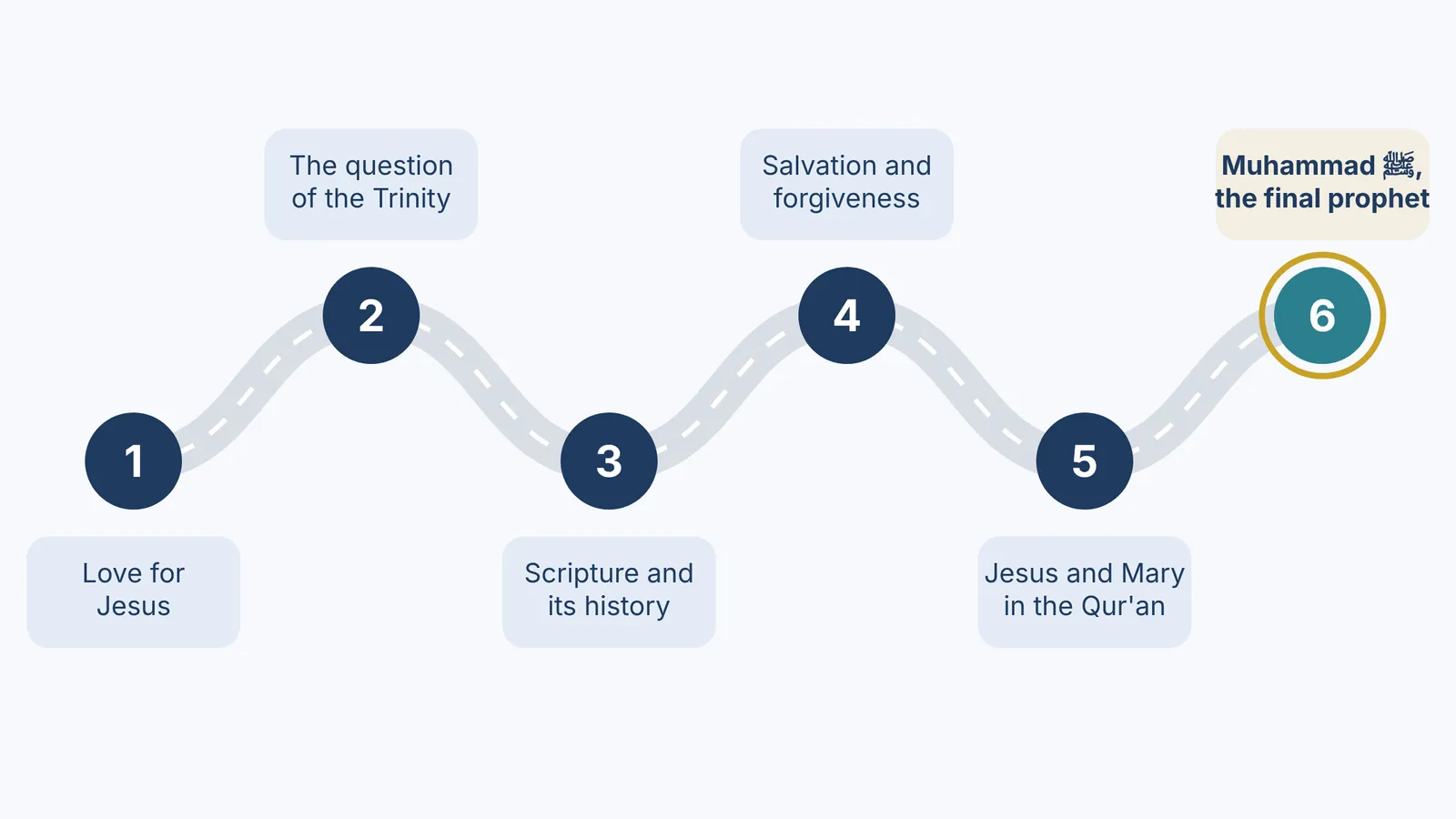
Station one: love for Jesus
Many start here, and there could hardly be a better place to start. Jesus, peace be upon him, stands in their hearts for mercy, humility and purity, and they fear that Islam is an invitation to leave him behind.
Then comes the first surprise: a Muslim is not a Muslim without believing in Jesus. The Qur'an calls him the Messiah, Jesus son of Mary, honoured in this world and the next, and one of those brought near to God4. Muslims believe in his virgin birth, in his miracles, and that he will return at the end of time as a just judge27. The Prophet ﷺ said: "I am the closest of people to the son of Mary"26. A whole chapter of the Qur'an is named after his mother, and it says of her: Mary, God has chosen you and purified you, and chosen you above the women of all the worlds3.
Many describe this station lifting a great fear. The question was no longer "Must I leave Jesus?" but "Who is Jesus, really?"
Station two: the question of the Trinity
Mainstream Christian doctrine does not teach three gods. It teaches one God in three persons, Father, Son and Holy Spirit, equal in substance and eternity. That deserves to be stated fairly first.
Yet many describe their question beginning when they read Jesus' own words in the Gospels. He says that the first commandment is: "Hear, O Israel; The Lord our God is one Lord" (Mark 12:29). He prays: "And this is life eternal, that they might know thee the only true God, and Jesus Christ, whom thou hast sent" (John 17:3). To a man who called him good, he replies: "Why callest thou me good? there is none good but one, that is, God" (Mark 10:18). And of the Last Hour he says: "But of that day and that hour knoweth no man, no, not the angels which are in heaven, neither the Son, but the Father" (Mark 13:32).
So the seeker asks: if the Son does not know what the Father knows, how are they equal? If Jesus calls the Father "the only true God", why is Jesus worshipped alongside Him? Then they find in the Qur'an a simple answer: Say: He is God, One21; He neither begets nor was begotten22. And they find Jesus in the Qur'an telling his people: Children of Israel, worship God, my Lord and your Lord10.
Islam never raises a human being, however great, to the rank of God: The Messiah, Jesus son of Mary, was only a messenger of God, and His word which He conveyed to Mary, and a spirit from Him7. The pages "The Trinity and the oneness of God" and "Islam and Christianity" examine this question in depth.
Station three: scripture and its history
Many describe their questions then turning to the scripture itself. The four Gospels were written in Greek decades after Jesus was raised up, while Jesus spoke Aramaic. The number of books in the Bible differs between Catholics, Orthodox and Protestants. So the seeker asks: which of these words did Jesus say, and which were written by those who came after him?
Some also notice something in the books of the Old Testament: descriptions of God that are hard to square with the Creator. Exodus says: "for in six days the LORD made heaven and earth, and on the seventh day he rested, and was refreshed" (Exodus 31:17). Genesis says: "And it repented the LORD that he had made man on the earth, and it grieved him at his heart" (Genesis 6:6). Then they read in the Qur'an, about the creation of the heavens and the earth: and no weariness touched Us18. And in the Verse of the Throne: neither drowsiness nor sleep overtakes Him1. They compare the two descriptions and ask which is worthy of the Creator.
Islam does not ask the seeker to despise the scripture they grew up with. It holds that God revealed the Gospel to Jesus, containing guidance and light8, and teaches Muslims neither to affirm nor to deny what the People of the Book relate when they cannot verify it, but to say: we believe in God and what was sent down to us29. It presents the Qur'an as the book that came confirming the scripture before it and standing guard over it9, preserved in the language in which it was revealed.
Station four: salvation and forgiveness
In mainstream Christian belief, humanity inherited Adam's sin, and there is no salvation except through Jesus' death on the cross as a sacrifice on their behalf. Many describe this as one of the heaviest stations. Is a baby born guilty? Why should God's forgiveness require blood?
Here the seeker finds a very different answer in Islam. Every child is born upon the fitrah, the natural disposition towards God24, and no one carries anyone else's sin: no bearer of burdens will bear the burden of another12. Adam himself erred, repented, and God accepted his repentance. The door of repentance opens straight to God, with no intermediary and no price: Say: My servants who have wronged themselves, do not despair of God's mercy; God forgives all sins17.
More than that, God is more delighted with His servant's repentance than a man who lost his camel in the desert, with his food and water on it, and then found it again31. In a hadith qudsi God says: son of Adam, if you came to Me with nearly an earthful of sins and then met Me without associating anything with Me, I would bring you nearly an earthful of forgiveness33. The page "Original sin, the crucifixion and forgiveness" examines this station in detail.
Station five: Jesus and Mary in the Qur'an
Many mention that reading the chapter of Mary was a turning point. It tells of Jesus' birth, and of him speaking as a baby in the cradle: He said: I am the servant of God; He has given me the Scripture and made me a prophet13, and then: God is my Lord and your Lord, so worship Him; this is a straight path14.
This is the very chapter Ja'far ibn Abi Talib recited to the Negus, the Christian king of Abyssinia. The king wept until his beard was wet. When the king asked about Jesus, Ja'far said: he is the servant of God and His messenger, His spirit and His word which He cast to Mary the virgin. The Negus picked up a twig from the ground and said that Jesus son of Mary did not go beyond what Ja'far had said by the length of this twig34. The Qur'an describes the same scene among a group of Christians: when they hear what has been sent down to the Messenger, you see their eyes overflowing with tears because of the truth they recognise11.
The seeker also finds in the Qur'an an explanation of Jesus' fatherless birth that needs no claim to divinity: The likeness of Jesus before God is that of Adam: He created him from dust, then said to him "Be", and he was5. If Adam was created with neither father nor mother, a birth from a mother without a father does not make Jesus God.
Station six: Muhammad ﷺ
Then there is a station where many pause for a long time. If Jesus was a prophet, why do we need another after him? And how do we know Muhammad ﷺ was truthful?
The seeker finds in the Qur'an that Jesus himself gave news of a messenger to come: bringing good news of a messenger who will come after me, whose name is Ahmad20. And in the hadith, that the prophets are like one building, with Muhammad ﷺ the last brick that completes it28. Islam does not present itself as a new religion that demolishes what came before. It presents itself as the final link in one message brought by Noah, Abraham, Moses and Jesus.
Heraclius, the Christian emperor of Byzantium, questioned Abu Sufyan, at that time an enemy of the Prophet ﷺ, about his lineage, his honesty and what he commanded, and concluded that a man who would not lie about people would not lie about God23. The page "Evidence for Muhammad's prophethood" sets out this evidence: his character, the Qur'an, his foretelling of the unseen, and the witness of those who knew him.
What changes after arriving?
Many who reach the end of this road describe not losing Jesus but finding him in his rightful place. They still love him and ask God's peace upon him whenever he is mentioned, but they direct their worship to the God whom Jesus himself worshipped. In the hadith, whoever bears witness that there is no god but God, that Muhammad is His servant and messenger, and that Jesus is the servant of God and His messenger, His word which He cast to Mary and a spirit from Him, God will admit to Paradise25.
The Qur'an promises those of the People of the Book who believe a double reward: they will be given their reward twice, for their patience15. The faith in God and His prophets that was already in their hearts was not wasted.
Nor does Islam ask the new Muslim to cut off Christian family. It asks them to be good and just to them19, and if they discuss faith, to do it in the best way, saying: our God and your God is One16.
"Christians converting to Islam proves nothing — Muslims convert to Christianity too"
This objection is right at its core. Some leave Christianity for Islam, some leave Islam for Christianity, and some leave both for atheism. If stories were evidence, the evidence would contradict itself.
We agree: a story does not prove Islam is true. That is why this page is built not on a story but on questions and arguments, and why each station points to a page that examines its evidence apart from any person. The question that settles the matter is not "How many people switched?" but "What did Jesus say about God? Which description of God is worthy of Him? Was Muhammad ﷺ a true prophet?"
But a documented testimony has another kind of value. It shows that a Christian who loves Jesus can take these questions seriously all the way through, without losing respect for how they were raised. A trustworthy report tells you what happened, not whether the conclusion is correct35. And Islam itself says: There is no compulsion in religion; the right way has become clearly distinct from error2. What matters is that it becomes clear to you, not that you follow someone else.
They were not asked to leave Jesus, only to put him in his place: the servant of God and His messenger.
Questions you may have
Would I have to stop loving Jesus if I became Muslim?
No. Love for Jesus is part of faith in Islam, and anyone who denies his prophethood is not a Muslim. What changes is that worship is for God alone, just as Jesus himself worshipped God and called people to Him.
What does Islam say about the crucifixion?
The Qur'an states that Jesus was neither killed nor crucified, but it was made to appear so to them, and that God raised him up to Himself6. This is a real point of difference with Christian belief, and the page "Original sin, the crucifixion and forgiveness" examines it in detail.
What about my family, their holidays and my relationship with them?
Islam commands goodness to parents and relatives even if they are not Muslim, and kindness towards them19. The practical questions of this stage are in the circle "I want to embrace Islam, but…".
If you asked Jesus himself, "Whom should I worship?", what do you think he would answer, judging by the words of his you have read?
Show a thought
Many who walked this road started from exactly this question. You are not being asked to give up your love for him, only to listen to him. The Qur'an records his answer: God is my Lord and your Lord, so worship Him.
We began with a woman reading in Mark's Gospel, "The Lord our God is one Lord", and stopping. Her pause was not a turning away from Jesus. It was listening to him.
That is the road many describe: it begins with love for Jesus, passes through honest questions about God, scripture and salvation, and arrives at one God who is near and forgives without an intermediary, and at a final prophet who came to confirm what was before him. When the documented testimony is attached here, you will hear this road in the voice of someone who walked it. Until then, the stations are in front of you; choose the one where you are standing.
Your next step
Sources (35)
- Qur'an 2:255 (al-Baqarah)
- Qur'an 2:256 (al-Baqarah)
- Qur'an 3:42 (Al 'Imran)
- Qur'an 3:45 (Al 'Imran)
- Qur'an 3:59 (Al 'Imran)
- Qur'an 4:157 (al-Nisa')
- Qur'an 4:171 (al-Nisa')
- Qur'an 5:46 (al-Ma'idah)
- Qur'an 5:48 (al-Ma'idah)
- Qur'an 5:72 (al-Ma'idah)
- Qur'an 5:83 (al-Ma'idah)
- Qur'an 6:164 (al-An'am)
- Qur'an 19:30 (Maryam)
- Qur'an 19:36 (Maryam)
- Qur'an 28:54 (al-Qasas)
- Qur'an 29:46 (al-'Ankabut)
- Qur'an 39:53 (al-Zumar)
- Qur'an 50:38 (Qaf)
- Qur'an 60:8 (al-Mumtahanah)
- Qur'an 61:6 (al-Saff)
- Qur'an 112:1 (al-Ikhlas)
- Qur'an 112:3 (al-Ikhlas)
- Sahih al-Bukhari 7
- Sahih al-Bukhari 1358
- Sahih al-Bukhari 3435
- Sahih al-Bukhari 3442
- Sahih al-Bukhari 3448
- Sahih al-Bukhari 3535
- Sahih al-Bukhari 4485
- Sahih al-Bukhari 6094
- Sahih Muslim 2747
- Sahih Muslim, Introduction, hadith 5
- Jami' al-Tirmidhi 3540 (hasan)
- Musnad Ahmad 1740 (isnad hasan)
- Centre course material: Sources of knowledge (report and its levels)