Which single question is standing between you and a clear position?
Imagine a notebook on your desk. For months you have been writing questions in it. Some are crossed out now: you found answers that satisfied you. Others remain. One is about a ruling you do not understand. One is about a hadith someone sent you. One is about what would happen with your family. One is just a quiet "what if I am wrong?"
Each time you open the notebook, the remaining questions seem to blur into one heavy feeling: not yet. You are not sure if you are being careful or simply stuck.
This page will not answer every line in your notebook. It will help you read the notebook differently, and decide what to do with each line.
Not every question carries the same weight
When questions pile up, they all start to feel equally urgent. They are not. Some questions sit at the foundation: Does God exist? Is the Qur'an His word? Was Muhammad ﷺ truly His Messenger? Others are about details that follow from those foundations. The page "Certainty, doubt and inquiry" explores this distinction in depth; here we want to use it practically.
There is also a third kind that people often forget to name: personal and practical questions. "How will my parents react?" "Can I keep my job?" "Will I manage the prayers?" These are real, and they deserve care. But they are not questions about whether Islam is true. They are questions about how to live it.
If you mix the three, you can end up treating a worry about your family as if it were evidence against God, or treating a puzzle about one ruling as if it cancelled the whole case for prophethood. Separating them does not make any question disappear. It puts each one where it can actually be answered.
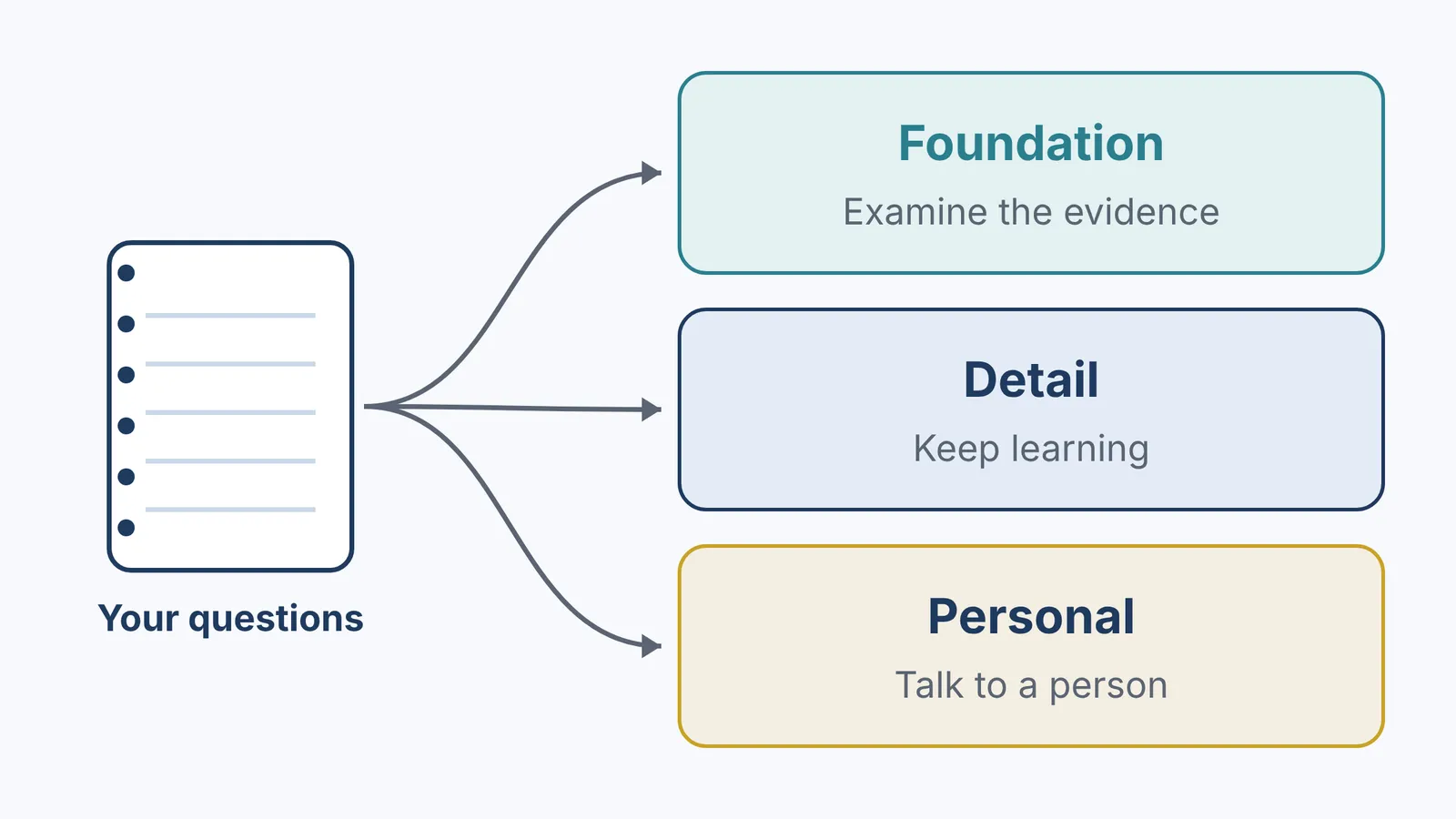
Find the question that really blocks you
Try a simple test on each question in your notebook. Ask yourself: if this question were answered in the way I fear, would it show that Islam is false? Or would it only show that I do not yet understand something?
If the honest answer is "it would show Islam is false", you have found a foundation question. Give it your full attention. Read the evidence, ask for the strongest answer, and do not rush.
If the honest answer is "it would only mean I do not understand it yet", then it is a detail. It matters, and you should keep looking into it, but it does not have the power to decide your position on its own. Most of us live with many such details in every serious area of life: we are confident in medicine while not understanding every drug, and confident in a friend while not understanding every choice they make.
And if the question is personal, about family, work, habits or fear, it does not belong in the "is it true?" column at all. It belongs in the "how do I go forward?" column, and that column is best worked through with someone who listens.
After this test, many people find that their notebook holds far fewer blocking questions than they thought. Sometimes only one. Sometimes none, and what they called "questions" was really a natural fear of a big change.
The Companions kept asking
You might worry that becoming Muslim means you must stop asking. The opposite is true.
The Qur'an itself records the questions people brought to the Prophet ﷺ, again and again: They ask you about the new moons1; They ask you about menstruation2; They ask you about the spirit5. Questions were not hidden from revelation. Revelation answered them.
His Companions asked about everything. Al-Harith ibn Hisham asked him how revelation came to him, and he described it7. Aishah, his wife, asked him why he prayed at night until his feet cracked when God had already forgiven him; he answered, "Should I not love to be a grateful servant?"8. Hanzalah came to him afraid that he had become a hypocrite, because the feeling of faith he had in the Prophet's presence faded at home; he was not scolded but reassured: "an hour and an hour"9.
Even before accepting Islam, Abdullah ibn Salam, a learned man of Medina, came with three questions he believed only a prophet could answer. He asked them directly, heard the answers, and then testified to the truth10. The famous hadith of Jibril is itself a set of questions: what is Islam, what is faith, what is excellence, asked so that people could learn their religion11.
The Prophet ﷺ once rebuked people who had given a wrong ruling to an injured man without knowledge, and said: "Why did they not ask when they did not know? The cure for not knowing is to ask"12. The Qur'an gives the same instruction: Ask the people of knowledge if you do not know4, and teaches the believer to pray, My Lord, increase me in knowledge6.
This is one of Islam's quiet strengths. It does not ask you to arrive with every question settled. It gives you a lifelong way to keep asking, with a source to return to and people of knowledge to ask.
How to list and route your questions
Here is a practical way to turn a heavy feeling into a clear path:
- Write every question down, even the ones that feel small or embarrassing. A question in your head grows; a question on paper has a size.
- Mark each one F (foundation), D (detail) or P (personal), using the test above.
- Choose the single F question that, if answered well, would change your position the most. Start there, not with the easiest one.
- Look for the page that addresses it. Questions about how evidence leads to a conclusion belong with "Rational conclusions". Questions about prophethood or the Qur'an have their own stops on this journey.
- Decide in advance what would count as a good answer. Not a perfect answer to every possible follow-up, but a reasonable one. Without this step, no answer will ever feel enough.
- Send one question at a time to a real person, in a sentence or two. You will get a clearer answer than if you send twenty at once.
Keep the D questions in a list you keep learning from. Many of them dissolve naturally as your understanding grows. Take the P questions to a private conversation, where they can be handled with care rather than debated.
Talk to a real person
A page can explain, but it cannot notice where exactly you hesitate. A person can. Often the question you write is not quite the question that troubles you, and a good listener helps you find the real one.
When you write, you do not need to sound learned or polite in any special way. "I don't understand why..." is a perfect beginning. You do not need to share personal details either; the question is enough.
Be prepared for an honest answer, which may sometimes be: "That is a good question; let me check with someone more knowledgeable." That is not weakness. Muslim scholars have long considered "I do not know" to be part of knowledge. A da'i who admits the limits of what they know is more trustworthy than one who pretends to know everything.
And know what the conversation is not. It is not a test you can fail, and it is not a sales call. You can ask, think, and come back weeks later. Your decision stays yours. And the question you feel shy about today may be the very one many others asked before you, found an answer to, and now help others with.
"If you cannot answer everything, how can you ask me to decide?"
This is a fair challenge: "Some of my questions still have no satisfying answer. Isn't it dishonest to embrace Islam while they remain open?"
Consider how you make every other serious decision. You choose a doctor, a spouse, a country to live in, or a field of study without having every question answered. What you need is enough evidence on the questions that decide the matter. Waiting for zero open questions is not a higher standard of honesty; it is a standard nobody applies anywhere else, and one that would make any decision impossible.
There is also an honest asymmetry here. If the foundations of Islam are sound, the open details are questions you will keep exploring as a believer, as the Companions did. If you find a foundation question that truly fails, that is a serious matter, and you should examine it openly. So the honest path is not to wait for the notebook to be empty. It is to make sure the foundation questions have been examined with care, and then to act on what you have found.
Islam asks you to believe with knowledge, not with every possible piece of knowledge. Only God knows everything; you have been given only a little of knowledge5.
You do not need an empty notebook to take a clear position. You need the foundation questions examined honestly.
Questions you may have
Isn't there a verse that tells Muslims not to ask questions?
The verse often cited says, in meaning, do not ask about things which, if made plain to you, would distress you3. Commentators such as Ibn Kathir explain that it concerned unnecessary questions asked while the Qur'an was still being revealed, which could have led to extra obligations, and questions asked to test or to show off13. It does not forbid sincere questions about faith; the same Qur'an commands asking the people of knowledge4.
Is it disrespectful to ask hard or sharp questions?
No. A sincere question, however difficult, is not an insult. You have seen how the Companions asked about revelation and about the state of their hearts, and how Abdullah ibn Salam came with questions meant to test prophethood itself, and was answered. Write your question as it really is in your mind, without polishing it. Someone who knows your real question can give you a real answer.
What if the answer I get does not satisfy me?
Say so, clearly and politely, and explain why. Ask for another angle, a source, or a more knowledgeable person. A dissatisfying answer is information too: it may mean the answer was weak, or that the real question has not yet been reached.
Can I become Muslim while still having questions about some details?
Yes. Every Muslim carries questions they are still learning about. What matters is that you believe in the foundations: that there is no god but God and that Muhammad ﷺ is His Messenger. Details are learned over a lifetime.
If you look honestly at your list, which one question would truly change your position if it were answered?
Show a thought
Perhaps you found one clear question; then you know exactly where to begin. Perhaps you found none, only fears about what comes next. Both discoveries are progress, and both are worth bringing to a real conversation.
Questions are not a sign that you are far from God. Often they are a sign that you are taking Him seriously. The people closest to the Prophet ﷺ asked him about the moon, the spirit, the state of their hearts, and the reasons behind his worship, and they were answered with patience.
You can bring your questions too. Sort them, choose the one that matters most, and ask it. The door does not close when you ask. That is often when it opens.
Your next step
Sources (13)
- Qur'an 2:189 (al-Baqarah)
- Qur'an 2:222 (al-Baqarah)
- Qur'an 5:101 (al-Ma'idah)
- Qur'an 16:43 (al-Nahl)
- Qur'an 17:85 (al-Isra')
- Qur'an 20:114 (Ta Ha)
- Sahih al-Bukhari 2
- Sahih al-Bukhari 4837
- Sahih Muslim 2750
- Sahih al-Bukhari 3329
- Sahih Muslim 8
- Sunan Abi Dawud 336 (graded hasan)
- Ibn Kathir, Tafsir al-Qur'an al-'Azim, on 5:101