Can an energy know your name?
Imagine standing on a hill at night beside a wind farm. The great blades turn slowly above you, and you know that somewhere below, the power they make is flowing into thousands of homes. It lights a hospital, warms a kitchen, charges a phone in a teenager's hand. It is vast, invisible and everywhere.
Now imagine you are in trouble, and you speak quietly into the dark: "Please, help me." The current in the cables does not change. It cannot hear you. It does not know that you are there.
Many sincere people today say, "I believe in God, but not as a person. God is an energy, a force, the power behind everything." This page takes that belief seriously and asks one question: what exactly do we mean, and what is the evidence for it?
Why the idea appeals
There are good reasons people are drawn to it, and they deserve respect.
The first is a healthy instinct: God must not be imagined as a large human being in the sky with human moods and limits. Many people grew up with pictures of God that seemed too small, too human, too much like an angry old man. Speaking of "energy" feels like a way to keep God great.
The second is that the word sounds scientific. Energy is real, it is everywhere, it cannot be seen, and it powers everything. It seems a natural bridge between faith and physics.
The third is that a force makes no demands. It does not send prophets, give commandments or hold anyone to account. For some, that feels like freedom.
The first reason is right, and Islam shares it completely. The second and third need a closer look.
Two meanings of "energy"
When a physicist says "energy", she means something precise: a measurable quantity, the capacity of a physical system to do work. It is counted in joules, it is conserved in a closed system, and it is always the energy of something, a moving body, a stretched spring, a hot gas. It follows laws. It never chooses.
When people say "God is energy", they usually mean something else: a sacred presence that flows through all things, gives life and perhaps guides us. But this second meaning borrows the scientific word without its scientific content. Nobody has measured it, and physics has no equation for an energy that loves or guides.
So we face a choice. If "energy" is meant in the physical sense, it is part of the universe, measured and governed by laws, and it cannot be the One who made the universe and its laws. If it is meant in a looser, spiritual sense, then it is not science at all, and we have to ask: on what evidence does this energy exist, and how do you know what it is like?
The question of energy healing, vibrations and chakras belongs to a separate page on this site, "Energy, vibrations and chakras", which weighs those claims one by one. Here we keep to the deeper question: what is God?
Everything measured has a Measurer
The Qur'an makes a short statement that is worth slowing down for: Indeed, We created everything with measure7.
Think of what physics has found. The energy in the universe is not infinite and shapeless. It comes in definite amounts, governed by exact constants and laws. On the standard picture of cosmology, it has existed only as long as the universe has. Something that is bounded, measured and governed by laws is exactly the kind of thing that needs an explanation outside itself. It does not explain why it exists, why it has these values and not others, or why it obeys these laws.
That is why energy cannot be the last answer. It is part of what needs explaining. A Creator who is not measured, not bounded and not governed by anything above Him is the kind of reality that can explain it. The Qur'an speaks of Him as the One who created everything and determined it precisely4.
What a force cannot do
Now compare what each picture can give you.
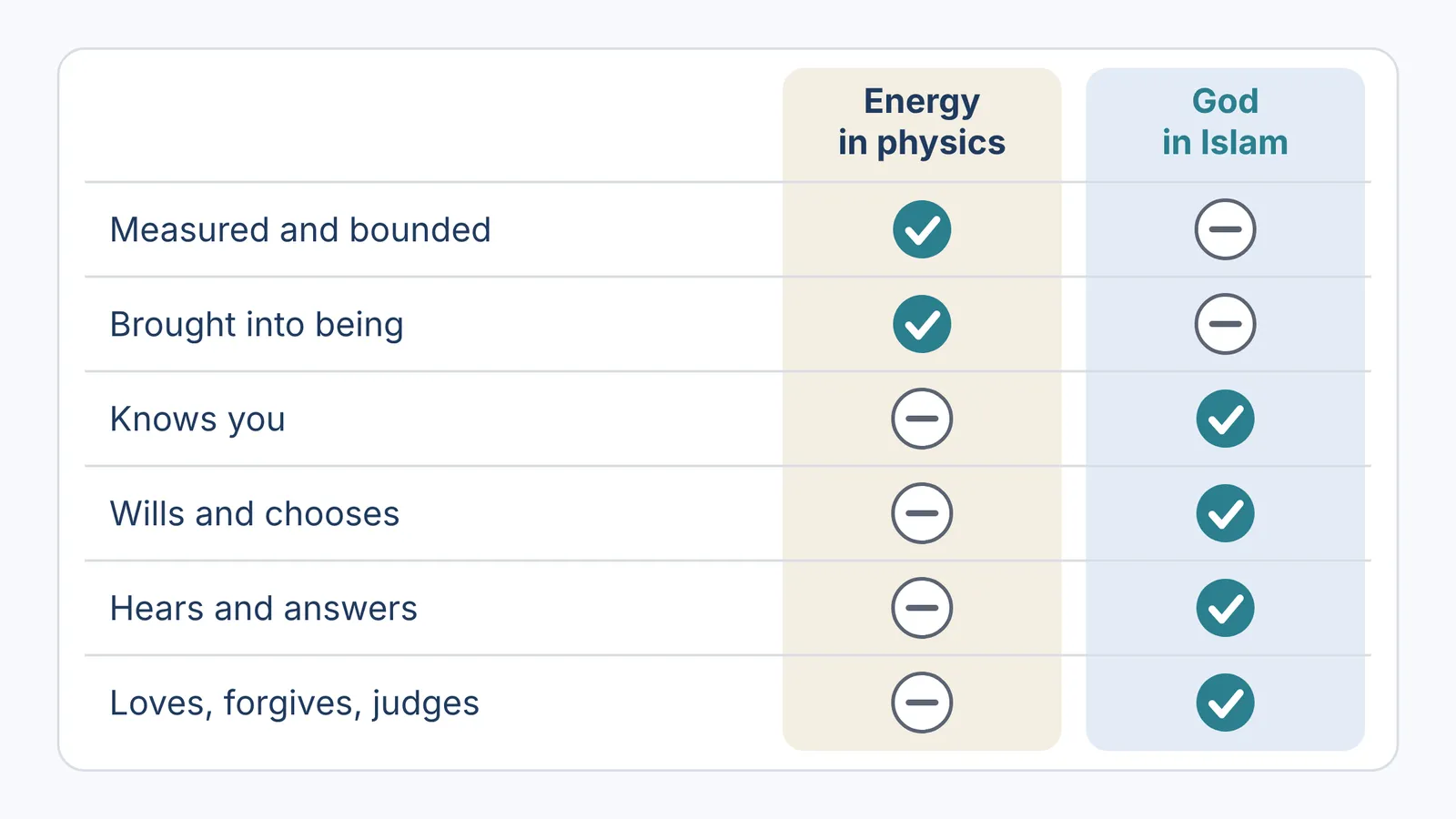
A force cannot know you. It acts the same way whether you are honest or cruel, grieving or grateful. Yet you are a being who knows, chooses and loves. The Qur'an asks a piercing question: Does He not know, the One who created? And He is the Subtle, the All-Aware8. Can a source with no knowledge produce beings with knowledge? Can the lesser give rise to the greater?
A force cannot will. The universe shows not only power but order, fine balance and beings fitted to their purpose. Power without will produces no plan.
A force cannot love or forgive. You cannot disappoint a current, and you cannot be forgiven by it. Your mistakes simply have their effects.
A force cannot guide. It sends no message, so it cannot tell you why you exist or what is good.
A force cannot judge. And if nothing will ever judge, then the tyrant who escaped and the victim who was never heard will both be lost to silence forever. Most people's conscience refuses that ending.
There is one more difference, quieter but deep. A force is something you use: you tap into it, channel it, align yourself with it. A Lord is Someone you turn to. In the first picture you stay at the centre, and the divine becomes a resource for your plans. In the second you discover that you are the one who is held, known and cared for, and that your plans are answerable to Someone wiser than you.
Islam: no likeness, yet fully living
Here is where Islam offers something better than both pictures.
It rejects anthropomorphism more strongly than the energy view does. There is nothing like Him, and He is the All-Hearing, the All-Seeing6. God is not a large human being; He does not tire, sleep, regret or need. Notice, though, how the verse ends. Having said that nothing is like Him, it immediately says that He hears and sees. Denying likeness does not mean denying life.
The Verse of the Throne, which many Muslims recite every day, describes Him this way: God, there is no god but He, the Ever-Living, the Sustainer of all. Neither drowsiness nor sleep overtakes Him… He knows what is before them and what is behind them, and they encompass nothing of His knowledge except what He wills2. Life, knowledge, will, sustaining power: these are not human weaknesses. They are perfections. To remove them from God is not to honour Him but to make Him less than His own creatures.
Sunni scholars summed up the balance in a clear rule: affirm what God affirmed for Himself, without likening Him to creation and without emptying the attributes of their meaning11. He truly knows, but not as we know. He truly hears, but not with ears like ours.
And because He is living and knowing, He is near: When My servants ask you about Me, I am near. I answer the call of the caller when he calls on Me1. He says: Call on Me; I will answer you5. He loves those who turn to Him, and they love Him3. The Prophet ﷺ said that God wrote, "My mercy prevails over My wrath"9, and that God is more pleased with the repentance of His servant than a man who lost his camel, with his food and water, in the desert and then found it10.
No energy can be pleased with you. Your Lord can.
"A personal God is a human projection."
The objection in its strongest form: humans see faces in clouds and agents behind every rustle in the grass. We are wired to imagine minds where there are none. So a God who knows, loves and listens is just our own reflection, cast onto the sky. The honest, mature view is an impersonal force.
It is worth taking seriously, and it has three weaknesses.
First, it explains why someone might believe, not whether the belief is true. The fact that people long for water does not prove there is no water. If there is a Creator who made us to know Him, we would expect exactly such a longing in us.
Second, the projection charge cuts both ways. "Energy" is also a human idea, borrowed from our own physics and our own experience of power. Imagining God as a force is just as much a projection; it simply projects our machines rather than ourselves.
Third, the question is not which picture feels more modest, but which explains the evidence. The universe contains beings who know, choose, love and ask about meaning. A cause without knowledge cannot give what it does not have. A living, knowing Creator explains a world with knowers in it. A blind force does not.
And remember: Islam's God is not a human being enlarged. He is unlike anything6. The personal God of Islam is not our projection. It is the opposite of one: a God with real knowledge and will, but with no human limits.
Denying that God is like us does not mean denying that He knows us.
What this means for your journey
If you believe in a divine reality, you already stand closer to the truth than you may think. Your sense that God is greater than every image is right. The step that remains is to ask whether a greater God would be one who knows less than you do, or one who knows everything, including you.
You do not have to give up your reverence for God's greatness to believe this. Keep all of the reverence; let go only of the silence. The One who created hearing cannot be deaf to your call.
The next page asks a related question: what if God is not a force within the universe, but the universe itself?
Questions you may have
Isn't "personal God" just a Christian idea?
The phrase is common in Christian writing, but the meaning is simply that God is living, knowing and willing, and can be addressed. Islam affirms this, while rejecting any idea that God became a human being. In Islam no creature is divine: not a prophet, not a saint, not a force of nature.
Can I still use the word "energy" in a spiritual sense?
Words matter, because they shape how you pray and what you expect. If by "energy" you mean God's power and care, Islam gives you better words: His names, such as the Ever-Living, the All-Knowing, the Most Merciful2. These keep His greatness without losing His nearness.
How can God hear everyone at once?
The question assumes that God hears as we do, with limited attention moving from one voice to the next. But limited attention is a creature's limit. The Qur'an says that neither drowsiness nor sleep overtakes Him and that preserving the heavens and the earth does not tire Him2. A billion prayers are no burden to One whose knowledge has no edges.
If God is not in space like us, how can He be near?
His nearness is the nearness of One who hears, sees, knows and answers, not of a body taking up space beside you. That is why it is closer than any physical nearness could be.
When you have been in real need, did you ever speak to God as "you"? What did you expect would happen?
Show a thought
Many people who call God an energy still pray to Him in hard moments, and they do not pray to a current. Perhaps the heart already knows that the One it speaks to can hear. Islam says that instinct is right, and gives it a name.
We began on a hill at night, beside a power that lit a city but could not hear a single whisper. The energy view keeps God vast and unseen, and that much is true. But it leaves you alone in the dark.
Islam keeps God vast and unseen too, beyond every image, and yet tells you He hears the quietest call, knows what your heart hides, and is pleased when you return. If you are looking for a God worthy of the universe, it may be worth asking which of the two is truly greater.
Your next step
Sources (11)
- Qur'an 2:186 (al-Baqarah)
- Qur'an 2:255 (al-Baqarah)
- Qur'an 5:54 (al-Ma'idah)
- Qur'an 25:2 (al-Furqan)
- Qur'an 40:60 (Ghafir)
- Qur'an 42:11 (al-Shura)
- Qur'an 54:49 (al-Qamar)
- Qur'an 67:14 (al-Mulk)
- Sahih al-Bukhari 7404
- Sahih Muslim 2747
- Ibn Taymiyyah, al-Risalah al-Tadmuriyyah