What if you met a religion that says, just as you do: the Creator is one, He is not born, and no image is made of Him?
Imagine a Muslim walking into a Sikh place of worship, a gurdwara, for the first time. He takes off his shoes and covers his head, as every visitor is asked to. He sees no statue and no image being worshipped. He hears hymns about the one Creator. Then he is invited to the community kitchen, the langar, where he sits on the floor in one row with rich and poor and eats the same food.
He will feel a real sense of familiarity. Then he will ask himself: if we are this close, what separates us? This page tries to answer fairly and respectfully.
What is Sikhism?
Sikhism arose in the Punjab, in the north of the Indian subcontinent. Its founder, Guru Nanak (1469–1539), called people to worship the one Creator and criticised empty ritual and discrimination between people. Nine Gurus followed him, ten in all, the last being Guru Gobind Singh, who founded the Khalsa in 1699.
The fifth Guru, Arjan, compiled the Gurus' compositions together with poems by other saints into a book called the Adi Granth in 1604. Strikingly, it includes poetry by saints from different backgrounds, among them the Muslim Sufi Shaykh Farid. Before his death in 1708, Guru Gobind Singh declared that the scripture itself would be the eternal Guru after him, and it became known as the Guru Granth Sahib.
Sikhs treat this book with deep reverence. It is placed on a raised platform under a canopy, an attendant waves a whisk beside it, it is ceremonially opened in the morning and laid to rest at night, and those who enter bow before it. Sikhs say they do not worship the book or regard it as God; they honour it as the living Guru that carries the divine Word.
Real common ground
The Sikh scripture opens with a passage called the Mul Mantar (root formula), meaning roughly: "One Creator (Ik Onkar); Truth is His name; the Creator-Being; without fear; without enmity; timeless in form; beyond birth; self-existent; known by the Guru's grace." Sikhs also call God Waheguru.
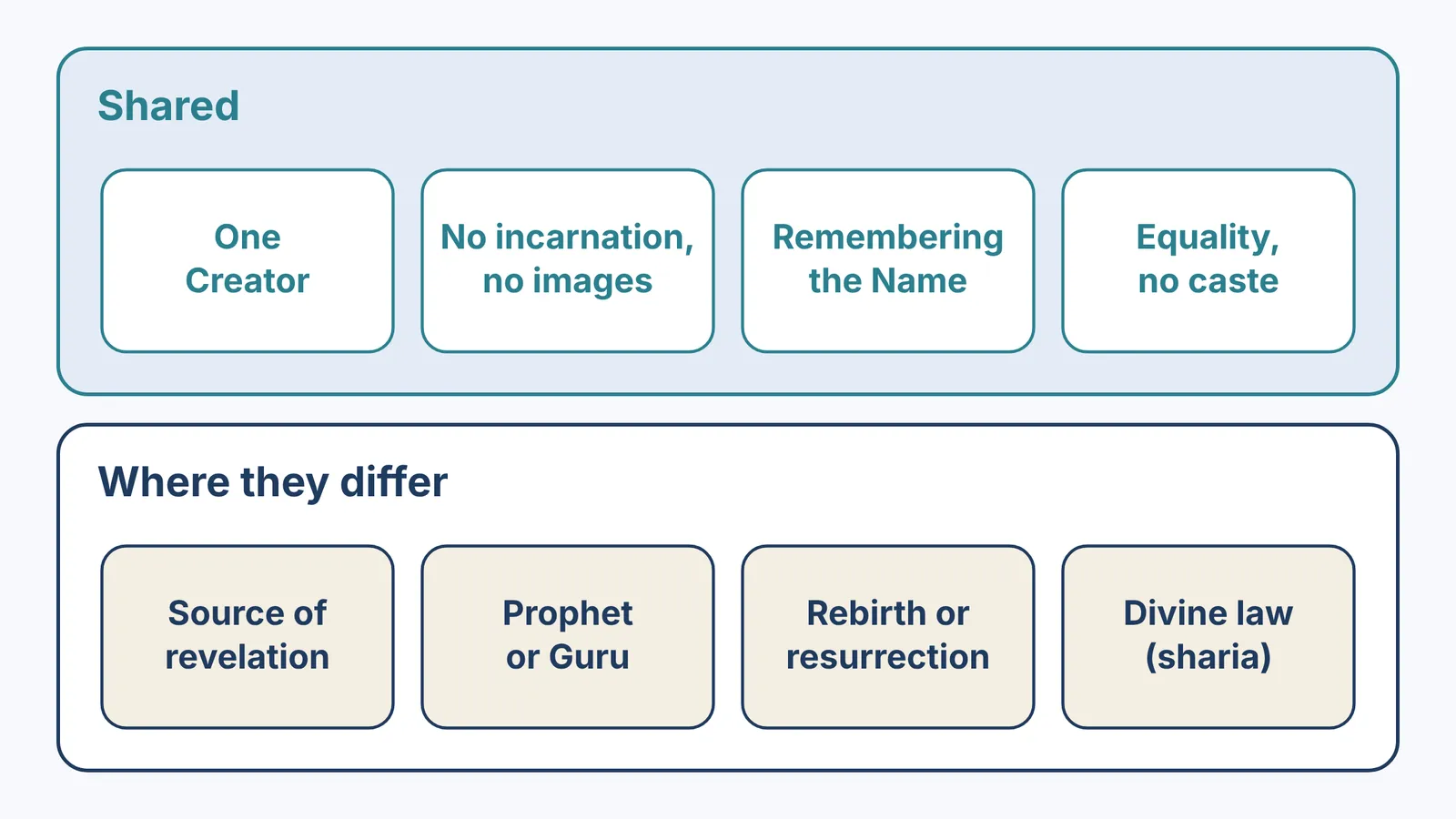
Notice how much of this meets Islam:
- God is one and the Creator: That is God, your Lord, Creator of all things; there is no god but Him12.
- He is not born and does not become incarnate: Sikhism rejects the avatar idea, and the Qur'an says: He does not beget, nor was He begotten19.
- No images in worship: a gurdwara has no worshipped images, and neither does a mosque.
- Remembering the Name: Sikhs repeat God's name (naam simran), and the Qur'an says: To God belong the most beautiful names, so call on Him by them4.
- Equality and rejection of caste: the langar seats everyone on the same floor, and the Qur'an says: The most honoured of you in the sight of God is the most mindful of Him15.
- Honest work and charity: central values in both.
These are not surface resemblances. Anyone who respects the truth acknowledges them before naming the differences.
Where the paths part
First: the source and nature of revelation. The Guru Granth Sahib is largely devotional poetry in which the Gurus and saints address God, describe Him and teach people, in several languages and dialects. Sikhs regard it as inspired, coming from the divine presence. The Qur'an presents itself differently: it is God's own speech, in which God speaks in the first person: I am God; there is no god but Me, so worship Me8. It challenges anyone in doubt to produce a single chapter like it1, and promises its own preservation: It is We who sent down the Reminder, and We will surely preserve it5. The fair question is: which of the two claims to be the Creator's direct speech, and puts before you a test you can examine?
Second: prophet and Guru. In Sikhism a Guru is an enlightened spiritual teacher, and Sikhs believe the same divine light passed from each Guru to the next until it came to rest in the scripture. Sikhism insists that the Gurus were not God, a position a Muslim appreciates. In Islam a prophet is a human being chosen by God to deliver His speech in its very words, not a general inspiration: Say: I am only a human being like you; it is revealed to me7. The prophets form one chain, from Noah and Abraham to Moses and Jesus, with one message14, and Muhammad ﷺ is their seal9. Islam holds that God sent a warner to every nation10, but it does not count spiritual guidance alone as prophethood, because prophethood is a report from God and needs evidence that proves it true.
Third: what follows death. Sikhism shares with Indian traditions the idea of a cycle of repeated births according to one's deeds, and release from it (mukti) through God's grace and remembrance of His Name. Islam teaches one life, then death, then resurrection and judgement. When someone objected, "Who will give life to bones once they have crumbled?", the answer came: Say: He who produced them the first time will give them life11. At the resurrection each person sees his own deeds: Whoever does an atom's weight of good will see it18, judged by a Lord who knows and is just: "It is only your deeds that I record for you and then repay you for"23.
Fourth: divine law. Guru Nanak criticised rituals performed without heart, among Hindus and Muslims alike. Sikhs today have a code of conduct (the Rehat Maryada) and daily practices of remembrance, recitation and service. Islam agrees that action without heart is worthless: "Actions are only by intentions"20, and "God does not look at your forms or your wealth, but at your hearts and your deeds"22. But it does not see the cure in abandoning acts of worship; it sees it in bringing them to life with intention. Prayer, fasting, almsgiving and pilgrimage are not rituals people invented but forms of worship God Himself ordained, along with a law that orders family, wealth and justice. That is what makes religion a complete way of life, not only a spiritual feeling.
Fifth: God and the world. Sikh texts speak a great deal of God pervading everything, present in His creation, while also beyond it. Some interpreters read this as the world being a manifestation of God. Islam keeps the distinction clear: God is above His creation; nothing of Him is in creation and nothing of creation is in Him. And yet He is with you wherever you are16, by His knowledge, hearing and sight.
Sixth: the book and reverence. We understand that Sikh reverence for the Guru Granth Sahib comes from sincere love of the divine Word, and we do not mock it. Muslims also revere the Qur'an greatly: they touch a written copy only in a state of purity, memorise it and recite it with humility. The difference is that in Islam the Qur'an is God's speech to be recited and lived by, not a person to be addressed or served with ceremonies. A Muslim does not bow to a copy of the Qur'an or to anything else, because prostration and bowing in veneration belong to God alone13. In Islam the book leads you to God; it does not stand between you and Him.
What Islam adds
If you are a Sikh, you already know the value of God's oneness, of rejecting idols and of equality between people. Islam does not ask you to give any of that up. It tells you that it lies at the heart of what all the prophets brought.
What Islam adds is certainty about the source: a book in which God speaks Himself, preserved word for word since it was revealed, recited today by millions exactly as the first Muslims recited it. A human messenger whose truthfulness is known through evidence, not feeling alone. And a law that keeps the heart from becoming spirituality without form, and keeps form from becoming ritual without spirit.
It also offers clarity about destiny: not a long cycle of births, but one life with real weight, then a meeting with a merciful Lord who rejoices when His servant turns back to Him24. That clarity gives life seriousness and hope at the same time.
"Sikhism already took the best of Islam and Hinduism"
Some people say: Sikhism combined Islam's monotheism with Hindu spirituality and left the narrowness of both behind. Why go back to either?
First, fairness requires saying that many Sikhs themselves reject the description of their faith as a blend. They see it as an independent revelation given to Guru Nanak, not a selection from here and there. That deserves respect in any conversation.
Second, "taking the best" needs a standard. Who decides what is best? If the standard is human taste, the result is a religion built by people according to what pleased them. If the standard is revelation, we are back at the starting point: where is the revelation that can be verified?
Third, Islam does not present itself as a new religion that gathers the best of others, but as the original message all the prophets brought, confirming what came before it and standing guard over it: We have sent down to you the Book in truth, confirming the scripture that came before it and as a guardian over it3. A Muslim believes in all the prophets without distinguishing between them2.
Fourth, look at what the idea of "combining" left behind: resurrection after death, prophethood in its full sense, and a law that orders life. If the monotheism in Sikhism is true, and in its root it is, then its completion lies in the message that brought it whole from its source.
What this means for your journey
If you are a Sikh, you are closer to Islam on the root of tawhid than many others. We do not ask you to forget that, only to ask two questions: how can I know for certain that these words are from God? And what awaits me after death?
And if you are a Muslim reading this to understand your Sikh neighbours, know that you share wide common ground, and that it is the right place to begin a conversation, with courtesy and patience, not with arguments about history.
The tawhid you love is not an idea people gathered from here and there. It is the message of all the prophets, completed in God's own words.
Questions you may have
How should a Muslim treat Sikhs?
With kindness, justice and respect, as the Qur'an commands towards all who are not hostile to Muslims17. Muslims and Sikhs share a complicated history in the Punjab, with painful conflicts, but that does not change the religious ruling: no injustice and no insult, only dialogue in the best manner6.
Isn't Sikhism's rejection of ritual closer to pure spirituality than Islamic prayer?
Spirituality needs both a heart and a path. A heart without a path can drift; a path without a heart becomes habit. Prayer in Islam joins the two: words God taught, and a presence of heart He asks of you. In prostration a servant is closest to his Lord21.
Do Muslims believe Guru Nanak was a prophet?
A Muslim has no evidence for that, so he does not claim it. Prophethood is a report from God and is established only by evidence. A Muslim acknowledges what is in his teaching of calling to one God and rejecting idols and discrimination, and respects his place among Sikhs, without calling him a prophet.
If you believe in the one Creator who is not born and cannot be pictured, what would you need in order to be certain that the words you read about Him are His own words?
Show a thought
That question is the heart of the difference between the two faiths. Tawhid alone gives you the direction; preserved revelation gives you the path in detail. The Qur'an places itself in front of you and says: examine, reflect, and try to produce something like it.
We began with a Muslim visitor sitting in one row with everyone in a gurdwara kitchen and feeling truly at home. That feeling is genuine and should not be lost: one Creator, no idols, no castes.
But familiarity is not the end of the road. The questions remain: how do we know God's words with certainty? And what awaits us after death? Islam answers with a book in which God speaks Himself, a messenger who carries proof, and one life that truly matters. If you want to examine revelation and prophethood further, continue on the path.
Your next step
Sources (24)
- Qur'an 2:23 (al-Baqarah)
- Qur'an 2:136 (al-Baqarah)
- Qur'an 5:48 (al-Ma'idah)
- Qur'an 7:180 (al-A'raf)
- Qur'an 15:9 (al-Hijr)
- Qur'an 16:125 (al-Nahl)
- Qur'an 18:110 (al-Kahf)
- Qur'an 20:14 (Ta Ha)
- Qur'an 33:40 (al-Ahzab)
- Qur'an 35:24 (Fatir)
- Qur'an 36:79 (Ya Sin)
- Qur'an 40:62 (Ghafir)
- Qur'an 41:37 (Fussilat)
- Qur'an 42:13 (al-Shura)
- Qur'an 49:13 (al-Hujurat)
- Qur'an 57:4 (al-Hadid)
- Qur'an 60:8 (al-Mumtahanah)
- Qur'an 99:7 (al-Zalzalah)
- Qur'an 112:3 (al-Ikhlas)
- Sahih al-Bukhari 1
- Sahih Muslim 482
- Sahih Muslim 2564
- Sahih Muslim 2577
- Sahih Muslim 2747