What do you mean when you say a religion is "true"?
Imagine a warm evening among friends of different faiths. One of them says gently, "We're all climbing the same mountain by different paths; the summit is one." Everyone nods, and the room feels warm. Then the youngest asks an innocent question: "But did Jesus die on the cross or not?" And the room goes quiet.
The question was not rude. It was simply honest. The first sentence was about our feelings; the second was about reality. Between them lies a distance worth walking together, calmly.
Three meanings of "true"
When someone says all religions are true, they may mean one of three quite different things.
First: moral value. All religions call for honesty, mercy and kindness to parents. That is true of many values, and Islam itself affirms that messengers were sent to every nation12, and that traces of their guidance remain in people's consciences and traditions.
Second: personal experience. Each person finds peace and meaning in their faith. That too is often true; the peace is a real feeling. But it does not tell us whether what a person rests on matches reality.
Third: a claim about reality. What each religion says about God, humanity and our destiny is accurate, matching what actually exists. This is where the problem begins, because religions do not say the same thing.
So the real question is not "Is there good in religions?" No one denies that. It is: "Can their claims about reality all be true together?"
The elephant and the blind men: pluralism's finest argument
Let us give the other view its strongest form. There is a famous parable from India. A group of blind men touch an elephant. One feels the trunk and says: an elephant is like a snake. Another feels the ear: no, it is like a fan. A third feels a leg: no, it is like a tree trunk. Each is right about what he touched, and each is wrong to think he has grasped the whole elephant.
Religious pluralists say: that is what religions are like. Each has touched one side of the divine reality, and no one has the right to claim the full picture. Humility means accepting everyone.
The parable is beautiful, and it holds real wisdom: human beings are limited and should not claim more than they know. But look at it again, and you will find two things that change the conclusion.
First, the blind men in the story did not contradict each other. A trunk really is like a snake, a leg really is like a tree trunk. Religions, though, do not describe different parts of one thing; they sometimes say things that cancel each other out. If one blind man said "there is no elephant at all" and another said "there are two elephants", they could not both be right.
Second, and more important: who is telling the story? Someone who sees the whole elephant and knows the blind men are mistaken. The parable itself assumes that someone sees the full picture. And that is exactly what revelation claims: that God, who sees everything, has told us how things are. So the question is no longer "Can anyone see the whole picture?" It is: "Has the One who sees it spoken?"
When claims contradict
Take three examples, fairly and without mocking anyone.
Did Jesus die on the cross? Christians believe Jesus, peace be upon him, was crucified, died and rose again, and that this is the heart of their faith. The Qur'an says: They did not kill him and they did not crucify him, but it was made to appear so to them7. These are two statements about one historical event. He cannot both have died on the cross and not have died on it.
Is God one, or a Trinity? Christians believe in one God in three persons: Father, Son and Holy Spirit, and they do not see themselves as worshipping three gods. The Qur'an says: Do not say "Three". Desist; it is better for you. God is only one God8, and: He neither begets nor was begotten20. Either Jesus is God incarnate, or he is a noble human messenger. Both descriptions cannot hold.
Is God a living Being who hears and answers? In the Abrahamic religions, God is living, all-knowing, hearing, seeing and speaking. In influential Hindu schools such as Advaita Vedanta, the ultimate reality, Brahman, is an Absolute beyond personal attributes. In Buddhism, across its major branches, there is no Creator God to worship. These cannot all be true: either there is a Creator who hears your prayer, or there is not.
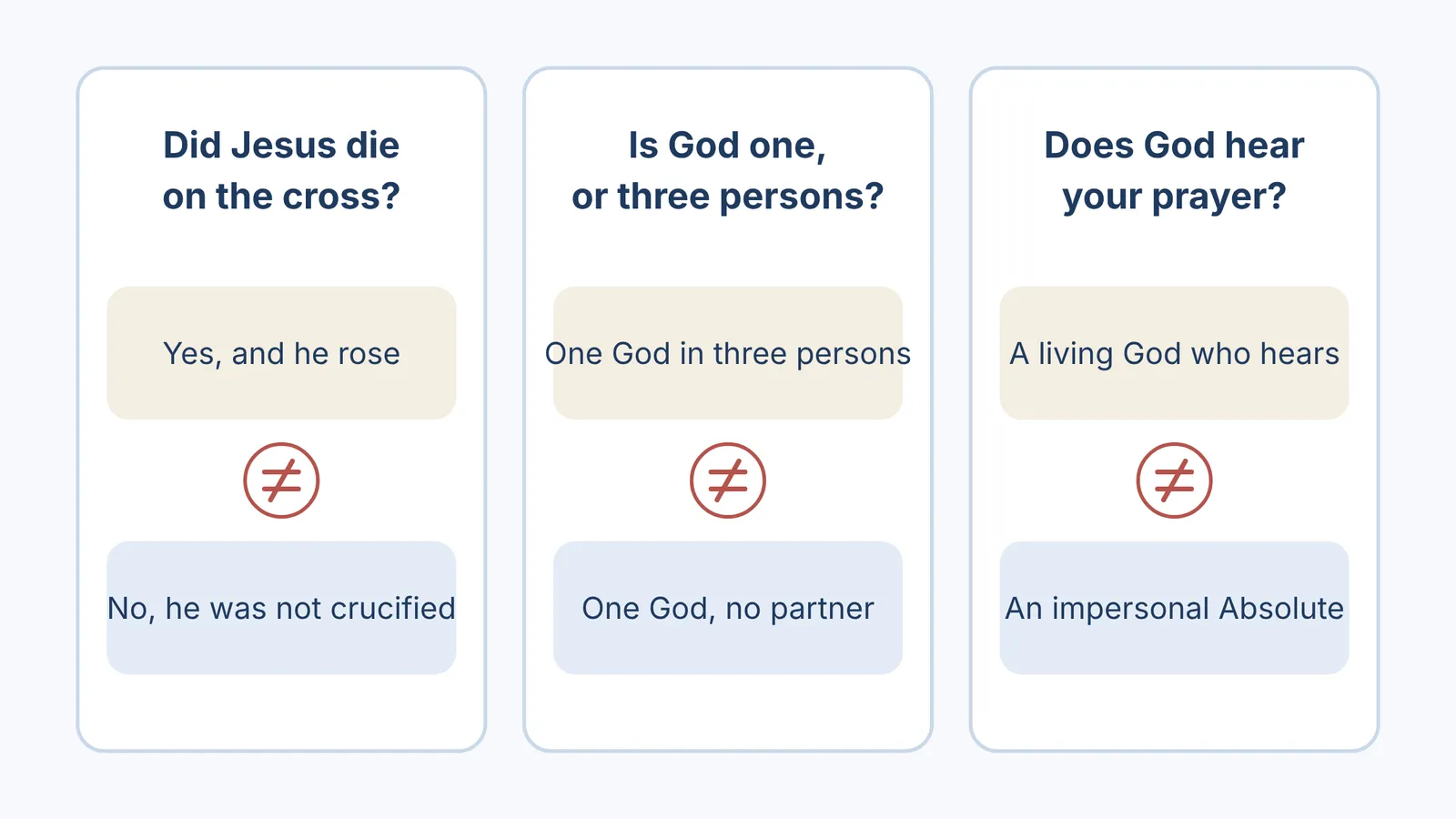
These are not side issues. They are questions about who God is, how we reach Him, and what becomes of us. And one of the first principles of reason, which no one needs to be taught, is that contradictories cannot both be true23. Saying that every religion's claims are true does not honour religions; it ignores what they say about themselves. No major religion says of itself, "I and whatever contradicts me are equally right."
Islam: one religion of all the prophets
You might assume that rejecting pluralism means Islam sees everything outside it as total darkness. Its view is deeper and more merciful than that.
Islam does not see itself as a new religion that appeared in the seventh century. It sees itself as the religion every prophet brought: We never sent a messenger before you without revealing to him: there is no god but Me, so worship Me15. Noah, Abraham, Moses, Jesus and Muhammad, peace be upon them, brought one foundation16, which is the very meaning of the word islam: submission to God alone. That is why the Qur'an says: The religion with God is Islam5, and: Whoever seeks a religion other than Islam, it will not be accepted from him6.
So for Islam the truth is one, but it belongs to no single people or race. The summit really is one, as in the mountain image, but the way up is not just any path. It is the path marked out by the One who made the mountain.
And what makes the Islamic picture of God worthy of being that summit? Three things deserve your own comparison. In Islam God is perfect and touched by no deficiency: He does not tire, sleep, regret or fail to know317. Islam raises no human being and no angel to divine status, not even Jesus, the great messenger whom Muslims love and honour10. And God in Islam is not a mute force or an Absolute without attributes, but a near Lord who hears and answers2. Weigh that picture against the others, and ask: which is worthy of the Creator of the heavens and the earth?
One truth, justice for all
Here Islam combines two things many assume cannot go together: certainty that the truth is one, and justice and mercy towards everyone who disagrees.
It forbids coercion explicitly: There is no compulsion in religion; right guidance has become clearly distinct from error4. It commands justice even towards those you dislike: Do not let hatred of a people lead you to be unjust. Be just; that is nearer to piety9. It permits kindness and fairness to non-Muslims who have not attacked Muslims18. It forbids insulting what others worship11, and commands discussion in the best manner13.
Respecting people is one thing; treating all claims as equal is another. You can respect your neighbour fully, be good to him, and defend his right to believe what he wishes, and still say to him courteously: "I think you are mistaken on this point, and here is my reason." That is not hostility. It is the seriousness that he, and the question, deserve.
"Claiming one true religion is arrogant and causes conflict"
This objection is often made sincerely, and it deserves a sincere answer. Who are you, it says, to decide that your religion alone is true and billions of people are wrong? Isn't that arrogance itself? And isn't this kind of certainty what lit the fires of religious wars?
Start with arrogance. Arrogance is not believing you are right. Everyone who states a view believes it is correct, including the person who says "all religions are true"; he thinks those who disagree with him are mistaken. Arrogance is something else, and the Prophet ﷺ defined it precisely: "Arrogance is rejecting the truth and looking down on people"21. The arrogant person rejects truth when it does not suit him, or despises those who differ. Whoever searches sincerely, accepts evidence wherever he finds it, and respects people is as far from arrogance as can be, even when he is certain.
Pluralism itself contains a huge claim that many overlook: that its holder knows every religion is wrong in claiming to be the truth, and that he alone has seen they are all equal paths. Isn't that also a claim to see the whole elephant?
As for conflict, its cause is injustice, not certainty. People fight over land, wealth, power and nationalism, with certainty or without it. The same Islam that says the truth is one says there is no compulsion in religion4, and says to those who differ: To you your religion, and to me mine19. Certainty disciplined by justice does not make war. It makes serious conversation.
Respecting people does not mean everything they say is true. Taking the truth seriously is the highest form of respect.
Questions you may have
Isn't there a verse saying Jews, Christians and Sabians will have their reward?
Yes, in Surat al-Baqarah1. Commentators explained that it refers to those who believed in God and the Last Day and followed the prophet sent to them before the coming of Muhammad ﷺ, such as the sincere followers of Moses and Jesus in their time22. It confirms that in every age religion meant believing in God and following His messenger. It does not mean that contradictory claims all became true once the final messenger had come.
What about those who never heard of Islam, or heard a distorted picture of it?
God is too just to wrong anyone. The Qur'an says: We never punish until We have sent a messenger14. God does not hold anyone accountable for a message that never reached them in a way that establishes the proof. Judging individuals belongs to God alone; our task is to search for ourselves, now that the message has reached us.
Does this mean Muslims learn nothing from others?
No. A Muslim accepts truth in medicine, science, administration and ethics from whoever brings it, whatever their religion, and thanks them for it. Muslims throughout history drew on the learning of earlier nations and added to it. But on the foundations of religion, who God is and how He is worshipped, the reference can only be what God Himself has told us.
If religions contradict each other on who God is and how to reach Him, is it enough for you to say "they're all true", or does the question deserve that you search for its answer yourself?
Show a thought
Saying all religions are true may spare us the effort of searching, but it does not answer the question. Islam invites you to search, not to imitate, and promises that the truth is clear to whoever seeks it: right guidance has become clearly distinct from error4.
We began with a warm gathering that fell silent before an innocent question. That silence was not a sign of failure but of honesty: everyone realised that beautiful words do not answer questions about reality.
Islam does not ask you to lose the warmth of that evening. It asks you to love your friends, be just to them and treat them well, and also to search with them, seriously, for the truth. If God has spoken, what He said deserves to be known. The next step is to ask: how do I test each religion's claims on a fair scale?
Your next step
Sources (23)
- Qur'an 2:62 (al-Baqarah)
- Qur'an 2:186 (al-Baqarah)
- Qur'an 2:255 (al-Baqarah)
- Qur'an 2:256 (al-Baqarah)
- Qur'an 3:19 (Al 'Imran)
- Qur'an 3:85 (Al 'Imran)
- Qur'an 4:157 (al-Nisa')
- Qur'an 4:171 (al-Nisa')
- Qur'an 5:8 (al-Ma'idah)
- Qur'an 5:75 (al-Ma'idah)
- Qur'an 6:108 (al-An'am)
- Qur'an 16:36 (al-Nahl)
- Qur'an 16:125 (al-Nahl)
- Qur'an 17:15 (al-Isra')
- Qur'an 21:25 (al-Anbiya')
- Qur'an 42:13 (al-Shura)
- Qur'an 50:38 (Qaf)
- Qur'an 60:8 (al-Mumtahanah)
- Qur'an 109:6 (al-Kafirun)
- Qur'an 112:3 (al-Ikhlas)
- Sahih Muslim 91
- Ibn Kathir, Tafsir al-Qur'an al-'Azim (on 2:62)
- Centre course material: Sources of knowledge (innate rational principles, including that contradictories cannot both be true)