Would you judge a medicine by its label, by its research, or by the people who stopped taking it halfway?
Imagine two friends arguing about two medicines. One reads out the slogan on the box of the first: "Natural, gentle, effective." The other tells a story about a neighbour who took the second one and still fell ill. Neither has read the research, the ingredients or the instructions. They argue for an hour and leave exactly where they started.
That is how many conversations about religion go. One side quotes a slogan, the other quotes a scandal. If you have come to this page, you probably want something better: a way to compare that you would accept even if the result surprised you.
First: one question, one standard, the right sources
A comparison goes wrong before it begins if three things are not settled.
The question. "Which religion is better?" is too vague to answer. "How does each religion describe God?" or "Can each scripture be traced reliably to the one who brought it?" can be answered. Compare one question at a time.
The standard. Before you look at any religion, write down what would count in its favour and what would count against it. Then apply that same measure to every side, including the one you grew up with. A standard you adjust once you see the result is not a standard.
The sources. Each religion should be represented by its own foundational texts and by what its mainstream scholars teach, not by its harshest critics, and not by its most eccentric followers. For Islam, that means the Qur'an and the authentic Sunnah as understood by its scholars. For Christianity, it means the Bible and the creeds that most Christians hold. Anything less is comparing a portrait with a caricature.
The Qur'an sets this tone itself. When others made claims about salvation, it did not answer with insults. It said: Bring your proof, if you are truthful1. And it holds you to the same discipline: Do not follow what you have no knowledge of; hearing, sight and heart will all be questioned8.
Six questions worth asking of any religion
Here is a set of criteria you can apply to every faith equally. None of them is designed to favour Islam; you could ask them in any library in the world.
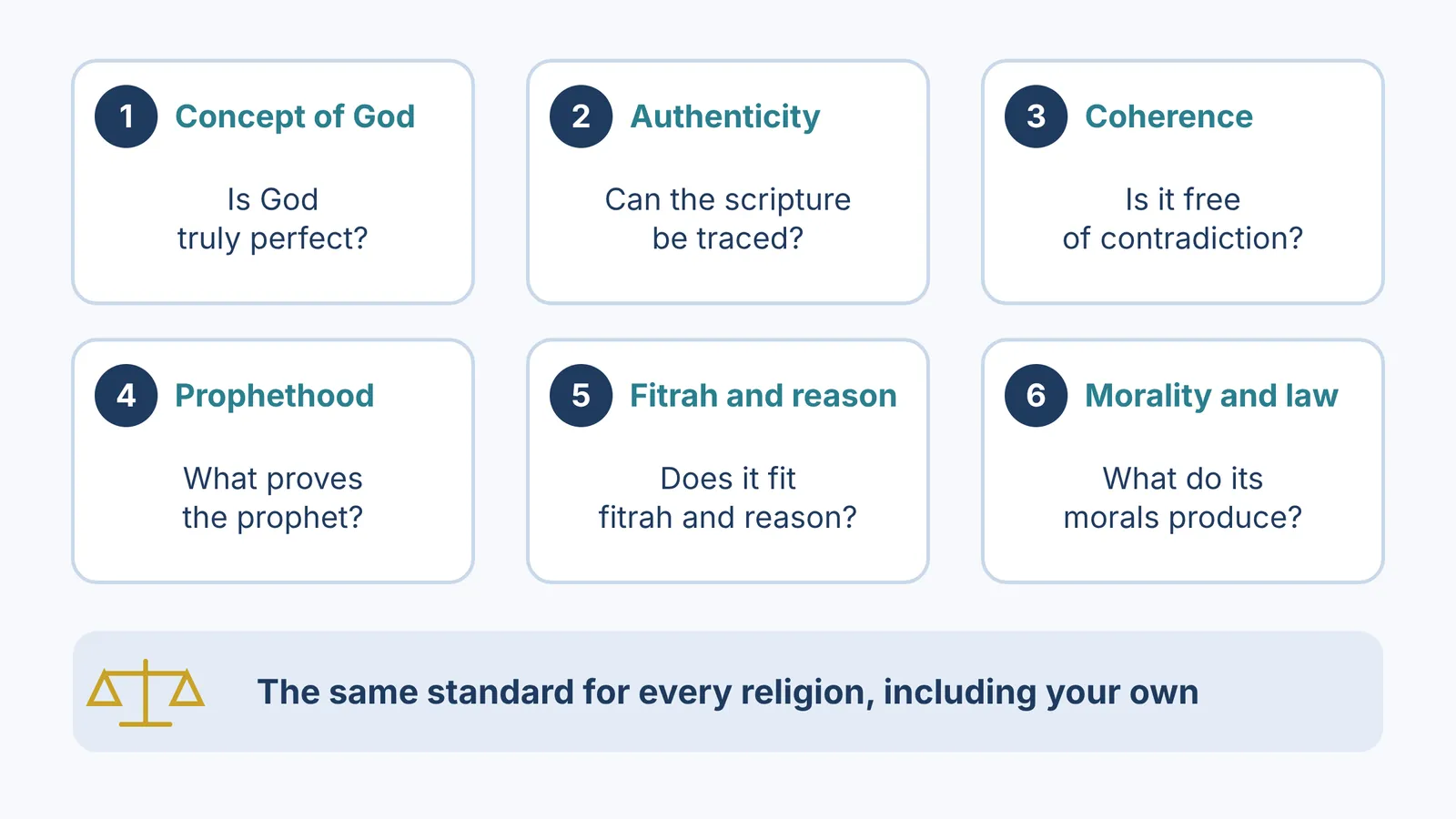
1. Is God described as truly perfect? The Creator of the heavens and the earth cannot be tired, ignorant, regretful or in need. So ask of each scripture: does it ever describe God with a human weakness? And does it ever raise a human being, or any creature, to divine status? This is not a trick question; it is the first test any concept of God must pass.
2. Can the scripture be traced? Who brought it, how was it written down, and how did it reach us? Is there a chain of transmission you can examine, or does the trail go cold for generations? Muslim scholars took this question so seriously that Abdullah ibn al-Mubarak said, "The isnad (chain of transmission) is part of the religion; were it not for the isnad, anyone could say whatever he wished"15.
3. Is the message coherent? Truth does not contradict itself. A scripture full of irreconcilable contradictions about God, or about what it asks of you, has a problem. The Qur'an invites exactly this test about itself: Do they not reflect on the Qur'an? Had it been from other than God, they would have found much contradiction in it4.
4. What evidence supports the prophet? Every religion rests on someone's claim to speak for God. What do we know of that person's honesty, character, message and life? Did what they brought fit what earlier prophets taught?
5. Does it fit the fitrah and sound reason? Does it agree with what you already know deep down, that you are created and dependent, that good and evil are real, that you will answer for your choices? Or does it ask you to accept what reason sees as impossible?
6. What do its morals and laws produce? Do they protect life, mind, family, property and dignity? Do they balance rights with duties, mercy with justice? Here you must read the law itself, not only headlines about it.
Ideal with ideal, practice with practice
The most common unfairness in comparing religions is mixing levels. Someone sets the noblest teachings of their own faith beside the worst behaviour of people from another. Then the result is decided before the comparison starts.
A fair comparison sets text beside text and teaching beside teaching. If you want to compare history, set the conduct of Muslims beside the conduct of Christians, Hindus or secular states, with the same honesty about the good and the bad of each. But never judge a teaching by those who ignore it. Muslims who lie are not evidence that Islam allows lying; it forbids it plainly, and the Prophet ﷺ said that truthfulness leads to righteousness and lying leads to wickedness14. The same fairness is owed to others.
This is not just good method. For a Muslim it is a duty: Do not let hatred of a people lead you to be unjust. Be just; that is nearer to piety5. A Muslim who misrepresents another religion to win an argument has broken his own religion's rule.
Read sources, not slogans
Today most people meet religions through clips, memes and comment threads. A thirty-second video that "destroys" a religion has rarely read that religion's books. The Qur'an gives a simple rule for this age: If a person of bad character brings you news, verify it11. Verify before you repeat, and verify before you believe.
In practice, that means a few habits:
- Read the scripture itself, in a reliable translation, and with an explanation by its own scholars. A verse cut from its context can be made to say almost anything.
- Ask a knowledgeable follower of the religion what it teaches, and listen to the answer before you respond.
- Note where a claim comes from: a text, a scholar, a critic, or "everyone knows".
- Separate what is agreed among a religion's followers from what is a minority view.
Applying the first question: an example
Let us take the first criterion and see how it works with care and respect.
Jews, Christians and Muslims share a great deal: belief in one Creator, in prophets such as Abraham and Moses, in revelation, in a Day of Judgement. That common ground is real, and the Qur'an calls to it: Come to a word common between us and you: that we worship none but God3.
Now apply the test. The Qur'an says that God created the heavens and the earth and no weariness touched Us12, and that neither drowsiness nor sleep overtakes Him2. The Bible says that "in six days the LORD made heaven and earth, and on the seventh day he rested, and was refreshed" (Exodus 31:17, KJV). Read both carefully, as their own followers read them, and ask: which description is more worthy of the Creator?
Or take the second half of the test. Christians hold that God is one God in three persons, and that Jesus is God the Son who became man. Muslims honour Jesus as one of the mightiest messengers, born miraculously of the Virgin Mary, but the Qur'an says: The Messiah, son of Mary, was only a messenger; messengers passed away before him, and his mother was a woman of truth; they both used to eat food6. One who eats food needs food. Is one who needs food the One who needs nothing?
Asking these questions is not an insult to anyone. It is exactly the kind of question a sincere person should be willing to ask of his own faith first.
Islam's invitation to compare
Notice something unusual. Islam does not ask you to stop comparing. It asks you to compare well.
It asks for proof1. It forbids speaking without knowledge8. It points to its own coherence as a test4. It commands justice even towards those you dislike5. It insists on verifying reports11. A religion that was afraid of scrutiny would not write such verses into its own scripture.
And when you apply the six questions, Islam's answers are clear and consistent. God is one, perfect, unlike anything, and yet He hears and sees10. No creature is raised to divinity: not a prophet, not a saint, not a king. Even the Prophet Muhammad ﷺ said: "Do not exaggerate in praising me as the Christians exaggerated about the son of Mary; I am only His servant"13. The way to God is direct, without a priestly go-between. The scripture has a transmission history you can study, line by line.
There is one more thing a fair comparison needs, and it is not a method. It is sincerity. The Qur'an promises: Those who strive for Us, We will surely guide them to Our ways9. Comparing religions is not like comparing phones. You are asking who made you and what He wants from you. So ask the One who knows. A short, honest prayer, in your own words, such as "God, if You are there, show me the truth and make me willing to follow it", costs you nothing and changes the spirit in which you search.
"Everyone thinks their own criteria favour their own religion."
This is a serious objection, and partly true. People do choose standards that suit them. A Muslim will stress the oneness of God; a Christian may stress love and sacrifice; a Buddhist may stress inner peace. So is every comparison rigged from the start?
Not if the criteria pass two tests. First, would you accept them before knowing the result? "Does this scripture contradict itself?" and "Can it be traced to its source?" are questions you would ask of any historical document, even one with no religion in it. They were not invented to favour anyone. Second, does the religion itself accept them? Christian, Jewish and Muslim scholars all agree that God is perfect and that truth does not contradict itself. Applying shared standards is not bias.
It also helps to notice that one-sided standards usually expose themselves. If a criterion would condemn your own religion when applied evenly, and you drop it only then, you have learned something important. The fair course is to keep the criterion and look again at your belief.
Finally, Islam does not ask you to accept its criteria on its word. The Qur'an appeals to reason, to the evidence in creation, to the coherence of its text and to the truthfulness of the Messenger. These are tests anyone can run.
Compare text with text and practice with practice, and ask first of your own faith what you would ask of any other.
Questions you may have
Do I need to study every religion before I decide?
No. Nobody can study every tradition in depth. Start with the large questions where religions clearly differ, such as who God is and whether a human being can be God, and with the faiths that make the strongest claims. If one religion answers the core questions coherently and with evidence, you can examine it in depth without first becoming an expert in every other.
What about religions that have no scripture or no prophet?
The six questions still help. Where there is no scripture, ask what grounds the teaching. Where there is no personal God, ask whether that fits what reason and the fitrah tell you about a Creator who knows and wills. A tradition that cannot answer a question is also telling you something.
Isn't it rude to compare at all?
It is rude to mock, to misrepresent or to caricature, and Islam forbids it7. Comparing honestly, with each side described as its own followers describe it, is respect. It takes people's beliefs seriously enough to ask whether they are true.
Which of the six questions would you find hardest to apply to the religion you grew up with, or to the beliefs you hold now?
Show a thought
The question that makes you uneasy is often the one worth starting with. A sincere search is not looking for a comfortable answer but for a true one. And God promised guidance to those who strive for it.
We began with two friends arguing about medicines by slogans and gossip. A fair search does the opposite: it opens the box, reads the research, and tests every claim the same way.
Islam is happy to be tested this way. It describes a God who is perfect and near, a scripture that invites scrutiny, and a Prophet who insisted he was only a servant. Put it beside the others with the same questions, the same honesty and a sincere prayer for guidance, and see where the evidence leads.
Your next step
Sources (15)
- Qur'an 2:111 (al-Baqarah)
- Qur'an 2:255 (al-Baqarah)
- Qur'an 3:64 (Al 'Imran)
- Qur'an 4:82 (al-Nisa')
- Qur'an 5:8 (al-Ma'idah)
- Qur'an 5:75 (al-Ma'idah)
- Qur'an 6:108 (al-An'am)
- Qur'an 17:36 (al-Isra')
- Qur'an 29:69 (al-'Ankabut)
- Qur'an 42:11 (al-Shura)
- Qur'an 49:6 (al-Hujurat)
- Qur'an 50:38 (Qaf)
- Sahih al-Bukhari 3445
- Sahih al-Bukhari 6094
- Sahih Muslim, Introduction: saying of Abdullah ibn al-Mubarak on the isnad