Did you know that a Muslim cannot be a Muslim without believing in Jesus?
Imagine opening the Qur'an for the first time, with a picture in your head built from news clips and passing remarks: a book that attacks Christians and knows nothing of Jesus but his name. Then you turn the pages and find an entire chapter named after Mary. You read that God chose her and purified her above the women of the worlds. You find Jesus speaking from the cradle, saying he is God's servant and prophet.
You might pause and ask: why did nobody tell me this? This page was written for exactly that moment.
Welcome, as you are
We are not asking about your denomination. You may have grown up Catholic, Orthodox or Protestant. You may be a committed believer, or you may have left church years ago and kept a love for Jesus and a handful of unanswered questions. There is room for all of that on this road.
You also arrive carrying something valuable: belief in a Creator, in a God who speaks to human beings, in true prophets, and in a day when every person will give account. That is not a small distance. It is close to half the journey. The Qur'an even addresses you with a title of respect, "People of the Book": people who received a scripture from heaven.
We ask only one thing of you: read what Islam says from its own sources, not from what is said about it, and then compare the evidence with an open mind. The Qur'an itself tells Muslims to discuss with you in the best way21.
Jesus and his mother in the Qur'an: a portrait with love
Start with Mary. She is the only woman the Qur'an calls by name, and it says, in meaning: O Mary, God has chosen you and purified you, and chosen you above the women of the worlds5. It describes her as a woman of truth, siddiqah14. Muslims still speak of her with reverence and name their daughters after her.
Then Jesus himself. The Qur'an says the angels gave Mary glad tidings of a word from Him, whose name is the Messiah, Jesus son of Mary, honoured in this world and the next, and one of those brought near6. A Muslim believes he is the Messiah, born of a virgin mother without a father; Mary asked how she could have a child when no man had touched her7. A Muslim believes in his miracles: healing the blind and the leper and raising the dead, by God's permission8.
The first words the Qur'an reports from him, as a baby in the cradle, are: I am the servant of God; He has given me the Scripture and made me a prophet20. God gave him the Gospel, the Injil, containing guidance and light12.
And the Prophet Muhammad ﷺ said: "I am the closest of people to the son of Mary… there has been no prophet between me and him"28. This is not an opponent speaking about a rival. It is a brother speaking about a brother. If you became Muslim you would not lose Jesus; you would join hundreds of millions who love him and ask God's peace upon him every time his name is spoken.
What continues with you
Much of what you believe stays exactly where it is:
- One Creator, who made the heavens and the earth, who hears, sees and answers.
- The line of prophets: Adam, Noah, Abraham, Moses, David, John, and then Jesus. Muslims are told to say: We make no distinction between any of them1.
- Revelation: the Torah, the Psalms and the Gospel were sent down by God.
- Worship and morals: prayer, fasting and charity; honouring parents; chastity; truthfulness.
- The Last Day: resurrection, judgement, Paradise and Hell.
There is even a sentence every reader of the Gospels knows. Asked which commandment is first, Jesus answered: "Hear, O Israel; The Lord our God is one Lord" (Mark 12:29, KJV). That sentence is the heart of Islam. The Qur'an invites you to precisely that: Come to a word common between us and you: that we worship none but God and associate nothing with Him9.
What Islam corrects
It would not be honest to tell you "it's all the same". There are real differences, and Islam states them plainly, because it sees them as matters that touch the very heart of believing in God.
First: no human being is raised to divinity. Most Christians believe in one God in three persons, and that the Son became incarnate in Jesus. Islam says Jesus is a mighty messenger, but a created one. The Messiah, son of Mary, was nothing but a messenger; messengers had passed away before him. His mother was a woman of truth. They both used to eat food14. Whoever eats needs food, and God needs nothing. Islam makes no exception for its own Prophet: "Do not exaggerate in praising me as the Christians exaggerated about the son of Mary; I am only His servant, so say: the servant of God and His Messenger"29. The details are on the page on the Trinity and the oneness of God.
Second: God is perfect, untouched by weakness. In the Qur'an God does not tire, sleep or regret: Neither drowsiness overtakes Him nor sleep3. Islam purifies the picture of God of everything that belongs to the creature rather than the Creator.
Third: no inherited sin, and no blood needed for God to forgive. In Islam Adam erred, repented, and God accepted his repentance. Every child is born upon the fitrah, the natural disposition26, and no bearer of burdens bears the burden of another18. The door of forgiveness opens directly between a person and their Lord23. The Qur'an states that Jesus was neither killed nor crucified, but that God raised him to Himself10. That large question has its own page: original sin, the crucifixion and forgiveness.
Fourth: scripture. A Muslim believes in the Gospel revealed to Jesus, but distinguishes it from the four Gospels written by others after him. Examining that question takes historical evidence, which you will find in the Revelation branch.
Notice that all these corrections point the same way: God alone remains God, and the prophets remain honoured human beings. That is what Jesus says in the words the Qur'an reports from him on the Day of Judgement: I said to them nothing except what You commanded me: Worship God, my Lord and your Lord17.
Your questions, and where to find answers
People who start from a Christian background usually carry five big questions. There is no fixed order. Start with the one that presses on you most.
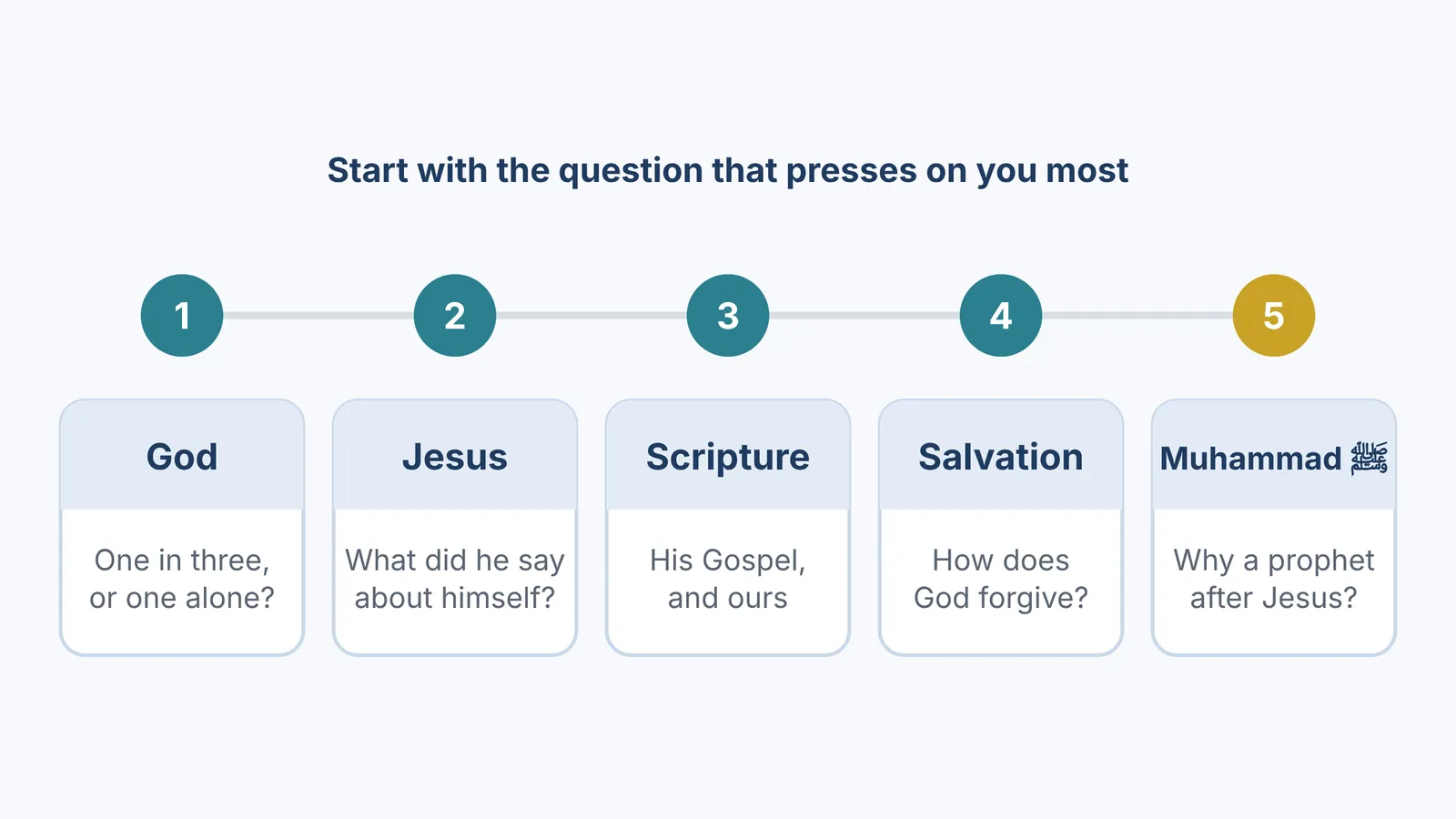
- God: is He one in three persons, or one without partner? And is "Allah", whom Muslims worship, the God you know?
- Jesus: who was he, and what did he say about himself in the earliest sources?
- Scripture: what is the difference between the Gospel given to Jesus and the Gospels we have? How was the Qur'an preserved?
- Salvation: how does God forgive? Does He need a ransom?
- Muhammad ﷺ: why would a prophet come after Jesus? Did Jesus point to someone after him?
Muhammad ﷺ and where Jesus's message points
The last question is the most delicate, so let us take it slowly. The Qur'an reports that Jesus told the Children of Israel: I am the messenger of God to you, confirming the Torah that came before me, and bringing glad tidings of a messenger to come after me, whose name is Ahmad25. Muslims understand "Ahmad" as one of the names of the Prophet Muhammad ﷺ.
We will not ask you to accept this because the Qur'an says it; you are not yet convinced the Qur'an is from God. Muslims also discuss passages in the Bible that they read as foretelling him. Those passages need careful, fair treatment, and you will find it on the page on earlier prophecies.
But look at something clearer than any single text: the content of the message. Jesus said the first commandment is that the Lord our God is one Lord. Six centuries later Muhammad ﷺ said: there is no god but God. Jesus came confirming Moses; Muhammad came confirming both Moses and Jesus, and the Qur'an describes him as written of among the People of the Book, in the Torah and the Gospel19. So here is a question worth sitting with: if God sent prophet after prophet with the same message, is it strange that He would send a final one to restore it to its purity?
"Becoming Muslim means betraying Jesus"
This is the most honest objection many people carry, and it is felt before it is argued. I have loved Jesus since childhood, they say. I prayed in his name and learned mercy and humility from him. How could I leave him?
The answer is that Islam does not ask you to leave him at all. A Muslim who denies Jesus leaves Islam; that is settled in its creed. Belief in all the messengers is a pillar without which faith is not valid4. Jesus is even named in a hadith that describes what brings a person into Paradise: "Whoever testifies that there is no god but God alone, without partner, that Muhammad is His servant and messenger, and that Jesus is the servant of God and His messenger, His word which He cast to Mary and a spirit from Him, and that Paradise is true and the Fire is true, God will admit him to Paradise according to his deeds"27. Think about that: testifying to Jesus is part of the Muslim's own testimony. You would not be asked to love Jesus less, only to understand him as the Qur'an presents him: a servant of God, a messenger, a word God cast to Mary and a spirit from Him11.
Then ask yourself, quietly: what would truly betray a messenger? Going against what he called people to. If Jesus taught that the first commandment is to worship the one God, and said "there is none good but one, that is, God" (Mark 10:18, KJV), then worshipping God alone does not betray him. It keeps faith with his message. The Qur'an portrays Jesus on the Day of Judgement disowning any call to worship him or his mother16. Islam lets you stand beside him in that moment, not opposite him.
The human side remains: family, memories, holidays. That is understandable, and Islam does not ask you to cut off your family. It commands you to honour your parents and keep them company in kindness even if they disagree with your faith22.
Islam does not ask you to love Jesus less. It asks you to understand him as he presented himself: a servant of God and a messenger.
How to walk this road
You do not need to decide quickly. Read a page, think, and return to your questions. If something does not convince you, write it down and ask about it. Islam loves an honest question, and it criticises following inherited belief without thought2.
Carry one question with you to every stop: which picture is more worthy of the God you believe in? A perfect God who does not tire, regret or become incarnate in a creature, or a picture in which the qualities of the Creator and the created are mixed? That question alone can carry you into a serious search.
Questions you may have
Do I have to state my denomination or what I believe now?
No. This road is designed so you can explore without saying anything about yourself. If you want to talk with a real person, you choose what to share.
Do Muslims see Christians as unbelievers and enemies?
Islam holds that the doctrine of the Trinity and the deification of Jesus are wrong about God, and says so clearly13. But judging a doctrine is not hostility towards people. The Qur'an commands kindness and justice towards those who do not fight Muslims24, describes Christians as nearest in affection to the believers, and speaks of those whose eyes overflow with tears when they hear the truth15.
Is the Gospel the Qur'an mentions the same as the New Testament?
The Gospel in the Qur'an is the revelation God gave to Jesus. The New Testament is a collection of books written by others after him, containing sayings attributed to him, letters and history. That difference deserves a calm examination, which you will find in the Revelation branch.
If you could ask Jesus himself, "Whom should I worship?", what would you expect him to answer, from what you know of his words?
Show a thought
Many people who ask this honestly remember his words about the first commandment and the one God. If that is your answer too, you may be closer to Islam than you think. If your answer is different, that is exactly what deserves examining at the next stops.
We began with someone opening the Qur'an and finding a chapter named after Mary, and a Messiah who says from the cradle: I am the servant of God. That is not a foreign picture. You already know many of its features.
Islam does not invite you to a new God. It invites you to the God of Abraham, Moses and Jesus, described with the perfection that befits Him, without intermediary and without flaw. Take your time, and start with the question that occupies you most.
Your next step
Sources (29)
- Qur'an 2:136 (al-Baqarah)
- Qur'an 2:170 (al-Baqarah)
- Qur'an 2:255 (al-Baqarah)
- Qur'an 2:285 (al-Baqarah)
- Qur'an 3:42 (Al 'Imran)
- Qur'an 3:45 (Al 'Imran)
- Qur'an 3:47 (Al 'Imran)
- Qur'an 3:49 (Al 'Imran)
- Qur'an 3:64 (Al 'Imran)
- Qur'an 4:157–158 (al-Nisa')
- Qur'an 4:171 (al-Nisa')
- Qur'an 5:46 (al-Ma'idah)
- Qur'an 5:73 (al-Ma'idah)
- Qur'an 5:75 (al-Ma'idah)
- Qur'an 5:82–83 (al-Ma'idah)
- Qur'an 5:116 (al-Ma'idah)
- Qur'an 5:117 (al-Ma'idah)
- Qur'an 6:164 (al-An'am)
- Qur'an 7:157 (al-A'raf)
- Qur'an 19:30 (Maryam)
- Qur'an 29:46 (al-'Ankabut)
- Qur'an 31:15 (Luqman)
- Qur'an 39:53 (al-Zumar)
- Qur'an 60:8 (al-Mumtahanah)
- Qur'an 61:6 (al-Saff)
- Sahih al-Bukhari 1358
- Sahih al-Bukhari 3435; Sahih Muslim 28
- Sahih al-Bukhari 3442; Sahih Muslim 2365
- Sahih al-Bukhari 3445