Would you trust someone to carry your most important letter if you had once caught him lying?
Imagine you must send a sealed letter across a desert to a distant city. The letter decides the fate of your family. Several couriers offer to carry it. One is charming but changes stories depending on who is listening. One is honest but cannot read the address or explain the message if asked. One is honest and capable, but you suspect he might sell the letter to the highest bidder.
You would not need a philosophy degree to choose. You would look for someone who tells the truth, keeps what is entrusted to him, delivers all of it, understands it well enough to explain it, and lives in a way that matches what he carries.
Now raise the stakes. The sender is God, and the letter is meant for all of humanity. What kind of person would He choose?
What carrying a message from God requires
Muslim scholars summarised the qualities of every messenger in four words, which have been taught to children for centuries: truthfulness (sidq), trustworthiness (amanah), conveying (tabligh) and intelligence (fatanah). Each has roots in the Qur'an.
Truthfulness. A messenger does not speak from his own desire: He does not speak from whim; it is only revelation revealed15. If he could lie about small things, no one could be sure he was not lying about God.
Trustworthiness. Prophet after prophet introduces himself to his people with the same words: I am to you a trustworthy messenger13. Hud says: I convey to you the messages of my Lord, and I am a sincere, trustworthy adviser to you5. A messenger does not betray what he carries, and he does not turn it into a business.
Conveying in full. The Qur'an addresses the Prophet ﷺ with a command that leaves no room for selection: يَـٰٓأَيُّهَا ٱلرَّسُولُ بَلِّغۡ مَآ أُنزِلَ إِلَيۡكَ مِن رَّبِّكَۖ وَإِن لَّمۡ تَفۡعَلۡ فَمَا بَلَّغۡتَ رِسَالَتَهُۥۚ
1; in meaning: O Messenger, convey what has been sent down to you from your Lord; if you do not, you have not conveyed His message. Hiding one part, even an inconvenient part, would betray the whole.
Intelligence and clarity. A messenger must understand the message and make it plain. God sent every messenger in the language of his people, so that he might make things clear to them9. Prophets argued, answered objections and taught; none of them was confused, unstable or obscure. When the Prophet's opponents called him mad, the Qur'an replied that by the grace of his Lord he was not16, and his whole public life of judging, teaching and leading was the evidence.
Behind all four stands a fifth fact: God chooses His messengers. God knows best where to place His message4. Prophethood is not earned by training or ambition; it is a selection, and those selected are prepared for it.
Protected where it matters
Islam adds a quality that surprises some readers: 'ismah, God's protection of His prophets. It is worth stating precisely, because it is often misunderstood.
According to Ahl al-Sunnah, prophets are protected, by agreement of the scholars, from lying and from error in conveying the message. Whatever they deliver from God is exactly what God revealed. They are also protected from major sins and from anything base that would destroy people's respect for them. As for minor slips that involve no baseness, the majority of scholars hold that they may occur, but a prophet is never left in one: he is corrected by revelation and he turns back to God at once.
Why is this not an extravagant claim? Because the whole purpose of a messenger depends on it. If he could distort the message, nothing he conveyed could be trusted. If he could openly commit grave sins, then the command to follow his example14 would become a command to imitate wrongdoing. The protection is not decoration; it is what makes the message reliable and the example safe to follow.
And notice something remarkable. The Qur'an records moments where God corrected His Prophet. When a blind man came seeking guidance while the Prophet ﷺ was busy addressing the leaders of Quraysh, the revelation began: عَبَسَ وَتَوَلَّىٰٓ أَن جَآءَهُ ٱلۡأَعۡمَىٰ وَمَا يُدۡرِيكَ لَعَلَّهُۥ يَزَّكَّىٰٓ
17; in meaning: He frowned and turned away because the blind man came to him. And what would make you know? Perhaps he would be purified. A man inventing a scripture to glorify himself does not write rebukes of himself into it and recite them in public. The Prophet ﷺ did, because it was not his to edit.
Fully human
The same Qur'an that affirms this protection insists, just as firmly, that prophets are human beings: We sent no messengers before you except that they ate food and walked in the markets12. We sent messengers before you and gave them wives and children8. The Prophet ﷺ was told to say: قُلۡ إِنَّمَآ أَنَا۠ بَشَرٞ مِّثۡلُكُمۡ يُوحَىٰٓ إِلَيَّ
10; in meaning: Say: I am only a human being like you, to whom it is revealed.
He lived that humanity openly. When his infant son Ibrahim was dying, he wept, and said that the eye weeps and the heart grieves, but we say only what pleases our Lord20. Once he made an error in the number of units of a prayer, and said: "I am only a human being like you; I forget as you forget, so when I forget, remind me"19. When his passing opinion about pollinating date palms did not work out, he told the farmers: "You know best the affairs of your worldly life"22.
This is the balance. The protection covers what the message needs. Everything else is ordinary, honest human life, which is exactly why he can be followed.
Two ways to get prophets wrong
Respect for prophets is something Muslims share with Jews and Christians. All three honour Noah, Abraham, Moses and David. But it is fair, and important, to see clearly where the pictures differ. There are two opposite ways of misplacing a prophet.
Raising him above humanity. Mainstream Christianity holds that God is one in three persons, and that Jesus is the second person, God the Son, who became incarnate. Christians do not mean three gods; they mean one God. Islam respectfully but firmly rejects the idea that any human being shares in divinity. It honours Jesus as a mighty messenger: I am the servant of God; He has given me the Scripture and made me a prophet11. And it uses the simplest sign of humanity as its argument: The Messiah, son of Mary, was only a messenger; messengers passed away before him, and his mother was a woman of truth. They both used to eat food2. The Prophet ﷺ even warned his own followers: "Do not exaggerate in praising me as the Christians exaggerated about the son of Mary; I am only His servant, so say: the servant of God and His Messenger"21.
Lowering him below his mission. Some narratives in the Hebrew Bible attribute grave acts to men whom Islam honours as prophets. Genesis says of Noah: "And he drank of the wine, and was drunken; and he was uncovered within his tent" (Genesis 9:21)24. Genesis 19:30-36 describes Lot made drunk and lying with his daughters. 2 Samuel 11 describes David taking the wife of Uriah and arranging Uriah's death. 1 Kings 11:4 says that in Solomon's old age his wives turned his heart after other gods. Jewish and Christian readers interpret these passages in different ways, often as lessons about human frailty. But place them beside the Islamic picture and the difference is plain. In the Qur'an, Noah, Lot, David and Solomon are men of God whom we are told to follow: Those are the ones God guided, so follow their guidance3. One cannot be told to follow a guide whose recorded life includes drunkenness, incest or idolatry. (The page B019 examines such descriptions more closely.)
Islam stands between the two errors. A prophet is not God, and he is not a cautionary tale. He is a human being, chosen, protected in his mission, and therefore a model. Compare the pictures and ask which one is worthy of the God who sent them, and which one actually helps you live.
The qualities as a test
These qualities are not only a description; they are a tool. Anyone who claims "God sent me" is either lying, sincerely deluded, or telling the truth. There is no fourth option25. The qualities help you tell which.
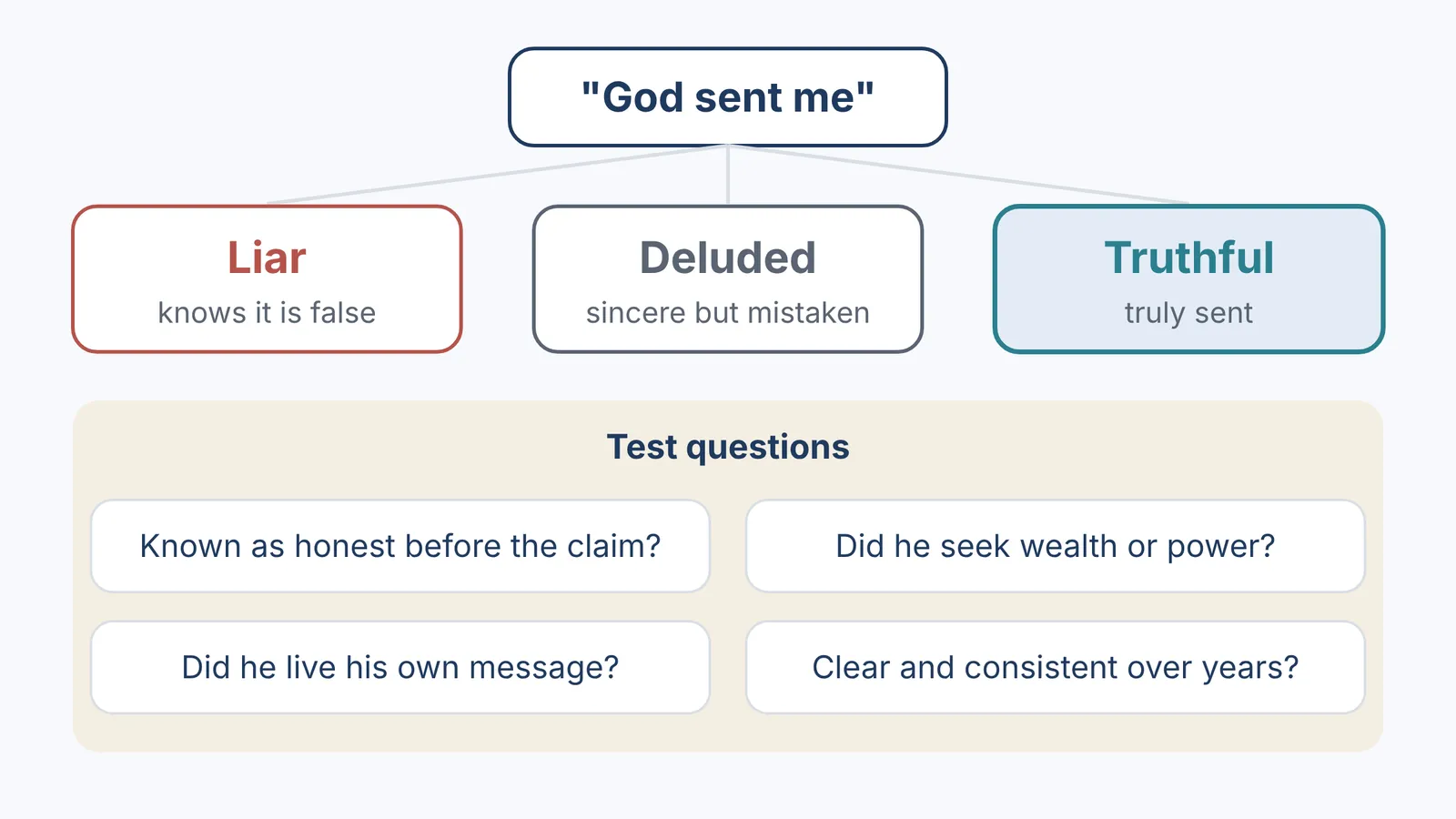
- Was he known as truthful before the claim? The Qur'an has the Prophet ﷺ say: I lived among you a lifetime before it; will you not reason?7. When the Byzantine emperor Heraclius questioned Abu Sufyan, then the Prophet's enemy, he asked whether they had ever accused him of lying before his claim. Told no, he reasoned that a man who would not lie about people would not then lie about God18.
- What did he gain? A liar usually wants wealth, power or pleasure. Look at whether the claimant used his position for himself or lived simply to the end.
- Did he live his own message? Does he keep the rules he gives others, or exempt himself?
- Is he clear and coherent? The deluded may be sincere, but their claims drift, contradict and dissolve under questions. A true messenger remains clear, consistent and sound in judgement over decades.
Scholars of prophethood used this kind of reasoning to separate the true prophet from the liar and the deluded23. These are the questions the pages on the Prophet's character (B029) and the evidence of his prophethood (B028) take up in detail.
"Infallible prophets are unrealistic"
The objection deserves its strongest form: Every human being makes mistakes. Claims that a leader cannot err are a warning sign, the kind of thing cults say about their founders. Isn't 'ismah just hero-worship with a theological name?
First, notice what Islam does not claim. It does not say prophets were all-knowing: the Prophet ﷺ is told to say that if he knew the unseen he would have avoided harm6. It does not say they never forgot or misjudged worldly matters; you have seen him say so himself1922. The protection is limited and purposeful: it covers the message and grave sins, not every human detail.
Second, compare the actual behaviour. Cult leaders exempt themselves from rules, demand worship and hide their failures. The Prophet ﷺ forbade exaggeration about himself21, bound himself by the rules he taught, and recited verses correcting him in front of everyone17. That is the opposite of the cult pattern.
Third, the claim is not that a prophet achieves perfection by his own strength. It is that God protects the channel through which He speaks. If you accept that God can send a message at all, it is not unrealistic that He would keep it from being corrupted at the source. What would be unrealistic is a God who sends guidance through a carrier He allows to falsify it.
A prophet is not God, and he is not a cautionary tale. He is a human being, chosen and protected, and therefore a model.
What this means for your journey
You now have a checklist that works for any claim: truthfulness, trustworthiness, complete conveying, clarity of mind, consistency of life, and a humanity that does not slide into either godhood or disgrace. Islam does not ask you to accept its Prophet before you apply it. It invites you to apply it.
Questions you may have
Did prophets ever sin?
They never lied in conveying the message and never committed grave sins. Most Sunni scholars allow that minor slips involving no baseness could occur, but a prophet was never left in one: he was corrected and returned to God immediately. That speed of return is itself part of what makes them models.
If prophets are human, why does Islam call them the best of people?
Because being the best does not require being more than human. It requires using human life perfectly: in sincerity, patience, mercy and obedience to God. Prophets are the best of people precisely as people, which is why the rest of us can learn from them.
Why should I trust a quality that was only reported about someone long ago?
The same way you trust any well-documented history: through the reliability of the reports. For the Prophet ﷺ, his conduct was observed by friends and enemies alike and transmitted through chains that Muslim scholars examined with unusual rigour. The pages on the evidence for his prophethood look at this closely.
Think of someone whose word you would trust with something precious. What qualities earned that trust, and how long did it take you to see them?
Show a thought
Trust is built from truthfulness over time, faithfulness with what is entrusted, and a life that matches one's words. Those are exactly the qualities God gave His messengers. If you would ask them of a friend, it is fair to ask them of anyone who claims to speak for God, and fair to examine honestly whether Muhammad ﷺ had them.
We began with a courier crossing a desert. You knew instinctively whom you would trust: the one who tells the truth, keeps what is given to him, delivers all of it, understands it and lives by it.
Islam's picture of the prophets is exactly that courier, chosen by God and protected in his task, yet human enough to weep, to forget and to be followed. It neither lifts him into divinity nor drags him into scandal. And it hands you the test, so that you can check the claim for yourself.
Your next step
Sources (25)
- Qur'an 5:67 (al-Ma'idah)
- Qur'an 5:75 (al-Ma'idah)
- Qur'an 6:90 (al-An'am)
- Qur'an 6:124 (al-An'am)
- Qur'an 7:68 (al-A'raf)
- Qur'an 7:188 (al-A'raf)
- Qur'an 10:16 (Yunus)
- Qur'an 13:38 (al-Ra'd)
- Qur'an 14:4 (Ibrahim)
- Qur'an 18:110 (al-Kahf)
- Qur'an 19:30 (Maryam)
- Qur'an 25:20 (al-Furqan)
- Qur'an 26:107 (al-Shu'ara')
- Qur'an 33:21 (al-Ahzab)
- Qur'an 53:3–4 (al-Najm)
- Qur'an 68:2 (al-Qalam)
- Qur'an 80:1–3 ('Abasa)
- Sahih al-Bukhari 7
- Sahih al-Bukhari 401
- Sahih al-Bukhari 1303
- Sahih al-Bukhari 3445
- Sahih Muslim 2363
- Ibn Taymiyyah, al-Nubuwwat
- The Bible, King James Version: Genesis 9:21; 19:30–36; 2 Samuel 11; 1 Kings 11:4 (cited as the object of comparison, not as religious authority)
- Ibrahim Elshahat, The Rational Sunnah-Based Proofs of Prophet Muhammed's Truthful Prophethood (PhD thesis, University of Malaya): character evidence, credibility and motive; distinguishing the truthful prophet from the liar and the deluded